
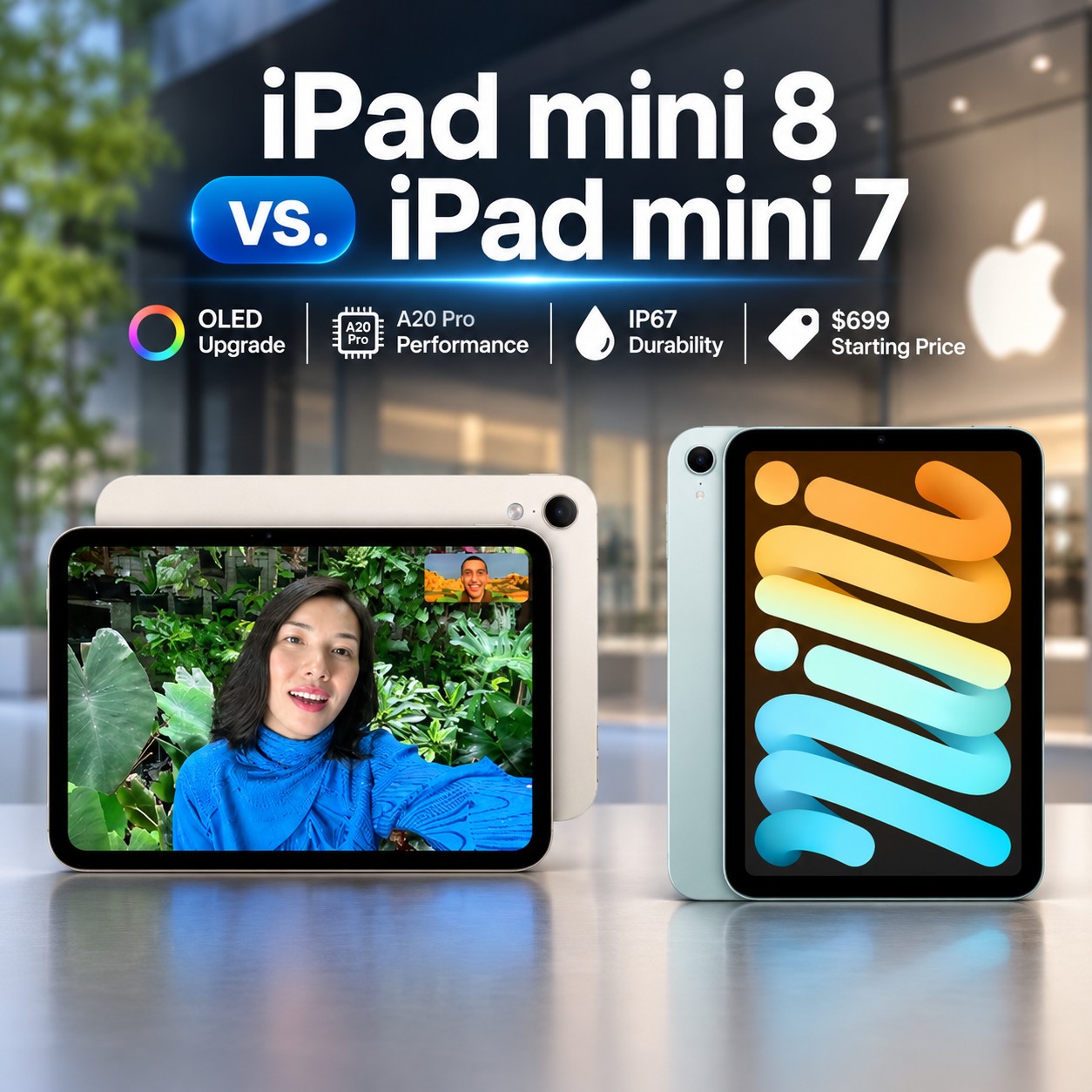

iPad mini 8 Brings OLED and Steep Pricing to Apple’s Smallest Tablet
Apple unveiled the eighth-generation iPad mini on October 26, 2026, with sales starting November 6. Pre-orders opened October 28 across 36 countries and regions, including the United States. Comparing the iPad mini 8 vs. iPad mini 7 highlights Apple’s biggest compact tablet overhaul. However, that hardware redesign introduces a steep $200 price jump for entry buyers. Apple officially labels the slate “iPad mini (A20 Pro),” mirroring its chip-based 2024 naming.
The 2026 model adds an 8.5-inch OLED screen, 2-nanometer silicon, and IP67 water resistance. Still, Apple omits a 120Hz ProMotion refresh rate and keeps Touch ID without Face ID. Meanwhile, this release follows Omdia’s November 5 report showing a 23% global tablet shipment drop. Shoppers must weigh pocketable OLED upgrades against a cost approaching larger Apple tablets.
iPad mini 8 (2026) vs. iPad mini 7 (2024)
Interactive hardware & pricing breakdown comparing Apple’s 2026 compact redesign against the 2024 model.iPad mini 8 vs. iPad mini 7: Core Specs and Price
Back in October 2024, Apple released the iPad mini 7 as a modest silicon refresh. That model paired an 8.3-inch LCD panel and A17 Pro chip at a $499 starting price. In contrast, Apple rebuilt almost every major subsystem for the 2026 generation. Base Wi-Fi models now cost $699, and cellular configurations start at $849.
| Specification | iPad mini 7 (2024) | iPad mini 8 (2026) |
| Availability Date | October 23, 2024 | November 6, 2026 |
| Starting Price | $499 Wi-Fi / $649 Cellular | $699 Wi-Fi / $849 Cellular |
| Display | 8.3-inch LCD, 500 nits | 8.5-inch OLED, 1,200 nits HDR |
| Refresh Rate | 60Hz (no ProMotion) | 60Hz (no ProMotion) |
| Processor | A17 Pro, 5-core GPU | A20 Pro (2nm), 7-core GPU |
| Neural Engine | 16-core | 16-core (128/256GB); 32-core (512GB) |
| Memory (RAM) | Not published by Apple | 12GB (per benchmarks/reviews) |
| Storage | 128GB, 256GB, 512GB | 128GB, 256GB, 512GB |
| Durability | No IP rating | IP67 water and dust |
| Wireless | Wi-Fi 6E, Bluetooth 5.3 | Wi-Fi 7, Bluetooth 6, Thread |
| Size and Weight | 6.3 mm thick, 293 g | 5.4 mm thick, 255 g Wi-Fi |
| Front Camera | 12MP portrait Center Stage | 12MP landscape Center Stage |
Specifically, the 5.4-millimeter chassis trims thickness from 6.3 millimeters and cuts weight to 255 grams. Apple narrowed finishes to Midnight and Starlight, retiring the earlier Blue and Purple options. Education buyers save $50, starting at $649 for the base Wi-Fi configuration. Buyers can lease the Wi-Fi version at $14.99 monthly across a 36-month term. Both tablets retain 10Gbps USB-C ports, Touch ID power buttons, and Apple Pencil Pro support.
OLED Display Gains and the 60Hz Catch
Display quality marks the widest visual gap between these two compact tablets. Apple expanded the panel from 8.3 inches to 8.5 inches by shrinking bezels 24%. Switching from LCD to OLED delivers deep blacks and a 2,000,000:1 contrast ratio. Typical SDR brightness climbs from 500 nits to 600 nits, with 1,200-nit HDR peaks. Furthermore, review roundups cite Tom’s Guide measuring 600 nits SDR and 1,032 nits HDR output. The same test recorded 82.9% DCI-P3 color coverage, up from 76.3% in 2024. At night, the screen dims to 1 nit for comfortable dark-room reading.
Additionally, buyers choosing 256GB or 512GB storage can add nano-texture glass to cut glare. AppleInsider notes that matte finish adds $100, and Gizmodo observed slightly softer OLED contrast. Nevertheless, Apple skipped ProMotion technology, capping the display refresh rate at 60Hz. Reviewers at Engadget and The Guardian criticized that 60Hz limit at a $699 price. Even so, Tom’s Guide called video and gaming smooth on the bright OLED panel.
A20 Pro Silicon and Storage-Tied Hardware
Under the glass, Apple replaces the A17 Pro chip with 2-nanometer A20 Pro silicon. Apple’s September 2026 internal tests claim up to 60% faster CPU and 2.7x graphics speed. Consequently, independent Geekbench 7 tests from PhoneArena hit 3,928 single-core and 11,116 multi-core points. That outpaces the mini 7’s 2,529 single-core and 6,741 multi-core scores in PhoneArena’s testing. Similarly, Mashable logged 4,001 single-core points, ahead of the M4 Air and M5 Pro. Review roundups cite Tom’s Guide reaching 4,720 single-core and 12,697 multi-core in Geekbench 6. AppleInsider logged GPU scores past 58,000, and Engadget ran Control and No Man’s Sky smoothly.
Indeed, Notebookcheck cautions that sustained performance inside the thin chassis needs longer review testing. On the other hand, Apple ties processor cores directly to storage tiers on this tablet. Both 128GB and 256GB units ship with a 5-core CPU and 16-core Neural Engine. Conversely, the $999 512GB tier unlocks six CPU cores and a 32-core Neural Engine. Apple omits RAM specifications, and Geekbench listings plus The Guardian report 12GB of memory. Forum users note most early reviews tested the higher-end 512GB unit over binned models.
IP67 Sealing, Acoustic Audio, and Battery Life
Apple built the eighth-generation chassis to survive tougher conditions than any earlier iPad. Its IP67 rating resists dust and freshwater immersion to one meter for 30 minutes. Apple’s footnotes warn that water resistance fades over time and excludes liquid damage warranties. Hardware chief Dave Pakula highlighted doctors, builders, gamers, and small business owners as beneficiaries. Therefore, engineers sealed the frame and replaced side cutouts with an Acoustic Display. Display-coupled woofers and hidden tweeters project clear stereo sound that hands never block. Moreover, a 12MP landscape front camera with an f/2.0 aperture improves horizontal video calls.
Also, Apple’s N1 wireless chip and C2 modem add Wi-Fi 7, Bluetooth 6, and faster 5G. Cellular units rely solely on eSIM and skip mmWave bands, according to AppleInsider. Battery capacity dips slightly to 18.9 watt-hours from 19.3 watt-hours inside the thinner frame. In Tom’s Guide’s 150-nit Wi-Fi test, cited in roundups, the tablet lasted 14 hours 24 minutes. That outlet ran a single test pass, and The Verge logged nine hours. Intensive gaming cuts battery endurance to between six and eight hours, per The Guardian. US boxes ship with a 20W charger, and 35W-plus adapters hit 50% in 30 minutes.
iPadOS 27, Siri AI, and the Q.ai Acquisition
Both generations run Apple Intelligence, and the 2026 tablet ships with iPadOS 27 onboard. Under iPadOS 27.2, users gain extended external display mode and beta Siri AI features. For instance, Siri AI uses personal app context and on-screen awareness for daily tasks. Nonetheless, EU iPadOS users wait for Siri AI, and cloud features carry usage limits. Apple’s footnotes warn that expanded cloud AI capabilities will require paid access later. In addition, Apple introduced new AI tools inside its Creator Studio suite on October 27.
These software moves align with Apple’s wider 2026 push toward on-device AI processing. In January, Apple bought Israeli startup Q.ai for nearly $2 billion, per the Financial Times. That deal ranks as Apple’s second-largest acquisition ever behind its $3 billion Beats purchase. In fact, Q.ai analyzes subtle facial micromovements to interpret silent or whispered voice commands. Thus, roughly 100 Q.ai engineers join Apple’s hardware group, led by PrimeSense founder Aviad Maizels. Industry observers view Q.ai as an efficiency bet aimed largely at wearables and Siri.
Accessories, Ergonomics, and Repair Costs
Apple strengthened the side magnets on iPad mini 8, securing Apple Pencil Pro inside bags. Budget sketchers can choose the $79 USB-C Pencil over the $129 Apple Pencil Pro. Apple kept Touch ID inside the top power button and left out Face ID. Yet, Apple builds no official keyboard folio for the narrow 5.22-inch-wide body. Instead, buyers pay $79 for a new TechWoven Smart Folio in Navy Blue or Taupe. That cover costs $20 more than the $59 Smart Folio sold for the 2024 model.
Everyday reviewers stress that compact ergonomics define where this slate fits in real workflows. Commuters, pilots, clinicians, and field crews favor its one-handed grip over larger 11-inch slates. By comparison, artists working on 3D models or long pages face frequent zooming on 8.5 inches. Inside the enclosure, Apple uses 35% recycled materials and rates the battery for 1,000 cycles. Accordingly, out-of-warranty service in the UK costs £115 for batteries or £519 for screen repairs.
Market Slump, Air Overlap, and Upgrade Verdict
Apple’s $699 price arrives during a sharp slowdown across the global tablet industry. On November 5, Omdia reported Q3 2026 worldwide shipments fell 23% to 32.19 million units. Total market volume hit its lowest quarterly mark in nearly three years. Apple kept first place with 36% share, down from 38.2%, as shipments slid 27.5%. Likewise, Samsung fell 21.7% and Huawei tumbled 43%, leaving Lenovo the sole growing top-five brand. Fourth-place Xiaomi shipped 2.35 million tablets, dipping 10.6% as market share rose to 7.3%. Omdia and AppleInsider cite surging memory costs and modest generational gaps delaying upgrades.
At $699, the mini 8 costs just $50 less than Apple’s entry M4 iPad Air. Buyers now choose between a larger Air workspace and a pocket-sized OLED screen. Besides, existing iPad mini 7 owners already hold Apple Intelligence and Pencil Pro support. Their 2024 tablets continue handling e-reading, quick notes, and travel streaming without trouble. Ultimately, upgrading makes sense mainly for buyers seeking OLED contrast, IP67 sealing, or A20 Pro speed.
Support Our Work
Help us keep creating and maintaining our projects. We appreciate your support!
Ways to contribute:
Shop via Affiliate LinksSupport us at no extra cost to you while you shop.
Support on Ko-fiBuy us a coffee to keep the engine running!




Leave a Reply