
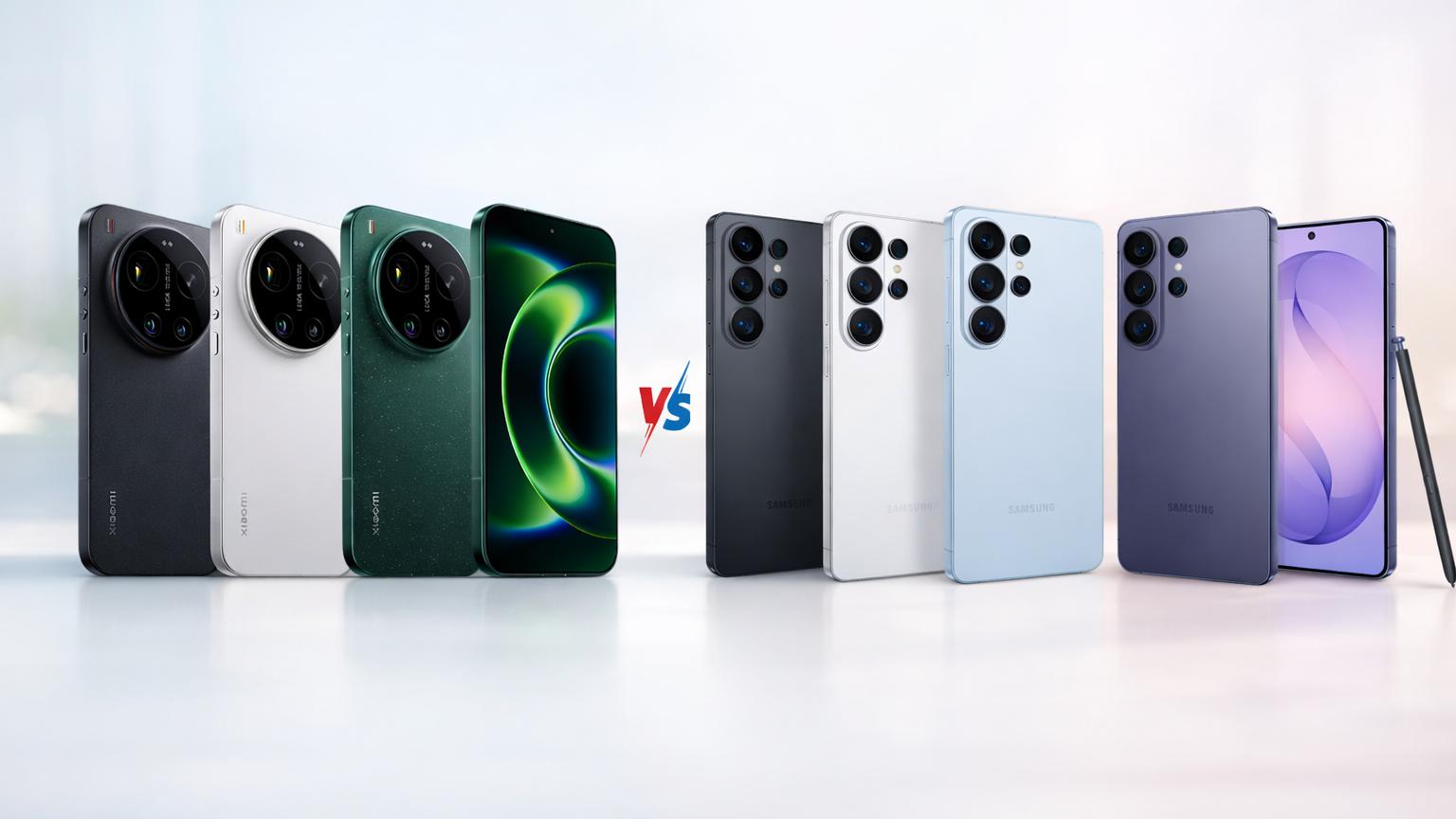
The 2026 tech landscape has finally reached its peak with the official arrival of two massive titans. Indeed, the Xiaomi 17 Ultra and the Samsung Galaxy S26 Ultra are currently battling for smartphone supremacy. Fans have waited months for this specific Android Flagships Comparison of 2026. Consequently, the mobile industry is buzzing with fresh comparisons of these flagship behemoths. This comparison dives deep into the latest specifications and market performance of both devices.

The Global Launch Spectacle
Last week, Xiaomi stunned the world during a massive global event held on February 28, 2026. This launch occurred just before the start of the Mobile World Congress in Barcelona. Meanwhile, Samsung hosted its own high-profile Unpacked event on February 25 in San Francisco. Both companies clearly wanted to dominate the early spring release cycle. Because of this timing, consumers now face a difficult choice between two top-tier devices. Market analysts suggest that this is the most competitive year for mobile technology in a decade.
Xiaomi chose to skip the number 16 entirely to align with its competitors’ numbering schemes. Therefore, the Xiaomi 17 Ultra represents a significant leap forward in naming and engineering. Samsung, however, followed its traditional sequence with the S26 series. Despite the different branding strategies, both phones target the exact same elite user base. These power users demand the absolute best in photography, gaming, and productivity.
A Closer Look at Design Philosophy
The Xiaomi 17 Ultra features a bold new design that prioritizes professional photography aesthetics. Notably, it sports a massive circular camera island that dominates the rear panel. This look reminds many enthusiasts of a classic Leica camera body. Furthermore, the device utilizes a premium aluminum frame paired with an eco-leather or glass finish. It feels incredibly substantial in the hand due to its unique weight distribution. However, some users might find the large camera bump a bit unwieldy.
In contrast, the Samsung Galaxy S26 Ultra remains committed to its iconic, sleek silhouette. The Korean giant has refined the corners of the device to be slightly more rounded. This change makes the massive phone much more comfortable to hold for long periods. Additionally, the S26 Ultra is remarkably slim at only 7.9mm in thickness. It retains the integrated S Pen slot, which remains a key selling point for productivity lovers. Samsung also introduced a new “Privacy Display” technology that hides content from side angles.
Display Excellence and Innovation
Both manufacturers have pushed the boundaries of screen technology to their absolute limits. The Xiaomi 17 Ultra boasts a stunning 6.9-inch LTPO AMOLED panel with 1.5K resolution. Surprisingly, this screen reaches a peak brightness of a staggering 3,500 nits. This means that users can see every detail even under direct, harsh sunlight. Moreover, the display supports a 120Hz adaptive refresh rate for buttery smooth animations. Xiaomi also utilized its new “Dragon Crystal Glass 3” for superior drop protection.
Samsung counters this with its own 6.9-inch Dynamic AMOLED 2X display. Although the resolution is a higher QHD+, the peak brightness sits slightly lower at 2,600 nits. Nevertheless, Samsung’s color accuracy and contrast levels are widely considered the industry gold standard. The M14 OLED material used here is more power-efficient than previous generations. Consequently, users get a gorgeous viewing experience without draining the battery too quickly. The S26 Ultra also features Gorilla Armor 2, which significantly reduces screen reflections.
Android Flagships Comparison: The Battle of Performance and Power
Under the hood, both devices are powered by the cutting-edge Snapdragon 8 Elite Gen 5 chipset. This 3nm processor delivers a massive jump in both CPU and GPU performance. However, Samsung has secured a “For Galaxy” version of the chip with higher clock speeds. This allows the S26 Ultra to handle intensive AI tasks with more efficiency. Specifically, the Prime cores on the Samsung variant can reach a blazing 4.74 GHz. Xiaomi’s version is no slouch either, offering a very capable 4.6 GHz peak speed.
Regarding memory, the competition is equally fierce between these two technological giants. The Xiaomi 17 Ultra comes standard with 12GB of RAM, but a 16GB option is available. Similarly, Samsung has finally made 16GB of RAM the standard for its Ultra model. This move was necessary to support the advanced on-device AI features of One UI 8.5. Both phones use UFS 4.1 storage for lightning-fast file transfers and app loading. Because of these specs, multitasking feels instantaneous on both pieces of hardware.
Photography: Leica vs. Samsung Optics
Photography is where these two titans truly begin to diverge in their philosophies. The Xiaomi 17 Ultra is a photography beast, featuring a 50MP primary sensor with a 1-inch size. This massive sensor allows for incredible natural bokeh and superior low-light performance. Furthermore, it includes a 200MP periscope telephoto lens that offers continuous optical zoom. This allows users to zoom from 3.2x to 4.3x without losing any detail. Leica’s color science provides a distinct, professional look to every shot.
Samsung approaches the camera war with its own 200MP main sensor featuring an f/1.4 aperture. This wider aperture helps the S26 Ultra capture 47% more light than its predecessor. Additionally, the quad-camera setup includes a 50MP periscope lens with 5x optical zoom. Samsung’s “Nightography” video has also seen a significant upgrade for clearer low-light footage. While Xiaomi focuses on raw sensor power, Samsung relies on its ProVisual Engine for AI-enhanced clarity. Professional creators will likely debate which system is superior for years to come.
Android Flagships Comparison: Battery Life and Charging Speeds
Xiaomi definitely takes the lead when it comes to raw battery capacity and speed. The 17 Ultra is equipped with a massive 6,800mAh silicon-carbon battery. This is a huge upgrade over the 5,000mAh cells found in most other flagships. Moreover, it supports 90W wired fast charging and 50W wireless charging. This means you can go from empty to full in less than an hour. For users who are always on the go, this capacity is a game-changer.
Samsung has finally addressed charging complaints by bumping the S26 Ultra to 60W wired charging. While this is an improvement, it still trails behind Xiaomi’s rapid charging technology. The battery in the S26 Ultra remains at 5,000mAh, though efficiency gains help it last all day. Samsung’s software optimization ensures that the phone sips power during idle times. However, Xiaomi’s sheer battery size gives it a clear advantage for heavy gamers. If you hate carrying a power bank, the Xiaomi 17 Ultra is the winner.
Software and Long-Term Support
The software experience provides a very different vibe on each of these devices. Xiaomi runs HyperOS 3.0, which is based on the latest Android 16 platform. This operating system is designed to be lightweight and extremely fast. It also features “Miclaw,” an experimental AI agent capable of performing complex cross-device tasks. However, Xiaomi’s record for long-term software updates has been somewhat inconsistent in the past. They are working hard to improve this, but Samsung still holds the crown here.
Samsung’s One UI 8.5 is arguably the most polished and feature-rich skin on Android. It includes the full suite of Galaxy AI tools, such as Circle to Search and Live Translate. Furthermore, Samsung has committed to a staggering seven years of OS and security updates. This means your S26 Ultra will still be getting fresh features in 2033. The integration with the S Pen also adds a layer of functionality that Xiaomi cannot match. For long-term reliability and support, Samsung is the safer bet for most users.
Android Flagships Comparison: Pricing and Market Availability
Pricing is another area where these two companies have taken different paths this year. The Xiaomi 17 Ultra starts at approximately £1,299 or €1,499 for the 512GB model. Surprisingly, Xiaomi has kept its global pricing identical to the previous generation despite the upgrades. This aggressive strategy makes it a very attractive option for value-conscious flagship buyers. The phone is available in the UK and most European territories starting this March. It also comes with a variety of color options like Starry Green and Purple.
Samsung has maintained its premium price point of $1,299.99 for the base 256GB model. While this is expensive, the brand offers some of the best trade-in deals in the industry. For example, some carriers are offering up to $900 off with an eligible device. The S26 Ultra comes in several standard colors and two Samsung.com exclusive shades. These exclusives include Pink Gold and Silver Shadow for those seeking a unique look. Shipping for the S26 series officially begins on March 11, 2026.
Android Flagships Comparison: Key Differences
| Feature | Xiaomi 17 Ultra | Samsung Galaxy S26 Ultra |
| Display | 6.9-inch (3,500 nits) | 6.9-inch (2,600 nits) |
| Main Camera | 50MP (1-inch sensor) | 200MP (f/1.4 aperture) |
| Battery | 6,800mAh (China) / 6,000mAh (Global) | 5,000mAh |
| Charging | 90W Wired / 50W Wireless | 60W Wired / 25W Wireless |
| Software | HyperOS 3 (Android 16) | One UI 8.5 (Android 16) |
| Special Feature | Leica Optics / Photography Kit | S Pen / Privacy Display |
Choosing between these two depends entirely on your personal priorities as a user. If you want the best possible battery life and a professional camera, pick Xiaomi. Their 1-inch sensor is simply unmatched for still photography in the mobile space. Conversely, if you value AI features and long-term software support, choose Samsung. The S Pen remains a unique tool that no other flagship offers. Both phones are undoubtedly the pinnacle of 2026 mobile engineering.
Final Thoughts on the 2026 Android Flagships Comparison
The rivalry between Xiaomi and Samsung has never been more intense than it is today. We are seeing a real divergence in how these companies view the future of phones. Xiaomi is leaning into hardware dominance with massive sensors and huge batteries. Samsung is focusing on the “smart” in smartphone with AI and software refinements. This competition is great for us as consumers because it drives rapid innovation. Both devices push the industry forward in ways we didn’t think possible last year.
As we move further into 2026, these two will remain the benchmarks for excellence. Whether you prefer the Leica-inspired Xiaomi or the productivity-focused Samsung, you’re getting a masterpiece. It’s truly a great time to be a fan of high-end mobile technology. Keep an eye on local retailers for hands-on opportunities with both of these incredible machines. Your next upgrade might just be the most exciting one yet.

Leave a Reply