
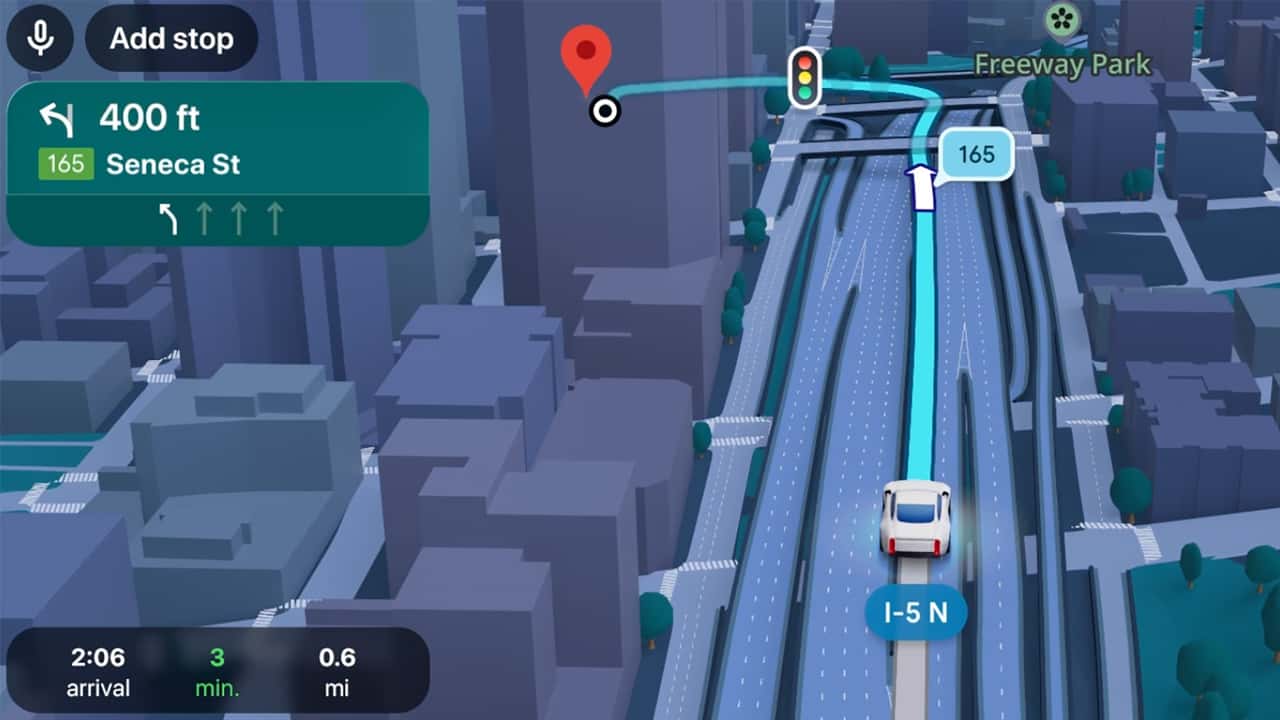
Everything you thought about digital navigation just changed forever. On March 12, 2026, Google officially launched its “Google Maps Immersive Navigation.” This seismic shift transforms the app from a flat tool into a living world. Consequently, the way we drive and explore will never feel the same again.
For years, we have stared at blue lines on a simple 2D grid. However, those days of squinting at abstract lines are finally over. Google is now deploying “Immersive Navigation” to provide a vivid 3D experience. Specifically, this new mode renders buildings, terrain, and overpasses with stunning realism. Because it uses the latest Gemini AI models, the map feels incredibly lifelike.

The Intelligence Behind the Visuals of Google Maps Immersive Navigation
Behind every pixel of this update lies the power of Gemini 3. Because Google wanted more than just pretty pictures, they integrated deep spatial understanding. Essentially, the AI analyzes billions of Street View and aerial images. Therefore, the app knows exactly where a median sits or a landmark rises. It does not just show you a route; it understands the environment.
While previous updates felt incremental, this one feels like a total overhaul. For instance, the map now includes “smart zooms” for complex junctions. Whenever you approach a tricky turn, the perspective shifts automatically. Moreover, buildings in your line of sight become translucent. Thus, you can always see the road ahead through the virtual concrete.
Driving Like a Human, Not a Robot
Have you ever been frustrated by robotic, poorly timed voice instructions? Fortunately, Google has addressed this common pain point with more natural guidance. Instead of hearing “In 500 meters, turn left,” you receive contextual clues. For example, the app might say, “Go past this exit and take the next one.” This change makes it feel like a friend is sitting beside you.
Furthermore, the new system offers better transparency regarding route choices. Whenever a faster path exists, Maps explains the specific trade-offs. It might tell you a route is longer but avoids heavy construction. Consequently, you can make informed decisions based on real-world conditions. Because of this, the stress of the “unknown” on the road significantly decreases.
The Arrival of Ask Maps in Google Maps Immersive Navigation
Alongside the visual upgrades, Google introduced a conversational assistant called “Ask Maps.” Because searching for “coffee” is too basic, this tool handles complex requests. You can ask, “Where can I charge my phone without waiting in a long line?” Instantly, the AI scans reviews from over 500 million contributors to find a spot.
This feature relies on a database of 300 million global locations. Thus, the recommendations are highly specific and personalized. If you frequently visit vegan cafes, the AI remembers that preference. It will prioritize those spots when you ask for a dinner suggestion. Therefore, the app evolves into a true digital concierge for every traveler.
Perfecting the Last Mile
We all know the frustration of arriving but being unable to find the door. To solve this, Immersive Navigation focuses heavily on the “last mile” of your trip. As you approach your destination, the app highlights the exact building entrance. Additionally, it shows you nearby parking options before you even stop the car. Because of this, the transition from driving to walking becomes seamless.
The app even tells you which side of the street to park on. Consequently, you won’t have to circle the block or make illegal U-turns. This level of detail was previously impossible with standard GPS technology. However, the fusion of AI and Street View makes it a daily reality. Truly, Google is trying to eliminate every possible moment of travel anxiety.
Availability and the Road Ahead
Currently, these features are rolling out across the United States. Specifically, users on Android and iOS should see the update appearing now. Furthermore, Google plans to expand this to CarPlay and Android Auto shortly. While the U.S. is the testing ground, a global rollout is expected. Countries like India are already receiving the “Ask Maps” feature as well.
The hardware requirements for these 3D visuals are somewhat demanding. Because the app renders complex environments in real-time, it uses more battery power. Nevertheless, the trade-off for such clarity is worth the extra energy. Most modern smartphones should handle the processing without significant lag. Ultimately, this is the future of how we move through our physical world.






Leave a Reply