


- [Next Gen Performance] Experience seamless multitasking and processing power with the Intel Core Ultra 9 288V (8 Cores, …
- [Multitask with Confidence] Featuring 32GB RAM and 1TB SSD, this system ensures lightning-fast boot times, seamless appl…
- [Quad Display Support] 2x USB 3.2 Gen2 Type-A, 2x Thunderbolt4, 2x USB 2.0 Type-A, 1x HDMI, 1x DC, 1x SD Card Reader, 1x…
Architectural Design of Claude Fable 5.1
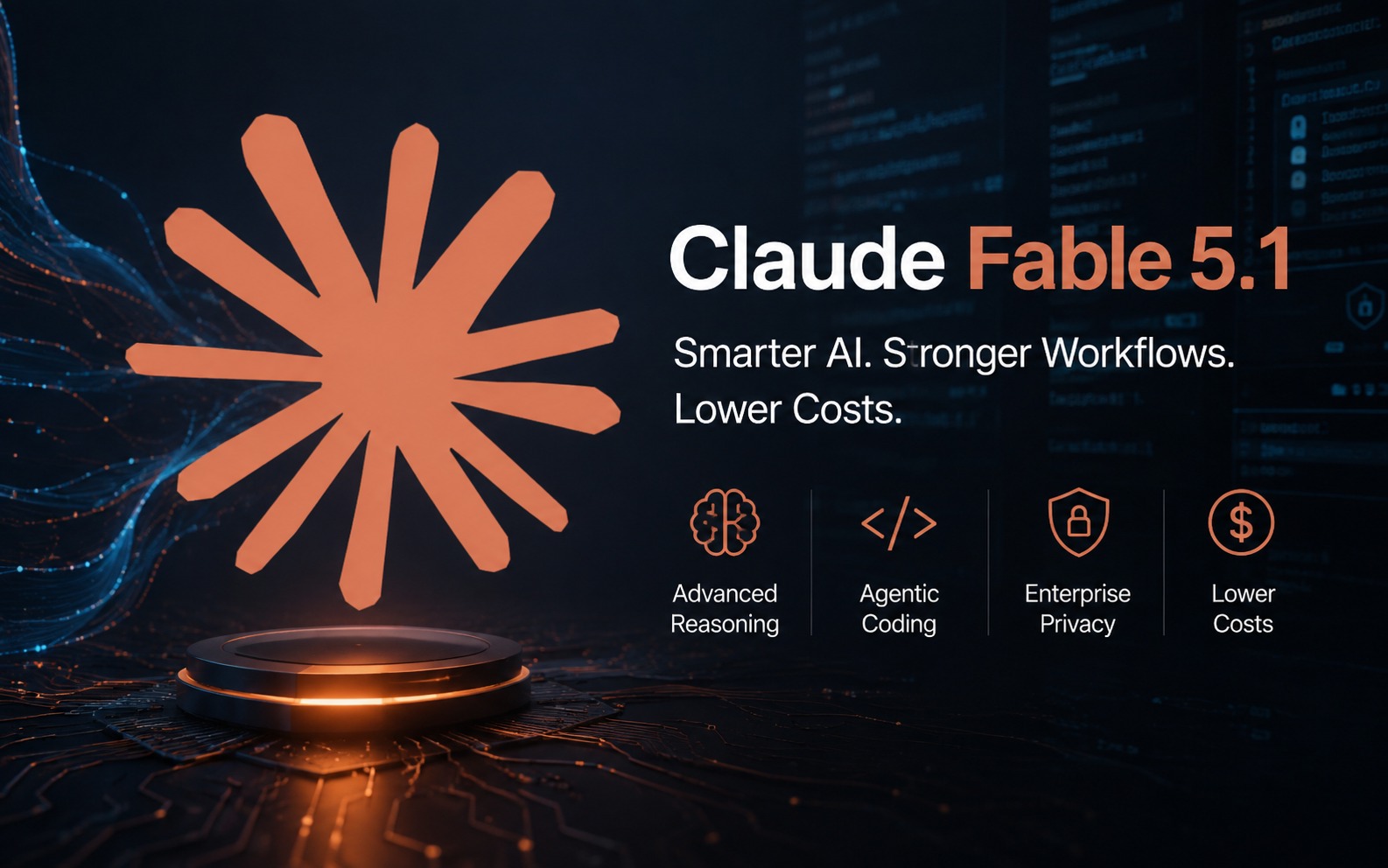
Anthropic released Claude Fable 5.1 to handle complex software engineering and long-horizon knowledge tasks. Consequently, this advanced model supports multi-hour technical workflows that require continuous problem solving. The architecture shares identical technical parameters with Mythos 5.1 while implementing standard operational safeguards. Furthermore, the platform provides a default context window reaching one million tokens for enterprise developers. Developers can generate up to 128 thousand output tokens per individual operational request. System architectures maintain durable logging mechanisms to support long-running agent execution loops.
Adaptive reasoning remains permanently enabled across all computational sessions to optimize cognitive effort. Specifically, users can modify effort settings mid-conversation without invalidating the active prompt cache. High effort modes default within coding environments to improve deep architectural refactoring. Conversely, medium effort modes apply to general chat interfaces for standard productivity applications. This granular control dramatically improves overall operational flexibility during complex research tasks. Engineers can dynamically raise thinking depth when tackling non-trivial software engineering steps.
🧠 Architectural Design: Claude Fable 5.1
Core infrastructure for long-horizon autonomous AI and complex software engineering.Empirical Performance Evaluations and Benchmarks
Comprehensive benchmark evaluations highlight substantial performance gains over fifth-generation AI predecessors. Notably, the system scored 52.6 percent on agentic scientific research tasks. That result more than doubles the benchmark score recorded by earlier model versions. Additionally, software development benchmarks on Terminal-Bench reached 55.8 percent accuracy. Knowledge work metrics demonstrated similar progress across standardized analytical evaluations. Automated workflow execution scores reached 31.4 percent on multi-stage business tasks.
Computer vision features enable direct interpretation of embedded financial charts and complex diagrams. Therefore, multi-stage enterprise workflows execute seamlessly with minimal direct human supervision. Production safety filters can slightly alter raw evaluation scores during automated security checks. Nevertheless, real-world deployment data confirms superior reasoning capabilities across diverse industries. Operational teams report consistent performance improvements during prolonged autonomous research projects. High-fidelity visual outputs ensure proper alignment with structural design specifications.
| Evaluation Metric | Fable 5.1 | Fable 5 | Opus 5 | GPT-5.6 Sol |
| Agentic Scientific Research | 52.6% | 24.7% | 29.0% | 22.4% |
| Agentic Coding Accuracy | 55.8% | 42.0% | 52.3% | 37.3% |
| Knowledge Work Benchmark | 1853 | 1723 | 1824 | 1711 |
| Business Workflow Automation | 31.4% | 17.1% | 26.9% | 19.6% |
| Developer Coding Benchmark | 73.4% | 70.5% | 70.0% | 67.2% |
📈 Empirical Performance Benchmarks
Comparative analysis of fifth-generation AI capabilities.Cost Structure and Caching in Fable 5.1
Base token pricing remains constant at ten dollars per million input tokens. Similarly, output generation costs fifty dollars per million tokens produced across standard workloads. Financial efficiencies stem primarily from a major price reduction on prompt cache reads. Cached token reads now cost twenty-five cents per million tokens. Hence, this adjustment represents a seventy-five percent discount compared to previous caching tiers. Stored context retrieval reduces total token expenses during iterative coding sessions.
Typical enterprise workloads achieve total cost savings near twenty-five percent. Meanwhile, highly agentic tasks save up to forty-five percent by accessing stored context repeatedly. Low effort configurations achieve competitive output quality while reducing total execution expense. Accordingly, organizational deployments benefit from improved financial sustainability at enterprise scale. Development budgets scale efficiently when managing large software repository refactoring operations. Lower operational costs encourage broader integration of persistent AI sub-agents.
💰 Cost Structure and Caching
Improved financial sustainability for organizational deployments.Enterprise Privacy Safeguards in Fable 5.1
New security architectures provide complete data privacy through Enterprise Frontier Safeguards. In particular, customer data remains stored on private cloud infrastructure rather than vendor servers. Eligible enterprise accounts can access zero data retention policies during current deployment phases. Moreover, system updates significantly reduce false positive security flags in routine cybersecurity operations. False positive security blocks decreased by sixty percent during automated network inspection tests. Automated safety routing transfers sensitive requests to secondary model tiers seamlessly.
Security teams can safely identify software vulnerabilities without generating harmful exploit code. Simultaneously, specialized access programs enable advanced biological science research through government partnerships. Experimental protein designs demonstrated tenfold higher binding affinities than competitive baseline models. Indeed, viability hit rates reached nearly fifty percent across multiple targeted drug design trials. These safety innovations balance advanced research access with rigorous public protection standards. Enterprise governance frameworks maintain complete auditability over all autonomous sub-agent actions.
🔒 Enterprise Privacy Safeguards
Rigorous public protection standards and infrastructure security.Strategic Industry Impact of Fable 5.1
Enterprise adopters report rapid progress on complex computational challenges across critical sectors. For instance, financial analysts successfully resolved a critical software crash that persisted for four years. Autonomous testing platforms executed thirty-eight hours of unattended machine learning experiments. Likewise, web automation software completed eighty-two percent of complex browser benchmark challenges. Engineering teams automate routine repository maintenance while focusing human oversight on high-level architecture. Persistent sub-agents perform continuous integration tasks without requiring manual session restarts.
🎯 Strategic Industry Impact
Real-world results of fully autonomous digital workflows.Long-horizon AI agents require persistent memory mechanisms and robust state management systems. Operational costs decrease substantially as prompt caching technologies mature across cloud environments. Overall, these technical advancements accelerate the transition toward fully autonomous digital workflows. Organizations can now deploy resilient agentic software systems to handle high-value knowledge work. Scientific institutions gain powerful computational tools to accelerate drug discovery pipelines. Future developments will likely expand autonomous execution capabilities across broader enterprise domains.
Support Our Work
Help us keep creating and maintaining our projects. We appreciate your support!
Ways to contribute:
Shop via Affiliate LinksSupport us at no extra cost to you while you shop.
Support on Ko-fiBuy us a coffee to keep the engine running!






Leave a Reply