


- BUILT FOR COLLEGE. AND BEYOND — MacBook Air with the M5 chip packs blazing speed and powerful AI capabilities into an in…
- TEAR THROUGH TOUGH ASSIGNMENTS — With its faster CPU and unified memory, the M5 chip delivers even more performance and …
- MAKE QUICK WORK OF YOUR TO-DO LIST — Apple Intelligence helps you write, express yourself, and get things done effortles…
Strategic Vision Behind Apple macOS Changes
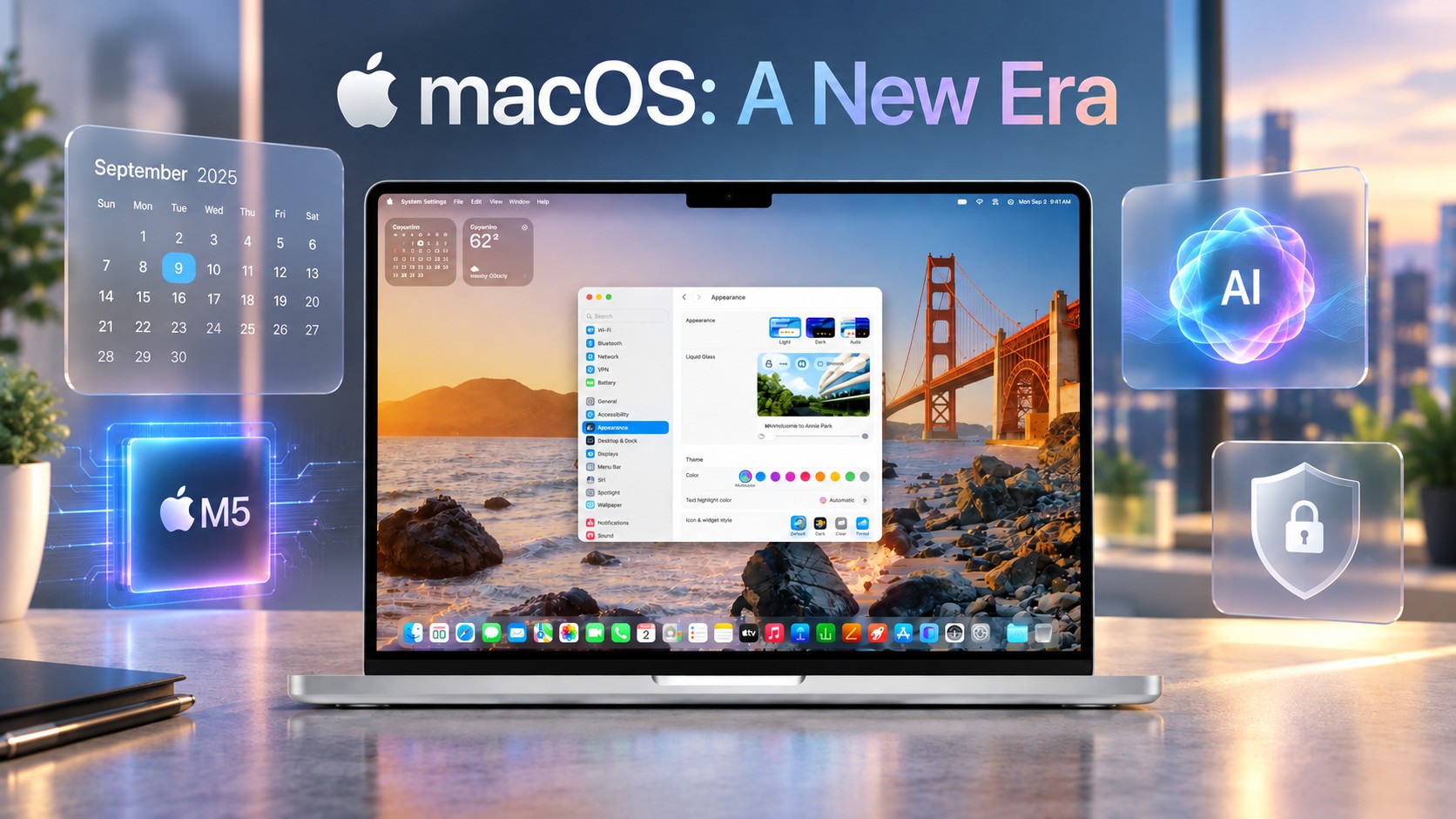
Tech analysts are closely evaluating recent Apple macOS Changes across enterprise and consumer markets. Apple shifted its operating system versioning to align directly with release calendar years. Consequently, macOS 26 Tahoe debuted in September 2025 under this unified release strategy. The company followed this release with macOS 27 Golden Gate in September 2026. This shift synchronizes build numbers across Mac, iPhone, and iPad operating systems.
Previously, sequential platform updates caused versioning confusion among multi-device software developers. Therefore, predictable build numbers simplify software deployment schedules for global IT organizations. Software releases now explicitly reflect the calendar year of their operational lifecycle. Legacy versioning paradigms now apply only to minor maintenance patches on older systems. Meanwhile, enterprise administrators gain increased confidence when planning annual platform upgrade cycles.
📅 Unified Release Strategy
macOS 15 Sequoia
- Apple Silicon & Intel
- Selected Intel & M-Series Macs
- Initial Apple Intelligence
macOS 26 Tahoe
- Apple Silicon & Final Intel
- Final 4 Intel Models & M-Series
- Liquid Glass & Spotlight
macOS 27 Golden Gate
- Pure Apple Silicon
- M-Series & A18 Pro (MacBook Neo)
- Visual Intelligence & Core AI
Hardware Deprecation and Apple macOS Changes
Hardware specifications have changed dramatically alongside recent software architecture updates. Specifically, macOS 26 Tahoe marked the final release supporting select Intel processor configurations. That transition version maintained support for the 2019 Mac Pro and 2020 Intel laptops. However, earlier Intel computers lost official platform upgrade eligibility during that update cycle. Apple systematically removed legacy driver frameworks to focus resources on custom silicon architectures.
The subsequent macOS 27 Golden Gate operating system runs exclusively on Apple Silicon chips. Legacy Intel machines will continue receiving essential security maintenance through 2029. Apple Silicon processors feature specialized Neural Engines that accelerate real-time machine learning workflows. Intel chips lack the matrix hardware required for complex on-device artificial intelligence tasks. As a result, complete Intel deprecation represents an inevitable step for platform hardware progression.
⚡ Hardware Architecture Transition
🚫 Legacy Intel
🚀 Apple Silicon
Interface Evolution and Visual Redesign
System designers introduced the Liquid Glass visual language to modernize desktop interaction paradigms. Notably, this aesthetic framework incorporates dynamic translucency alongside customizable folder emblems. Translucent menu bars expand desktop visibility while maintaining focus on active application windows. Users can apply light, dark, or tinted custom styles across system desktop icons. Additionally, Live Activities in the menu bar deliver real-time operational updates from connected iPhones.
Designers refined these visual layers in macOS 27 to optimize application window responsiveness. Structured toolbars and edge-to-edge sidebars restore spatial clarity across desktop workspaces. Operating system optimizations reduce application launch times significantly across modern hardware. Furthermore, visual components adapt dynamically to user actions without introducing desktop distractions. Customizable options ensure enterprise users can maintain standardized workstation layouts when necessary.
| macOS Version | General Availability | Primary Architecture | Supported Hardware Scope | Primary System Focus |
| macOS 15 Sequoia | September 16, 2024 | Apple Silicon & Intel | Selected Intel & M-Series Macs | Initial Apple Intelligence |
| macOS 26 Tahoe | September 15, 2025 | Apple Silicon & Final Intel | Final 4 Intel Models & M-Series | Liquid Glass & Spotlight |
| macOS 27 Golden Gate | September 14, 2026 | Pure Apple Silicon | M-Series & A18 Pro (MacBook Neo) | Visual Intelligence & Core AI |
🎨 Liquid Glass Visual Redesign
Dynamic Translucency
Live Activities
Custom Emblems
Spatial Clarity
On-Device Intelligence and Developer Frameworks
Operating system updates embed generative machine learning tools directly into system architecture layers. Developers utilize the Foundation Models Framework to execute local model inference efficiently. Similarly, the Core AI framework enables seamless deployment of full-scale custom large language models. Unified memory architecture allows Neural Engines to process complex multimodal tasks on local hardware. On-device processing preserves user privacy while eliminating cloud API costs and network latency.
macOS 27 Golden Gate integrates Visual Intelligence to evaluate on-screen content through direct selection. Currently, users can highlight screen regions to query context-aware information instantly. Developer tools in Xcode 27 incorporate autonomous coding agents to streamline software engineering. Spotlight search now executes multi-step application actions directly through concise keyboard shortcuts. Accordingly, intelligent system tools automate routine daily tasks across native desktop applications.
🤖 On-Device Intelligence
- Foundation Models Framework Executes local model inference efficiently
- Core AI Integration Seamless deployment of custom full-scale LLMs
- Visual Intelligence (macOS 27) Evaluate on-screen content via direct highlight selection
- Autonomous Coding Agents Integrated inside Xcode 27 for streamlined software engineering
👱 Enterprise Security
- Endpoint Security APIs Delivers granular telemetry, replacing legacy kernel extensions
- Gatekeeper & XProtect Continuous real-time monitoring of processes and sockets
- Developer ID Transition Certificate chains require mandatory updates prior to 2027 expiration
- Third-Party Integrations Remains vital for central audit logging and policy enforcement
Enterprise Endpoint Security and IT Management
System administrators face evolving operational standards as Apple replaces legacy kernel extensions. Indeed, Endpoint Security APIs deliver granular telemetry while maintaining platform system stability. Built-in Gatekeeper and XProtect services continuously monitor system processes to prevent malware execution. Security frameworks inspect process launches, file modifications, and network sockets in real time. Nevertheless, third-party security utilities remain vital for central audit logging and policy enforcement.
Enterprise IT departments must carefully organize hardware refresh schedules to maintain system compatibility. Organizations deploying native Apple Silicon devices achieve superior hardware performance and data protection. Developers must update Developer ID certificate chains prior to legacy authority expirations in 2027. Operating system tools provide enhanced administrative governance over fleet software environments. Overall, enterprise security architectures must adapt swiftly to these evolving infrastructure requirements.
Future Outlook and Platform Lifecycle Guidance
The convergence of software versioning and chip architecture defines a transformative era for Mac computing. Thus, enterprise technology leaders should accelerate the phase-out of legacy x86 workstation hardware. Modern Apple Silicon hardware delivers exceptional power efficiency alongside localized artificial intelligence performance. Software developers must leverage updated SDKs to deliver fully optimized native desktop applications. IT departments benefit from predictable software maintenance schedules across all managed Apple devices.
Native AI frameworks and tight operating system integration ensure sustained competitive advantages for businesses. Moreover, organizations that refresh hardware fleets promptly will maximize worker productivity and data security. System stability remains consistently strong across recent minor software updates and background security patches. Businesses can confidently deploy Apple Silicon infrastructure to support long-term digital transformation initiatives. Ultimately, the modern desktop platform relies firmly on custom silicon, local intelligence, and proactive security.
Support Our Work
Help us keep creating and maintaining our projects. We appreciate your support!
Ways to contribute:
Shop via Affiliate LinksSupport us at no extra cost to you while you shop.
Support on Ko-fiBuy us a coffee to keep the engine running!




Leave a Reply