


- Ray Tracing – Immerse yourself in worlds with a new level of realism as rays of light are individually simulated, creati…
- Faster Loading – Fast-travel across the map and get back into the game almost instantly with the PlayStation 5 console’s…
- Stunning Visuals – Experience the vast world in stunning 4K and HDR at 120 FPS (with a 4K and HDR compatible TV or displ…
Retail Inventory Deficits and the PS5 Pro Shortages
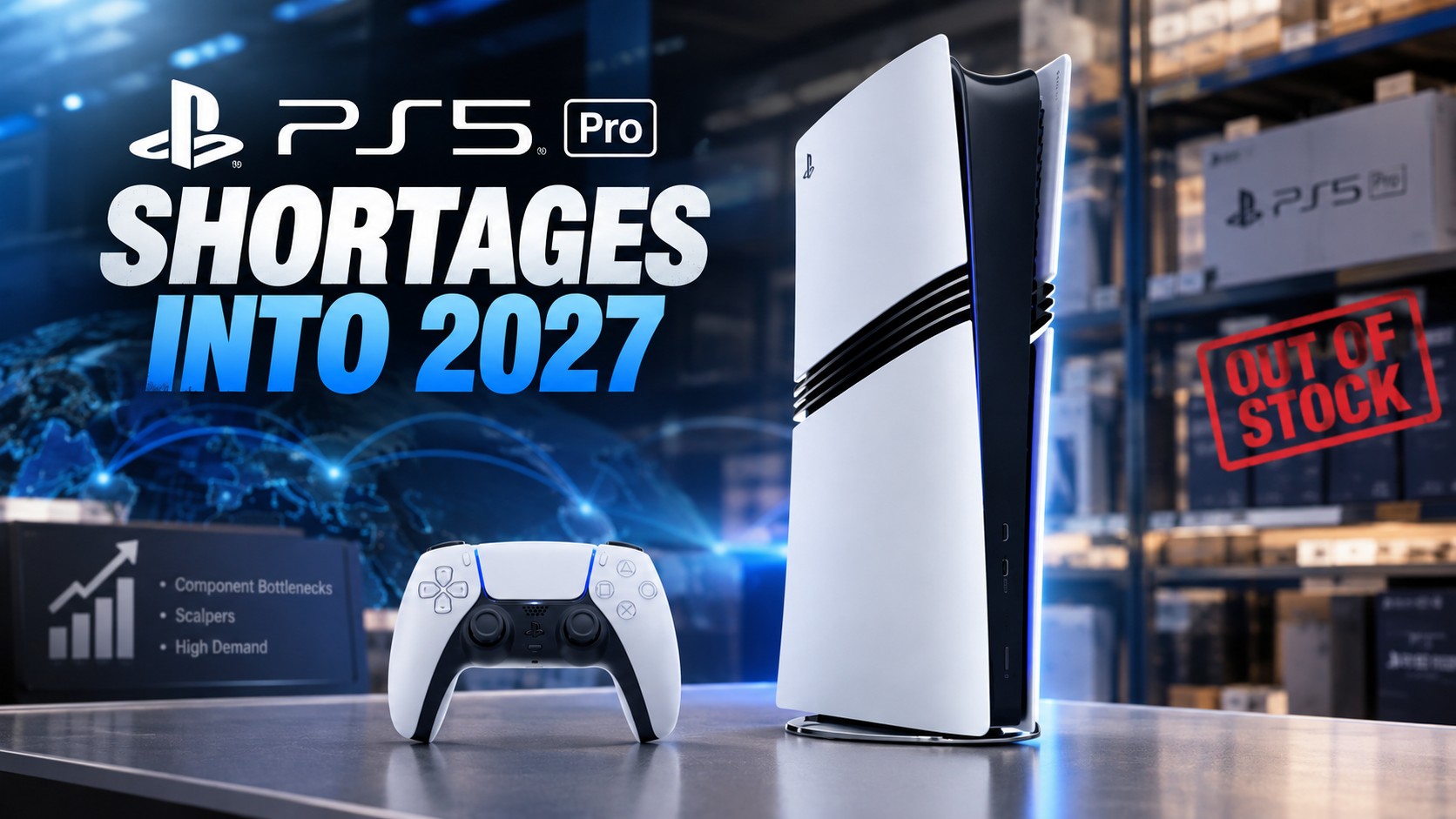
Retail availability for high-end video game consoles remains severely restricted across major global store channels. Consequently, gamers trying to buy enhanced consoles face an ongoing PS5 Pro Shortages at primary outlets. Internal Sony communications to international distributors indicate that stock limitations will continue through early 2027. Meanwhile, new stock shipments sell out within minutes of appearing on official direct sales websites. Enthusiast demand consistently exceeds current factory output across major international markets.
Standard baseline consoles remain in steady supply across most major physical and online stores. However, third-party resellers exploit hardware shortages by charging excessive premiums on secondary marketplaces. Auction listings for single console units routinely reach prices exceeding twelve hundred dollars online. Enthusiast buyers face difficult financial decisions while searching for available upgraded systems. Therefore, core gamers encounter significant frustration when trying to upgrade their existing home setups.
Component Bottlenecks and Semiconductor Manufacturing
Semiconductor supply disruptions represent the central bottleneck hindering accelerated hardware assembly output. Global dynamic random-access memory shortages constrain the monthly output of advanced electronic hardware. Specifically, Sony collaborates with major chip suppliers to secure critical high-speed memory components. Global competition for advanced silicon capacity creates severe procurement challenges for consumer technology firms. Specialized hardware components require sophisticated fabrication processes that limit rapid production increases.
Furthermore, modern four-nanometer silicon architectures involve elevated wafer production costs for manufacturers. High manufacturing costs prevent rapid production expansion during global component supply contractions. Sony manages hardware allocations while navigating broader macroeconomic price pressures in foreign markets. As a result, distributors receive smaller inventory batches than originally projected for the current fiscal year. International retail channels continue operating under tight inventory allocations across multiple regions.
Software Catalysts and Secondary Market Pressures
High-profile software announcements significantly drive hardware demand among core interactive media consumers. In particular, Grand Theft Auto VI prompts millions of players to seek upgraded system options. Gamers desire superior frame rates and enhanced ray tracing for upcoming blockbuster video game titles. Promotional campaigns highlight exclusive graphical enhancements available on premium console hardware. In addition, players express concerns regarding potential frame rate limitations on standard baseline hardware.
Opportunistic scalpers target limited store restocks by deploying automated checkout scripts on retail sites. Resellers list acquired units on auction portals for nearly double the original retail price. In contrast, detachable disc drives face similar inventory shortages due to heavy reseller markups. Standalone optical drives routinely fetch prices fifty percent above manufacturer suggested retail pricing. Consumer frustration grows as unauthorized secondary sellers monopolize limited retail inventory drops.
📈 Market Outlook & Pricing
Inventory deficits and secondary market pricing data
Player Verification Systems and Allocation Strategies
Sony implemented a player-focused purchase lottery in Japan to prevent commercial scalpers from hoarding units. Instead, customers must submit purchase applications through a structured regional lottery system. Applicant eligibility depends directly on verified gameplay history logged on PlayStation Network accounts. For instance, applicants must maintain a registered Sony account unified across platform network services. Entrants must prove at least sixty hours of total gameplay logged on recent PlayStation systems.
Account tracking evaluates recorded user activity across a strict two-year timeframe prior to application. Thus, active platform users receive priority access over reseller accounts created solely for commercial gain. Selected lottery winners receive official purchase windows to buy consoles directly at standard MSRP. Unclaimed purchase allocations return to subsequent drawing pools for remaining eligible applicants. Gaming communities praise these verification measures as an effective strategy against automated retail scalping.
🎫 Japan Lottery Verification
Strict requirements designed to prevent automated retail scalping
Hardware Benchmarks and Specification Analysis
Substantial internal hardware modifications differentiate the upgraded console from baseline platform revisions. For example, GPU rendering capability expands significantly to support demanding graphical features. Central processing unit architecture remains largely consistent across both system configurations. The enhanced console incorporates additional dedicated system memory to manage background operating assets. Detailed technical specifications clarify core performance differences between baseline and upgraded hardware models.
Higher memory bandwidth enables enhanced system hardware to render complex game textures smoothly. Dedicated artificial intelligence upscaling maintains steady target frame rates during intense action sequences. Base internal storage increases to two terabytes for managing massive contemporary game files. Indeed, visual quality improves noticeably when running games specifically optimized for upgraded console hardware. Players utilizing high-refresh displays benefit most from improved frame rates and ray tracing detail.
⚙ Hardware Specification Analysis
Direct comparison between standard and upgraded architectures
Industry Impact and Supply Chain Projections
Global industry projections suggest hardware availability challenges will remain active into 2027. Accordingly, Sony plans inventory distribution strategies across major international sales divisions. Component supply limits constrain rapid factory output expansion despite strong worldwide consumer demand. Industry analysts expect broader adoption of player verification lotteries across western retail markets. Retailers aim to reduce scalper activity while maintaining fair hardware distribution for genuine gamers.
Simultaneously, manufacturers negotiate extended memory component supply contracts to stabilize production levels. Strong sales metrics demonstrate solid consumer willingness to invest in premium video gaming hardware. In fact, platform owners continue expanding enhanced software libraries to maximize hardware upgrade value. Structured purchase queuing systems set new operational standards for handling high-demand hardware launches. Ultimately, hardware ecosystems adapt effectively despite ongoing international supply chain constraints.
Support Our Work
Help us keep creating and maintaining our projects. We appreciate your support!
Ways to contribute:
Shop via Affiliate LinksSupport us at no extra cost to you while you shop.
Support on Ko-fiBuy us a coffee to keep the engine running!






Leave a Reply