
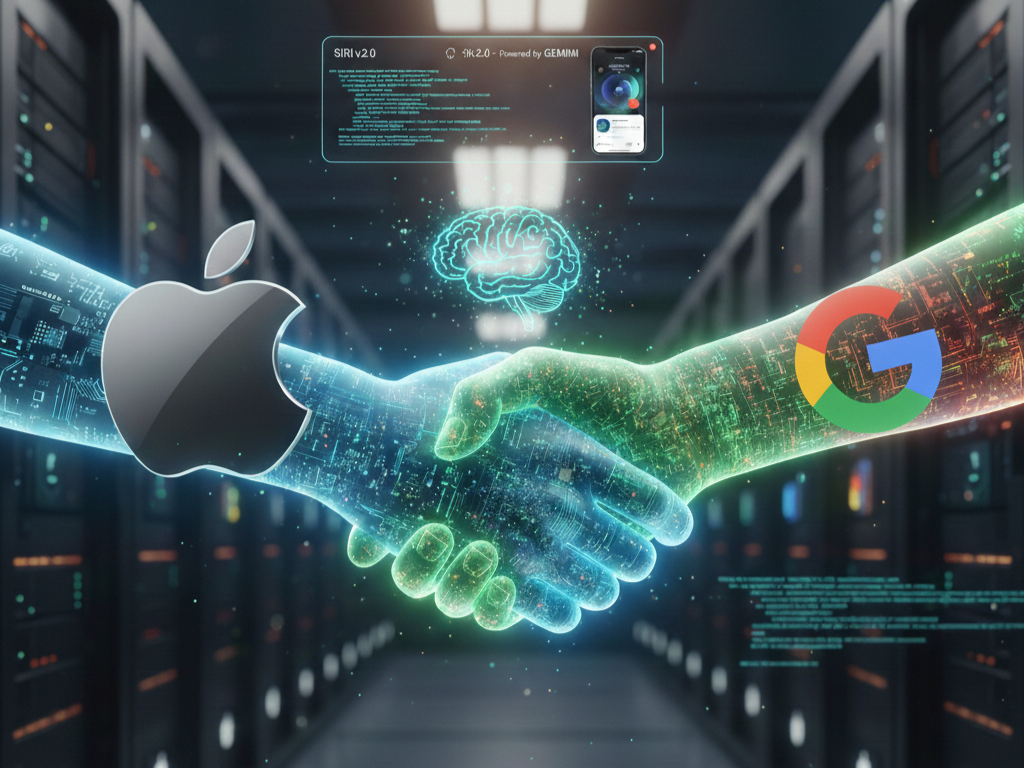
The tech world recently witnessed a massive shift in power. Apple officially confirmed a groundbreaking partnership with Google. This deal focuses on a specific goal. Apple is now using Google Gemini to save Siri. Many users felt Siri had fallen behind the competition. Consequently, Apple sought a powerful partner to bridge the gap. So, they selected Google’s most advanced AI models for this task.
This collaboration marks a historic moment for both companies. Historically, these two giants were fierce rivals in mobile software. Now, they are working together on a multi-year project. This agreement reportedly costs Apple around $1 billion annually. However, the price is small compared to the potential benefits. Apple needs a “brain” for its new Deep Intelligence Layer. Meanwhile, Google Gemini provides the perfect foundation for this ambitious goal.

A New Brain for an Old Assistant
Siri first launched in 2011 as a pioneer. Yet, it struggled to keep up with generative AI. Rivals like ChatGPT and Gemini offered more natural conversations. Meanwhile, Siri often redirected users to web search results. This frustration led to a strategic pivot in Cupertino. Apple decided to stop relying solely on its own models. Instead, it embraced the power of Google Gemini for complex reasoning.
The new Siri is not just a minor update. It represents a fundamental architectural shift for the iPhone. Hence, engineers are building a three-tier hybrid AI stack. On-device models handle simple tasks like setting timers. However, Google Gemini powers the most difficult queries. This system allows Siri to understand personal context deeply. It can now look at your emails and messages simultaneously. Then, it can book a ride based on your flight.
- Release Date: Second half of February 2026.
- Operating System: Part of the iOS 26.4 update.
- Core Technology: Google Gemini 3 Pro integration.
- Privacy Model: Processed via Private Cloud Compute.
Apple Using Google Gemini: The Architecture of Intelligence
How does Apple maintain privacy while using Google’s models? This question remains vital for many loyal iPhone users. Apple insists that the privacy standards will not change. They are using a system called Private Cloud Compute. This ensures that no data is shared with Google directly. Essentially, Apple runs Gemini on its own high-end Mac chips. Therefore, Google never sees your specific personal requests.
Furthermore, the integration is structural rather than a simple plugin. In previous versions, users had to opt-in for ChatGPT. Now, the Gemini logic is woven into the operating system. It acts as a “Query Planner” for the entire device. This means it can coordinate tasks across different apps seamlessly. For instance, it can find a photo and edit it. Afterward, it can send that photo to a friend.
“Apple determined that Google’s AI technology provides the most capable foundation for its models.” — Official Joint Statement.
Why Google Gemini Won the Deal
Apple spoke with several AI companies before choosing Google. They reportedly held talks with OpenAI and Anthropic as well. However, Anthropic’s pricing was considered too high for the deal. Additionally, OpenAI presented certain strategic concerns for Apple leadership. Google offered the best combination of performance and favorable terms. Moreover, Google’s cloud infrastructure is incredibly robust for global scale.
The timing of this deal is also quite significant. Google recently regained massive market momentum in the AI space. Its Gemini 3 model has impressed researchers worldwide. By partnering with Apple, Google gains a massive distribution network. Millions of iPhones will now serve as a gateway to Gemini. This cements Google’s position as a leader in consumer AI. Meanwhile, Apple avoids the massive cost of building a trillion-parameter model.
Apple Using Google Gemini: What to Expect in iOS 26.4
The first features will arrive in just a few weeks. Users should look for “World Knowledge Answers” first. This feature provides summarized responses with clear citations. It functions very similarly to a search-focused chatbot. However, the deep app integration is the real highlight. Siri will soon understand exactly what is on your screen. You can ask it to summarize a specific open window.
Furthermore, expect improvements in media and productivity apps. Siri will have new “Assistant Schemas” for better control. You can tell Siri to find a specific podcast episode. Then, you can ask it to play a specific segment. These multi-step actions used to be impossible for Siri. Now, Google Gemini provides the logic to handle them easily. The experience will feel much more natural and fluid.
The Long-Term Vision: Project “Campos”
Furthermore, the February update is only the beginning of the journey. Apple is already planning a larger overhaul for late 2026. This project is internally known as “Campos” among developers. It aims to turn Siri into a full-scale AI chatbot. This version will likely debut with iOS 27 and macOS 27. So, it will support long, back-and-forth conversations without losing track.
Under the hood, Apple is developing “Foundation Models version 11.” This system will compete directly with the world’s best AI. To support this, Apple might use Google’s cloud more directly. They are discussing the use of Google’s Tensor Processing Units. This would represent a major shift in Apple’s server strategy. However, the goal is to provide the fastest responses possible. Quality and speed are now the top priorities for Apple.
Market Reactions and Future Trends
The stock market reacted positively to this massive announcement. Apple shares rose significantly after the news broke. Investors finally see a clear AI roadmap for the company. Similarly, Alphabet’s stock saw a healthy boost from the deal. This partnership reduces the risk of Apple falling behind. It also provides Google with a steady stream of revenue. Both companies seem to benefit from this “AI truce.”
Nevertheless, some analysts worry about the competitive landscape. This deal might attract the attention of antitrust regulators. Google already pays billions to be the default search engine. Adding a billion-dollar AI deal might complicate legal matters. Still, the non-exclusive nature of the deal helps Apple. They can still work with other partners like OpenAI. This flexibility allows Apple to maintain its leverage.
Apple Using Google Gemini: Hardware Requirements for New AI
However, you might need a new iPhone for these features. Modern AI requires a significant amount of memory. As a result, reports suggest the upcoming iPhone 17 will have 12GB of RAM. This extra memory helps handle the on-device “pre-processing.” Older devices might struggle with the most advanced Gemini tasks. Apple is pushing for a major hardware upgrade cycle. They want users to see the value in new silicon.
The internal NPU (Neural Engine) is also becoming critical. Apple is optimizing its chips to work with Gemini. This ensures that the hybrid model runs efficiently. If a task can be done locally, it stays locally. If it needs more power, it goes to the cloud. This balancing act is the secret to a smooth experience. It also helps preserve the battery life of the device.
Impact on the Creative Suite
Apple is also launching the “Apple Creator Studio” bundle. This subscription includes Final Cut Pro and Pixelmator Pro. Subscribers will get exclusive Gemini-powered features in these apps. Imagine using AI to remove objects from a video instantly. Or, think about generating music for a project using Siri. These creative tools will become much more accessible to everyone.
Furthermore, developers will get new tools in Xcode. Gemini can help write and debug code for apps. This will likely accelerate the development of third-party AI apps. Apple wants to foster a rich ecosystem of intelligent software. By providing a strong foundation, they empower every developer. The entire App Store could soon look very different. Every app will likely feature some form of Gemini integration.
The Evolution of Siri: Before and After the Gemini Integration
This table highlights the significant leap in capabilities as Apple moves from its legacy Siri infrastructure to the new, Gemini-powered Deep Intelligence Layer.
| Feature Area | Legacy Siri (Pre-2026) | Gemini-Powered Siri (Post-Feb 2026) |
| Conversational Flow | Mostly one-off commands and limited follow-ups. | Natural, back-and-forth dialogue with memory of context. |
| Contextual Awareness | Struggles to connect data across different apps. | Deeply understands personal data across Mail, Photos, and Messages. |
| On-Screen Knowledge | Cannot “see” or interact with what is currently on screen. | Can analyze open windows and take actions based on on-screen content. |
| Query Complexity | Limited to basic tasks like timers, weather, and light control. | Handles multi-step, agentic tasks (e.g., “Find the photo from dinner and email it to Mom”). |
| Processing Model | Primarily on-device or basic Apple cloud relay. | Hybrid: On-device for speed, Google Gemini for complex reasoning. |
| Creative Support | Minimal to no support for content generation. | Generates summaries, rewrites text, and assists in media creation. |
| App Integration | Limited to specific Siri Shortcuts and basic commands. | Controls system-wide settings and executes deep per-app actions. |
The Competitive Response
How will rivals like Microsoft and Samsung react? Samsung has already integrated many Google AI features. However, Apple’s deep OS-level integration is unique. Microsoft is continuing to push its Copilot software everywhere. The competition for the “best AI assistant” is heating up. Every company wants to own the primary user interface. With Gemini, Apple has a strong chance to win.
OpenAI might face the biggest challenge from this deal. They were the early favorite for an Apple partnership. Now, they are relegated to a secondary role for queries. This change shifts the momentum back toward Google. It shows that established tech giants still have massive power. They can leverage their existing relationships to dominate new fields. The AI war is far from over, but the lines are drawn.
Apple Using Google Gemini: Final Thoughts on the Partnership
In conclusion, Apple using Google Gemini is a pragmatic choice for 2026. Finally, it shows that Apple prioritizes the user experience. They are willing to collaborate to deliver the best results. For years, Siri was a source of jokes. Now, it has the potential to be a market leader again. This partnership combines Apple’s design with Google’s data science. It is a formidable combination that few can match.
As we move toward February, anticipation continues to grow. Users are eager to test the new Siri for themselves. Will it truly understand our personal context? Can it handle the messiness of daily life? Only time will tell if this bet pays off. For now, the future of the iPhone looks brighter. It finally has the intelligence it deserves.



Leave a Reply