
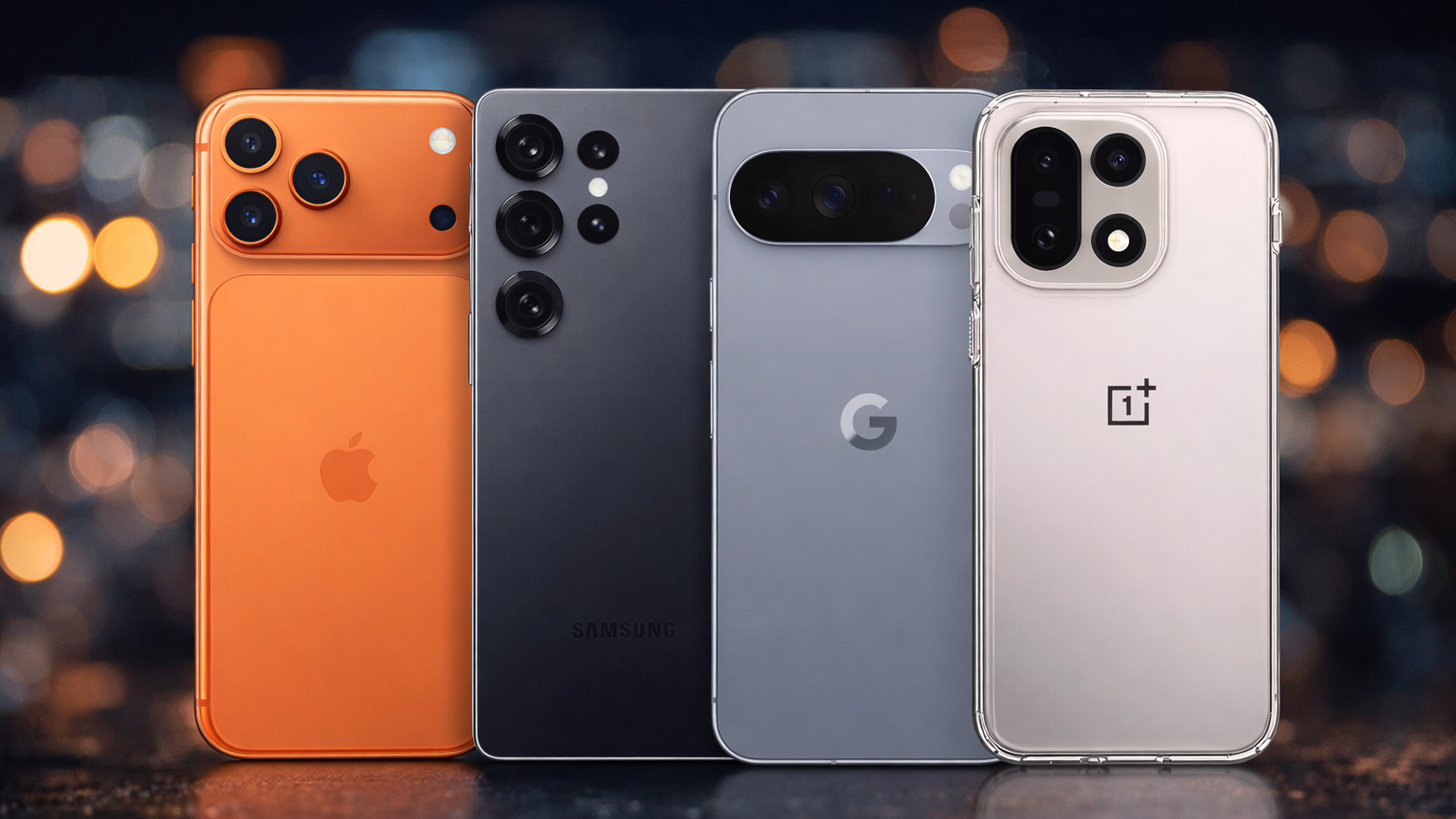
Welcome to the ultimate Flagship Face-Off of February 2026. Today, we analyze the titans of the smartphone industry. Specifically, we focus on four incredible devices that dominate the headlines. These include the iPhone 17 Pro Max, Samsung Galaxy S25 Ultra, Google Pixel 10 Pro, and the OnePlus 15.
Each manufacturer has taken a distinct path this year. Consequently, the choice for consumers has never been more difficult. Apple emphasizes professional video workflows and refined thermal management. Meanwhile, Samsung prioritizes raw productivity and ultra-thin display bezels. Google, however, doubles down on its unique AI-first philosophy. Finally, OnePlus disrupts the market with an massive battery and incredible charging speeds.

Are you ready to dive into the details? Let us explore how these giants compare in the real world. We will look at performance, cameras, and battery longevity. Stay tuned as we break down every specification.
Processing Power and Performance
The heart of every flagship remains its internal processor. For instance, the iPhone 17 Pro Max utilizes the new A19 Pro chip. This silicon is built on a cutting-edge 3nm process. Furthermore, Apple has finally introduced an internal vapor chamber. This hardware change allows the phone to maintain peak performance longer. Therefore, gamers and video editors will notice significantly less throttling.
In contrast, the Samsung Galaxy S25 Ultra employs the Snapdragon 8 Elite. This “for Galaxy” variant offers the highest clock speeds on Android. Specifically, it excels in multi-core tasks and heavy multitasking. Users can easily run multiple apps without any lag. However, benchmarks show that the Apple A19 Pro still leads in single-core efficiency.
- iPhone 17 Pro Max: Best for sustained, professional workloads.
- Samsung Galaxy S25 Ultra: The king of Android multitasking.
- Google Pixel 10 Pro: Smooth, AI-optimized daily performance.
- OnePlus 15: Blazing fast animations and gaming speed.
Google has taken a different route with the Tensor G5. Notably, this is the first chip Google designed entirely in-house. While it lacks the raw power of Qualcomm, it shines in machine learning. Thus, the Pixel 10 Pro handles local AI tasks with impressive grace. It may not win every benchmark race. Nevertheless, the user experience feels remarkably fluid and intelligent.
Lastly, the OnePlus 15 also uses the Snapdragon 8 Elite. It pairs this chip with an aggressive cooling system. As a result, OnePlus delivers some of the best gaming results in the industry. It often outperforms the Samsung in frame rate stability.
Display Brilliance and Design
Screens are the windows to our digital souls. First, consider the iPhone 17 Pro Max. It features a 6.9-inch Super Retina XDR display. Additionally, the new Ceramic Shield 2 provides 3x better scratch resistance. This screen is notably less reflective than previous models. Consequently, outdoor visibility is much improved in direct sunlight.
Samsung remains a leader in display technology. The Galaxy S25 Ultra boasts a Dynamic AMOLED panel with the thinnest bezels yet. Because of this, the phone feels like a floating slab of glass. It also features a new anti-reflective coating. This glass competes directly with the iPhone’s new shield. Many reviewers claim Samsung still has the most vibrant colors.
“The S25 Ultra is a monolithic slab of glass wrapped in a titanium band.” — The Guardian
The Google Pixel 10 Pro offers a more compact feel. It uses a 6.3-inch Actua Display with incredible brightness. While it is smaller, it does not compromise on quality. Google’s design language remains unique with its iconic camera bar. This year, the bar is more refined and integrated.
OnePlus has surprised everyone by ditching curved glass. The OnePlus 15 now features a fully flat 165Hz OLED. This high refresh rate makes everything feel faster. Furthermore, the OnePlus design is now more boxy and matte. It feels very premium but looks quite different from its predecessors.
Camera Systems: A Professional Battle
Photography enthusiasts have much to celebrate in 2026 Flagship Face-Off. The Samsung Galaxy S25 Ultra leads with its 200MP main sensor. Samsung also upgraded the ultra-wide lens to 50MP this year. This change significantly improves low-light performance indoors. Moreover, the 10x optical zoom remains a standout feature for distance shots.
Apple has focused on “Fusion” technology. The iPhone 17 Pro Max features three 48MP cameras. These include the main, ultra-wide, and telephoto lenses. For the first time, Apple offers an 8x optical-quality zoom. However, the real magic is in the video. With Log 2 recording and Genlock support, it is a professional tool. Filmmakers will choose the iPhone without hesitation.
Google continues to win hearts with its computational photography. The Pixel 10 Pro uses a 50MP main sensor with a massive 1/1.3-inch size. While the hardware is great, the software is better. Features like Magic Editor and Video Boost are now faster. The Pixel 10 Pro captures the most natural skin tones. It also excels in challenging HDR situations.
OnePlus has ended its partnership with Hasselblad. Instead, it introduced the DetailMax Engine. The OnePlus 15 features a trio of 50MP cameras with larger sensors. Specifically, the main sensor grew to 1/1.4 inches. While it holds its own, it still trails the Pixel in software processing. However, the new 3.5x telephoto lens is very sharp.
Flagship Face-Off: Battery Life and Charging Speeds
In terms of endurance, there is one clear winner of this Flagship Face-Off. The OnePlus 15 features a staggering 7,300mAh battery. This is a massive jump from last year. Even better, it supports 120W wired charging. You can charge from 0% to 100% in just 39 minutes. No other flagship in this list comes close to this speed.
Apple has also made strides in battery life. The iPhone 17 Pro Max offers the best longevity ever for an iPhone. This is due to the efficient A19 Pro and iOS 26. In recent tests, it survived over 24 hours of heavy use. It also supports 40W fast charging. While improved, it still feels slow compared to OnePlus.
| Feature | iPhone 17 Pro Max | Galaxy S25 Ultra | Pixel 10 Pro | OnePlus 15 |
| Battery Size | ~4,800mAh | 5,000mAh | 4,970mAh | 7,300mAh |
| Wired Charge | 40W | 45W | 29W | 120W |
| Wireless Charge | 25W | 15W | 15W | 50W |
Samsung maintains a reliable two-day battery life. The S25 Ultra is very consistent for daily tasks. However, it performed poorly in extreme cold during recent tests. Users in freezing climates should take note of this. It still supports 45W charging, which is adequate but aging.
The Google Pixel 10 Pro has a 4,970mAh cell. Performance is stable but not revolutionary. It typically lasts a full day with ease. However, the 29W charging speed is the slowest in this group. You will need more patience when refueling this device.
Software and AI Innovation
Software is where these phones truly diverge. Apple’s iOS 26 brings advanced local AI. This allows for faster Siri responses and better privacy. The ecosystem remains Apple’s greatest strength. Furthermore, the integration with Mac and iPad is seamless.
Samsung’s One UI 7 is packed with features. The S-Pen now includes “Air Motion 2.0” for 3D control. This is great for artists and power users. However, some find the AI tools to be gimmicky. While powerful, the software can feel cluttered to some users.
Google offers the cleanest experience with Android 16. The Pixel 10 Pro is the “smartest” phone available. It uses AI to screen calls and translate conversations in real-time. Additionally, Google promises seven years of software updates. This makes the Pixel a great long-term investment.
OnePlus uses OxygenOS 16, which is incredibly fast. It prioritizes smooth animations and high-refresh-rate support. While it lacks some of the deep AI of Google, it feels the most responsive. Some users have reported minor bugs, but updates are frequent.
2026 Flagship Face-Off: Price Comparison (USD)
As a comparison, here is the detailed breakdown of the current market pricing for these flagship titans. Please note that these figures reflect the standard retail prices in the United States as of February 2026.
| Storage Capacity | iPhone 17 Pro Max | Galaxy S25 Ultra | Pixel 10 Pro | OnePlus 15 |
| 256GB | $1,199.99 | $1,299.99 | $1,099.00 | $899.99 |
| 512GB | $1,399.99 | $1,419.99 | $1,219.00 | $999.99 |
| 1TB | $1,599.99 | $1,659.99 | $1,449.00 | $1,149.00* |
| 2TB | $1,999.99 | N/A | N/A | N/A |
*Note: 1TB availability for the OnePlus 15 varies by region and carrier.
When we look at the numbers, a few fascinating trends emerge. First, the OnePlus 15 remains the undisputed “value king.” It offers the lowest entry price despite having the largest battery in the group. Conversely, the Samsung Galaxy S25 Ultra holds the title for the most expensive base model. This premium is often justified by the inclusion of the integrated S-Pen.
Apple continues its tradition of offering a massive 2TB storage option. This tier specifically targets professional filmmakers who shoot in ProRes Log. However, the Pixel 10 Pro is arguably the most “stable” in its pricing. Google has maintained a very competitive $999 starting price for the 128GB version (not shown in table).
Final Verdict: Which One Should You Buy?
Choosing the right phone depends on your priorities. If you are a video professional, buy the iPhone 17 Pro Max. Its video quality and ecosystem are unmatched. For those who want a productivity beast with a stylus, choose the Samsung Galaxy S25 Ultra.
Do you value smart features and the best still photography? In that case, the Google Pixel 10 Pro is for you. It is the most helpful smartphone on the market. Finally, if you hate charging your phone, get the OnePlus 15. Its battery life and charging speed are industry-leading.
2026 Flagship Comparison Table
| Feature | iPhone 17 Pro Max | Galaxy S25 Ultra | Pixel 10 Pro | OnePlus 15 |
| Display | 6.9″ Super Retina XDR OLED (120Hz) | 6.9″ Dynamic AMOLED 2X (120Hz) | 6.3″ LTPO Actua OLED (120Hz) | 6.8″ LTPO AMOLED (165Hz) |
| Processor | Apple A19 Pro (3nm) | Snapdragon 8 Elite (for Galaxy) | Google Tensor G5 (3nm) | Snapdragon 8 Elite |
| RAM | 12GB | 12GB | 16GB | 12GB / 16GB |
| Main Camera | 48MP (f/1.8) | 200MP (f/1.7) | 50MP (f/1.7) | 50MP (f/1.6) |
| Zoom Lens | 48MP (4x-8x Fusion) | 50MP (5x) + 10MP (3x) | 48MP (5x) | 50MP (3.5x) |
| Front Camera | 18MP (Center Stage) | 12MP (Dual Pixel) | 42MP (Dual Pixel) | 32MP |
| Battery | ~5,088mAh | 5,000mAh | 4,870mAh | 7,300mAh (Si-C Tech) |
| Charging | 40W Wired / 25W MagSafe | 45W Wired / 15W Wireless | 29W Wired / 15W Wireless | 120W Wired / 50W Wireless |
| OS | iOS 26 | Android 15 (One UI 7) | Android 16 | Android 16 (OxygenOS 16) |
| Special | Genlock Video, Log 2 | Integrated S-Pen | Gemini Nano Local AI | DetailMax Engine, 165Hz |
The year 2026 has delivered incredible innovation for the sake of Flagship Face-Off. Regardless of your choice, you are getting a masterpiece of engineering. Which one will you pick?
Flagship Face-Off: Camera Battle
This video provides a real-world camera comparison including side-by-side shots and video stabilization tests for the latest flagships.


Leave a Reply