
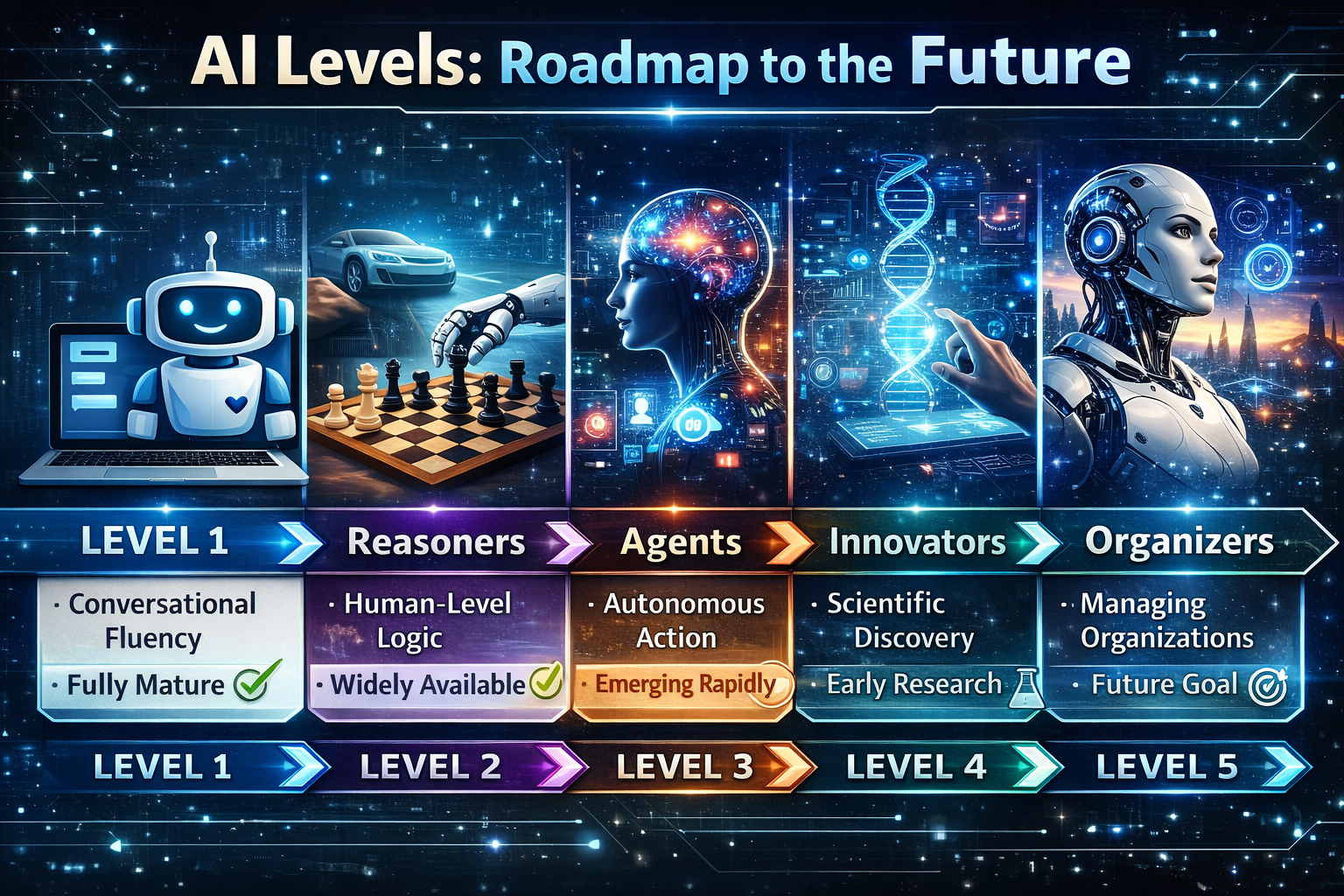
The world of Artificial Intelligence moves faster than a heartbeat. We are currently witnessing a massive shift in how machines think. Let’s explore the specific stages of AI evolution as of 2026. We will use insights from OpenAI, Google DeepMind, and Anthropic. These leaders are defining the roadmap to Artificial General Intelligence (AGI).

Level 1: The Era of Chatbots and Conversation
Historically, the first stage focused on basic interaction. Most users first met AI through simple text boxes. These systems are known as Conversational AI. They use large language models to predict the next word. Because of this, they can mimic human speech patterns. However, they do not truly “understand” the world around them.
Earlier models like GPT-4o set the initial standard. They could write poems and summarize long documents. Nevertheless, they often struggled with deep logic. They frequently suffered from “hallucinations” or false facts. Therefore, Level 1 is considered the base of the mountain. It proved that machines could finally master human language. But language is not the same thing as intelligence.
Level 2: The Rise of the Reasoners
By late 2024, the industry moved toward Level 2. OpenAI identifies this stage as “Reasoners.” These models do not just predict the next word. Instead, they spend time “thinking” before they respond. This process is called “Chain of Thought” processing. It allows the AI to verify its own logic. As a result, the accuracy of complex answers has increased.
Currently, in 2026, we see GPT-5.2 and similar models. These models can solve Ph.D.-level physics problems. Furthermore, they can debug incredibly complex computer code. They act like a human expert in a specific field. Consequently, the rate of hallucinations has dropped significantly. Humans are starting to trust AI for technical tasks. This transition marks a departure from simple mimicry.
Level 3: The Dawn of AI Agents
We are now entering the third stage: Agents. This level is perhaps the most exciting for businesses. An agent does not just talk to you. Rather, an agent performs actions on your behalf. Imagine an AI that can book your entire vacation. It would browse flights, hotels, and dinner reservations. Then, it would execute the payments autonomously.
Reputable sources like PwC highlight the value of Agentic AI. They predict that agents will manage entire business workflows. For instance, an AI agent could handle a company’s payroll. Or, it might coordinate a global supply chain. Unlike Level 2, these systems possess a sense of agency. They can interact with external software and tools. This capability transforms AI from a consultant into a collaborator.
Level 4: The Innovators and Scientific Pioneers
The fourth stage is called the “Innovators” level. At this point, AI begins to create new knowledge. It does not just summarize what humans have done. Instead, it proposes new scientific theories or inventions. Dario Amodei of Anthropic has discussed this potential. He envisions AI that acts like a Nobel Prize winner.
Such a system could discover new life-saving drugs. It might design more efficient batteries for electric cars. This stage requires a deep understanding of physical laws. The AI must be able to simulate reality accurately. Because of this, Level 4 is still mostly theoretical. However, some labs are seeing early signs of innovation. These “sparks” suggest that Stage 4 is coming soon.
Level 5: Organizations and Full AGI
The final stage is known as “The Organizers.” This level represents the achievement of true AGI. A Level 5 AI can run an entire company. It can coordinate thousands of smaller AI agents. It handles strategy, execution, and problem-solving simultaneously. Essentially, it matches or exceeds human capability in everything.
Sam Altman of OpenAI has often discussed this vision. He suggests that AGI could arrive by late 2026. However, many experts believe it may take longer. Achieving Level 5 requires massive amounts of computing power. It also requires a level of safety we haven’t reached. If we succeed, the global economy will change forever. Wealth creation could become decoupled from human labor.
Comparison of AI Evolution Stages
| Stage | Name | Key Capability | Current Status (2026) |
| Level 1 | Chatbots | Conversational fluency | Fully Mature |
| Level 2 | Reasoners | Human-level logic | Widely Available |
| Level 3 | Agents | Autonomous action | Emerging Rapidly |
| Level 4 | Innovators | Scientific discovery | Early Research |
| Level 5 | Organizers | Managing organizations | Future Goal |
The Critical Role of the Safety of AI Evolution Stages
As we climb these stages, safety becomes paramount. Each level introduces new and complex risks. For example, Level 3 agents could make mistakes. They might accidentally spend large amounts of money. Or, they could be tricked into leaking data. Therefore, companies are building “constitutions” for their models.
Anthropic is a leader in “Constitutional AI.” They give the model a set of ethical rules. This helps the AI refuse harmful or biased requests. Furthermore, regulators are finally catching up to the tech. The EU AI Act is now coming into force. It demands transparency from the creators of powerful models. We must ensure that AI remains a tool for good.
The Socio-Economic Impact of AI Evolution Stages
How will these stages affect your daily life? In the short term, productivity will likely soar. You will spend less time on boring tasks. Level 2 and 3 tools will handle your emails. They will also manage your schedule and basic research. Consequently, humans can focus on high-level creative work.
However, there are also significant concerns about jobs. White-collar roles are particularly at risk in 2026. Entry-level coding and data analysis are being automated. Therefore, we must rethink our education and social systems. Some leaders are calling for Universal Basic Income (UBI). This would provide a safety net during the transition. The goal is to share the benefits of AI.
AI Evolution Stages: Looking Toward the Horizon
The journey to AGI is not just about chips. It is also about our values as humans. We are teaching machines how to think and act. In doing so, we are learning about ourselves. The five stages provide a helpful roadmap for us. They allow us to measure progress and prepare.
Every new update brings us closer to Level 4. We are currently living in the “Agentic Era.” This is a time of great experimentation and change. So, we must stay informed and remain adaptable. The future is being written in code right now. We are all part of this digital narrative.
Why Reputable Sources Matter
In this fast-paced field, misinformation is very common. So, always look for data from established research labs. Organizations like DeepMind provide peer-reviewed papers on these topics. They offer a grounded view of what is possible. Consequently, avoid the hype and focus on the technical milestones. This is the best way to understand the stages.
Final Thoughts on the Journey of AI Evolution Stages
Finally, the transition through these stages is inevitable. Technology rarely moves backward once it has started. We have already conquered the first two levels. Now, we are mastering the third level of agents. The leap to Level 4 will be historic. It will change the very nature of human discovery.
Ultimately, AGI is the “North Star” of this industry. We are following a path that was once science fiction. So, it is a matter of engineering and ethics. We should embrace the potential for a better world. But we must also walk this path with caution. The stages of AI are the stages of our future.






Leave a Reply