
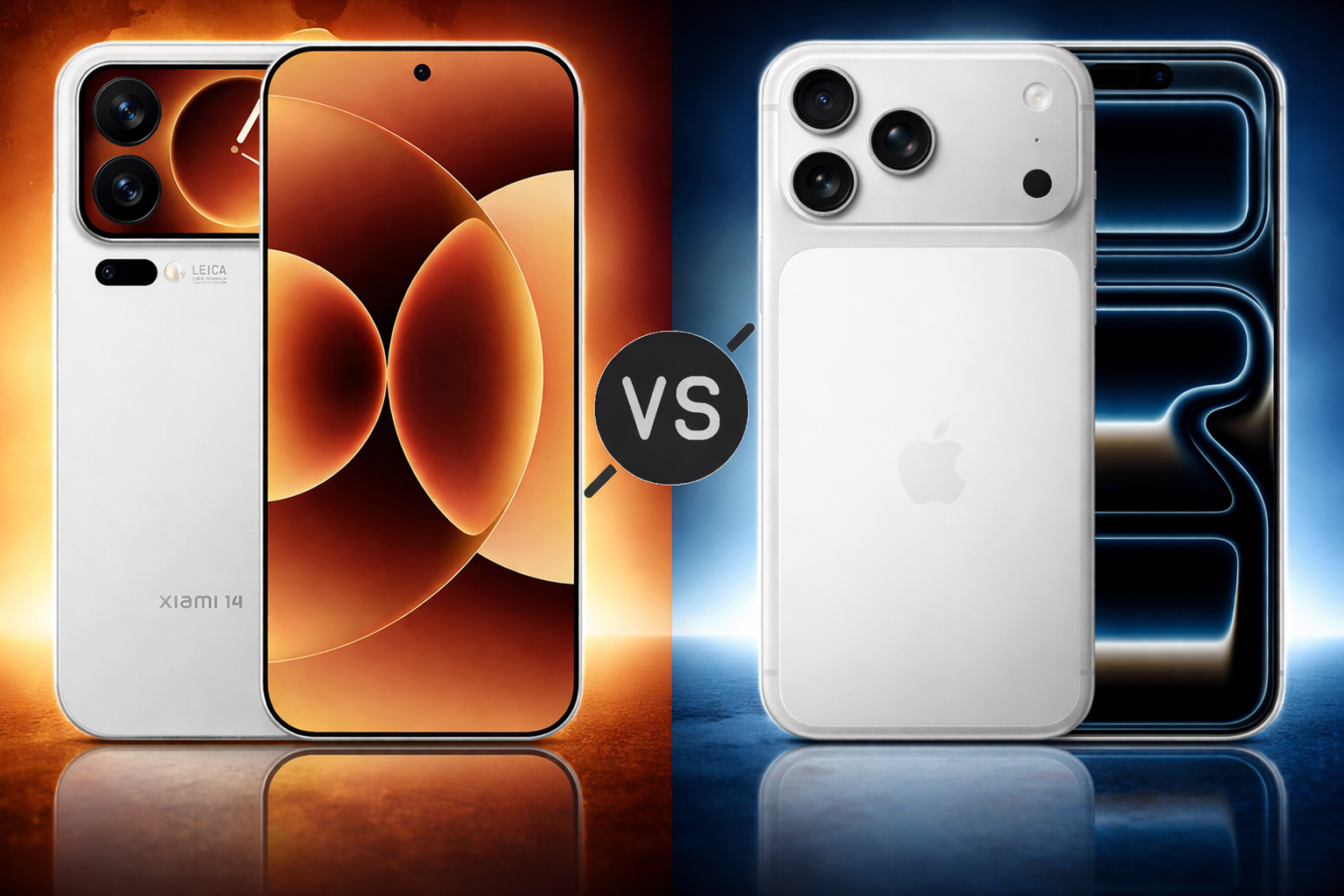
In the ever-evolving landscape of 2026, the mobile world remains focused on two titans. Xiaomi 17 Pro Max vs. iPhone 17 Pro Max represents the pinnacle of current engineering. Consequently, enthusiasts are debating which flagship truly commands the premium market this season. While Apple relies on refined luxury, Xiaomi pushes the boundaries of hardware raw power. This comparison explores every intricate detail of these two revolutionary devices.

The Aesthetic Duel: Ceramic vs. Magic
Design remains the first point of contact for every user. Consequently, Apple has doubled down on its unibody titanium construction. The iPhone 17 Pro Max feels incredibly dense and premium in the hand. Furthermore, it introduces a new “plateau camera” design that spans the rear width. This change marks the first major camera layout shift since the iPhone 11 Pro era. Meanwhile, Xiaomi has opted for a more futuristic and experimental approach.
The Xiaomi 17 Pro Max features a striking “Magic Back Screen” near the lens. Specifically, this 2.9-inch secondary AMOLED display allows for easier high-quality rear-camera selfies. Whereas Apple focuses on tactile elegance, Xiaomi prioritizes functional innovation on the back panel. Additionally, the iPhone 17 Pro Max has grown slightly thicker to roughly 8.75mm. This allows for a much more robust thermal management system inside the frame.
Conversely, Xiaomi utilizes a slimmer profile despite housing a significantly larger internal battery. Transitioning to durability, Apple now utilizes Ceramic Shield 2 for its front glass. This new material offers significantly better scratch resistance than previous generations. Moreover, it features a new anti-reflective coating to improve outdoor visibility. Xiaomi counters this with its own Dragon Crystal Glass for the 6.9-inch front panel.
Display Technology: Nits and Nuance
Both devices boast massive 6.9-inch displays, yet they target different visual goals. iPhone 17 Pro Max utilizes a Super Retina XDR OLED with ProMotion technology. Interestingly, it now achieves a staggering 3,000 nits of peak outdoor brightness. This ensures that the screen remains perfectly legible even under direct sunlight. Nevertheless, Xiaomi 17 Pro Max pushes the limit even further with 3,500 nits.
Xiaomi also incorporates a 300Hz touch sampling rate for ultra-responsive gaming sessions. Although Apple keeps the refresh rate at 120Hz, its LTPO technology is highly efficient. For example, it can drop down to 1 nit for a battery-saving always-on display. Furthermore, the iPhone’s Dynamic Island has been refined with a smaller “metalens” for Face ID. This reduction makes the notch less intrusive during full-screen video playback.
Xiaomi, however, retains the classic punch-hole design for its 50MP selfie camera. Because of this, the screen feels slightly more expansive for media consumption. Both phones support Dolby Vision and HDR10+ for a cinematic viewing experience. Yet, Apple’s True Tone technology often provides more natural color temperatures. Xiaomi offers deeper manual calibration for professional users who want specific color gamuts.
Silicon Showdown: A19 Pro vs. Snapdragon 8 Elite
Under the hood, we witness a clash of two different processing philosophies. The iPhone 17 Pro Max is powered by the custom-built A19 Pro chip. This processor is built on an upgraded 3-nanometer process for maximum power efficiency. Moreover, Apple has integrated new “Neural Accelerators” into every single core. These accelerators allow the device to handle complex AI tasks locally and instantly.
On the other side, Xiaomi 17 Pro Max uses the Qualcomm Snapdragon 8 Elite Gen 5. This chipset is a beast in raw benchmarks and multi-core performance. Specifically, it reaches clock speeds up to 4.6 GHz on its primary cores. While the A19 Pro excels in single-thread tasks, the Snapdragon thrives in heavy multitasking. Additionally, Xiaomi provides up to 16GB of LPDDR5X RAM in its top configurations.
Apple has finally upgraded the iPhone’s RAM to 12GB to support its Intelligence features. Nevertheless, the software optimization of iOS 26 makes that 12GB feel incredibly fluid. Both phones now feature vapor chamber cooling systems to prevent thermal throttling. Apple’s chamber is built into the aluminum unibody for 40% better heat dissipation. Consequently, gaming on both devices remains a stutter-free experience even after an hour.
Xiaomi 17 Pro Max vs. iPhone 17 Pro Max: The Battle of the 48MP and 50MP
Camera technology is perhaps the most contested category in this 2026 flagship rivalry. The iPhone 17 Pro Max features a triple 48MP system for the first time. This includes a main, ultrawide, and a new “tetraprism” telephoto lens. Specifically, the telephoto lens now supports 4x optical zoom with a high-resolution sensor crop. This allows for 8x optical-quality zoom without losing any fine detail.
Xiaomi 17 Pro Max responds with a Leica-tuned triple 50MP camera array. Its periscope lens offers a native 5x optical zoom for distant subjects. Furthermore, the Leica partnership provides unique color profiles that mimic classic film photography. While Apple focuses on realism and video stability, Xiaomi leans into artistic flair. The iPhone remains the king of video with its new Log 2 recording.
It also introduces “Dual Capture” to record front and rear cameras simultaneously. This is a dream feature for content creators and reaction-style vloggers. Transitioning to the front, Apple has a new 18MP “Centre Stage” selfie camera. This square sensor allows the image to rotate digitally without moving the phone. Xiaomi, however, wins on raw resolution with its 50MP front-facing sensor.
Battery and Longevity: Efficiency vs. Capacity
The most surprising data comes from recent battery endurance tests conducted this year. Xiaomi 17 Pro Max houses a mammoth 7,500mAh silicon-carbon battery inside. Naturally, one would expect it to crush every other phone on the market. However, the iPhone 17 Pro Max keeps pace with a much smaller 5,088mAh cell. This is largely due to the extreme efficiency of the A19 Pro.
In a standard “torture test,” both phones lasted over 13 hours of continuous use. Remarkably, the iPhone only trailed the Xiaomi by a mere five minutes. This proves that software optimization is just as vital as physical battery size. Nevertheless, Xiaomi absolutely dominates when it comes to recharging speeds. It supports 100W wired Hyper Charging to fill the battery in minutes.
Apple remains conservative, offering 40W wired charging and 25W MagSafe wireless. While Xiaomi’s speeds are convenient, Apple argues its slower charging preserves battery health. Furthermore, Apple’s new N1 networking chip reduces power draw during 5G usage. This ensures that the iPhone stays cool even when downloading massive files. Both devices easily provide two days of battery life for average users.
Xiaomi 17 Pro Max vs. iPhone 17 Pro Max: iOS 26 vs. HyperOS 3
Software often determines the final purchase decision for many smartphone buyers. Apple’s iOS 26 introduces the “Liquid Glass” theme with translucent, floating menus. It feels modern, cohesive, and deeply integrated with the rest of Apple’s hardware. Moreover, the focus on “Memory Integrity Enforcement” makes it the most secure iPhone ever. This hardware-level defense is specifically designed to block advanced mercenary spyware.
Xiaomi’s HyperOS 3, based on Android 16, offers a vastly different experience. It is highly customizable and allows users to tweak every aspect of the UI. Furthermore, the integration with Xiaomi’s vast smart home ecosystem is incredibly seamless. The secondary rear display is also managed through HyperOS for quick notifications. While iOS is more polished, HyperOS provides more freedom for power users.
Both systems now rely heavily on integrated AI for daily tasks. Apple Intelligence can summarize long emails and generate custom emojis in real-time. Xiaomi uses its NPU to enhance night photography and provide real-time voice translation. Because both companies have their own AI clouds, the competition is fierce. Ultimately, your choice depends on whether you prefer a “walled garden” or “open plains.”
Global Availability and Final Pricing
Pricing remains a significant differentiator between these two high-end flagship devices. The iPhone 17 Pro Max starts at $1,199 for the 256GB base model. This price can climb significantly if you opt for the 2TB storage tier. Conversely, the Xiaomi 17 Pro Max is priced more aggressively in many markets. It often starts around $899, depending on the region and local taxes.
However, there is a catch regarding the availability of the Xiaomi Pro models. Recent reports suggest the Pro Max might remain exclusive to certain Asian markets. Global users might have to settle for the standard Xiaomi 17 or the Ultra. Apple, meanwhile, ensures that the Pro Max is available in almost every country. This global reach makes it the easier choice for international travelers.
If you live in a region where both are sold, the value proposition is clear. You pay a premium for Apple’s resale value and long-term software support. You choose Xiaomi for the fastest charging and the most innovative camera hardware. Both phones represent the absolute best that 2026 has to offer so far. Whether you want the “Magic” of Xiaomi or the “Pro” of Apple, you won’t lose.
Xiaomi 17 Pro Max vs. iPhone 17 Pro Max: Comparison Summary Table
| Feature | iPhone 17 Pro Max | Xiaomi 17 Pro Max |
| Chipset | Apple A19 Pro (3nm) | Snapdragon 8 Elite (Gen 5) |
| RAM | 12 GB | Up to 16 GB |
| Display | 6.9″ Super Retina XDR | 6.9″ LTPO AMOLED |
| Peak Brightness | 3,000 nits | 3,500 nits |
| Rear Camera | Triple 48 MP | Triple 50 MP (Leica) |
| Battery | 5,088 mAh | 7,500 mAh |
| Charging | 40W Wired / 25W MagSafe | 100W Wired / 50W Wireless |
| OS | iOS 26 | HyperOS 3 (Android 16) |



Leave a Reply