
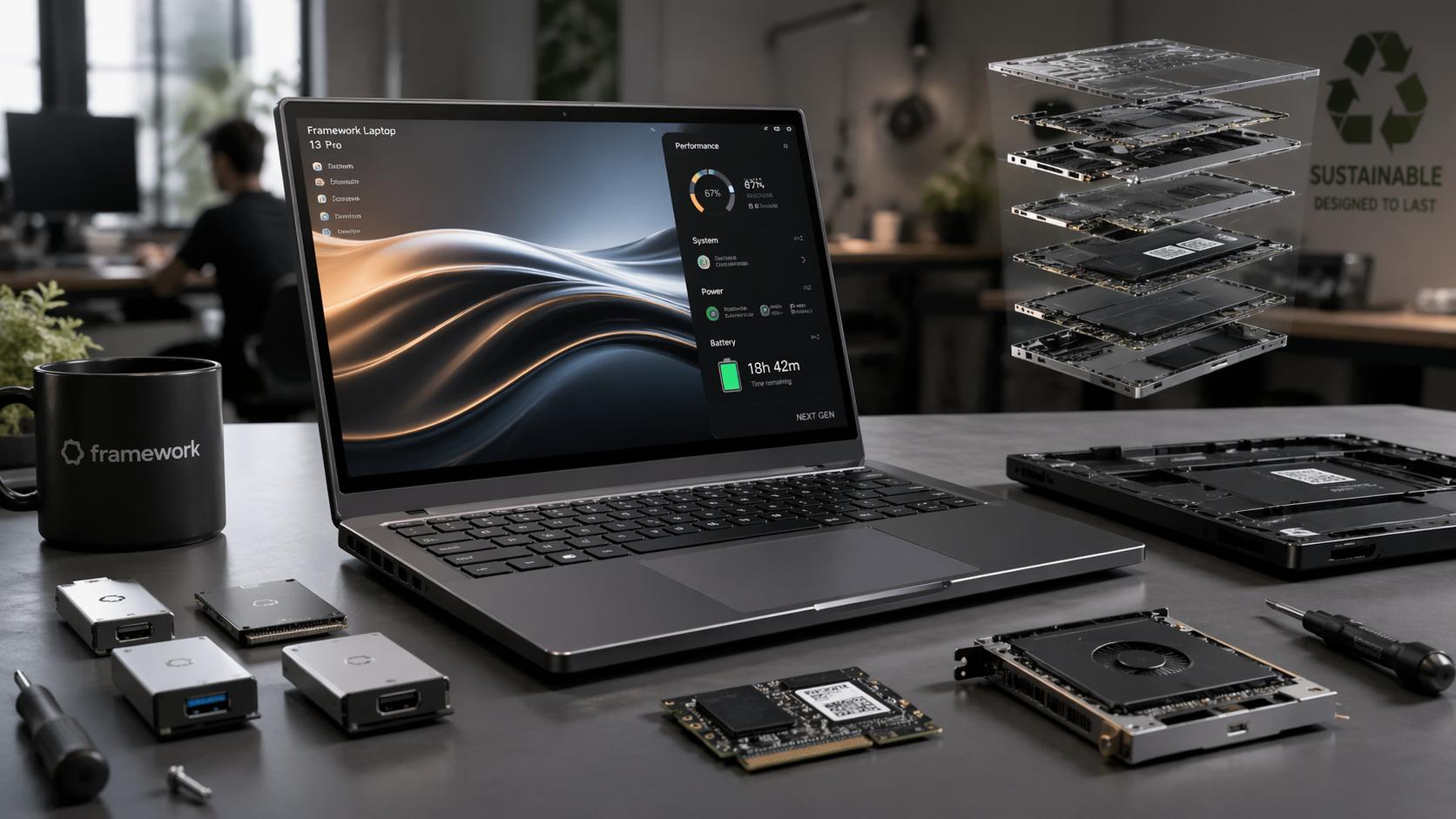
The tech world just witnessed a massive shift this week. Framework Computer held its “Next Gen” event yesterday in San Francisco. Many enthusiasts expected a simple refresh of old hardware. Instead, the company unveiled a complete hardware overhaul. They introduced the Framework Laptop 13 Pro to the public.

This new machine targets professional developers and power users. It feels like a significant departure from their previous iterations. Historically, Framework focused on utility over pure luxury. Now, they seem to be chasing the premium market. They want to compete directly with the MacBook Pro series.
Furthermore, the “Pro” label actually means something here. It is not just a marketing buzzword for faster chips. The company redesigned the laptop from the ground up. This article explores every detail of the recent April 2026 announcements. We will look at hardware, software, and sustainability goals.
A New Standard in Portable Engineering
The Laptop 13 Pro features a fully CNC-machined chassis. Specifically, it uses 6063 aluminum for maximum structural rigidity. This material choice makes the device feel incredibly solid. Many early reviewers noted the lack of keyboard flex. Previous models used a thinner aluminum stamping process.
Consequently, the new unibody feels much more premium in hand. It weighs roughly 1.4kg with all expansion cards installed. Despite the extra strength, it remains very thin. The sleek “Graphite” color option looks professional and stealthy. Alternatively, users can still choose the classic silver finish.
Moreover, Framework improved the internal geometry of the base. This change allows for better cooling and bigger components. You can still open the device with a single tool. Every part remains labeled with easy-to-read QR codes. Repairs remain at the heart of the design philosophy.
The Screen Users Have Demanded
Display quality was often a critique for earlier models. Framework addressed these concerns with a stunning new panel. The Laptop 13 Pro sports a 2.8K touchscreen display. It features a 3:2 aspect ratio for better productivity. Content creators will appreciate the 100% sRGB color gamut.
Additionally, the screen now hits 700 nits of peak brightness. This makes it usable even in direct sunlight. A new matte polarizer helps reduce annoying glare significantly. Furthermore, the refresh rate is now variable. It scales from 30Hz up to 120Hz smoothly.
Instead of rounded corners, the panel uses sharp edges. This maximizes the usable screen real estate for developers. The touch response feels snappy and accurate on Windows 11. Similarly, the panel performs well under Linux environments. It truly feels like a world-class workstation display now.
Power and Efficiency Redefined
Inside the Laptop 13 Pro, Intel’s “Panther Lake” chips debut. These Core Ultra Series 3 processors offer incredible efficiency. Specifically, the Ultra X7 358H model is a powerhouse. It features 16 cores and 16 threads for heavy workloads. The integrated Arc B390 GPU provides impressive graphics performance.
During the event, Framework showed the laptop running Cyberpunk 2077. It maintained nearly 70 frames per second at medium settings. This is remarkable for a laptop without a dedicated GPU. Intel’s new architecture focuses heavily on power-per-watt metrics. Consequently, the laptop runs cooler during daily productivity tasks.
Furthermore, the NPU delivers 50 TOPS for local AI tasks. This allows for fast on-device large language model execution. Users can run AI assistants without needing a cloud connection. Moreover, the efficiency gains translate directly into longer battery life. The “Pro” model aims for the top of the benchmarks.
Breaking the Battery Barrier
Battery life has been a persistent challenge for modular designs. Framework finally solved this issue with a dual-pronged approach. First, they increased the battery capacity to 74.45Wh. This represents a 22% increase over the previous generation. They achieved this by optimizing the internal space usage.
Second, the new processor architecture consumes much less power. Framework claims the laptop achieves over 20 hours of video streaming. Specifically, Netflix 4K streaming lasted longer than a MacBook Pro M5. This is a historic milestone for the x86 laptop market. Users no longer have to sacrifice longevity for repairability.
Moreover, the battery chemistry is now much more dense. It retains 80% capacity even after 1,000 charge cycles. This longevity reduces the need for frequent battery replacements. Consequently, the total cost of ownership drops over time. Framework continues to lead the industry in sustainable power management.
The LPCAMM2 Memory Revolution
Framework is among the first to adopt LPCAMM2 memory. This new standard replaces traditional SO-DIMM slots for LPDDR5X. It uses a high-density compression interposer for signal integrity. This allows for much higher bandwidth in a small footprint. Specifically, the memory runs at speeds up to 7467 MT/s.
Many people worry that LPDDR usually means soldered RAM. However, LPCAMM2 modules are still fully user-replaceable. You only need to remove a few small screws. This maintains the core promise of the Framework ecosystem. It offers the speed of soldered RAM with the flexibility of slots.
Furthermore, this change helps reduce the laptop’s overall thickness. The module sits closer to the motherboard than older sticks. Currently, users can configure up to 64GB of memory. Consequently, large datasets and virtual machines run much more efficiently. It is a win for both performance and modularity.
Comparing the Laptop 13 Models
To understand the progress, we must look at the specs. The following table compares the original 13 and the Pro.
| Feature | Framework Laptop 13 (Original) | Framework Laptop 13 Pro |
|---|---|---|
| Chassis | Stamped Aluminum | CNC Machined 6063 Aluminum |
| Display | 2.2K / 400 Nits / 60Hz | 2.8K / 700 Nits / 120Hz VRR |
| Touch Support | No | Yes (Integrated) |
| Processor | Intel Core Ultra Series 1 | Intel Core Ultra Series 3 |
| Memory | DDR5 SO-DIMM | LPDDR5X LPCAMM2 |
| Battery | 61Wh | 74.45Wh |
| Max Brightness | 400 nits | 700 nits |
| Speaker Type | Standard Stereo | Dolby Atmos Side-Firing |
The Gaming Titan: Framework Laptop 16 Updates
The Laptop 13 Pro was not the only star. Framework also announced major upgrades for the Laptop 16. Gaming enthusiasts can now upgrade to NVIDIA graphics modules. Specifically, the GeForce RTX 5070 Laptop GPU is now available. This module features 8GB of next-generation GDDR7 memory.
Furthermore, the module supports G-Sync for tear-free gaming. It provides 798 AI TOPS for advanced rendering techniques. Users can swap this module in under five minutes. Instead of buying a new laptop, you just swap the back. This makes the Laptop 16 a future-proof gaming investment.
Similarly, Framework updated the CPU options for the 16-inch model. It now supports the AMD Ryzen AI 300 Series. The Ryzen AI 9 HX 370 offers 12 high-performance cores. This combination makes it a monster for video editing. Consequently, the Laptop 16 remains the king of modular performance.
Refining the Input Experience
Input modules received a significant overhaul this year. Framework introduced a “One Piece” Haptic Touchpad for the 16. This module uses four piezoelectric elements for haptic feedback. It eliminates the physical diving-board mechanism of older trackpads. Therefore, you get a consistent click feel across the whole surface.
Additionally, a new One Piece Keyboard is now available. It removes the need for individual spacers on the sides. This creates a much cleaner and more stable typing deck. The black anodized aluminum lattice looks incredibly sleek. However, it is currently only available in the US English layout.
Moreover, Framework previewed the Wireless Touchpad Keyboard. This accessory allows you to use your laptop modules externally. You can snap your keyboard and touchpad into a standalone case. This is perfect for those using their mainboard in a desktop. It extends the life of your inputs beyond the laptop.
The RISC-V Frontier
DeepComputing and Framework shared some exciting news regarding open architecture. They officially launched the DC-ROMA RISC-V Mainboard III. This board uses the SpacemiT K3 RISC-V AI SoC. It features an 8-core CPU running at 2.5GHz. Specifically, it supports the RVA23 profile for modern software stacks.
This board fits perfectly into any Framework Laptop 13 chassis. It targets developers who want to escape the x86/ARM duopoly. The integrated NPU provides 30 TOPS for specialized AI development. Consequently, it is a playground for open-source hardware enthusiasts. Framework is the only major brand supporting this architecture.
Furthermore, the board includes 16GB or 32GB of LPDDR5 memory. It supports Ubuntu 24.10 out of the box for easy setup. Instead of a closed ecosystem, this promotes a truly open future. Early access programs for developers start this month. It is a bold step toward hardware independence.
Expanding the Ecosystem with OCuLink
External graphics support just got a massive official boost. Framework previewed the OCuLink Expansion Card Dev Kit. OCuLink offers much higher bandwidth than traditional Thunderbolt 4. Specifically, it allows for near-native PCIe performance for external GPUs. This is a game-changer for professional workstations.
Instead of losing performance to overhead, users get full speed. The kit is currently in the hands of early testers. Furthermore, it fits into the standard Expansion Card slots. This means even older Framework models can benefit from it. Consequently, the ecosystem continues to grow in unexpected ways.
Moreover, Framework is working on a custom eGPU enclosure. This enclosure will likely house the modular GPU modules. Therefore, you could use your Laptop 16 GPU as a desktop card. This level of cross-compatibility is unprecedented in the industry. It truly embodies the spirit of circular electronics.
Linux is Now First-Class
Framework has always been a favorite for Linux users. Now, they have made that relationship official and certified. The Laptop 13 Pro is their first “Ubuntu Certified” system. This means every hardware component works perfectly out of the box. Users can even buy the laptop with Ubuntu pre-installed.
Additionally, the fingerprint reader now has native libfprint support. No more hacking drivers to get biometric login working. The Wi-Fi 7 modules also feature robust open-source drivers. Furthermore, the firmware remains accessible for community audits. This transparency builds immense trust within the developer community.
Similarly, Framework continues to support Fedora and Mint officially. They provide detailed guides for almost every major distribution. Consequently, the “MacBook for Linux” moniker feels very earned. Instead of fighting the hardware, the hardware supports your workflow. It is a refreshing change for the open-source world.
Audio and Connectivity Upgrades of Framework Laptops
The audio experience on Framework laptops was often criticized. The new CNC chassis allowed for a complete redesign. Framework moved the speakers to the sides of the laptop. This prevents the sound from being muffled on soft surfaces. Consequently, the audio sounds much clearer and louder.
Moreover, they partnered with Dolby for Atmos certification. The Laptop 13 Pro delivers a surprisingly wide soundstage. It is perfect for watching movies or video conferencing. Similarly, the 1080p webcam received a sensor upgrade. The new OmniVision sensor performs much better in low-light rooms.
Connectivity also took a step forward with Wi-Fi 7 support. The new Intel and AMD modules offer blazing fast speeds. Furthermore, the 100W GaN charger is now more compact. It can charge the 74Wh battery to 50% in 30 minutes. Framework handles the small details as well as the big ones.
Framework: Commitment to Sustainability
Sustainability is not just a marketing slogan for Framework. They published their 2026 impact report alongside the hardware. The Laptop 13 Pro uses 75% pre-consumer recycled aluminum. Furthermore, the plastic bezels contain 35% post-consumer recycled content. The packaging remains 100% recyclable and plastic-free.
Instead of throwing away old parts, Framework encourages resale. Their Marketplace now features a robust “Used” section. You can buy refurbished mainboards at a significant discount. Consequently, the carbon footprint of each device is minimized. Framework even offers carbon capture credits at checkout.
Moreover, the company achieved B-Corp status earlier this year. This legally binds them to social and environmental goals. They prioritize longevity over the typical yearly upgrade cycle. By making parts compatible across generations, they reduce e-waste. It is a business model built for the future of the planet.
Pricing and Availability of Framework Laptop 13 Pro
The Framework Laptop 13 Pro is available for pre-order now. The DIY Edition starts at a competitive $1,199 USD. If you want it pre-built, prices start at $1,499 USD. High-end configurations with 64GB RAM can reach $2,499 USD. First shipments are scheduled to begin in June 2026.
Furthermore, the company is expanding its shipping regions. They recently added support for several new Asian markets. However, some regions still face logistics challenges due to battery regulations. Framework is working with local partners to solve these issues. Consequently, more people can join the modular movement every day.
Instead of waiting years for local availability, the company is moving fast. They aim to be available in 30 countries by year-end. This global scale helps bring down the cost of parts. Moreover, it ensures a healthy secondary market for used modules. The community is growing larger and more diverse.
Final Thoughts on the Framework Next Gen Event
The April 2026 event was a turning point. Framework proved they can build a truly premium product. The Laptop 13 Pro is no longer a compromise. It offers better battery life than most mainstream ultrabooks. Furthermore, the screen and chassis finally match the high-end competition.
Consequently, the “Repairability” label is now paired with “Performance.” You don’t have to be a hobbyist to love this laptop. It is a legitimate tool for the most demanding professionals. Framework has successfully navigated the difficult path of scaling a startup. They are now a major player in the PC industry.
Instead of following the industry trend of soldering everything, they led. They showed that modularity can be beautiful and efficient. The future of computing looks much more personal and sustainable. If you want a laptop that lasts a decade, this is it. Framework has finally arrived at the summit of laptop design.

Leave a Reply