
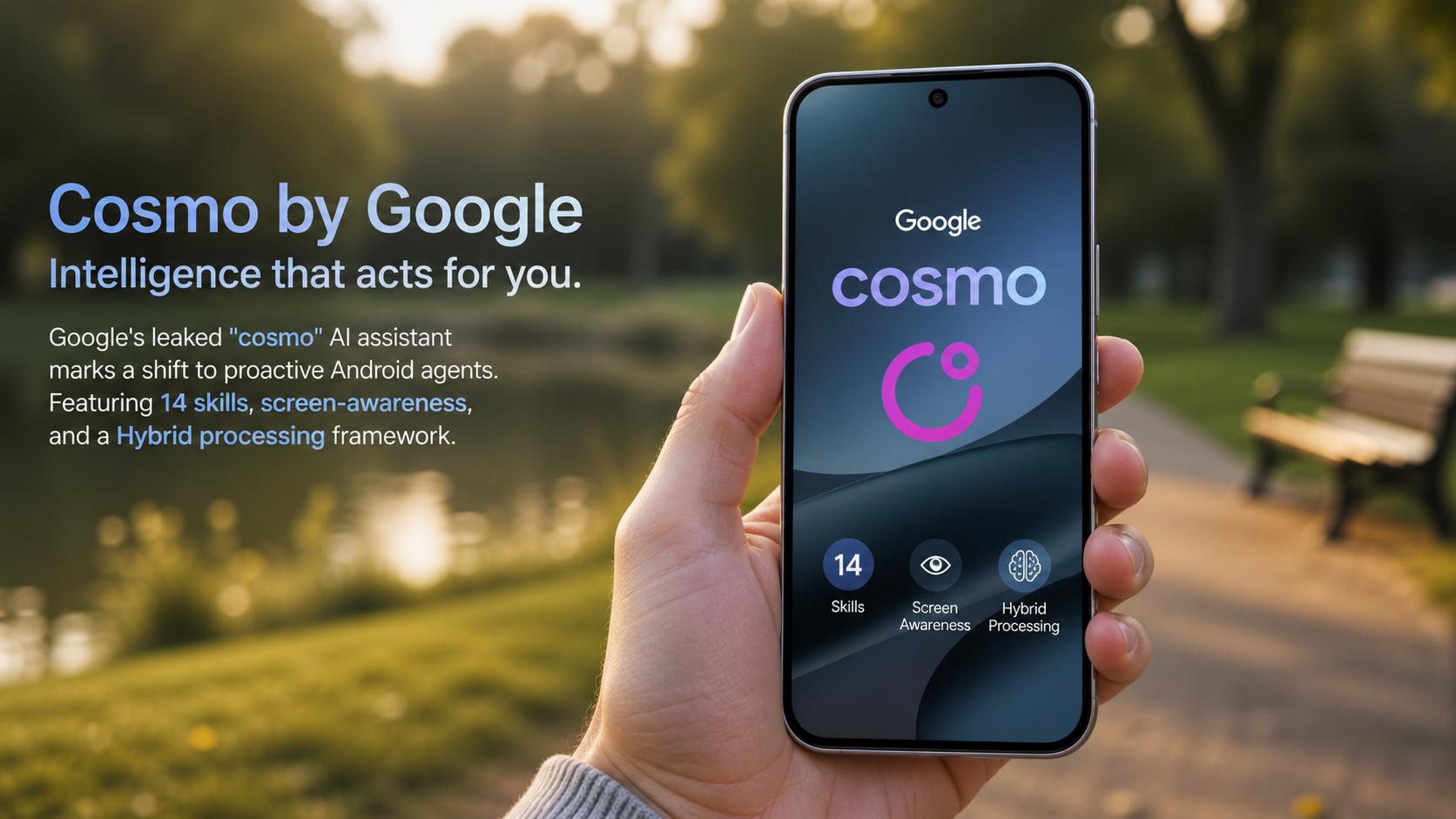
Google Research recently triggered a massive wave of excitement in the tech industry. This event started when a new app appeared on the Play Store. The listing carried the name “Google Cosmo AI Assistant” for only a short time. However, developers and reporters captured the details before it vanished. This release confirms Google is moving toward proactive mobile agents.

The app appears to be an internal testing tool for research teams. Specifically, it acts as a test bed for next-generation Android features. Meanwhile, the timing of the leak suggests a reveal at Google I/O 2026. This tool represents a departure from simple reactive chatbots. Therefore, it signals a deeper integration of AI into the operating system.
The package name for this project is com.google.research.air.cosmo. This naming convention points directly to Google’s experimental AI division. Consequently, the app is likely an incubator for high-level reasoning skills. It brings advanced agency directly to the hardware of the user. This signifies a shift toward persistent and autonomous digital help.
Technical Specifications of the Google Cosmo AI Assistant
The most striking detail of the leaked app was its massive size. The installer required exactly 1.13 GB of storage space on the device. Therefore, analysts knew immediately that it contained significant local model weights. This confirms that the assistant does not rely solely on the cloud. Specifically, it bundles a local version of Gemini Nano.
Local processing allows the assistant to function without a network connection. However, this requires substantial compute power from the mobile chipset. The local model is a distilled version of larger Gemini systems. Meanwhile, the on-device nature of the app ensures maximum user privacy. No data needs to leave the handset for core tasks.
The local core exists in two distinct parameter configurations. Nano-1 uses 1.8 billion parameters for budget-friendly hardware. Conversely, Nano-2 utilizes 3.25 billion parameters for high-end phones. These models use 4-bit quantization to preserve valuable RAM. Thus, the system achieves impressive latency below 100 ms.
System Footprint
Bundled local weights
NPU execution speed
On-Device Model Tiers
Parameter counts across hardware classes
The Hybrid Fulfillment Framework
Google has designed a sophisticated routing system for this new tool. Specifically, the assistant offers three distinct modes for task completion. Users can choose between Hybrid, PI Only, and Nano Only modes. However, the Hybrid mode is the default setting for most tasks. This allows the system to balance speed and intelligence.
The Hybrid mode determines where to process a specific request. Simple tasks remain on the local Gemini Nano model. Meanwhile, complex reasoning queries travel to the "PI" server. This ensures the user gets the best possible answer quality. Consequently, the device manages its battery life more effectively.
This architectural choice addresses the classic constraints of mobile AI. These include network latency, data privacy, and hardware compute costs. Therefore, the assistant can work in low-connectivity areas. It simply switches to local processing when the internet fails. This makes the assistant more reliable than current cloud-only systems.
Hybrid Routing Architecture
Privacy-First
Intelligent Delegation
Deep Reasoning
Defining Personal Intelligence Within the Google Cosmo AI Assistant
The "PI" in the settings menu stands for Personal Intelligence. Specifically, this is a server-side model that understands personal context. It connects data across Gmail, Photos, and Search history. Therefore, the assistant can remember your work, hobbies, and goals. It creates a truly tailored digital experience for each user.
Personal Intelligence solves the "context packing problem" for AI models. It enables Gemini to reason over vast amounts of personal data. However, this is done without compromising the privacy of the user. The system retrieves only the relevant context for each specific prompt. Meanwhile, it leverages advances in dense retrieval and tool use.
The PI model creates a comprehensive understanding of your habits. Specifically, it analyzes patterns across your email and search behaviors. It can anticipate your needs before you even ask. For example, it might suggest travel plans based on a photo. Thus, the assistant feels like a dedicated human helper.
Examining the 14 Proactive Skills
The assistant includes a library of 14 granular proactive skills. These skills fire automatically based on your background activity. Specifically, the agent observes your context and suggests useful actions. However, the user does not need to open a chat. The agent simply surfaces a shortcut when an opportunity arises.
One powerful skill is the List Tracker for organizing tasks. It identifies lists in messages and saves them to Keep. Meanwhile, the Calendar Event Suggester handles scheduling in the background. It recognizes dates and times in your incoming conversations. Therefore, it offers to schedule events with a single tap.
Other skills focus on deep knowledge and research needs. The Deep Research skill can generate multi-source reports automatically. Consequently, it saves users from hours of manual web searching. The Document Writer can even draft letters or summaries. These skills turn the phone into a proactive workstation.
| Skill Name | Functionality | Context |
| List Tracker | Saves task lists to Google Keep | Messages/Notes |
| Calendar Suggester | Proposes events based on chats | Conversations |
| Document Writer | Drafts letters and summaries | Work Mentions |
| Deep Research | Creates multi-source research reports | Complex Queries |
| Browser Agent | Automates tasks in Chrome | Web Navigation |
| Quick Photo Lookup | Finds specific images for sharing | Gallery |
| Jargon Definitions | Explains technical terms in real-time | Reading/Browsing |
Understanding the Google Cosmo AI Assistant Skill Triggers
The skills within the system are not just simple shortcuts. They are intelligent agents that understand the intent of the user. Specifically, they utilize semantic triggers rather than keyword matching. Therefore, the assistant understands the meaning of a conversation. It can tell the difference between a joke and a plan.
These triggers allow the assistant to remain helpful but unobtrusive. It only offers help when it is highly relevant. Meanwhile, users can disable specific skills they do not want. This ensures that the assistant does not become annoying. Notably, the proactive nature is what sets it apart from Gemini.
The system learns from your interactions over time. Consequently, it gets better at predicting which skills you need. For example, it might learn you prefer specific restaurant types. It then prioritizes those suggestions in your search results. This creates a cycle of increasing utility and personalization.
The Role of AccessibilityService and Perception
The assistant achieves its proactive power through the AccessibilityService API. This system interface was originally built for screen readers. However, Google is using it to give the AI "eyes". Specifically, the assistant can see and read every screen. It identifies text and UI elements across all your apps.
This screen perception is the foundation of modern AI agency. It allows the assistant to infer context without app switches. Meanwhile, the agent can "see" a problem and offer a fix. For example, it can see a broken link in a browser. Therefore, it can offer to find a working version.
Using the accessibility API raises serious questions about data security. Specifically, the AI can see sensitive banking or medical information. Google has not yet published a full privacy policy for this. However, the Nano Only mode suggests a way to stay private. This will be a critical factor for enterprise users.
Project Mariner and Web Automation
One of the most advanced skills is the Browser Agent. This skill is powered by DeepMind's Project Mariner. Specifically, Mariner can navigate the web on your behalf. It understands images, code, forms, and other web elements. Therefore, it can carry out complex tasks like shopping.
Mariner operates as a highly capable user in a browser. It can fill forms, book travel, and retrieve information. However, the agent remains under the supervision of the human. If it gets stuck, it asks the user to intervene. This human-in-the-loop design ensures high accuracy and trust.
The browser agent can even learn and repeat custom workflows. Specifically, it can automate your weekly grocery order or job hunt. Meanwhile, it has a high success rate on benchmarks. Project Mariner represents a leap in digital worker capabilities. It turns the web browser into an autonomous tool.
Research and Memory Capabilities of Google Cosmo AI Assistant
The assistant features a powerful "Recall" capability for long-term memory. Specifically, it maintains a history of your conversations and activity. This allows you to ask questions about things you saw earlier. Therefore, it acts as a digital backup for your brain. It conceptually mirrors the Recall feature found in Copilot+ PCs.
Memory is handled locally on the device for privacy. However, it can sync with the Personal Intelligence cloud when permitted. This allows the assistant to maintain context across different hardware. Meanwhile, it can summarize recently ended conversations automatically. This helps you pick up where you left off.
The assistant can also provide context about people and events. Specifically, it understands your relationships and social patterns. It can identify which contacts are involved in upcoming events. Consequently, it helps you manage your professional and personal life. This holistic memory is a core part of the system.
Google Cosmo AI Assistant Comparison to Legacy Assistant Systems
The new tool is significantly different from the old Google Assistant. Legacy systems were largely reactive and relied on voice. Conversely, this new agent is proactive and screen-aware. Specifically, it does not wait for a wake word to help. It lives in the background of the operating system.
Google Assistant was best for simple general knowledge questions. Meanwhile, the new assistant excels at complex task orchestration. It uses large language models for deep reasoning and logic. Therefore, it can handle multi-step workflows that were previously impossible. This marks a paradigm shift in how we use phones.
The transition from the old system has been somewhat confusing. Specifically, users feel that some voice features have regressed. However, the goal is to merge these functions into Gemini. The new agentic framework is the ultimate destination for this journey. It represents the "universal assistant" vision of Google.
Strategy for the Google Cosmo AI Assistant Deployment
Google is positioning this tool as the future of mobile AI. Specifically, the rollout will likely begin at Google I/O 2026. The focus is on "agent-first" workflows and production systems. Therefore, the assistant will be a centerpiece of Android 17. This is no longer just an experimental side project.
The strategy involves a heavy push toward agentic ecosystems. Specifically, Google is investing $750 million in its partners. This fund supports the building of new AI agents. Meanwhile, the assistant acts as the glue for these services. It creates a unified interface for all your digital tasks.
This rollout targets high-end hardware like the Pixel 10. Specifically, these devices have dedicated NPUs for fast local AI. However, Google is also expanding support to other manufacturers. These include Samsung, Xiaomi, Motorola, and others. This broad distribution is critical for market dominance.
Market Impact and Enterprise Adoption
The assistant will have a profound impact on the enterprise world. Specifically, it allows workers to automate routine digital drudgery. This frees up time for higher-value creative work. Therefore, companies are racing to integrate these agents into workflows. Google Cloud is leading this transformation for its clients.
Enterprise-ready agents must follow strict security and governance policies. Specifically, they must ensure data confidentiality and compliance. Google's Secure AI Framework (SAIF) provides the necessary standards. Meanwhile, admins can control who has access to these tools. This makes the assistant safe for business use.
The cost of running these agents is a new challenge. Specifically, non-linear scaling of agents can lead to high costs. However, the efficiency of Gemini 3.1 Pro helps mitigate this. Google is also focusing on performance-per-dollar with new hardware. This makes the agentic era financially viable for firms.
Universal Commerce Protocol and Shopping
Google is transforming retail through the Universal Commerce Protocol (UCP). This open standard allows for agentic shopping experiences. Specifically, the assistant can handle everything from discovery to checkout. Therefore, users can buy things directly within the AI interface. This removes friction from the digital shopping journey.
UCP is co-developed with industry giants like Shopify and Walmart. It establishes a common language for agents and merchants. Meanwhile, it supports secure payments through Google Wallet. This builds trust and reduces cart abandonment for retailers. Consequently, agentic commerce is becoming a reality in 2026.
The protocol works across all commerce categories, including travel. Specifically, it can manage flight bookings and hotel reservations. It even allows for personalized offers based on your loyalty status. Thus, the assistant becomes your personal shopper and travel agent. This represents a massive opportunity for retailers to grow.
Comparing Google Cosmo AI Assistant and Microsoft Recall
Both Google and Microsoft are racing to build AI memory. Specifically, the "Recall" skill in the assistant mirrors Windows Recall. Both tools aim to help you find things you saw. However, they take different technical approaches to privacy. Microsoft captures full-screen snapshots of all your PC activity.
Microsoft Recall faced major security backlash in 2024 and 2025. Specifically, experts found that malware could easily extract sensitive data. Google's approach with the assistant may be more surgical. It uses the accessibility API to recognize text and actions. Meanwhile, it offers a local-only mode for maximum privacy.
The battle for "on-device perception" is a major trend. Specifically, both companies want to give their AI "eyes". This allows the assistant to understand the user's world. However, it creates a "privacy paradox" for the average user. People want helpful agents but fear constant surveillance. This remains a significant hurdle for adoption.
Benchmarking Gemini 3.1 Pro Performance
The server-side models for the assistant show world-class reasoning. Specifically, Gemini 3.1 Pro leads in context and efficiency. It features a massive 2 million token context window. Therefore, it can process entire codebases or long documents easily. This is a different class of capability.
In reasoning benchmarks like GPQA Diamond, it scores 94.3%. This is nearly identical to competitors like GPT-5.4. Meanwhile, it dominates in multi-modal benchmarks like Video-MME. Specifically, it has the largest gap in video understanding. This makes it perfect for a screen-aware assistant.
| Metric | Gemini 3.1 Pro | GPT-5.4 | Claude 4.6 |
| GPQA Diamond | 94.3% | 94.4% | 91.3% |
| ARC-AGI-2 | 77.1% | 73.3% | 68.8% |
| SWE-bench (Coding) | 80.6% | N/A | 80.8% |
| Context Window | 2M tokens | 512K tokens | 1M tokens |
| Video-MME | 78.2% | 71.4% | N/A |
Gemini 3.1 Pro is also much cheaper for tasks. Specifically, it is less than half the cost of competitors. This allows for the hundreds of agent calls required daily. Therefore, it offers the best value for production workloads. This economic edge is a major strategic advantage.
Reasoning Benchmarks
Local vs Cloud Inference Performance
On-device AI currently faces a significant performance gap. Specifically, local Gemini Nano is about 6x slower than cloud APIs. Median inference time for local tasks is 7.7 seconds. Conversely, the server API completes tasks in 1.3 seconds. Therefore, "no network latency" is often outweighed by raw compute.
This speed difference matters for the user experience. However, local models are critical for privacy and offline use. Specifically, they handle simple text summarization and proofreading well. Google is working to improve local NPU performance. This will narrow the gap in the coming years.
The model files themselves are quite large for downloads. Specifically, they are around 1.5 to 2 GB per user. This can take time to download in the background. Meanwhile, hardware requirements are strict for these local features. Devices need at least 2GB of RAM and an AI accelerator. This limits the rollout to newer phones.
Inference Speed Gap
Processing time in seconds (Lower is better)
Investments in the AI Ecosystem
Google is spending heavily to maintain its AI lead. Specifically, it plans to invest up to $40 billion in Anthropic. This is part of a larger $700 billion industry surge. Therefore, Google is securing its supply of talent and chips. This supports the development of the assistant and its models.
The company is also funding a $750 million partner fund. Specifically, this supports the "agentic transformation" of global firms. Major partners like Accenture and Deloitte are already involved. They are building specialized agents using Google's framework. This creates a massive ecosystem around the new assistant.
These investments signal a "pivotal moment" for the industry. Specifically, the future of enterprise AI lies in these rich ecosystems. Google is providing the full stack from infrastructure to models. This makes it the primary platform for the agentic era. This scale is unmatched by any other single vendor.
Enterprise Acceleration
Allocated to integrate Secure AI Framework (SAIF) and build proactive skills for global enterprises.
Future Outlook for Universal Assistants
The leaked assistant is just the beginning of the journey. Specifically, it points toward a future of Artificial General Intelligence. The goal is a universal assistant that manages your life. Therefore, the AI will maintain continuous awareness across all apps. It will integrate with every service beyond the Google ecosystem.
This vision includes proactive suggestions before you even ask. Specifically, it might suggest preparations for a future trip. It could even identify budget risks or health patterns. This makes the assistant a proactive guardian of your well-being. Meanwhile, it maintains a transparent audit trail for trust.
The era of simple prompts is officially over. We are entering the "agent leap" where AI handles workflows. Specifically, digital assembly lines will run entire systems. This represents the defining opportunity for users and firms in 2026. The Google Cosmo AI Assistant is the first step.
Final Verdict on the Google Cosmo AI Assistant
The accidental Play Store leak revealed a groundbreaking shift. This tool is a proactive, screen-aware agent for Android. Specifically, it uses 14 skills to automate your digital life. Therefore, it is far more capable than current chatbots. It represents the future of mobile interaction for everyone.
The assistant combines local privacy with cloud reasoning power. Specifically, the Hybrid mode offers the best of both worlds. Meanwhile, the integration with UCP transforms the world of shopping. This creates a seamless and personal experience for the user. Consequently, the assistant is a powerful new paradigm.
Google is now well-positioned to dominate the agentic market. Specifically, its massive investments and ecosystem are unmatched. The upcoming Google I/O 2026 will likely confirm these details. We are moving from talking to AI to working with AI. This is a transformative moment for the world.
Support Our Work
Help us keep creating and maintaining our projects. We appreciate your support!
How you can help:
Shop via Affiliate LinksSupport us at no extra cost to you while you shop via the link above.



Leave a Reply