
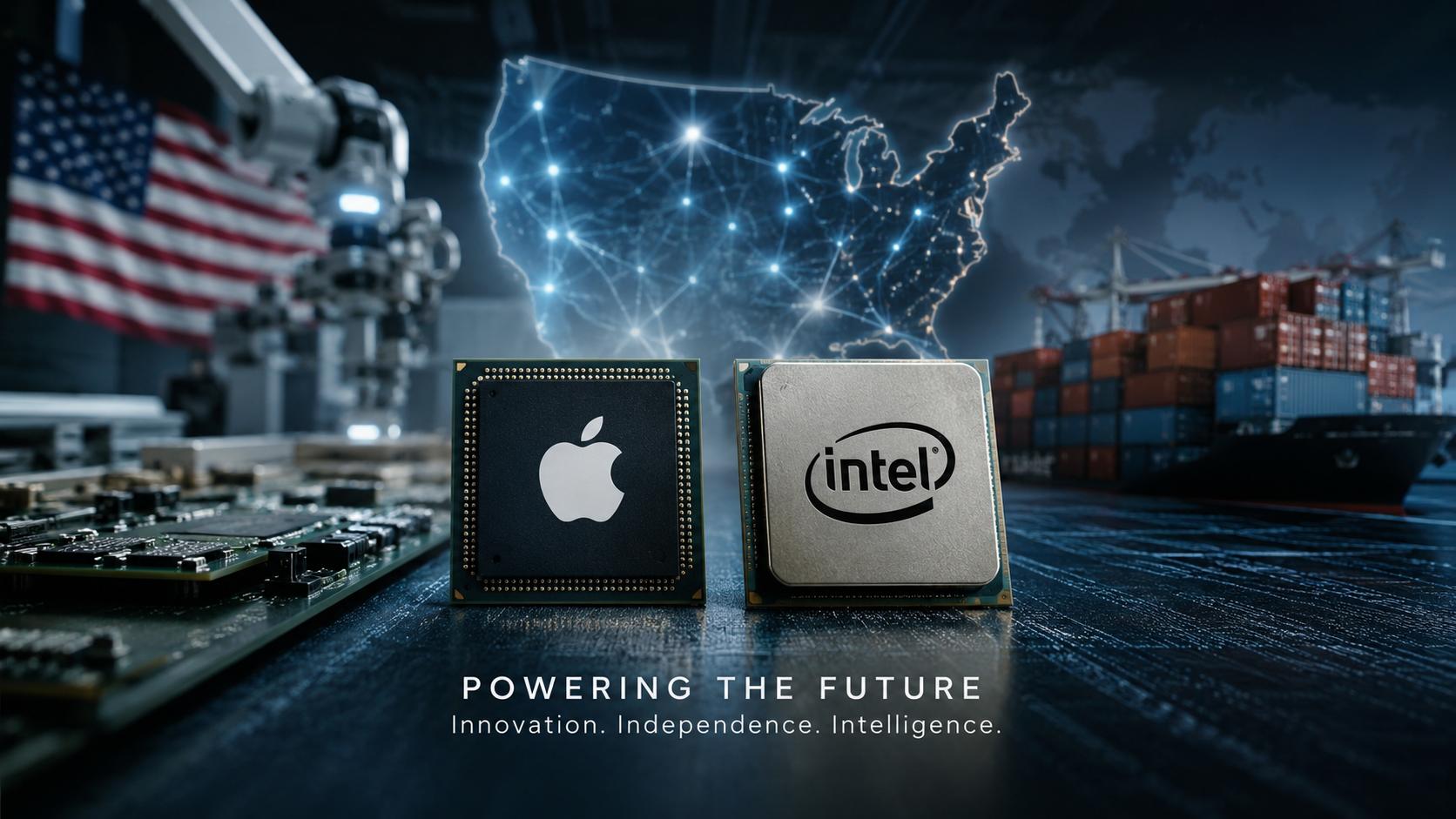
The semiconductor industry witnessed a massive shift on Friday, May 8, 2026. Intel Corporation shares reached historic levels after reports emerged regarding a new partnership. Specifically, the Apple and Intel chip deal sent Intel stock to an all-time high of $118.37. This surge reflects a dramatic transformation for the American chipmaker. Meanwhile, the broader market processed the implications of this monumental manufacturing shift. Consequently, investors now view Intel as a serious contender in the contract foundry space.

The Apple and Intel chip deal marks a pivotal moment for domestic manufacturing. This arrangement allows Apple to diversify its supply chain away from its heavy reliance on Taiwan. However, Apple will continue to design its own custom silicon internally. Intel will act purely as a contract fabricator for these advanced chip designs. Therefore, this partnership represents a manufacturing collaboration rather than a return to Intel-designed processors.
Market Performance Surge
Visualizing Intel’s record-high stock trajectory throughout the May 8, 2026 trading session.
Market Reactions to the Apple and Intel Chip Deal
Wall Street responded to the news with overwhelming optimism for the tech sector. Specifically, Intel shares jumped nearly 14% during afternoon trading on Friday. This rally pushed the market capitalization of the company past $550 billion. Furthermore, the stock has gained over 240% since the start of 2026. Conversely, Apple shares saw a more modest increase of approximately 2%. This suggests that investors see Intel as the primary beneficiary of the deal.
The massive volume of shares traded indicates significant institutional interest in the recovery. Consequently, analysts at several firms have raised their fair value estimates for Intel. Meanwhile, the Nasdaq Composite rose 1.71% due to the strength of these technology stocks. Therefore, the Apple and Intel chip deal acted as a catalyst for the entire market. Similarly, other semiconductor firms saw peripheral gains as the AI cycle broadened.
| Stock Metric | Intel (INTC) Performance | Apple (AAPL) Performance |
| May 8 Price Change | +14% to 19% | +2% |
| 2026 YTD Return | +240% | Record Highs |
| Market Cap | Over $550 Billion | Sector Leader |
| 52-Week Low | $18.96 | Not Applicable |
Summary of key financial and technical milestones achieved following the May 8 partnership announcement.
The Strategic Vision of Lip-Bu Tan
CEO Lip-Bu Tan has successfully revitalized the manufacturing strategy of Intel. Specifically, he took over the company in 2025 during a period of financial distress. He immediately focused on rebuilding the reputation of the foundry division. This strategy involved securing high-profile external clients to fill new domestic factories. Consequently, winning the business of Apple serves as a major validation of his plan.
Furthermore, Tan has reshaped the leadership team by hiring talent from rival companies. He also streamlined the process for external designers to use Intel’s production kits. Meanwhile, his efforts have led to a 7% year-over-year increase in first-quarter revenue. Therefore, his leadership is seen as the primary driver behind the recent turnaround. Similarly, the company has secured multi-billion dollar deals with Microsoft and Amazon under his tenure.
Apple’s Dependence on TSMC and Potential Risks
Apple has relied almost exclusively on Taiwan Semiconductor Manufacturing Company for its advanced chips. However, this single-source strategy has become increasingly risky due to global tensions. Specifically, any conflict in the Taiwan Strait could devastate the product lineup of Apple. Therefore, diversifying production across different geographic locations has become a top priority. Consequently, the Apple and Intel chip deal provides a necessary hedge against geopolitical instability.
Moreover, the surge in AI demand has created massive capacity constraints at TSMC. Rivals like Nvidia and AMD are competing aggressively for the same production lines. This competition limits the ability of Apple to secure the volume it requires. Meanwhile, Apple ships over 200 million iPhones annually, requiring immense manufacturing scale. Therefore, Intel represents a critical alternative to ensure consistent supply.
The Apple and Intel Chip Deal and Supply Chain Resilience
Supply chain resilience is now a matter of national and economic security. Specifically, the Apple and Intel chip deal strengthens the domestic industrial base. This shift allows Apple to manufacture its critical components within the United States. Consequently, the company reduces its exposure to international logistics disruptions. However, TSMC remains the primary partner for the most advanced silicon designs.
Furthermore, having multiple suppliers gives Apple more leverage in price negotiations. The company can now pivot production between different foundries based on yield and cost. Meanwhile, Samsung is also being evaluated as a potential third option in Texas. Therefore, the Apple and Intel chip deal is part of a broader diversification strategy. Similarly, other tech giants are watching this move to determine their own reshoring plans.
| Strategic Goal | Detail | Impact |
| Risk Mitigation | Geographic diversification from Taiwan | Reduced geopolitical vulnerability |
| Capacity Security | Accessing Intel’s US-based fabs | Hedge against AI-driven shortages |
| Cost Control | Secondary sourcing leverage | Improved bargaining power |
| Domestic Support | Alignment with US government policy | Enhanced reputation in Washington |
Technical Innovations in the 18A Process Node
Intel is currently ramping up its cutting-edge 18A manufacturing process. Specifically, this node represents the first use of RibbonFET and PowerVia technologies. RibbonFET is a new implementation of gate-all-around transistors for better current control. Consequently, this design reduces leakage and improves overall performance-per-watt. Meanwhile, PowerVia introduces the first functional backside power delivery system in the industry.
Furthermore, moving power circuitry to the back of the wafer eliminates wiring congestion. This allows for a 5% to 10% increase in logic density for complex chips. Therefore, Intel claims a technical lead over competitors who lack this capability. However, achieving high yields remains the most significant challenge for the company. Similarly, the success of the Apple and Intel chip deal depends on this technology maturing.
Exploring the Performance Gains of 18A-P Technology
The Apple and Intel chip deal reportedly focuses on the enhanced 18A-P node. Specifically, this performance-tuned variant offers significant upgrades over the baseline 18A. Intel confirmed that 18A-P delivers a 9% performance gain at the same power level. Alternatively, it can achieve 18% power savings at the same performance. Consequently, these metrics are highly attractive for mobile devices like the iPhone.
Moreover, the 18A-P node introduces tighter process variability control for better consistency. Specifically, it features 30% tighter skew corners to improve parametric yields. This makes the performance of individual chips more predictable for designers. Meanwhile, the node adds extra threshold voltage options for more precise binning. Therefore, the Apple and Intel chip deal utilizes a highly optimized manufacturing platform.
Technical Framework: 18A-P
| Innovation | Metric | User Value |
|---|---|---|
| RibbonFET | GAA Transistors | Eliminates current leakage for cooler performance. |
| PowerVia | -30% Droop | Optimized power delivery to silicon logic cores. |
| Heat Flux | +50% Thermal | Prevents CPU throttling during sustained loads. |
Detailed specifications of the 18A-P node utilized in the strategic Apple chip deal.
Apple and Intel Chip Deal: Thermal Improvements and Efficient Power Delivery
Managing heat is a critical concern for modern high-performance semiconductors. Specifically, Intel has improved thermal conductivity by 50% in the 18A-P node. This enhancement helps transfer heat more efficiently away from the transistor layer. Consequently, chips can maintain peak performance for longer durations without throttling. However, this improvement does not necessarily mean the chips will run cool.
Furthermore, reduced thermal resistance is a major benefit for thin devices like tablets. Meanwhile, the PowerVia system reduces voltage droop by as much as 30%. This leads to more stable power delivery across the entire silicon surface. Therefore, the Apple and Intel chip deal leverages several architectural breakthroughs. Similarly, these features provide a meaningful advantage over older FinFET designs.
| Technical Feature | 18A-P Improvement | User Benefit |
| Performance Gain | +9% at same power | Faster processing in apps |
| Power Efficiency | -18% at same speed | Longer battery life |
| Thermal Conductivity | +50% Better | Sustained peak performance |
| Variability Control | 30% Tighter Skew | More consistent chip behavior |
The High-NA EUV Gamble for 14A Production
Intel is looking toward the future with its upcoming 14A node. Specifically, this 1.4nm-class technology will be the first to use High-NA EUV tools. These machines from ASML cost roughly $400 million per unit. Consequently, Intel is taking a significant financial risk to lead in lithography. However, the 14A process promises up to 20% better performance-per-watt than 18A.
Furthermore, the 14A node features RibbonFET 2 and PowerDirect technologies. These innovations aim to optimize critical timing paths for even higher frequencies. Meanwhile, mass production is expected to begin in 2027 for major customers. Therefore, the Apple and Intel chip deal could eventually transition to this advanced node. Similarly, the high cost of 14A requires large orders from clients like Apple to break even.
Apple and Intel Chip Deal: A Shift in Manufacturing
The preliminary agreement signifies a new era of cooperation between old rivals. Specifically, the companies spent more than a year negotiating this arrangement. Neither side has officially confirmed the specific chips involved in the deal. However, analysts believe lower-end M-series chips are the primary candidates. Consequently, this allows Apple to test the relationship with secondary products.
Moreover, this shift supports the broader goal of American semiconductor independence. Intel will provide a reliable domestic footprint for the most critical technology of Apple. Meanwhile, the government continues to provide grants and support to facilitate these partnerships. Therefore, the Apple and Intel chip deal is a cornerstone of the new industrial policy. Similarly, it marks a return to manufacturing excellence for the United States.
Geopolitical Factors Influencing the Trump Administration
The Trump administration has been a vocal advocate for the domestic chip industry. Specifically, President Trump personally lobbied Apple to work with Intel. He believes that manufacturing critical tech at home is vital for national security. Consequently, the government has used its influence to bring tech giants to the table. However, this intervention has drawn mixed reactions from some market purists.
Furthermore, the administration has implemented tariffs to protect the local industrial base. These policies make overseas manufacturing more expensive and less attractive. Meanwhile, the Department of Commerce is actively investigating various sectors to reshore capacity. Therefore, the Apple and Intel chip deal is a direct result of these political pressures. Similarly, the government aims to create a self-sufficient semiconductor ecosystem in America.
The Government’s Financial Stake in Intel Corporation
The US government took an unprecedented step by acquiring an equity stake in Intel. Specifically, it purchased roughly 10% of the company for $8.9 billion last year. This stake was funded through the CHIPS and Science Act. Consequently, the government now has a direct interest in the stock performance of Intel. Meanwhile, the value of this position has surged past $50 billion recently.
This financial involvement has provided the capital necessary for massive fab expansion. It also signals to other companies that Intel is “too important to fail”. Therefore, the government is acting as both a regulator and a strategic investor. However, this dual role requires careful management to avoid conflicts of interest. Similarly, the administration expects this investment to yield massive long-term returns for taxpayers.
| Investment Data | US Government Stake in Intel |
| Purchase Price per Share | $20.47 |
| Total Initial Investment | $8.9 Billion |
| Current Estimated Value | Over $50 Billion |
| Ownership Percentage | 9.9% Equity |
| Funding Source | CHIPS and Science Act |
Howard Lutnick and the Drive for Reshoring
Commerce Secretary Howard Lutnick has been central to the new semiconductor policy. Specifically, he has met repeatedly with CEOs like Tim Cook and Jensen Huang. His goal is to secure trillions of dollars in domestic investment commitments. Consequently, he views the Apple and Intel chip deal as a major success for his department. Meanwhile, he is also pushing for a broader industrial revival beyond just chips.
Furthermore, Lutnick has streamlined the Department of Commerce to act more efficiently. He cut staff and terminated non-critical contracts to free up resources. Therefore, his leadership reflects the aggressive “America First” economic strategy. However, some critics worry about the sustainability of such large government-led deals. Similarly, he continues to promote the “Trump Gold Card” program for international investors.
MacBook Neo: Redefining the Entry-Level Laptop Market
Apple launched the MacBook Neo in early 2026 to target the mainstream market. Specifically, the device features a 13-inch Liquid Retina display and a $599 starting price. It is designed to compete directly with budget Windows laptops and Chromebooks. Consequently, the laptop has been a massive commercial success for the company. Meanwhile, it serves as the primary gateway for students and first-time Mac buyers.
The MacBook Neo is powered by the A18 Pro chip, which provides all-day battery life. It also supports modern features like Apple Intelligence for on-device AI tasks. Therefore, the performance of the device is significantly higher than its competitors. However, the base model lacks a backlit keyboard and Touch ID. Similarly, the fanless design ensures that the laptop runs completely silent during use.
A18 Pro Specifications and the Move to 3nm
The A18 Pro chip inside the MacBook Neo is built on a 3nm process. Specifically, it features a 6-core CPU with two performance and four efficiency cores. The integrated 5-core GPU supports hardware-accelerated ray tracing for gaming. Consequently, the chip delivers sharp graphics and efficient multitasking for daily workloads. Meanwhile, the 16-core Neural Engine enables fast processing for AI tools.
Apple currently uses TSMC’s N3E technology for the production of these chips. However, the ongoing shortage of 3nm capacity has led to price increases. Therefore, finding a secondary source for the A18 Pro or its successor is essential. Consequently, the Apple and Intel chip deal could eventually cover these entry-level processors. Similarly, the A18 Pro provides a solid baseline for comparing future Intel-produced silicon.
| Component | MacBook Neo (A18 Pro) Specs |
| CPU Cores | 6 (2 Perf / 4 Efficiency) |
| GPU Cores | 5 (Ray Tracing Support) |
| Neural Engine | 16-core |
| Memory | 8GB Unified |
| Manufacturing Node | 3nm (TSMC N3E) |
| Starting Price | $599 / $699 |
Understanding the A21 Chip and Future Production
The A21 chip is rumored to be the next major project for Apple silicon. Specifically, this processor could power the next generation of iPhones and MacBook Neo models. Sources suggest that Apple is evaluating Intel’s 18A-P node for the A21. Consequently, this would mark the first flagship processor manufactured by Intel for Apple. Meanwhile, the Pro models of the iPhone might continue using TSMC’s 2nm process.
This “split-foundry” strategy allows Apple to manage supply more flexibly. Specifically, the company can use Intel for high-volume, mainstream chips while keeping TSMC for cutting-edge tiers. Therefore, the A21 represents a critical test for the foundry capabilities of Intel. However, official confirmation of the A21 node remains unavailable to the public. Similarly, the success of the A21 would solidify the long-term Apple and Intel chip deal.
The Apple and Intel Chip Deal in Consumer Electronics
The broader consumer electronics industry is watching the Apple and Intel chip deal closely. Specifically, this partnership could set a precedent for other major tech firms. If Apple proves that domestic manufacturing is viable, firms like Nvidia and AMD may follow. Consequently, the deal could trigger a wave of reshoring across the entire sector. Meanwhile, consumers may benefit from more stable product availability.
Moreover, the deal strengthens the overall semiconductor ecosystem in the United States. It attracts global suppliers and talent to new manufacturing hubs in Arizona. Therefore, the regional impact of the Apple and Intel chip deal is immense. However, the higher cost of domestic production could lead to slightly higher retail prices. Similarly, the move aligns with a growing consumer preference for “Made in USA” products.
Intel Foundry vs TSMC: The Yield Competition
Yield is the most important metric for any chip manufacturing partnership. Specifically, it measures the percentage of functional chips produced on each silicon wafer. TSMC is known for its legendary yield consistency, often reaching over 70% at launch. However, Intel has struggled with yields on its advanced nodes in the past. Consequently, improving the 18A yields to commercial levels is the top priority for Tan.
Recent reports suggest that 18A yields have improved to over 60%. This is reportedly “good enough” to begin ramping production for some client chips. Meanwhile, Intel is targeting an 8% yield improvement per month to close the gap with TSMC. Therefore, the success of the Apple and Intel chip deal depends on this trajectory. Similarly, any stall in yield progress could put the preliminary agreement at risk.
| Foundry Benchmark | Reported Yields (2026) | Target Status |
| TSMC (N2 Node) | 70% – 80% | Industry Benchmark |
| Intel (18A Node) | 60% – 65% | Improving / Good Enough |
| Samsung (SF2 Node) | Less than 40% | Struggling |
| Intel Improvement Rate | 7% – 8% Per Month | Aggressive Ramp |
Benchmarking Performance: 18A vs N2 vs SF2
Technical analysts have begun comparing the upcoming 2nm-class process nodes. Specifically, Intel 18A is expected to lead in performance efficiency. Research from TechInsights gives 18A a performance score of 2.53. Conversely, TSMC N2 follows with a score of 2.27, and Samsung SF2 trails at 2.19. Consequently, Intel is currently “setting the pace” for power-efficient computing.
However, performance is not the only factor for large clients like Apple. Density and cost remain critical considerations for high-volume consumer products. TSMC is expected to maintain a lead in transistor density for its N2 node. Meanwhile, Samsung remains a “value contender” for less demanding components. Therefore, the Apple and Intel chip deal leverages the specific performance advantages of the 18A-P node.
Foundry Yield Benchmarks (%)
Current manufacturing yield rates for next-generation 2nm-class nodes as of Q2 2026.
Transistor Density and the Logic Capacity Gap
Transistor density measures how many electronic switches can fit in a square millimeter. Specifically, TSMC N2 is projected to reach 313 million transistors per square millimeter (MTr/mm^2). Intel 18A currently trails with a density of roughly 238 MTr/mm^2. Consequently, TSMC remains the leader for designs requiring the absolute smallest footprint. However, the architectural lead of Intel in backside power delivery helps close this gap.
Furthermore, raw density does not always translate to better real-world system performance. Intel’s PowerVia technology allows for more efficient layout and component utilization. This compensates for having fewer transistors per millimeter by making each one more effective. Meanwhile, Apple is carefully evaluating how this density gap affects their proprietary designs. Therefore, the Apple and Intel chip deal is a balance between raw capacity and architectural innovation.
The Role of RibbonFET in Next-Gen Design
RibbonFET represents the most significant change in transistor design in over a decade. Specifically, it replaces the FinFET architecture that has been used since 2011. In RibbonFET, the gate wraps around the channel on all four sides. Consequently, this provides superior electrostatic control and minimizes current leakage. This architectural shift is essential for scaling below the 2nm threshold.
Intel is ramping volume production of RibbonFET chips at its Fab 52 in Arizona. TSMC and Samsung are also adopting similar gate-all-around technologies for their next nodes. However, Intel claims to have reached commercial-grade maturity earlier than its rivals. Therefore, the Apple and Intel chip deal is built on this new foundation of silicon design. Similarly, RibbonFET allows Apple to push the performance limits of its future silicon.
| Feature | FinFET (Old) | RibbonFET (New) |
| Gate Structure | Wraps 3 sides of fin | Wraps all 4 sides of channel |
| Current Leakage | Higher at small scales | Significantly lower |
| Control | Standard | Superior Electrostatic |
| Scaling Potential | Limited below 5nm | Ideal for 2nm and below |
PowerVia and the Revolution of Backside Power
PowerVia is the “secret sauce” for the manufacturing comeback of Intel. Specifically, it decouples the power delivery network from the signal routing layer. Traditionally, both shared the same side of the wafer, causing significant interference. By moving power to the back, Intel has eliminated this “wiring congestion”. Consequently, this architectural leap provides a temporary advantage over TSMC’s N2 node.
Furthermore, PowerVia reduces “IR drop,” which is the loss of voltage due to resistance. This leads to a 30% reduction in voltage droop during peak operation. Meanwhile, it frees up the front side of the chip purely for high-speed signal routing. Therefore, the Apple and Intel chip deal benefits from a more efficient silicon layout. Similarly, this technology is critical for the heat-constrained environments of mobile hardware.
Advanced Packaging: The Rise of EMIB and Foveros
Advanced packaging is the shift from chip-level logic to system-level logic. Specifically, technologies like EMIB and Foveros allow multiple chiplets to be integrated into one package. EMIB facilitates high-speed horizontal connections between adjacent dies. Conversely, Foveros enables vertical 3D stacking of processors atop one another. Consequently, Intel can integrate diverse components with near-zero performance loss.
Intel has raised its advanced packaging revenue outlook to over $1 billion recently. Apple is reportedly evaluating these technologies for its high-end M-series chips. Meanwhile, Google and Amazon have already placed orders for EMIB-based AI accelerators. Therefore, the Apple and Intel chip deal could involve these integration services. Similarly, this modular approach overcomes the physical size limits of traditional single-chip designs.
Analyzing the Apple and Intel Chip Deal Revenue
The financial impact of the Apple and Intel chip deal will be realized over several years. Specifically, analysts estimate that Apple’s validation is worth more than the direct revenue. A preliminary deal for low-end chips could generate $1 billion to $2 billion annually. Consequently, this helps fill idle capacity and spread high fixed costs. However, if Apple moves more volume, the revenue could grow significantly.
Intel CFO David Zinsner confirmed that the company is closing multiple deals worth billions. Therefore, the foundry business is on track to reach a break-even point by 2027. Meanwhile, the Apple and Intel chip deal acts as a “trust vote” for other potential clients. Similarly, this steady stream of demand will improve the unit economics of new factories.
| Potential Revenue Stream | Estimated Value ($B/yr) | Status |
| Apple (Low-end M-series) | $1 – $2 Billion | Preliminary Deal |
| Microsoft (Azure AI) | $1 – $2 Billion | Confirmed |
| Amazon (Custom ASICs) | $1 – $2 Billion | Reported |
| Nvidia (Gaming GPUs) | $1 – $2 Billion | Evaluated |
| Advanced Packaging | Over $1 Billion | Growing Demand |
Nvidia and AMD Responses on the Apple and Intel Chip Deal
Nvidia and AMD are also feeling the pressure from TSMC capacity shortages. Specifically, Nvidia has already invested $5 billion in Intel to develop data center CPUs. This shift suggests that even the biggest rivals of Intel are becoming its customers. Consequently, the Apple and Intel chip deal confirms a broader industry trend toward foundry diversification. Meanwhile, AMD CEO Lisa Su has stated she is “open” to using Intel Foundry.
Furthermore, this competition forces TSMC to accelerate its own expansion in the United States. It also puts pressure on Samsung to improve its yield rates in Texas. Therefore, the Apple and Intel chip deal has reshaped the competitive landscape for everyone. However, most firms still maintain a multi-foundry strategy to minimize risk. Similarly, the presence of three viable players benefits the entire semiconductor ecosystem.
Google and Amazon: The Early Foundry Adopters
Google and Amazon were among the first hyperscalers to embrace the foundry push of Intel. Specifically, Amazon Web Services signed a deal to build custom AI fabric chips on 18A. Google has expressed interest in using EMIB packaging for its TPU accelerators. Consequently, these early wins paved the way for the Apple and Intel chip deal. Meanwhile, these firms are seeking specialized chips to run their proprietary AI models.
Moreover, these partnerships help Intel refine its customer service model for fabless firms. Dealing with large cloud providers requires consistent delivery and high volume. Therefore, Intel is gaining the experience necessary to handle the massive requirements of Apple. However, each of these clients has unique technical needs that Intel must meet. Similarly, the combined demand from Google, Amazon, and Apple will fully load the new fabs.
Tesla and SpaceX: Partnerships with Intel Foundry
Elon Musk has recently become a major supporter of the manufacturing turnaround of Intel. Specifically, his companies are partnering with Intel for the “TeraFab” project. Tesla will reportedly use the 14A process technology for its future AI and robotics chips. Consequently, Musk’s public endorsement adds significant credibility to the foundry division. Meanwhile, he recently toured the state-of-the-art Oregon fab to see production firsthand.
This partnership aligns with the broader goal of building an end-to-end AI infrastructure. Tesla needs high-performance silicon for its Full Self-Driving and Optimus robot projects. Therefore, the Apple and Intel chip deal is just one part of a growing roster of believers. However, the Tesla partnership involves “unconventional” ways to improve manufacturing. Similarly, this deal highlights the strategic importance of domestic chip production for all US tech firms.
Supply Chain Security of the Apple and Intel Chip Deal
The risk of a conflict in the Taiwan Strait is a primary driver for reshoring. Specifically, a “Day X” scenario could wipe out the global semiconductor supply overnight. Apple is acutely aware that 60% of its production flows through a single geographic point. Consequently, the Apple and Intel chip deal is a “Plan B” to ensure long-term survival. Meanwhile, the US government is providing “silicon sovereignty” through the CHIPS Act.
Moreover, supply chain security is now tied to national defense capabilities. Semiconductors power everything from smartphones to advanced missile systems. Therefore, the Apple and Intel chip deal supports both commercial and military interests. However, moving high-volume production stateside will take several more years to complete. Similarly, the goal is to create a resilient network of factories that can withstand global shocks.
The Apple and Intel Chip Deal and National Security
National security concerns have reshaped the semiconductor landscape under current policy. Specifically, the Bureau of Industry and Security enforces strict export controls on advanced chips. The government wants to ensure that the “best chips” are manufactured and controlled domestically. Consequently, the Apple and Intel chip deal is viewed as a victory for secure manufacturing. Meanwhile, Intel already has a $3 billion deal to build products for the US military.
Furthermore, the domestic production of Apple silicon reduces the risk of malicious hardware tampering. Secure supply chains are essential for protecting the data of millions of American citizens. Therefore, the Apple and Intel chip deal aligns with the goals of the Department of Defense. However, verifying these high standards requires intensive collaboration between the government and private firms. Similarly, the partnership helps preserve American technical leadership against foreign adversaries.
Financial Strength and Intel’s Quarterly Growth
Intel has demonstrated significant financial improvement in its recent reports. Specifically, data center and AI revenue rose 22% to over $5 billion in the first quarter. This performance beat Wall Street expectations by a substantial margin. Consequently, investors have embraced the narrative of a successful turnaround. Meanwhile, the company projected revenue as high as $14.8 billion for the second quarter.
Moreover, the adjusted earnings per share of $0.29 was well ahead of the consensus of $0.01. These results show that the core products of Intel are also regaining market share. Therefore, the Apple and Intel chip deal lands on a foundation of improving fundamentals. However, heavy capital commitments for new fabs remain a significant expense. Similarly, the company must maintain this momentum to fund its ambitious 14A roadmap.
| Financial Item | Q1 2026 Results | Growth / Expectation |
| Total Revenue | $13.6 Billion | +7% YoY |
| Data Center/AI Revenue | $5.05 Billion | +22% YoY |
| Adjusted EPS | $0.29 | Beat $0.01 Consensus |
| Gross Margin (non-GAAP) | 41% | Above Guidance |
| Q2 Revenue Guidance | Up to $14.8 Billion | Strong Outlook |
Analyzing Intel Stock Valuation and Future Potential of the Apple and Intel Chip Deal
Intel stock is currently trading at record highs, yet valuation concerns exist. Specifically, GuruFocus notes that the stock may be “significantly overvalued” based on intrinsic value. The current price of over $120 is much higher than historical historical medians. Consequently, new investors should be aware of the low margin of safety. However, the stock’s momentum score remains high at 9 out of 10.
Furthermore, recent analyst price targets have been raised to as high as $150. This suggests that many on Wall Street believe the rally has further to run. Therefore, the Apple and Intel chip deal has fundamentally changed the long-term earnings potential of the company. Meanwhile, insiders have sold $4 million in shares recently, which could indicate a short-term peak. Similarly, the volatility of semiconductor stocks remains a factor for retail portfolios.
The End of the x86 Era and ARM’s Dominance
The Apple and Intel chip deal occurs as the industry shifts toward ARM architecture. Specifically, Apple moved away from Intel x86 chips in 2020 to its own ARM-based silicon. This move offered considerable cost savings and performance gains. Consequently, Intel was forced to rethink its business model as a chip designer. Meanwhile, ARM architecture has proven it can compete effectively in the high-performance market.
Now, Intel is embracing this change by manufacturing ARM-based chips for Apple. This represents a “if you can’t beat them, join them” strategy. Therefore, the foundry division is agnostic to the underlying processor architecture. However, x86 remains dominant in the server and gaming markets for now. Similarly, the Apple and Intel chip deal shows that manufacturing is the new battleground for supremacy.
Silicon Sovereignty: The Global Race for Control
Countries worldwide are prioritizing semiconductor independence through industrial policy. Specifically, the United States, Japan, and the European Union are all subsidizing domestic fabs. This global race is known as “silicon sovereignty”. Consequently, the Apple and Intel chip deal is a landmark achievement for the US in this race. Meanwhile, China is also pushing for 70% homegrown silicon use by 2026.
Moreover, the control of advanced nodes determines who leads in AI and future tech. The “Angstrom Era” transition is a pivotal moment for this global competition. Therefore, the Apple and Intel chip deal strengthens the technological sovereignty of the United States. However, achieving full independence is difficult due to the interconnected nature of the supply chain. Similarly, the presence of multiple US-based fabs provides a vital strategic buffer.
Implications of the Apple and Intel Chip Deal
The long-term implications of the Apple and Intel chip deal are profoundly positive for Intel. Specifically, it removes the objection that “Intel doesn’t know how to be a foundry”. This validation is expected to convert the rest of the foundry pipeline faster. Consequently, Intel could become the second-largest contract manufacturer in the world. Meanwhile, Apple gains a level of supply security that its rivals may lack.
Furthermore, the deal supports the goal of the US government to lead in advanced manufacturing. It creates thousands of high-tech jobs and drives local economic growth. Therefore, the Apple and Intel chip deal is a win-win-win for the company, the client, and the country. However, the success of the arrangement requires multi-year consistency in execution. Similarly, it marks the definitive end of the “dark era” for Intel Corporation.
Apple’s Negotiating Leverage in the Foundry Market
Having Intel as a viable partner significantly increases the leverage of Apple over TSMC. Specifically, Apple can now threaten to move more production if TSMC raises prices too aggressively. This competitive tension keeps wafer costs down for the consumer tech giant. Consequently, the Apple and Intel chip deal pays for itself through lower overall supply chain costs. Meanwhile, TSMC must work harder to retain its “anchor” customer.
Moreover, Apple can play different foundries against each other for better technical terms. The company might request exclusive access to certain nodes or packaging lines. Therefore, the strategic value of the deal exceeds the simple cost of manufacturing. However, Apple must be careful not to damage its long-standing relationship with TSMC. Similarly, the company will likely maintain a balance of power between all its manufacturing partners.
Samsung Foundry’s Strategy in Texas and Beyond
Samsung Foundry remains a major player in the global diversification race. Specifically, it is building a massive $20 billion fab in Taylor, Texas. Apple executives have visited this facility to discuss potential foundry cooperation. Consequently, Samsung could become a third source for the chips of Apple. Meanwhile, Samsung is already working on supplying peripheral components like image sensors.
However, Samsung has faced significant challenges with yield consistency on its 3nm nodes. Recent reports suggest its SF2 yields are currently less than 40%. Therefore, Intel has a temporary advantage over its Korean rival in the US market. Nevertheless, Samsung continues to undercut TSMC on wafer pricing to win new business. Similarly, the presence of Samsung in Texas provides another option for the domestic strategy of Apple.
Improving Production Reliability
Production reliability is the foundation of any foundry contract. Specifically, Intel must prove that its 18A process can deliver millions of chips without failure. The company is using “skew corner tightening” to reduce variations across each wafer. This technical refinement makes the manufacturing process more predictable and reliable. Consequently, it reduces the waste and cost of individual silicon units.
Furthermore, Intel is conducting “Test Chip verification” with clients like Apple to ensure compatibility. These tests help identify potential design flaws before mass production begins. Therefore, the Apple and Intel chip deal involves a rigorous multi-stage validation process. Meanwhile, the company expects its 14A node to yield even better results than 18A. Similarly, consistent yield improvements are necessary to hit the 2027 shipping commitments.
The Apple and Intel Chip Deal and AI Innovation
The Apple and Intel chip deal is deeply intertwined with the future of on-device AI. Specifically, Apple Intelligence requires highly efficient silicon to run large language models locally. The performance-per-watt of the 18A-P node is ideal for these AI workloads. Consequently, this partnership helps Apple stay competitive in the rapidly evolving AI race. Meanwhile, Intel’s advanced packaging allows for the integration of specialized AI accelerators.
Moreover, the deal ensures that Apple has the silicon capacity to scale its AI services. As more apps integrate AI, the demand for Neural Engine processing will grow exponentially. Therefore, the Apple and Intel chip deal is a strategic investment in the future of computing. However, the software layer must also be optimized for this new hardware. Similarly, the entire industry is moving toward a model where every device is an AI-powered workstation.
Long-term Strategic Outlook for the Silicon Industry
The long-term outlook for the silicon industry is one of intense geographic and technical competition. Specifically, the “Angstrom Era” will redefine who leads in semiconductor technology. Intel is aggressively pursuing a “5 Nodes in 4 Years” strategy to reclaim the crown. Consequently, the Apple and Intel chip deal is the most significant milestone of this strategy so far. Meanwhile, the rise of domestic manufacturing will rebalance the global power structure.
Furthermore, the industry is moving toward “system-level” logic through chiplet architectures. This allows companies to mix and match the best components from different manufacturers. Therefore, the traditional boundaries between foundries and designers are blurring. However, the massive capital costs of new fabs will likely limit the market to just a few major players. Similarly, the Apple and Intel chip deal serves as a blueprint for the next decade of tech collaboration.
Final Conclusions on the Apple and Intel Chip Deal
The revival of the American semiconductor industry is now a reality. Specifically, the Apple and Intel chip deal proves that domestic manufacturing can compete on a global scale. This partnership provides economic growth, national security, and supply chain resilience. Consequently, the turnaround of Intel is one of the most dramatic stories in market history. Meanwhile, Apple has successfully secured its future in an increasingly volatile world.
However, the hard work of manufacturing millions of perfect chips is just beginning. Intel must continue to innovate and hit its technical targets to keep the trust of Apple. Therefore, the eyes of the entire world remain on the fabs of Oregon and Arizona. Similarly, the Apple and Intel chip deal will be remembered as the moment the industry truly changed. Consequently, the silicon throne is once again within reach for the United States.
Support Our Work
Help us keep creating and maintaining our projects. We appreciate your support!
Ways to contribute:
Shop via Affiliate LinksSupport us at no extra cost to you while you shop.
Support on Ko-fiBuy us a coffee to keep the engine running!






Leave a Reply