
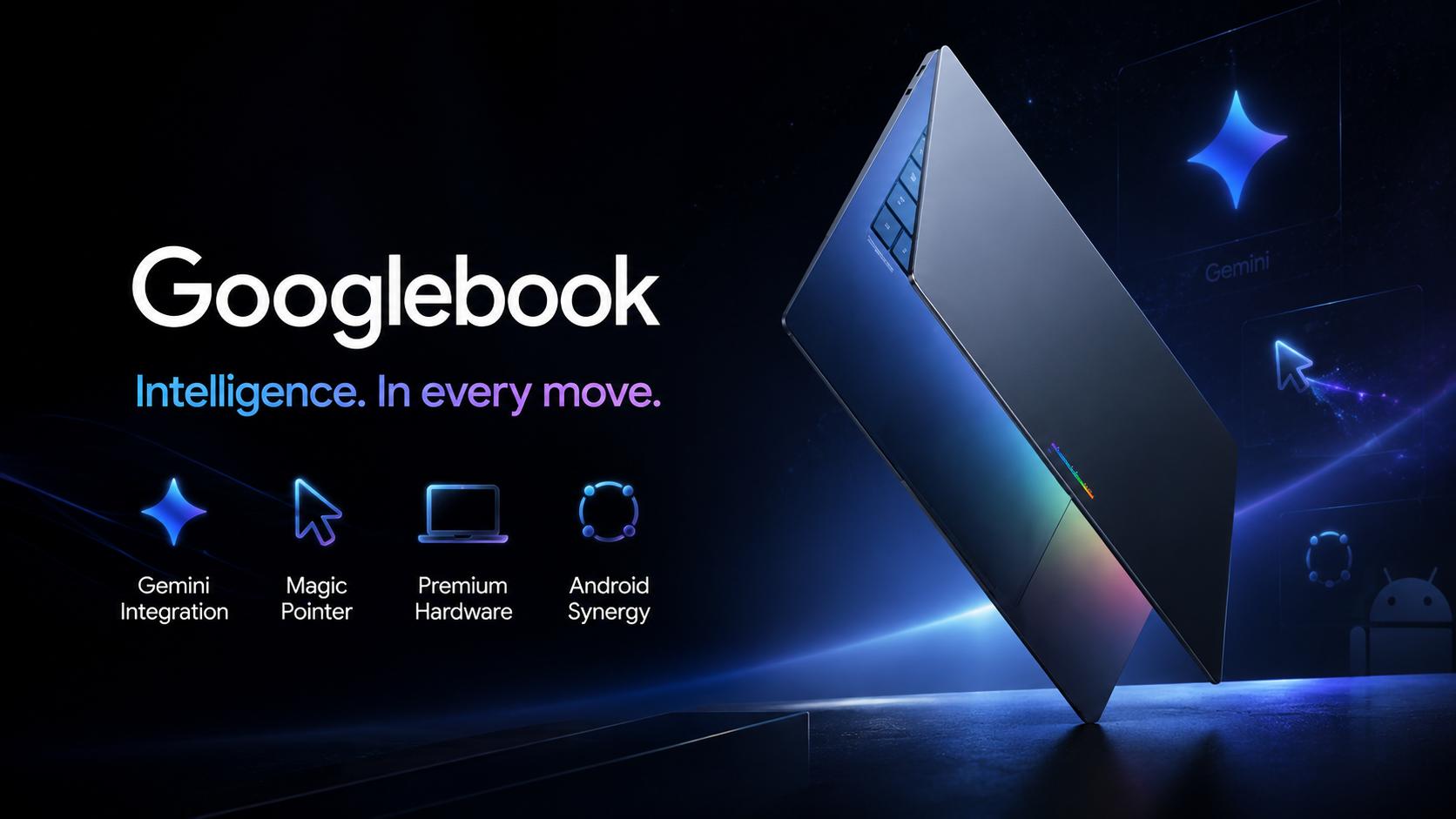
The technology industry witnessed a monumental shift in May 2026. Google officially introduced a brand new category of laptops. This product line is known as the Googlebook. It represents the first major hardware pivot in fifteen years. The company previously relied heavily on the Chromebook branding. However, it now seeks to redefine personal computing for the AI era.

The new devices were unveiled during a special event. This session was titled The Android Show: I/O Edition. During the presentation, executives described the Googlebook as an intelligence system. It is no longer just a traditional operating system. The primary goal is to provide proactive assistance to users. Furthermore, it integrates deeply with the entire Android ecosystem.
Defining the Googlebook Identity
The Googlebook is not simply a refreshed version of older laptops. Instead, it is a built-for-Gemini breed of personal computers. Google designed these machines from the ground up for Gemini Intelligence. They combine the speed of Chrome with the versatility of Android. Consequently, the platform offers a more modern and responsive user interface.
One major distinguishing factor is the focus on premium craftsmanship. Traditional Chromebooks often targeted the education and budget sectors. Conversely, the Googlebook targets the high-end professional market. The hardware also features superior materials like aluminum and glass. Therefore, Google intends to compete directly with elite Windows and Mac devices.
The Googlebook Hardware Aesthetic
Design also plays a critical role in the new Googlebook category. Every model features a unique hardware element called the Glowbar. This light strip is located on the lid of the device. It serves as a visual signature for the entire product line. Meanwhile, it provides functional feedback during AI processing tasks.
The aesthetics emphasize a featherweight design with heavyweight power. Partners like Acer and ASUS are focusing on ultraportable form factors. Additionally, Dell and Lenovo are developing various premium shapes. HP also remains a core partner for the initial launch window. These manufacturers ensure a diverse range of high-quality hardware choices.
Deep Gemini Integration in Googlebook
Gemini Intelligence is the fundamental core of the Googlebook experience. It is woven into every aspect of the operating system. AI no longer functions as a separate sidebar or chatbot. Instead, it understands the context of the entire screen. Consequently, it can anticipate user needs before a command is given.
Users can interact with Gemini through natural language and gestures. It handles complex tasks across multiple applications simultaneously. For example, it can scan an email and organize a trip. Furthermore, it manages files and schedules without manual user input. This integration represents a shift toward truly agentic computing.
The Googlebook Magic Pointer Feature
Moreover, the mouse cursor has received its biggest upgrade in decades. Google introduced the Magic Pointer for the Googlebook category. This feature was developed in collaboration with Google DeepMind. It transforms the traditional cursor into an AI-aware navigation tool. So, users can activate it simply by wiggling the mouse.
When wiggled, the Magic Pointer offers contextual AI suggestions. It recognizes dates, images, and text on the screen. For instance, hovering over a date helps create a calendar event. It can also visualize furniture items in a room photo. Thus, it bridges the gap between intent and action seamlessly.
Technical Foundations of Googlebook OS
The software powering the Googlebook is a modern intelligence platform. Moreover, this system was developed under the codename Aluminium OS. It effectively merges the foundations of Android and ChromeOS. The operating system runs Android apps natively on the desktop. Moreover, it utilizes a custom window manager for professional multitasking.
Google has removed the containerization layers found in older systems. Therefore, this allows apps to achieve desktop-class performance levels. It also ensures that mobile apps receive consistent updates. Furthermore, the system includes the full Chrome desktop browser experience. This combination provides the best of web and mobile software.
Creating Widgets on Googlebook
A standout software feature is called Create Your Widget. This tool allows users to generate custom desktop dashboards. Users simply type a prompt describing their specific needs. Gemini then gathers data from Gmail and other apps. Subsequently, it builds a functional widget to display that information.
This feature is designed to reduce constant app switching. For example, a user can track a family reunion. The widget would show flights, hotels, and a countdown. Additionally, it pulls live data from the web when necessary. Therefore, the desktop becomes a dynamic and personalized workspace.
The Googlebook Partner Ecosystem
Google is working with several major PC manufacturers. Acer, ASUS, Dell, HP, and Lenovo are confirmed partners. These companies will produce the first wave of devices. Hence, each manufacturer will add its own unique style and craftsmanship. However, every device must include the signature Glowbar light.
This partnership also ensures that Googlebooks are available in various sizes. Some models will be convertibles or traditional clamshell designs. Others may focus on high-end OLED display technology. Consequently, consumers will have a broad range of choices. The launch is slated for the fall of 2026.
Processor Architecture in Googlebook
The hardware requirements for the Googlebook are quite stringent. Google has confirmed support for several major chipset vendors. These include Intel, Qualcomm, and MediaTek. Specifically, the platform will span both x86 and ARM architectures. This ensures high performance across different device price points.
Intel is preparing its Core Series 3 chips for this category. Meanwhile, Qualcomm will offer Snapdragon X series processors. MediaTek will likely contribute mid-tier expertise to the market. Therefore, Googlebooks will offer competitive power and battery life. As a result, this diverse chipset support allows for a flexible manufacturing strategy.
Competitive Positioning of Googlebook
The Googlebook is positioned as a direct rival to premium laptops. It specifically targets the market share of the MacBook Neo. Apple recently released that device as an affordable entry point. However, Google aims to win users with deeper AI integration. The Googlebook offers native Android app support as a bonus.
| Feature | Googlebook | MacBook Neo | Chromebook |
| Core AI | Gemini Intelligence | Apple Intelligence | Limited Gemini |
| OS Base | Android / Chrome | macOS Tahoe | ChromeOS |
| Materials | Premium Metal / Glass | All-Aluminum | Varies / Plastic |
| Price | $550 – $1,200 | $599 Base | $150 – $500 |
| Ecosystem | Android Native | iOS / macOS | Web Focused |
The Strategic Googlebook Launch Window
Google plans to release the first Googlebooks in late 2026. This fall launch coincides with the back-to-school and holiday seasons. Hardware announcements are expected around the IFA tradeshow. Meanwhile, Google continues to tease specific software capabilities. The rollout represents a multi-year plan to overhaul computing.
Pricing for these devices will likely be premium. Analysts expect models to range from $550 to $1,200. Thus, it is a significant jump from traditional Chromebook costs. Indeed, the higher price reflects the advanced AI hardware. Every unit must support complex on-device Gemini tasks.
Android Synergy on Googlebook
A major selling point is the relationship with Android phones. Google designed these laptops to stay perfectly in sync. So, users can access phone files directly from the file browser. Additionally, they can stream phone apps to the laptop screen. This does not require any additional software downloads.
This synergy is called the Cast My Apps feature. It allows for a seamless transition between mobile and desktop. Furthermore, the Quick Access feature simplifies data sharing. Users can drag files from their phone into documents. Consequently, the Googlebook acts as an extension of the smartphone.
The Legacy of Chromebook vs. Googlebook
The arrival of the Googlebook marks the end of an era. Google introduced Chromebooks fifteen years ago for the cloud. Those devices were successful in the education sector. However, the company now believes computing is shifting to AI. Thus, the Googlebook is the successor to the Chromebook.
However, existing Chromebooks will not be abandoned immediately. Google promised to support them for their ten-year lifespan. Some high-end models might even be eligible for OS upgrades. Nevertheless, the focus of innovation has clearly shifted. Future hardware investments will prioritize the Googlebook platform.
Security Infrastructure for Googlebook
Security is a paramount concern for the new category. Google is utilizing its world-class architecture for protection. The system includes a dedicated Private Compute Core. This ensures that sensitive AI data stays on the device. Additionally, new safeguards defend against prompt injection attacks.
Explicit user control is a core security principle. Users must opt-in to connect Gemini to their accounts. Furthermore, AI tasks require confirmation before making purchases. Google is also increasing operational transparency for researchers. Therefore, the Googlebook aims to be the most secure AI laptop.
Privacy and Data Control on Googlebook
Privacy settings on the Googlebook are granular and transparent. Users can disable entire AI features at any time. Data protection also applies across all form factors and apps. Moreover, key parts of the security code are open-source. This allows third-party experts to audit the handling of data.
The system uses advanced defenses like protected KVM. These technologies isolate sensitive workflows from the rest of the OS. Consequently, users have total authority over their personal information. Google emphasizes that AI should feel like a partner. It should never become an intrusive presence in daily life.
Creative Tools on the Googlebook Platform
Content creators will find several new tools on the Googlebook. Android 17 brings pro-grade video features to the platform. For instance, Adobe Premiere Pro is finally arriving natively. It will support YouTube Shorts templates and high-end effects. Additionally, Google introduced the Advanced Professional Video format.
This new format is optimized for high-quality recording. It uses less storage while maintaining incredible visual detail. Furthermore, Screen Reactions allows users to record dual-camera videos. This is perfect for reaction style content on social media. Thus, the Googlebook is a versatile tool for digital artists.
Social Media Integration with Googlebook
Google is deepening its partnership with Meta for this launch. Android devices now offer optimized Instagram video uploads. This includes support for Ultra HDR and Night Sight. Consequently, video quality on social platforms has improved drastically. The Instagram Edits app is also getting AI tools.
Smart Enhance can upscale photos and videos in one tap. Meanwhile, Sound Separation isolates voices from background noise. These features are exclusive to the Android-based ecosystem. They leverage the powerful NPU hardware in Googlebook devices. Therefore, social media professionals will benefit from these innovations.
Productivity Enhancements on Googlebook
Productivity is a central theme of the Googlebook marketing. The system uses agentic AI to automate routine tasks. For example, Gemini can organize book lists from a syllabus. It can also summarize complex documents directly on the desktop. These features are designed to save time every day.
Another innovation is the Gboard Rambler tool for dictation. It removes filler words like “um” in real time. This results in cleaner text for emails and notes. Furthermore, it supports multiple languages simultaneously during speech. Consequently, the Googlebook is a superior machine for writing tasks.
The Impact of Googlebook on Education
The educational landscape will face changes due to Googlebook. Chromebooks were primarily designed for simple classroom management. However, the Googlebook focuses on high-end performance and AI. Some schools may find the higher prices challenging. Indeed, most students do not need premium metal builds.
Furthermore, the Magic Pointer requires users to be adults. This creates a deployment issue for primary schools. Nevertheless, Google will continue supporting the standard Chromebook line. These devices will remain the standard for K-12 students. The Googlebook will likely target university students and faculty.
Googlebook Sustainability and Supply Chain
Google is prioritizing sustainability for the new laptop category. The company recently published a Recycled Materials Guide. It outlines how to integrate recycled metals into electronics. For example, the Pixel 10a uses 36% recycled materials. This includes 100% recycled aluminum for the chassis.
Furthermore, Google aims for 50% recycled plastic usage. The supply chain is moving toward circular economy models. This reduces the carbon footprint of hardware manufacturing. Indeed, recycled content is a scalable pathway for reductions. Consequently, the Googlebook rollout will focus on ethical sourcing.
Green AI and Decarbonization Efforts
The tech giant is also focusing on Green AI. This involves choosing low-carbon cloud partners for processing. AI is both a lever and a load. It helps optimize networks but consumes significant energy. Therefore, Google is co-optimizing cost and carbon emissions. This reflects a broader industry shift toward accountability.
Supply chain decarbonization is no longer a side initiative. New climate disclosure laws are reshaping global expectations. For instance, California’s SB 253 requires detailed emissions reporting. Google is leading this trend with primary carbon data. Thus, the Googlebook project is grounded in environmental responsibility.
Googlebook and the Future of Android Auto
The Googlebook ecosystem extends into the automotive world. Android Auto received a major redesign with Gemini integration. The new interface uses the Material 3 Expressive system. It offers immersive navigation with 3D visuals and lights. Users can even watch YouTube in full HD.
Gemini becomes smarter inside the car through Magic Cue. It pulls context from texts and emails for replies. Furthermore, drivers can order food via voice commands. This deep integration ensures a consistent AI experience. Consequently, the car becomes a third screen for Googlebook.
Samsung and the July 22 Unpacked Event
Rumors regarding a Samsung Googlebook are circulating heavily. Samsung has an Unpacked event planned for July 22. This event is expected to take place in London. They will likely reveal new foldable smartphones there. However, a new Galaxy laptop is also anticipated.
Leaks suggest this laptop will run the Googlebook OS. It could feature a wider aspect ratio for productivity. Moreover, the device would likely include the S Pen. This would make it a powerful competitor in 2026. Therefore, the Samsung partnership remains a critical factor.
The Evolution of the Mouse Cursor
The Magic Pointer represents a radical evolution of hardware. For decades, the cursor only tracked location on screen. Now, it understands the semantic meaning of pixels. It can turn a scribbled note into a list. Additionally, it turns video frames into booking links.
This innovation was driven by the DeepMind research team. Their goal was to make AI intuitive and fluid. Users no longer need to write detailed text prompts. Instead, they use physical gestures and natural shorthand. Consequently, the Magic Pointer is a headline Googlebook feature.
Googlebook Strategy: Intelligence is the Spec
Google is shifting away from traditional hardware specifications. The new philosophy is that intelligence is the spec. This means AI capabilities define the laptop’s value. Every Googlebook is built for proactive assistance. It does more than just run standard applications.
The laptop serves as a partner in every task. It organizes information and speeds up routine workflows. Moreover, it connects actions across multiple apps and devices. This reflects a broader shift in personal computing expectations. Users now demand that AI handles the heavy lifting.
Market Expectations for Googlebook 2026
The industry impact of the Googlebook will be massive. It challenges the dominance of Windows and macOS laptops. By leveraging the Android brand, Google gains immediate recognition. Furthermore, the premium focus attracts higher spending consumers. The Glowbar provides a unique visual brand marker.
However, its success depends on reliability and privacy. Users must trust the AI system with their data. Additionally, the contextual suggestions must be accurate and useful. If these features perform well, then Googlebook wins. Conversely, a failure in utility could hinder adoption.
Technical Principles of AI Pointers
DeepMind outlined four principles for the Magic Pointer. First, it must maintain the user’s flow. Second, it should understand through “show and tell”. Third, it must embrace natural human shorthand. Finally, it must turn pixels into actionable entities. These pillars guide the entire interface design.
This approach shifts context capture to the client pointer. It reduces the need for explicit prompt engineering. The computer “sees” what matters to the user. Consequently, the interaction feels more fluid and seamless. This represents a productization of generative AI in core UI.
The Convergence of Android and ChromeOS
Google confirmed the merger of its operating systems. Sameer Samat announced this strategic shift in 2025. The goal is to create a unified computing platform. This involves replacing the ChromeOS stack with Android. The resulting system is more effective for desktop users.
Aluminium OS is the fruit of this long-term labor. It allows for deeper integration with mobile devices. Furthermore, it removes the split between different development cycles. Android apps now run with native performance on laptops. Consequently, the Googlebook bridges the gap between phone and PC.
Expert Analysis: The Bigger Shift in Computing
Industry analysts are watching the Googlebook launch closely. This event felt different from previous design tweaks. Google is now treating AI as the foundation. The goal is a device that understands intent. This moves beyond the reactive nature of old software.
Whether this vision works depends on several key factors. Reliability and privacy safeguards are the most important ones. Users must also find the features genuinely useful. Indeed, the Magic Pointer is a bold UI experiment. It signals Google’s renewed ambitions in the hardware space.
Googlebook Hardware Craftsmanship
Every Googlebook will be built with premium materials. This includes high-end finishes and durable craftsmanship. The devices will come in various shapes and sizes. Manufacturers are targeting the upper range of ultraportables. Consequently, the build quality will rival the best hardware.
A Touch ID-like key was spotted on early prototypes. This suggests a focus on biometric security for professionals. Furthermore, the laptops emphasize lightweight and powerful designs. The Glowbar provides a futuristic and identifiable glow. Thus, the Googlebook category feels modern and technologically advanced.
iPhone to Android Migration Tools
Google is making it easier to switch ecosystems. A new migration system simplifies the entire process. Users can transfer photos, messages, and home layouts. It even supports transferring eSIM data and passwords. This feature will roll out first on Pixel phones. Eventually, it will expand to other Android partners.
This move aims to capture more premium users. Many of these users may then buy a Googlebook. The seamless connection between phone and laptop is key. Therefore, Google is removing friction from the switching process. This strategy directly challenges Apple’s strong ecosystem lock-in.
The Future of Google-Branded Hardware
There are rumors about a first-party Googlebook model. While not confirmed, experts believe it is inevitable. This would likely follow the legacy of the Pixelbook. A “Google Googlebook” would serve as a reference device. However, the company currently focuses on third-party partners.
Partners like HP and Dell are leading the way. They offer established supply chains and global distribution. Nevertheless, a first-party device could appear later in 2026. This would showcase the purest vision of Aluminium OS. For now, the ecosystem relies on manufacturing variety.
Closing Thoughts on the Googlebook Era
The Googlebook is the most ambitious play in years. It merges two successful platforms into one intelligence system. Gemini Intelligence provides the proactive help users now expect. Furthermore, the Magic Pointer redefines how we interact with cursors. This marks a definitive shift toward premium AI computing.
While Chromebooks remain for the budget market, change is here. The Googlebook platform represents the next fifteen years of computing. It is designed for a world where AI is everywhere. Consequently, the hardware and software have finally caught up. The fall launch will truly test this bold vision.
Support Our Work
Help us keep creating and maintaining our projects. We appreciate your support!
Ways to contribute:
Shop via Affiliate LinksSupport us at no extra cost to you while you shop.
Support on Ko-fiBuy us a coffee to keep the engine running!



Leave a Reply