
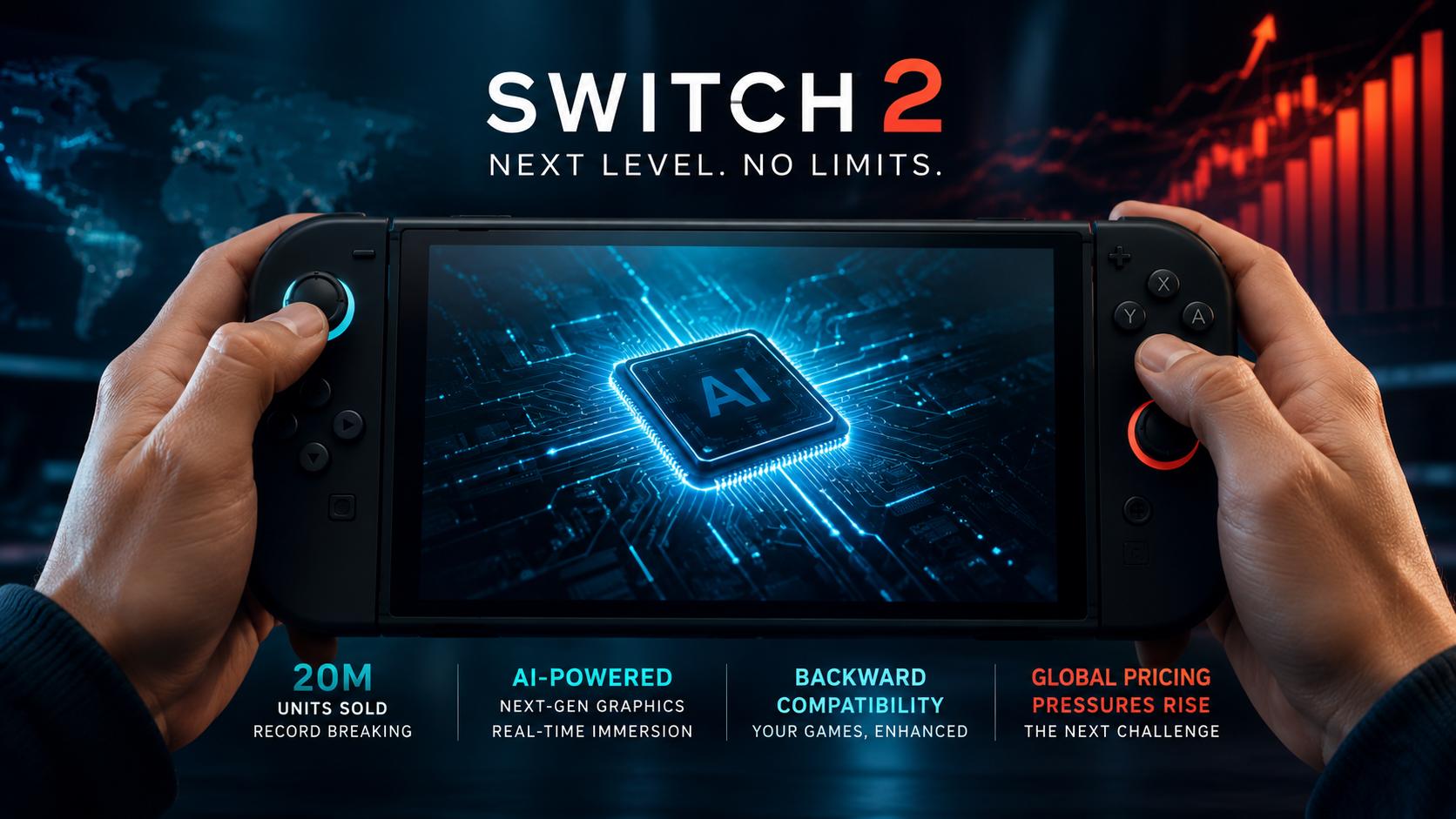
The global gaming landscape experienced a major shift during the summer of 2025. Particularly, Nintendo officially launched its highly Nintendo Switch 2 in multiple major regions on June 5, 2025. The new device arrived with substantial hardware enhancements and an impressive software library. Hardware sales quickly exceeded initial expectations and shattered several previous company records. Indeed, the platform shipped nearly twenty million units within its first ten months on shelves. This rapid adoption rate represented a massive increase over the debut of its predecessor. Global consumers embraced the hybrid model with unprecedented enthusiasm during this introductory phase. Consequently, net sales for the company grew by ninety-nine percent over the prior fiscal year. More than two-thirds of this massive revenue flowed from international markets outside of Japan. The company established a strong financial foundation to support the console’s multi-year lifecycle.

The second year of Nintendo Switch 2 presents unique market challenges for executive leadership. However, the manufacturer projected a minor downturn in hardware sales for this fiscal period. The updated sales forecast targets 16.5 million shipments by the end of March 2027. Such a projected dip aligns with historical trends observed across previous hardware generations. Nevertheless, current demand remains remarkably firm as adoption continues smoothly around the globe. Industry analysts note that initial adoption has been extremely fast compared to the original console. Strong momentum suggests the platform will comfortably surpass legacy consoles in total sales. Additionally, rapid user migration minimizes the risk of generational player fragmentation. Nintendo continues to leverage strong software brands to encourage immediate hardware upgrades. Players willingly adopt the new ecosystem for its advanced gameplay features.
Market Momentum
Regional Pricing for the Nintendo Switch 2
A sudden economic change surprised many consumers less than a year after the launch. Specifically, Nintendo announced a regional fifty-dollar price increase starting September 1, 2026. The base retail price of Nintendo Switch 2 in the United States will rise from $449.99 to $499.99. Customers in Canada will see an equivalent adjustment to $679.99 CAD during this period. Meanwhile, European markets will experience a hardware price hike to €499.99. Japan will see its price revision take effect much earlier on May 25, 2026. These substantial regional adjustments are also necessary to maintain a healthy corporate earnings structure. Subsequently, the executive team publicly apologized for the financial inconvenience caused to global customers. Rising manufacturing costs made it impossible to maintain the original introductory pricing model. So, the company hopes a strong software library will justify this new entry barrier.
Price Revision (Sept 2026)
Global UpdateMultiple ongoing macroeconomic factors forced the executive team to revise their pricing strategy. Moreover, surging memory component prices represent a primary driver of these rising costs. This memory shortage stems directly from massive global investments in artificial intelligence infrastructure. Volatile currency exchange rates and a weak yen further impacted hardware manufacturing margins. Therefore, the brand must offset these long-term issues to prevent severe operational deficits. Surging crude oil prices also threatened the stability of international shipping routes. Ongoing shipping delays occurred due to geopolitical conflicts in critical maritime lanes. Separately, regional price adjustments vary because each local market experiences unique economic strains. Nintendo is working diligently to overcome these external economic barriers through internal efficiency. The updated hardware prices do not fully cover the entire manufacturing cost increases.
System Architecture of the Nintendo Switch 2
Nvidia T239 Architecture
The hardware specifications of the successor system represent a massive generational leap. Concurrently, the console utilizes a custom Nvidia T239 system on a chip. This processor features an eight-core ARM Cortex A78C CPU cluster for heavy operations. Six of these high-performance cores are also fully available to external game developers. Conversely, the operating system reserves the remaining two cores for background tasks. The CPU clocks up to 1.7GHz under highly demanding computing scenarios. Normal operation clocks drop to conserve battery power during mobile sessions. Undeniably, the processor runs at 1100MHz in handheld mode to optimize thermal efficiency. The clock speed drops further to 998MHz when connected to the dock. This unique scaling approach prioritizes system stability over raw processing power.
| Spec | Original Switch | Successor |
| SoC | Tegra X1 | Custom T239 |
| CPU | 4 Cores | 8 Cores |
| GPU | Maxwell | Ampere |
| RAM | 4GB | 12GB |
The custom graphics unit utilizes Nvidia’s advanced Ampere architecture. Additionally, the GPU features 1536 CUDA cores for rendering. The graphics processor clocks at 1007MHz when docked. Mobile play drops this clock speed to 561MHz. Furthermore, the system memory features 12GB of LPDDR5X. The background operating system reserves exactly 3GB of RAM. Developers also have access to 9GB of memory. Thus, memory bandwidth scales up to 102 GB per second. Handheld mode drops the bandwidth to 68 GB per second. These combined components ensure highly efficient performance.
Graphical Innovation and Display Capability of Nintendo Switch 2
Display & Optical Systems of Nintendo Switch 2
• HDR10 and VRR (Up to 120 FPS)
• DLSS AI-driven 4K upscaling
Visual performance on the modern platform reaches remarkable heights. Additionally, the integration of Deep Learning Super Sampling optimizes gameplay. This AI technology upscales low-resolution frames to deliver sharp images. Demanding blockbusters can run smoothly without sacrificing raw system performance. Subsequently, ray tracing features provide highly realistic lighting and reflections. The hardware processes ten giga rays per second in portable mode. Performance doubles to twenty giga rays when connected to a dock. Moreover, a custom decompression engine dramatically reduces annoying game load times. This specific architecture allows assets to load directly into system memory. Players experience a highly seamless journey across expansive open worlds.
The integrated display delivers a premium viewing experience during mobile play. Specifically, the system features a robust 7.9-inch wide color gamut touchscreen. This LCD screen outputs a native 1080p resolution for extreme clarity. The device also supports HDR10 and Variable Refresh Rate features. Thus, compatible titles can scale up to 120 frames per second. Developers can also target a balanced forty frames per second. This middle option offers a great compromise between fidelity and battery. Meanwhile, a 5220 mAh lithium-ion battery powers the portable gaming console. Resource-intensive titles deplete the battery in about two hours of play. Simpler games can extend the portable run time to six hours.
Backward Compatibility with Previous Catalogs
Moving to a new hardware generation often frustrates dedicated game collectors. Fortunately, Nintendo prioritized a seamless transition for its massive global audience. The successor console provides full backward compatibility for physical and digital titles. This specific architecture prevents user base fragmentation across different systems. Currently, a dual-keyed cartridge slot accepts older game cards directly. Original game cards function instantly without requiring any external adapters. Players can insert their favorite classics to begin playing immediately. Separately, previously purchased digital titles carry over to the modern eShop library. Logged-in accounts populate the redownload list with older digital purchases. The company charges no extra upgrade fees to access these standard games.
Legacy games enjoy noticeable performance improvements on the advanced hardware platform. In fact, automatic boost modes stabilize frame rates and improve dynamic resolutions. These retro titles run smoother without requiring any manual developer patches. Save data transfers easily through local wireless or cloud backup services. However, certain physical games face slight limitations due to unique hardware setups. Software relying heavily on old motion sensors might exhibit different behaviors. Party games utilizing original Joy-Con features may require some configuration. Additionally, original Bluetooth controllers remain fully compatible with the new console. Players can easily sync their original Pro controllers to navigate menus. This deliberate continuity respects the investments of loyal Nintendo customers.
Corporate Strategy and Studio Acquisitions
Strategic expansion plays a critical role in securing long-term software support. Recently, Nintendo announced an agreement to acquire Bandai Namco Studios Singapore. The transaction will proceed in two distinct phases over the coming months. The publisher will buy eighty percent of shares on April 1, 2026. Subsequently, the company will purchase the remaining twenty percent to finalize ownership. The acquired team will continue operations under the name Nintendo Studios Singapore. This talented group previously led the development of New Pokémon Snap. Moreover, they contributed significant design assets to the popular Splatoon series. This buyout directly bolsters internal resources to support ambitious future projects. Analysts expect the studio to assist with the upcoming Splatoon Raiders.
The Japanese gaming giant continues its steady pursuit of organic growth. Previously, the company completed several key acquisitions of veteran partner studios. They bought Next Level Games and software developer SRD after long partnerships. They also achieved complete ownership of Xenoblade developer Monolith Soft in 2024. Furthermore, they acquired Shiver Entertainment to facilitate high-quality software ports. These acquisitions differ from the aggressive consolidation strategies of key competitors. Nintendo focuses strictly on teams with a proven history of close collaboration. Accordingly, this careful selection process minimizes corporate friction and cultural clashes. Secured talents ensure a highly consistent flow of premium exclusive content. This targeted consolidation protects key intellectual properties for future system lifecycles.
Architectural Evolution of GameChat Socialization
Social connectivity receives a major upgrade with the integration of GameChat. Essentially, the system features built-in communication software running on the console. Players no longer need a separate mobile app to chat with friends. An integrated console microphone captures vocal audio with high clarity and range. Additionally, a dedicated audio chip automatically balances games and voice volumes. The custom audio chip filters out background noises to ensure comfortable multiplayer conversations. Users quickly activate the chat overlay by pressing a dedicated controller button. Actually, the C button on the right controller opens social settings instantly. Players can easily invite up to twelve friends into voice chat sessions. Friends can talk seamlessly while playing completely different software titles.
Advanced visual features allow friends to share their real-time gameplay screens. Accordingly, up to four players can broadcast active sessions in a room. The system reduces stream frame rates to prioritize main console performance. Players can expand any shared screen to examine a friend’s progress. Meanwhile, optional video chat features connect players face-to-face via external cameras. Users connect a compatible USB-C camera directly to the main dock. This setup enables motion-tracking features in compatible multiplayer family games. Nevertheless, standard voice chat remains fully operational without a connected camera. Parents can manage these social options using integrated mobile parental controls. Secure verification steps prevent unauthorized communication and protect younger users.
Dual Generation Ecosystem Sustainability
Managing a generational transition requires balancing new sales with existing software markets. Evidently, the manufacturer plans to support both hardware generations for the foreseeable future. The original system has sold over 155 million units worldwide since launch. Millions of active players represent a highly lucrative source of continuous software revenue. However, this massive audience must transition slowly to prevent sudden revenue drops. The publisher continues to develop major software releases for the older system. Cross-generation titles allow players to enjoy new games on both hardware ecosystems. Furthermore, popular live-service games transfer player profiles and progress instantly. This approach keeps players engaged within the ecosystem during the transition period. Financial stability remains secure as the newer console builds its audience.
A robust pipeline of upcoming software releases guarantees long-term engagement for players. Currently, the company prepares both first-party masterpieces and major third-party blockbusters. Splatoon Raiders and Pokémon Pokopia will anchor the software catalog this fiscal year. High-profile ports like Cyberpunk 2077 demonstrate the successor’s incredible performance. Therefore, executive teams remain highly confident in the system’s long-term commercial momentum. The blend of classic franchises and modern technology creates an appealing value proposition. Nintendo will continue to expand its media presence through movies and theme parks. Conversely, these efforts ensure the brand remains highly relevant across multiple entertainment sectors. Loyal fans can expect consistent innovation and support for many years to come. The future of the hybrid platform looks exceptionally bright in this evolving market.
Support Our Work
Help us keep creating and maintaining our projects. We appreciate your support!
Ways to contribute:
Shop via Affiliate LinksSupport us at no extra cost to you while you shop.
Support on Ko-fiBuy us a coffee to keep the engine running!



Leave a Reply