
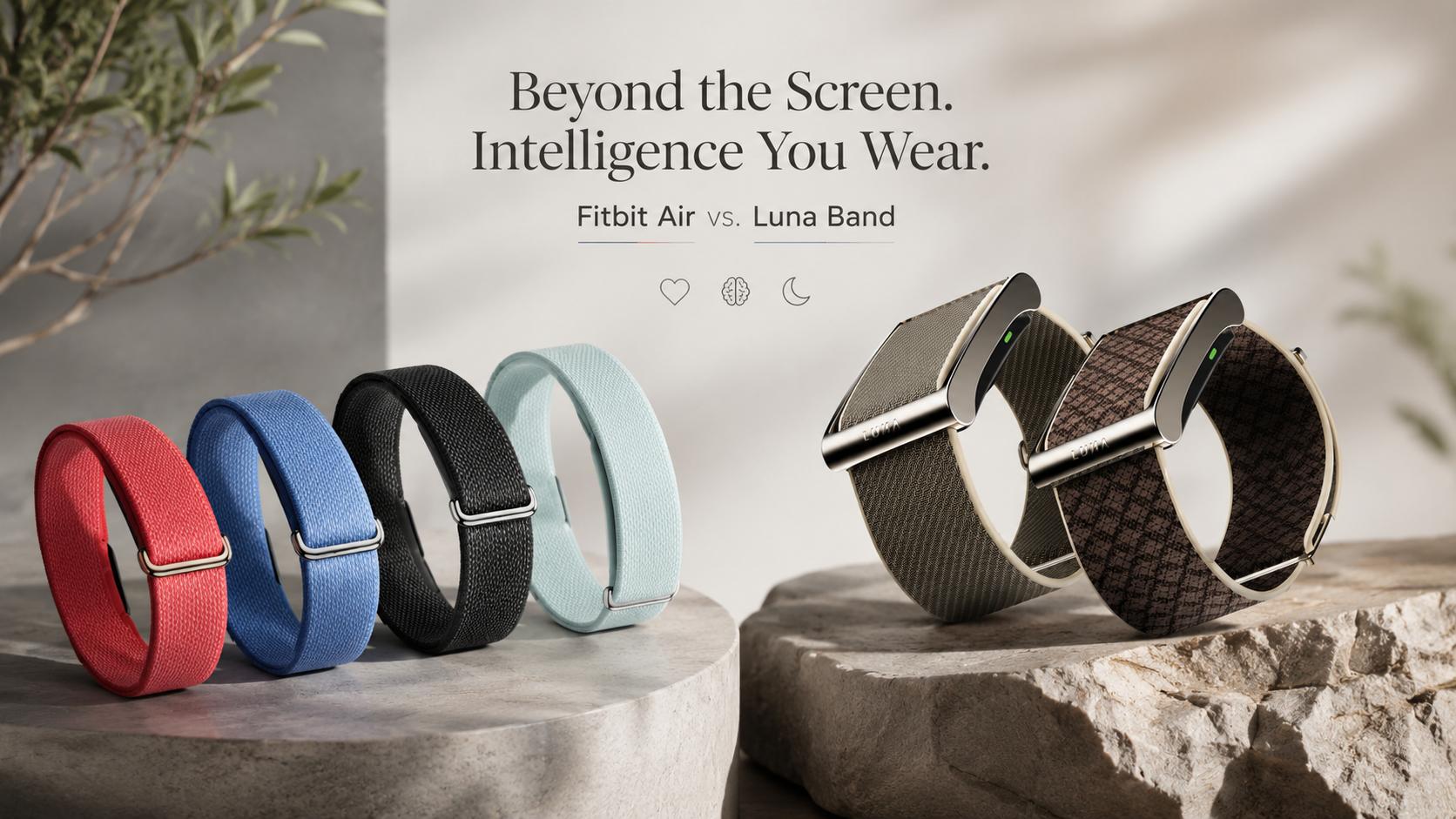

Fitbit Air vs. Luna Band: Evolution of Minimalist Health Hardware
Modern tech consumers experience severe notification fatigue from smartwatches. Consequently, many individuals now look to screenless options like the Fitbit Air vs. Luna Band to monitor vital health metrics silently. These minimalist devices eliminate glowing displays and digital interruptions. Users can focus entirely on daily activities without compulsively checking their wrists. This shift reflects a broader consumer trend toward passive background tracking. Modern shoppers are prioritizing mental peace alongside daily physical conditioning.
Screenless trackers strip away complex notification systems to foster digital mindfulness. At the same time, they capture research-grade biometric data without constantly taxing the user’s attention span. Instead of reacting to real-time buzzes, wearers review their personalized metrics on companion smartphone applications only when they intentionally choose to. By design, this physical partition encourages deeper human connections in a highly connected digital era. Ultimately, such mindful designs ensure that people remain anchored in their immediate environments, proving why the wearable market is splitting into distinct lanes: smartwatches and screenless bio-trackers.
Fitbit Air vs. Luna Band Focus Strategy
Google launched its tiny screenless tracker to provide comfortable, continuous wellness monitoring. Specifically, this device uses a 5.2-gram polycarbonate pebble that slots into swappable performance athletic bands. In contrast, a startup recently introduced a schedule-oriented alternative that runs entirely without subscription fees. Instead of focusing purely on passive background tracking, this newer device actively plans the user’s day hour-by-hour using an advanced health engine. Ultimately, both products represent a distinct departure from standard, notification-heavy smartwatches by offering lightweight form factors that enable comfortable overnight sleep tracking and deep recovery analysis.
Indeed, these minimalist wearables represent a significant commercial threat to traditional smartwatch markets. Low-profile physical designs encourage continuous day and night usage. Users can collect uninterrupted biometric trends over weeks and months. They help users escape the anxiety of constant notifications while maintaining health awareness. However, the true differentiator lies in how each brand processes user data. Google relies on cloud analysis while its competitor emphasizes direct physical feedback. Therefore, consumers must evaluate their personal lifestyle preferences before buying.
Fitbit Air vs. Luna Band: Minimalist Health Tracking
The lightweight tracker features an optical heart rate sensor and red-light SpO2 monitoring. To complement these health metrics, a built-in skin temperature sensor also estimates body variation during sleep. However, to keep the device compact, it lacks onboard GPS, requiring a connected phone for location mapping. Nevertheless, its high-fidelity sensors still handle plenty of heavy lifting in the background by detecting irregular heart rhythms and passive workout activities. When it comes to power, a robust five-minute quick charge provides one full day of battery life. By comparison, a full top-off takes approximately ninety minutes via a custom-designed magnetic cable.
Google rebranded its official companion application to Google Health on May 19, 2026. As part of this major application update, the platform integrates a redesigned layout built around four distinct core tabs. Beyond the visual overhaul, premium subscribers also gain access to the new Gemini-powered Health Coach. This conversational AI assistant provides adaptive, science-backed guidance for individual fitness goals. For instance, it replaces rigid, traditional daily targets with a highly flexible weekly cardio goal. At the same time, the program automatically adjusts active workout recommendations based on real-time sleep scores to keep your recovery in check.
The special edition tracker featuring a design from Stephen Curry costs $129.99. Along with the custom look, users can select specialized bands that improve airflow during intense workouts. Specifically, this build features raised interior prints to increase active airflow. For those looking for other options, standard swappable accessories begin at $34.99 on the Google Store. Additionally, these accessory bands are easily interchangeable to match casual or formal wear. As for the release timeline, the base device officially arrives on retail shelves on May 26, 2026. On the software side, Android users can enjoy a spacious quick access widget on home screens.
Fitbit Air Power Efficiency
Luna Approaches Proactive Daily Schedules
The competitor leverages its LifeOS platform to create a comprehensive biological calendar. Specifically, instead of displaying complex graphs, the device translates physiological data into actionable scheduled events. To achieve this, the software interprets body signals alongside blood markers and nutrition habits. Based on these continuous insights, haptic wrist vibrations gently nudge users to adjust their routines throughout the day. Furthermore, the companion application features modular micro-apps for stress and training. Consequently, users can quickly create customized modules to manage specific health challenges.
The hardware features an optical array and a six-axis motion unit. Users interact with the device using voice commands via paired wireless earbuds. Specifically, iOS integration allows seamless verbal food and symptom logging through Siri. Android smartphone compatibility remains active, though it currently lacks any voice logging functionality. Amit Khatri designed this setup to manage finite energy levels compounding daily. Meanwhile, the system connects smoothly with health platforms like Apple Health and Google Fit.
The lightweight, buttonless tracking module sits inside a metallic casing. As a result, the design is extremely comfortable for continuous, long-term sleep monitoring. Beyond overnight use, the matte metallic housing also offers solid durability and water resistance for daily workouts. To match personal styles, buyers can choose from several physical colors like Aloe Green and Onyx Black. As for availability, the company opens its invite-only waitlist for shipping orders in late July 2026. Ultimately, the zero-subscription model provides a highly compelling financial alternative, representing a strategic shift away from recurring digital payments.
24-Month Total Cost of Ownership
Financial projection of Fitbit’s subscription-based pricing ($99.99 + $9.99/mo) versus the Luna Band’s one-time $149.00 investment.
Legal Landscapes and Future Outlook
The screenless wearable space is facing intense legal battles over product designs. Specifically, Whoop filed a trademark infringement lawsuit against the startup in Delaware federal court. Indeed, the legal complaint focuses on visual similarities and trade dress violations. Whoop alleges the physical band design closely mirrors its established buttonless hardware formula. Therefore, the startup updated its hardware aesthetics ahead of the summer launch. This adaptive response shows how legal pressure can dictate physical design choices.
Similar trademark disputes currently involve other prominent wearable brands like Polar and Bevel. Nevertheless, these ongoing court cases confirm the soaring valuation of distraction-free designs. This shift is largely driven by the fact that active consumers demand continuous biometrics without the burden of constant glowing screens. To keep pace, wearable tech firms must deliver smarter, more personalized AI analysis to retain active users. Consequently, these advanced companion apps will become the primary focus of the product experience. Eventually, this evolution marks the beginning of a highly competitive era for wellness trackers, in which the companion software itself will drive future consumer engagement in the screenless health market.
Support Our Work
Help us keep creating and maintaining our projects. We appreciate your support!
Ways to contribute:
Shop via Affiliate LinksSupport us at no extra cost to you while you shop.
Support on Ko-fiBuy us a coffee to keep the engine running!


Leave a Reply