
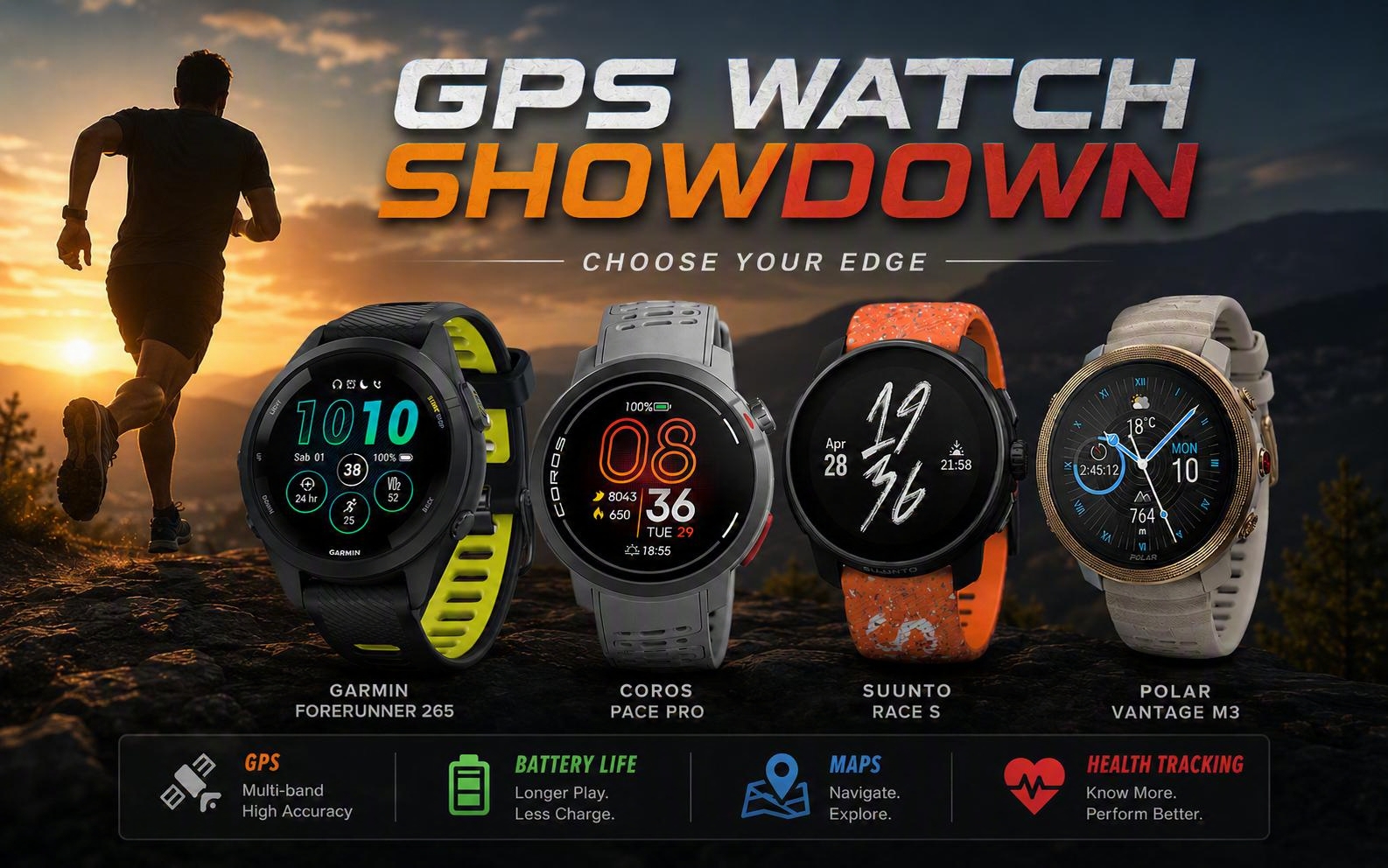

The market of affordable sports watches features intense rivalry as top brands vie for supremacy in the mid-range category. Consequently, selecting the ideal training companion has become more challenging than ever for modern runners. Athletes now demand a vibrant AMOLED screen and highly accurate dual-band GPS for daily runs. A detailed Garmin Forerunner 265, COROS Pace Pro, Suunto Race S, and Polar M3 Comparison reveals critical performance distinctions.
Historically, athletes had to sacrifice display quality to achieve long battery life on athletic devices. However, modern engineering has completely eliminated this annoying compromise in premium sports watches. Brand ecosystems now deliver rich maps, deep recovery insights, and beautiful screens in affordable packages. Meanwhile, recent firmware updates have brought high-end software features to these competitive mid-tier sports watches. This analysis evaluates the unique strengths of each model to highlight the best training options.
Endurance athletes face vastly different environmental conditions and tracking requirements in daily workout routines. Furthermore, budget constraints often dictate the specific training metrics a runner can realistically obtain. This comprehensive review evaluates physical specifications and software ecosystems to clarify the consumer purchasing process. The findings provide clear recommendations based on verified technical data and recent software developments.
Garmin Forerunner 265: The Training Standard
Garmin launched the Forerunner 265 in early 2023 to bring vibrant displays to its core running lineup. This lightweight device continues to set the benchmark for mid-range multisport wearables. It features an incredibly bright touchscreen and retains the physical five-button layout for reliable operation. Runners appreciate the dual-band GPS tracking which ensures highly precise route tracking under heavy tree cover.
The outstanding Training Readiness feature remains the strongest selling point for this seasoned competitor. Moreover, the watch monitors sleep quality, recovery time, and acute training load. These metrics calculate a daily energy score to help athletes make informed training choices. The recent release of the entry-level Forerunner 170 signals a major shift in brand strategy.
This newer entry-level series incorporates AMOLED technology and advanced training insights at a lower price point. Additionally, Garmin continues to offer superior training algorithms and reliable Bluetooth integration across all tiers. The brand maintains its dominant market position by trickling down premium features to more affordable options. The Forerunner 265 faces strong competition from both rival brands and internal updates.
COROS Pace Pro: AMOLED and Map Performance
COROS disrupted the sports watch market in late 2024 by releasing the advanced Pace Pro. Specifically, this model represents the first AMOLED sports watch from the brand to feature full-color maps. It boasts a powerful processor that delivers exceptionally fast screen scrolling and map rendering. The watch maintains the signature lightweight build that athletes associate with the classic Pace lineup.
Battery longevity is another area where the Pace Pro excels compared to its immediate rivals. For instance, the device offers thirty-eight hours of continuous GPS tracking on standard settings. Daily smartwatch use stretches to nearly twenty days without requiring a single battery charge. Therefore, ultra-runners choose this model to manage multi-day adventures without experiencing charging anxiety.
To expand its lifestyle appeal, COROS introduced the Pace 4 with an anodized aluminum bezel in 2025. This newer model balances structural strength with a polished finish at a lower price point. Yet, the Pace Pro remains the premier choice for runners who require offline navigation. It successfully merges premium display clarity with the lightweight engineering of classic sports wearables.
Suunto Race S: Nordic Elegance and Power
Suunto introduced the Race S in mid-2024 as a more compact version of its flagship watch. This elegant device features a high-definition AMOLED touchscreen in a durable stainless steel bezel. Besides, it includes a highly tactile digital crown that simplifies navigation through menus and maps. Users with smaller wrists get premium sports styling and rugged build quality without excess weight.
Recent software updates in early 2026 have significantly enhanced the value of this Finnish wearable. Subsequently, the firmware now supports heart rate broadcasting to external bike computers and smart trainers. It also integrates smart turn-by-turn navigation alerts and advanced Garmin Varia radar support for safer cycling. Suunto continues to bridge the feature gap with its larger competitors through rapid development.
The watch provides highly detailed heart rate variability measurements after every intense training session. Likewise, the free downloadable offline topographic maps offer unmatched clarity for trail running adventures. Suunto Coach AI provides personalized training guidance to help athletes reach their goals. This premium Nordic watch delivers incredible aesthetic appeal alongside reliable outdoor tracking tools.
Polar Vantage M3: The Biosensing Powerhouse
Polar entered the mid-range AMOLED arena in late 2024 with the launch of the Vantage M3. This versatile multisport watch stands out primarily due to its advanced Polar Elixir biosensing technology. Specifically, the watch offers wrist-based electrocardiogram tests, skin temperature tracking, and blood oxygen monitoring. These biological sensors provide a deeply comprehensive view of cardiovascular health and sleep recovery.
The Vantage M3 also matches its rivals by including dual-frequency GPS and free downloadable topographic maps. Moreover, the Polar OS 5 firmware update introduced a dark mode for maps and zooming gestures. It added customizable watch face widgets and detailed weekly training summaries directly to the wrist. Therefore, health-focused athletes get pro-level biosensing metrics at a highly competitive price point.
The Polar Flow application remains one of the most comprehensive platforms for analyzing athletic recovery. The watch excels at tracking nightly skin temperature fluctuations to detect early signs of fatigue. This biosensing powerhouse represents an incredibly smart choice for triathletes and health-conscious runners. It blends premium health diagnostics with reliable outdoor navigation features in a compact design.
Comparative Technical Analysis of Key Metrics
Analyzing the core physical specifications and battery ratings clarifies the primary differences among these advanced sports watches. Accordingly, the detailed table below highlights the crucial differences in pricing, display, weight, and tracking capabilities.
| Metric | Forerunner 265 | Pace Pro | Race S | Vantage M3 |
| Launch Price | $449.99 | $349.00 | $349.00 | $399.95 |
| Display Type | 1.3″ AMOLED | 1.3″ AMOLED | 1.32″ AMOLED | 1.28″ AMOLED |
| Storage Capacity | 8 GB | 32 GB | 32 GB | 32 GB |
| Physical Weight | 47 g | 49 g | 60 g | 53 g |
| Daily Use Battery | 13 Days | 20 Days | 9 Days | 7 Days |
| Dual-Band GPS | 14 Hours | 31 Hours | 30 Hours | 30 Hours |
| Offline Mapping | No | Yes | Yes | Yes |
While Garmin continues to charge a premium, its rivals now offer superior internal storage and offline maps. Additionally, COROS, Suunto, and Polar provide thirty-two gigabytes of storage on their mid-range models. Conversely, the older Garmin Forerunner 265 limits users to only eight gigabytes for music and software. Garmin remains highly competitive due to its superior training algorithms and solid ecosystem integration.
The Final Verdict
Choosing the right sports watch ultimately depends on training priorities, outdoor navigation needs, and financial considerations. For instance, the Garmin Forerunner 265 remains the best choice for runners who value structured training metrics. Nonetheless, athletes who require full-color offline mapping on a budget should prioritize the COROS Pace Pro. Meanwhile, the Suunto Race S appeals to outdoor enthusiasts who demand premium design and durability.
Alternatively, the Polar Vantage M3 represents the ultimate option for individuals who prioritize comprehensive health and recovery tracking. Each of these excellent AMOLED smartwatches offers exceptional GPS accuracy and highly useful fitness metrics. Thus, the mid-range sports watch market has never been more vibrant or beneficial for consumers. Serious athletes can confidently select any of these models to elevate their training experience.
Support Our Work
Help us keep creating and maintaining our projects. We appreciate your support!
Ways to contribute:
Shop via Affiliate LinksSupport us at no extra cost to you while you shop.
Support on Ko-fiBuy us a coffee to keep the engine running!



Leave a Reply