

A Wearable Revolution in 2026
![Apple Watch Ultra 3 [GPS + Cellular 49mm] Running & Multisport Sm...](https://m.media-amazon.com/images/I/41H6S7vjc+L._AC_.jpg)


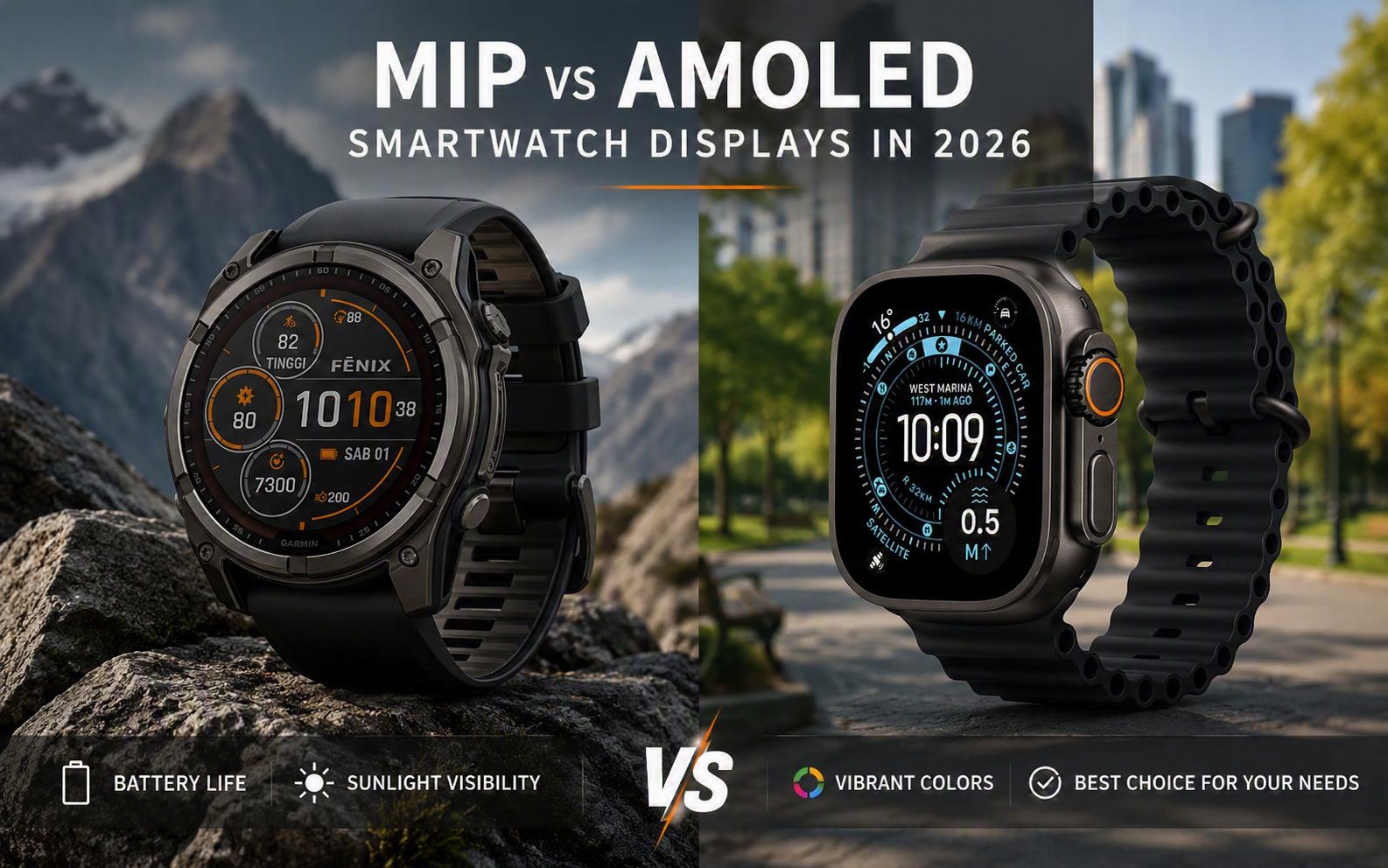
The market battle of MIP vs AMOLED Displays in Smartwatches has reached a defining turning point this year. Currently, prominent brands are forcing outdoor adventurers to make a difficult choice between battery life and visual brilliance. For decades, sports watches relied on reflective screens to survive weeks in the wilderness without a single charge. This technical choice directly impacts device durability, visual aesthetics, and everyday charging frequencies for athletes globally.
Mainstream consumers overwhelmingly prefer the rich colors and high contrast that self-emitting screens provide in daily use. Consequently, major manufacturers are slowly phasing out transflective screens in favor of their brighter alternatives. Hardcore athletes continue to demand ultra-efficient screens for their superior readability during long-distance training sessions. This ongoing tension shapes the product strategies of industry leaders like Garmin, Suunto, and Coros in 2026.
Understanding Screen Mechanics
To understand this debate, users must examine how each screen technology operates under different lighting conditions. Memory-in-Pixel technology, standardly abbreviated as MIP, functions as a highly efficient transflective liquid crystal display. Each pixel contains a tiny memory circuit that holds its state without requiring constant power refreshes. These screens use ambient light to illuminate the display, making them exceptionally clear under direct sunlight.
Conversely, Active Matrix Organic Light Emitting Diode screens, or AMOLED, work by lighting each pixel individually. These screens do not rely on reflected light, allowing them to produce infinite contrast and deep blacks. While this self-illuminating property creates stunning visuals indoors, it requires significant power to combat bright outdoor environments. Indeed, AMOLED displays often struggle to maintain visibility under the sun without draining the battery.
The Endurance and Solar Equation
Battery longevity remains the strongest argument for keeping transflective screens in high-end multi-sport watches. Garmin showcases this advantage with its powerful Enduro 3 adventure watch on the market. The Enduro 3 features a massive 1.4-inch MIP screen that thrives on solar harvesting. In smartwatch mode, this watch lasts up to 36 days without sun and 90 days with it.
Meanwhile, the AMOLED-equipped Garmin Fenix 8 represents a major shift in the company’s product design. If buyers choose the 47mm Fenix 8 AMOLED with always-on display, the battery lasts only seven days. In contrast, the equivalent 47mm Fenix 8 Solar with an MIP screen offers 21 days of battery life. This three-fold difference illustrates why endurance athletes still hesitate to adopt energy-demanding AMOLED screens.
MIP vs AMOLED Displays in Smartwatches
Despite the benefits of transflective screens, consumer trends are shifting the market toward richer color displays. Recent financial reports indicate that the wearable display market is growing at an incredible rate. A recent poll of over one thousand Garmin users reveals a deep division in customer loyalty, however. Thirty-four percent of core users would switch brands immediately if the company discontinued MIP displays.
Furthermore, fifty-one percent of respondents stated that they prefer MIP over AMOLED screens for active outdoor tracking. This loyalty highlights a massive market gap that smaller competitors are eager to exploit in 2026. Mainstream brands like Suunto are moving away from MIP entirely due to high manufacturing economics. Suunto launched the Vertical 2 with an LTPO AMOLED screen, ending its long transflective watch history.
Coros transitioned its popular Pace 4 model to a vibrant 1.2-inch AMOLED screen. Nevertheless, the Pace 4 achieves an impressive nineteen days of daily battery life through optimized tracking software. This achievement proves that software updates can bridge the battery gap between these competing technologies. Amazfit is pushing display boundaries even further with its latest Cheetah 2 Ultra outdoor smartwatch.
The Cheetah 2 Ultra features a stunning three-thousand-nit AMOLED screen for flawless direct sunlight visibility. Moreover, it houses a large battery that delivers up to thirty days of runtime in standard smartwatch mode. The traditional argument against AMOLED outdoor visibility is losing ground as hardware continues to advance. Users must decide whether they prioritize paper-like outdoor simplicity or vibrant smartphone-like interfaces.
The Specifications Showdown
To help buyers make an informed decision, this article compiles the latest specifications of both technologies. This comparison highlights the fundamental trade-offs between battery endurance, color depth, and outdoor visibility. Therefore, buyers can easily identify which screen type aligns with their training needs and daily habits.
The data clearly shows that each technology excels in entirely different environments and use cases. MIP screens remain the undisputed king of endurance, making them perfect for ultra-marathons and multi-day hikes. Meanwhile, AMOLED screens offer unmatched clarity for navigation, detailed topographic mapping, and indoor smartwatch features. The final choice depends on whether buyers view their watch as an active tool or a daily gadget.
| Feature | MIP | AMOLED |
|---|---|---|
| Resolution | 280x280px | 454x454px |
| Sunlight | Perfect | Variable |
| Always-On | Native | High Drain |
| Battery | 36-90d | 16-30d |
The Future of Wrist-Wear Displays
As analysts look beyond this year, display technologies will continue to evolve and challenge existing limits. Specifically, manufacturers are investing in next-generation materials like MicroLED to bridge the current display gap. MicroLED promises to deliver the extreme brightness of AMOLED while maintaining the ultra-low power consumption of MIP. However, early industry reports indicate that high production costs and manufacturing complexities are slowing mass adoption.
Therefore, the rivalry between transflective and self-emitting screens will remain highly relevant for the foreseeable future. Mainstream buyers will likely continue driving the demand for beautiful, high-resolution AMOLED displays in their smartwatches. Simultaneously, a dedicated cohort of endurance athletes will keep the market for MIP screens alive and thriving. Ultimately, both display technologies serve essential roles in the diverse and rapidly growing wearable ecosystem.
Support Our Work
Help us keep creating and maintaining our projects. We appreciate your support!
Ways to contribute:
Shop via Affiliate LinksSupport us at no extra cost to you while you shop.
Support on Ko-fiBuy us a coffee to keep the engine running!


Leave a Reply