


- FAST RUNS IN THE FAMILY — The 14-inch MacBook Pro with the M5 Pro or M5 Max chip brings next-generation speed and powerf…
- BUCKLE UP — Along with a next-generation CPU, faster unified memory, and up to 2x faster SSD storage,* M5 Pro and M5 Max…
- BUILT FOR AI — Apple silicon, and every major component that powers it, is designed to run demanding on-device AI worklo…

- ULTRA-PORTABLE LAPTOP – Boost productivity and creativity with the Microsoft Surface Laptop 7 for Business in a sleek, u…
- POWERFUL PERFORMANCE – Powered by Snapdragon X Plus processor with Qualcomm Adreno Graphics, this system delivers fast, …
- EXCELLENT VISUAL – Enjoy stunning visuals on the 13.8″ 2K+ (2304 x 1536) touchscreen with 120Hz refresh rate. USB4 ports…
The ARM Shift in Modern Engineering
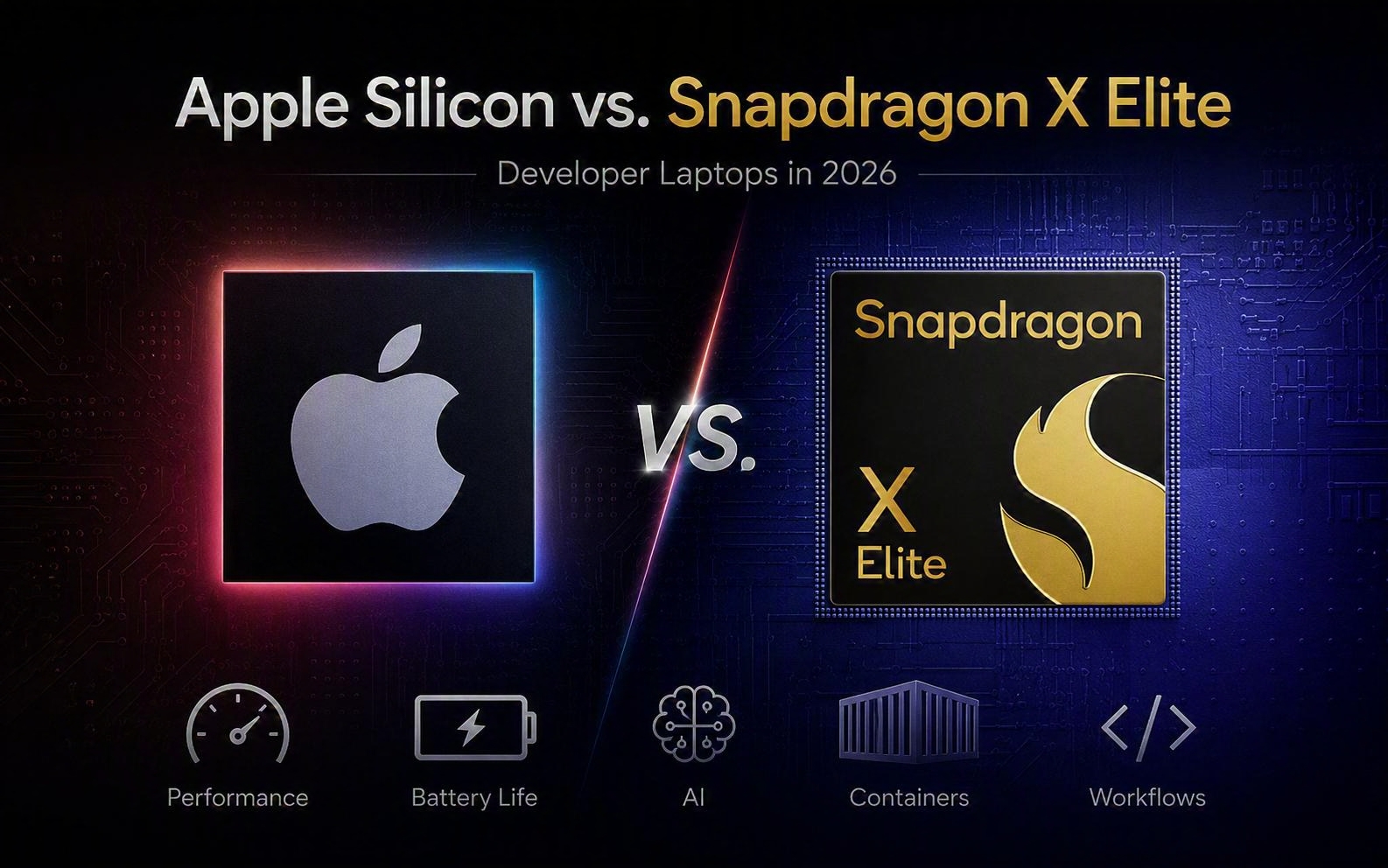
The desktop landscape is witnessing a major transformation driven by the ongoing rivalry of Apple Silicon vs. Snapdragon X Elite. Developers now face a pivotal choice when selecting their next high-performance portable workstation. Consequently, engineering teams must evaluate these competing architectures beyond mere synthetic benchmarks.
This hardware transition offers software engineers unprecedented options for quiet, power-efficient mobile software development. Apple established early dominance with its vertically integrated hardware and software stack. Meanwhile, Qualcomm’s horizontal platform strategy enables multiple laptop manufacturers to ship competitive Windows-on-ARM hardware. This strategy allows original equipment manufacturers to experiment with diverse laptop form factors. These systems deliver impressive real-world battery life without sacrificing critical daily performance.
Furthermore, the rapid shift toward ARM architecture ensures long-term software support from major platform vendors. Both platform ecosystems have crossed the line from technological curiosities to highly credible engineering environments. Additionally, mainstream development applications now run natively across both hardware platforms. This structural maturation reduces the friction developers previously faced when migrating from legacy architectures.
Architectural Divergence and Nuvia Heritage
At the heart of Qualcomm’s strategy lies the custom Oryon CPU core technology. This design stems from Qualcomm’s strategic acquisition of startup Nuvia. Specifically, the Snapdragon X Elite features twelve homogeneous high-performance CPU cores. These Oryon cores run up to a base clock of 3.4 GHz under full multithreaded loads. Conversely, Apple utilizes a heterogeneous architecture combining high-performance and efficiency cores. This hybrid approach balances raw peak performance with industry-leading baseline power draw. Apple integrates the CPU, GPU, and neural engine into a single unified memory pool. Subsequently, this layout eliminates high-latency data-copy penalties across the system PCIe bus.
The Adreno graphics processing unit delivers DirectX support for Windows-based visual development pipelines. This graphics implementation targets mainstream creative tasks. However, Apple’s custom graphics processor maintains a significant lead in raw offscreen rendering frame rates. Apple’s GPU cores leverage tight operating system integration to execute creative tasks predictably. Therefore, macOS systems deliver highly consistent performance during heavy graphic rendering pipelines. Qualcomm relies on partners like Microsoft to bridge the hardware and software divide. Developers must consider these hardware differences before choosing a specific ARM platform.
Compilation Performance and Benchmark Realities
Developers measure laptop capability by testing compile times and parallel multi-core performance. Under sustained load, Snapdragon’s twelve high-performance cores achieve impressive parallel computing throughput. Additionally, Visual Studio project compilations complete fast on the Snapdragon platform. A standard C++ compilation task finishes in thirty-seven seconds under active cooling. Meanwhile, comparable old-generation x86 hardware requires fifty-four seconds to complete the same task.
Single-core performance remains critical for interface responsiveness and lightweight developer toolchains. Apple M3 and M4 chips continue to dominate this single-threaded performance category. Consequently, everyday tasks like code editing feel noticeably quicker on macOS laptops. Unoptimized x86 development tools running on Windows ARM suffer from minor translation latency. Accordingly, native ARM compilation tools deliver the best real-world responsiveness on Snapdragon devices. Benchmark data proves that native compilation maximizes the strengths of both architectures. Multi-threaded workloads scale predictably when developers use optimized tools.
Cinebench Performance: Apple vs. Snapdragon
Compares Single-Core (max 200) and Multi-Core (max 1432) raw rendering throughput.| Processor SoC | Core Structure | CB Single-Core | CB Multi-Core | NPU Power (TOPS) | Memory Bandwidth |
| Snapdragon X Elite | 12 Homogeneous | 124 | 972 | 45 | 135 GB/s |
| Apple M3 Series | Hybrid Heterogeneous | 140 | 900 | 30 | 100 GB/s |
| Apple M4 Series | Hybrid Heterogeneous | 178 | 968 | 38 | 120 GB/s |
| Snapdragon X2 Elite | Custom Oryon Gen 2 | 146 | 1432 | 80 | Over 100 GB/s |
| Apple M5 Chip | Next-Gen Silicon | 200 | 1153 | Advanced | Ultra-High |
Apple Silicon vs. Snapdragon X Elite in Container Workflows
Modern software engineering relies heavily on containerization tools like Docker and virtual machines. Docker historically suffered from file-sharing latency on macOS platforms. However, Apple mitigated this issue by introducing the VirtioFS framework for fast local virtualization. This framework provides significantly faster folder synchronization than legacy file sharing methods. Consequently, macOS developers compile code inside containers with minimal input-output delays.
Windows on ARM handles containers natively through the Windows Subsystem for Linux. Docker in WSL2 performs exceptionally well when compiling native ARM64 container images. Furthermore, native ARM64 images start almost four times faster than translated legacy x86 images. Forcing x86 container translation requires QEMU emulation. Additionally, this emulation layer introduces persistent processor overhead and higher memory consumption. Developers should verify that their external software dependencies provide official ARM64 container targets. Toolchain support remains a key determinant of speed in local virtualized environments.
Developer Workflow Efficiency
Highlights compilation and local container speeds derived from real-world testing.Efficiency, Thermals, and Recent Innovations
Energy consumption directly influences the daily experience of developers working away from power outlets. Snapdragon laptops deliver up to fifteen hours of battery life during lightweight coding tasks. Meanwhile, Apple MacBooks achieve similar endurance with far more predictable battery drain curves. Apple’s custom M-series silicon designs operate highly efficiently under passive thermal configurations. Alternatively, Snapdragon systems frequently require active cooling to prevent CPU throttling during sustained builds.
Recent market developments show both silicon manufacturers aggressively pushing boundaries for upcoming product launches. Qualcomm announced the Snapdragon X2 Elite platform with eighty TOPS of AI capability. Indeed, early leaks show the X2 Elite surpassing Apple’s M5 chip in multi-threaded rendering. Apple maintains a clear lead in single-core responsiveness and overall graphical rendering efficiency. Therefore, the upcoming hardware generation promises even tighter performance margins for modern developers. Competition drives rapid hardware innovation across both the macOS and Windows laptop ecosystems. Developers ultimately benefit from this intense competition between the industry’s top silicon designers.
NPU AI Capability
Measures Neural Processing Unit power in Trillions of Operations Per Second (TOPS).Strategic Takeaways for Development Teams
Choosing a developer platform requires matching hardware characteristics to your team’s specific software toolchain. Apple Silicon remains the safest path for engineers who prioritize absolute system stability. Nonetheless, the Snapdragon platform represents a viable alternative for teams requiring native Windows environments. Modern Windows translation layers handle legacy corporate applications with very high success rates. Consequently, corporate developers can confidently adopt ARM hardware without fear of immediate workflow breakage.
The decision ultimately hinges on whether your team values a closed, highly optimized pipeline. Apple’s vertical integration ensures that software updates rarely introduce unexpected compiler or virtualization regressions. Conversely, Snapdragon’s horizontal model offers incredible hardware diversity and competitive pricing options. Individual computer manufacturers customize cooling designs and battery capacities to fit different engineering budgets. Thus, software architects must weigh structural consistency against deployment flexibility. Both platforms clearly demonstrate that high-performance ARM developer laptops are no longer just a temporary trend. Hardware choices will shape developer productivity and software architecture choices for years to come.
Support Our Work
Help us keep creating and maintaining our projects. We appreciate your support!
Ways to contribute:
Shop via Affiliate LinksSupport us at no extra cost to you while you shop.
Support on Ko-fiBuy us a coffee to keep the engine running!




Leave a Reply