
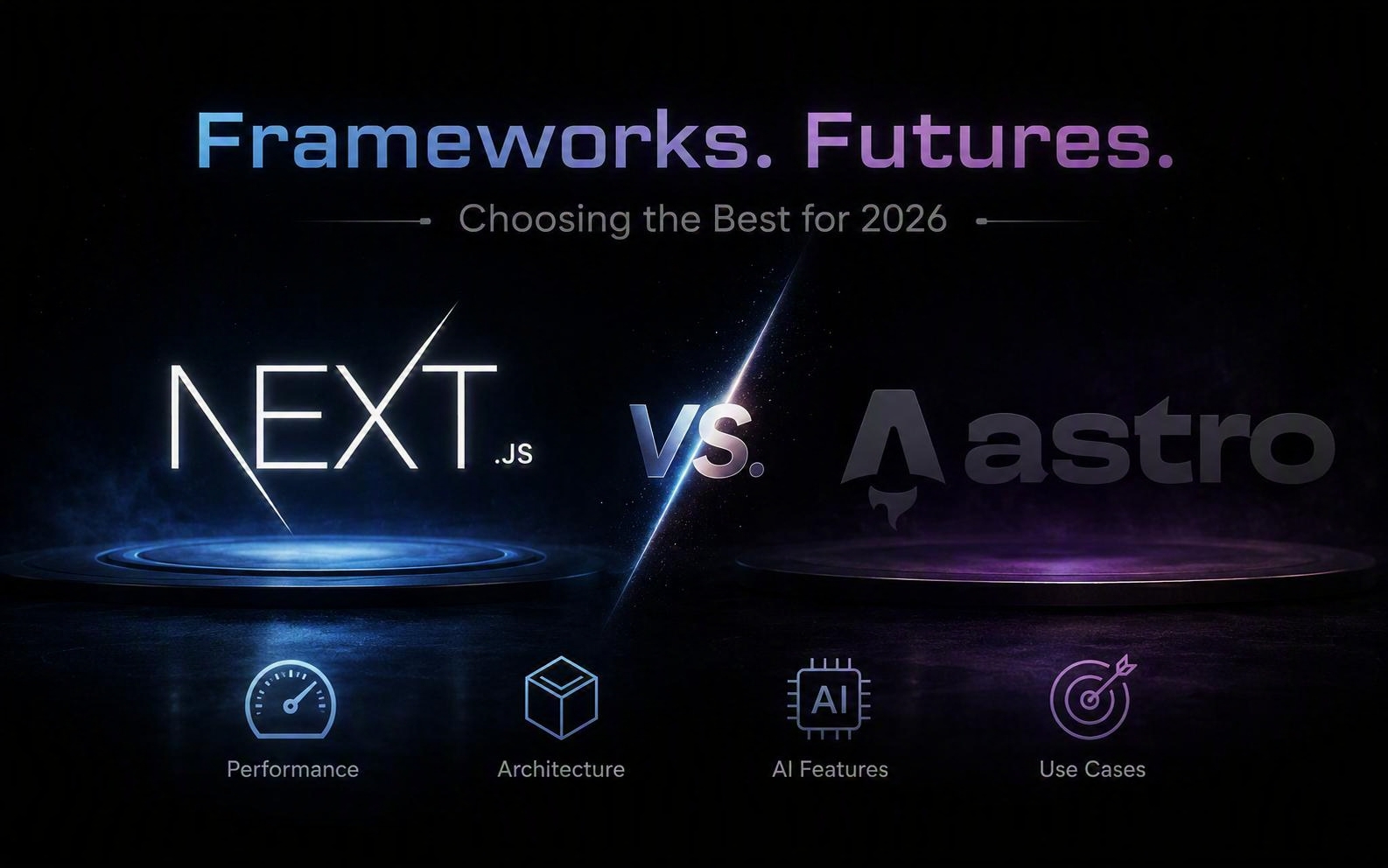

Analyzing Next.js vs. Astro in Enterprise Architecture

- FAST RUNS IN THE FAMILY — The 16-inch MacBook Pro with the M5 Pro or M5 Max chip brings next-generation speed and powerf…
- BUCKLE UP — Along with a next-generation CPU, faster unified memory, and up to 2x faster SSD storage,* M5 Pro and M5 Max…
- BUILT FOR AI — Apple silicon, and every major component that powers it, is designed to run demanding on-device AI worklo…
Web developers constantly search for faster, more efficient digital building tools. Therefore, comparing these leading frontend platforms remains highly essential for modern enterprise success. The ongoing debate of Next.js vs. Astro represents two opposing software philosophy paradigms. Next.js focuses on dynamic, server-rendered applications with interactive user experiences. Conversely, Astro champions static-first web performance and lightweight build outputs. Developers must understand these fundamental differences in mid-2026.
Both frameworks have evolved rapidly to meet strict enterprise requirements. Meanwhile, they are targeting different types of modern digital projects. Next.js excels when applications require real-time updates and high interactivity. On the other hand, Astro provides perfect solutions for content-heavy sites. Subsequently, choosing the correct tool depends entirely on specific performance goals.
Modern digital landscapes demand rapid page loads and great user experiences. Additionally, search engines prioritize loading speed when indexing various web pages. These strict requirements force technical teams to evaluate their options very carefully. Thus, selecting the ideal architecture remains a critical business planning decision.
Next.js: The Dynamic Application Champion
Next.js remains a dominant force under Vercel’s active enterprise stewardship. Indeed, the framework continues to mature its robust full-stack React capabilities. Version 16.2 represents a massive performance leap for modern developers. Specifically, Turbopack is now the default production and development bundler. This native engine speeds up local server startup by roughly 400 percent. Furthermore, it completes production builds up to five times faster.
Next.js 16.2 also simplifies routing mechanisms and dynamic data caching. Instead of utilizing confusing implicit caching, developers write the explicit ‘use cache’ directive. This simple directive delivers highly predictable caching behavior across dynamic pages. Additionally, stable Partial Prerendering creates instant HTML shell layouts for complex routes. These speed enhancements elevate the overall end-user experience to new technical heights.
Vercel is actively aligning its frontend platform with artificial intelligence tools. Consequently, Next.js 16.2 introduces dedicated local tooling for AI coding agents. The framework generates a structured local AGENTS.md file automatically during startup. Furthermore, it bundles version-matched documentation as Markdown files for local reference. These smart tools allow developers to build intelligent applications seamlessly.
Astro: The Static Content Leader
Astro has firmly established itself as the premier framework for content-first websites. Indeed, its global npm bundle adoption doubled throughout the last twelve active months. Astro 7.0 officially arrived in June 2026 with outstanding technical compiler upgrades. Specifically, the core engineering development team completely rebuilt the core compiler in Rust. This replacement of the old Go compiler guarantees remarkably faster local builds. Moreover, the framework integrates Vite 8 and the Rust-based Rolldown bundler.
Astro 7.0 also introduces Sätteri as the default local Markdown processor. Sätteri operates as a native, high-speed parsing pipeline using Rust language. Consequently, large documentation portals experience build times decreasing by over a minute. This massive reduction represents a significant financial saving for enterprise CI/CD pipelines. Furthermore, the tool supports advanced Markdown and MDX features natively without plugins.
Performance remains Astro’s primary selling point for frontend engineering teams. Indeed, the framework ships zero client-side JavaScript to the browser by default. However, developers can add interactive elements selectively using the islands architecture. Thus, static websites maintain exceptional loading speeds and maximize organic search rankings.
Technical Evolution: Next.js vs. Astro Core Performance
Comparing the overall rendering performance of these tools requires analyzing how they handle JavaScript. Next.js always ships a heavy client-side React runtime to the client browser environments. Subsequently, this baseline runtime bundle size usually starts around 85 kilobytes. In contrast, standard Astro web pages load with zero JavaScript by default. Therefore, Astro websites consistently achieve higher initial Lighthouse performance scores globally.
Both platforms handle complex backend application databases and logic very differently. Next.js provides robust React Server Components and dynamic, full-stack React server actions. Alternatively, Astro uses Server Islands to defer rendering of heavy interactive components. This unique architectural layout ensures that the initial page paint remains incredibly rapid. Meanwhile, dynamic data streams in smoothly after the static layout loads.
Mobile device optimization is another critical area where these frameworks diverge. Specifically, heavy JavaScript bundles can slow down performance on low-end mobile devices. Indeed, Astro’s lightweight static output thrives in these highly restricted environments. Conversely, Next.js requires more powerful hardware processing to complete client-side hydration. Thus, mobile-first audiences will notice faster load times on Astro pages.
| Feature | Next.js 16.2 | Astro 7.0 |
| Default Bundle Size | ~85KB React runtime | 0KB JavaScript |
| Rendering Concept | Server Components (RSC) | Islands Architecture |
| Dynamic Hydration | Full page hydration | Selective component hydration |
| Markdown Processing | Requires external libraries | Built-in Rust Sätteri pipeline |
| Default Bundler | Rust-based Turbopack | Rust-based Rolldown |
| Framework Lock-in | Locked to React | Multi-framework support |
| Primary Backing | Vercel ($9.3B valuation) | Cloudflare (Acquired 2026) |
Corporate Support and Future Security Strategies
Major corporate investments heavily shape the future trajectories of both web frameworks. Vercel closed an oversubscribed 300 million dollar Series F round in late 2025. This massive corporate transaction valued the frontend cloud platform at 9.3 billion dollars. Additionally, Vercel announced a multi-year partnership with the Mercedes-AMG PETRONAS Formula One Team. These extensive financial resources fuel aggressive future scaling for Vercel’s enterprise AI cloud services.
However, Vercel faced unexpected platform security infrastructure challenges in April 2026. An unauthorized actor accessed internal systems through a compromised third-party AI tool. This digital data breach exposed non-sensitive environment variables for a small subset of customers. Consequently, Vercel immediately strengthened its secure secret management and internal hygiene. These proactive security measures restored trust among its massive enterprise developer client base.
Astro also underwent a massive corporate and structural business transformation recently. Specifically, Cloudflare acquired The Astro Technology Company on January 16, 2026. All full-time Astro employees joined Cloudflare to focus entirely on core development. Nevertheless, Astro remains open-source and committed to multi-platform deployment flexibility. Thus, developers can still host Astro projects on Netlify, Vercel, or AWS.
Choosing Your Modern Frontend Solution
Selecting between these powerful frameworks depends heavily on specific product requirements. Next.js is the absolute best choice for highly dynamic, interactive enterprise SaaS platforms. Indeed, its unified backend API routes and robust global state management are unmatched. Therefore, teams building interactive web software should select Next.js.
Conversely, Astro is the ultimate option for static content-driven digital experiences. Corporate marketing sites, technical documentation, and personal web blogs thrive on Astro. Specifically, the combination of Sätteri and Vite 8 makes Astro unstoppable. Consequently, developers seeking perfect Core Web Vitals performance scores should adopt Astro 7.0.
Both ecosystems offer highly incredible tools for the modern web. Additionally, their rapid engineering advancements are pushing the entire frontend industry forward. Ultimately, this critical choice will shape team workflows and performance metrics. Hence, engineering teams should experiment with both solutions to discover their ideal stack.
Support Our Work
Help us keep creating and maintaining our projects. We appreciate your support!
Ways to contribute:
Shop via Affiliate LinksSupport us at no extra cost to you while you shop.
Support on Ko-fiBuy us a coffee to keep the engine running!





Leave a Reply