


- Bring virtual worlds to life with WQHD quality: Explore your games’ vast, detailed landscapes with WQHD resolution and f…
- Dive into expansive details: Whether you’re exploring open worlds or completing challenges, you’ll never miss a detail t…
- Fluid Performance: Get in the game with a smooth 180Hz refresh rate, 1ms gray to gray response time, AMD FreeSync Premiu…
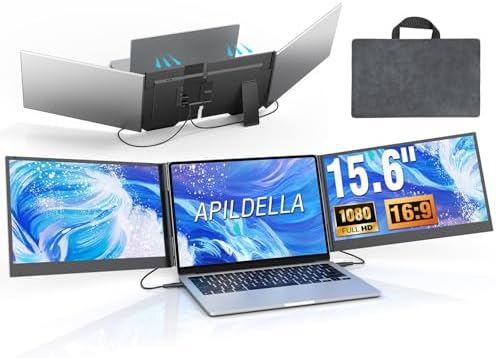
- 【2 Cable Connection】 This 15.6-inch laptop extender features the latest technology for 2026 and has undergone a complete…
- 【Ultra-thin and Lightweight Design】 This travel screen extender has an aerospace-grade aluminum alloy shell for fast hea…
- 【Widely Compatible】Portable external monitor work for 13″-17.3″ laptops, compatible with Mac, Windows, Chrome and Switch…

- DUAL MONITOR SETUP – Curved monitors in a dual setup provide a seamless viewing experience with reduced peripheral disto…
- ERGONOMIC DESIGN – The 1500R curved design provides a more comfortable viewing experience by reducing eye strain and nec…
- FAST RESPONSE TIME – Fast response times reduce ghosting & blurring while transitioning pixels, always keeping the enemy…
Modern Workspaces in 2026
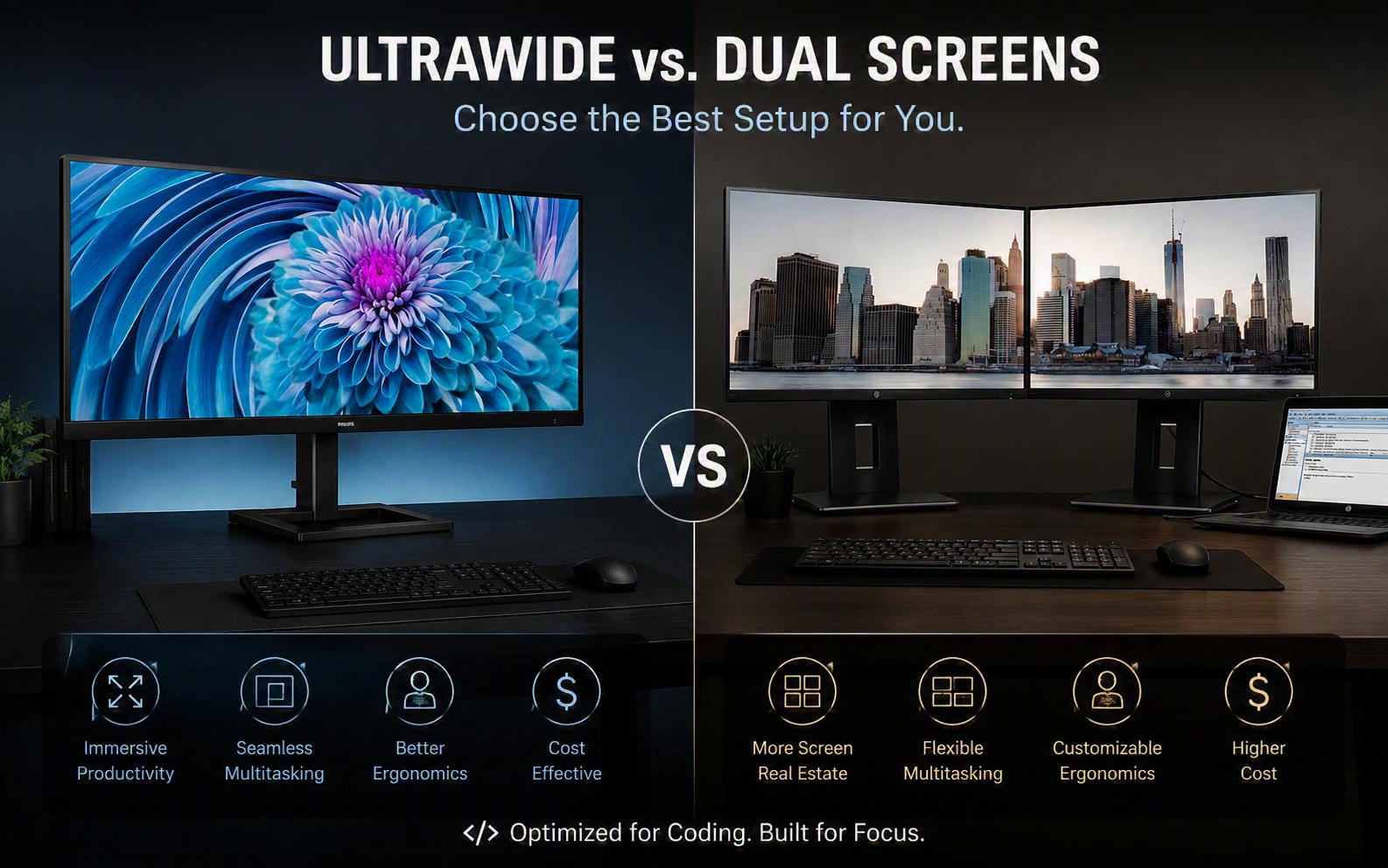
Selecting the optimal workspace display configuration represents a critical technical decision for software engineers. Specifically, the structural debate over an Ultrawide Monitor vs. Dual Screens setup dictates daily programming workflows. The physical layout directly influences visual focus, cognitive load, and daily typing efficiency. Consequently, choosing an incompatible screen system often leads to severe eye strain and desk clutter. Professionals must analyze their development tasks comprehensively before purchasing expensive premium monitors. Different software engineering disciplines require unique panel properties to maintain peak operational output.
Recently, major display manufacturers have introduced advanced screen technologies to capture this lucrative professional market. For instance, LG Commercial Display released updated business panels in May 2026 to streamline complex multitasking. Meanwhile, Samsung showcased high-resolution Odyssey monitors at CES 2026 to assist creators and developers. These corporate innovations offer modern software developers highly sophisticated alternatives to traditional multi-panel workstations. Therefore, evaluating the hardware strengths of each configuration assists in building an efficient desktop.
Pixel Density & Panel Technology
Ultrawide Monitor vs. Dual Screens
Large curved panels offer exceptional visual continuity to minimize physical neck turning during long coding sessions. Indeed, high-end ultrawide monitors like the Dell U4025QW provide an expansive 5120×2160 resolution. The built-in IPS Black technology delivers a 2000:1 contrast ratio for deep black levels in dark themes. Additionally, LG now ships the 39GX950B Tandem OLED display featuring a native 165Hz frame rate. This high-density panel reaches 143 pixels per inch to render small code characters with extreme clarity. The gentle 1500R curvature keeps the display edges within a natural human field of vision.
Conversely, a dual-monitor system traditionally pairs two separate widescreen displays such as 27-inch 4K screens. This setup offers an impressive total resolution of 7680×2160 pixels for broad multitasking workspaces. Furthermore, employing two independent displays allows users to run full-screen software programs on separate devices. Programmers can comfortably center their primary text editor while keeping auxiliary web resources open nearby. However, plastic screen bezels inevitably create a physical gap that disrupts continuous horizontal mouse movements.
Hardware Specifications
| Feature | Single Ultrawide | Dual Traditional | Stacked Panel |
|---|---|---|---|
| Exemplar Model | Dell U4025QW | Two Dell U2723QE | LG DualUp 28MQ780 |
| Screen Size | 39.7 Inches Curved | Two 27.0 Inches Flat | 27.6 Inches Flat |
| Aspect Ratio | 21:9 Widescreen | Dual 16:9 Displays | 16:18 Dual-QHD |
| Pixel Density | 140 Pixels Per Inch | 163 Pixels Per Inch | 140 Pixels Per Inch |
| USB-C Hub | Thunderbolt 4 (140W) | Integrated Hub (90W) | Dedicated Hub (90W) |
| Hardware KVM | Integrated Auto-KVM | Network KVM Switch | Built-in KVM Port |
Optimizing Your Window Layout
Positioning multiple windows requires sophisticated software solutions to maximize daily programming performance. Software tools like Microsoft PowerToys FancyZones allow programmers to define custom grid zones on ultrawides. Developers can easily organize several code columns next to each other without manual window resizing. Using these custom columns, software engineers can view text repositories, terminal outputs, and live API documentation. macOS developers can also deploy automated window management platforms to maintain clean workspace environments.
Alternatively, multi-monitor configurations rely on native desktop snapping functions to spread software applications across screens. Users can comfortably maximize a complex compiler on one monitor while tracking ongoing team communications elsewhere. Thus, physical screen dividers establish clean visual boundaries that prevent windows from overlapping or getting lost. This separation helps many developers compartmentalize core testing and writing tasks away from secondary distractions. Ultimately, the choice depends on whether a programmer prefers a unified digital canvas or distinct screens.
Window Layout Management
Ultrawide Setup
- Seamless visual alignment without physical gaps
- Custom grid zones via Microsoft PowerToys FancyZones
- Multiple parallel code columns without manual resizing
- Continuous horizontal mouse movement
Dual Screen Setup
- Clean physical boundaries prevent window overlapping
- Native OS desktop snapping across displays
- Independent full-screen software compartmentalization
- Ability to orient one panel vertically for scripts/logs
Streamlining Desk Cables and Mounts
Desktop organization and neat physical ergonomics play a critical role in preventing visual and muscle fatigue. Moreover, a premium ultrawide panel dramatically simplifies cable management by using a single video input connection. Curved displays like the Dell U4025QW charge connected laptops with 140W of power over Thunderbolt. This advanced interface seamlessly carries high-speed network traffic, peripheral data, and video signals in one cable. Workspace designers can readily maintain clean desks without needing expensive external docking stations.
Dual-monitor arrangements demand extensive power configurations and multiple video lines to function correctly. Computer hardware setups must daisy-chain the monitors or connect separate output lines from the host computer. Unfortunately, Apple laptops do not natively support DisplayPort Multi-Stream Transport daisy-chaining over single USB-C ports. Subsequently, macOS developers must deploy specialized docking hubs or run separate cables to each individual display. Likewise, managing two independent monitors often requires sturdy dual-arm desk mounts to ensure precise physical alignment.
Ergonomics & Desk Infrastructure
Choosing Your Perfect Desktop Setup
Both system designs present excellent physical benefits for software developers handling demanding daily project timelines. A large ultrawide display fits professional settings where seamless image alignment remains a core requirement. A single panel avoids central bezel gaps and makes continuous timeline scrubbing highly immersive for developers. Instead, purchasing a unified 5K2K display generally incurs a substantial initial cost compared to dual displays. Budget planners must balance these visual efficiency gains against immediate hardware procurement expenses. Traditional setups offer simpler hardware deployment options when scaling a business department.
Double widescreen configurations remain the primary deployment when developers prefer distinct visual divisions on their desktop. This physical layout provides generous viewing areas and allows independent full-screen management for separate software programs. Dual mounts allow programmers to orient one of the displays vertically to review long scripts. Portrait modes excel at presenting endless files of database tables and legacy code files without scrolling. Overall, both display strategies will significantly upgrade programming output when configured to match developer tasks.
Support Our Work
Help us keep creating and maintaining our projects. We appreciate your support!
Ways to contribute:
Shop via Affiliate LinksSupport us at no extra cost to you while you shop.
Support on Ko-fiBuy us a coffee to keep the engine running!




Leave a Reply