
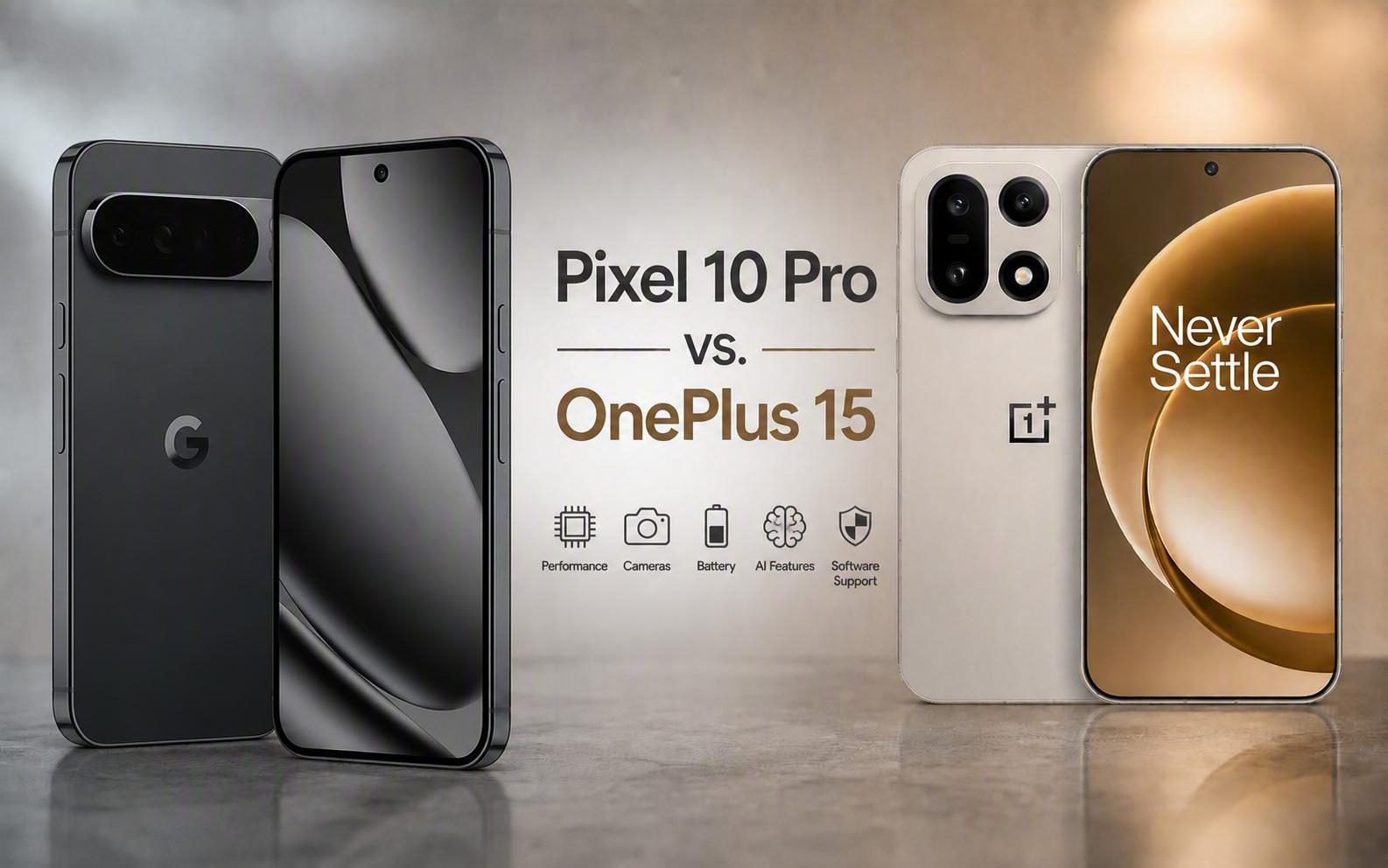


Industry Landscape and Flagship Strategies
The rivalry between the Google Pixel 10 Pro vs. OnePlus 15 showcases two distinct visions for mobile technology. Smartphone manufacturers must balance processing efficiency, camera quality, and software longevity in modern designs. Furthermore, Google emphasizes deep artificial intelligence integration and sleek physical aesthetics across its lineup. The search giant leverages custom silicon to enhance user convenience and daily automation.
Conversely, OnePlus builds high-performance hardware designed for demanding mobile gamers and power users. The company focuses heavily on industry-leading battery capacity and rapid wired charging solutions. Therefore, consumers face a direct choice between computational intelligence and extreme raw horsepower. This detailed report analyzes both flagship devices across key operational metrics and engineering choices.
Silicon Architecture and System Performance
Google built its newest flagship around the custom-designed Tensor G5 system-on-chip. Specifically, TSMC manufactures this advanced three-nanometer processor to improve overall power efficiency. The octa-core CPU architecture pairs a single high-performance Cortex-X4 core with five Cortex-A725 cores. Additionally, a fourth-generation Tensor Processing Unit accelerates on-device Gemini AI tasks dramatically. Benchmark tests show a thirty-four percent CPU speed gain over previous Pixel generations.
However, Qualcomm powers the competing OnePlus flagship with the formidable Snapdragon 8 Elite Gen 5. This chip utilizes custom Oryon V3 CPU cores clocked up to four point six gigahertz. Consequently, the device achieves exceptional peak performance in intensive graphic rendering benchmarks. Gamers will experience significantly higher frame rates during extended demanding gameplay sessions.
Display Innovation and Structural Durability
The Google Pixel 10 Pro features a compact six point three inch Super Actua LTPO display. This OLED panel dynamically adjusts its refresh rate from one to one hundred twenty hertz. Moreover, the screen reaches an impressive peak brightness of three thousand three hundred nits. Durable Gorilla Glass Victus 2 protects both the front glass and frosted rear panel.
In contrast, OnePlus equips its smartphone with a larger six point seven eight inch BOE display. The vibrant AMOLED panel supports a fluid one hundred sixty-five hertz maximum refresh rate. Furthermore, the device earns an advanced IP69 rating against high-pressure water jets and dust. This robust ingress protection ensures outstanding mechanical resilience during adverse environmental conditions.
Camera Hardware and Computational Imaging
Google implements a refined triple rear camera array on its flagship compact phone. The system includes a fifty-megapixel primary sensor and a forty-eight-megapixel ultrawide camera lens. Meanwhile, a forty-eight-megapixel periscope telephoto lens provides five-times optical zoom capabilities. Advanced generative artificial intelligence enables crystal-clear imagery even at extreme digital zoom levels.
On the other hand, OnePlus incorporates three fifty-megapixel image sensors across its camera array. The main sensor uses a high-end Sony LYT-700 image capture component with optical stabilization. Dual Samsung ISOCELL JN5 sensors power the ultrawide module and three point five telephoto camera. Nevertheless, Google retains an edge in computational photography and low-light image processing.
Battery Engineering and Hardware Specifications
OnePlus engineered a massive seven thousand three hundred milliamp-hour Silicon NanoStack glacier battery. As a result, the device dominates battery endurance tests across continuous browsing and video playback. Rapid one hundred twenty-watt wired charging restores a full charge within twenty minutes. The device also supports fast fifty-watt wireless charging using compatible proprietary charging pads.
In comparison, Google integrates a four thousand eight hundred seventy milliamp-hour battery cell. The company introduced magnetic Qi2 wireless charging under its original Pixelsnap product branding. MagSafe-compatible power banks attach directly onto the rear casing for aligned energy delivery. The table below details key hardware specifications for both flagship mobile devices.
| Hardware Parameter | Google Pixel 10 Pro | OnePlus 15 |
| Display Size & Type | 6.3-inch LTPO OLED (1–120Hz) | 6.78-inch BOE LTPO AMOLED (1–165Hz) |
| Processor Architecture | Google Tensor G5 (TSMC 3nm) | Snapdragon 8 Elite Gen 5 (3nm) |
| RAM & Storage Tiers | 16GB / 128GB to 1TB UFS 4.0 | 12GB–16GB / 256GB to 1TB UFS 4.1 |
| Primary Rear Camera | 50MP f/1.68 Wide Sensor | 50MP Sony LYT-700 Sensor |
| Telephoto Lens | 48MP 5x Optical Periscope | 50MP 3.5x Optical Periscope |
| Battery Capacity | 4,870 mAh | 7,300 mAh Silicon NanoStack |
| Charging Technologies | 30W Wired / 15W Qi2 Pixelsnap | 120W SuperVOOC / 50W Wireless |
| Water Resistance Class | IP68 Certification | IP68 / IP69K Dual Certification |
| Software Commitment | 7 Years Major OS Upgrades | 4 Years Major OS Upgrades |
Software Ecosystems and Upgrade Longevity
Google delivers Android 16 alongside its Material 3 Expressive user interface theme out of the box. The platform features new software capabilities including Magic Cue and automated Call Notes. Thus, users receive an intuitive operating system tailored around proactive generative assistant tools. Google pledges seven full years of major operating system and security software updates.
Alternatively, OnePlus couples Android 16 with its customized OxygenOS 16 software overlay. The skin offers smooth animations, heavy customization options, and fast application launching speeds. However, the vendor guarantees four years of operating system upgrades for global device variants. Enterprise customers must weigh immediate hardware performance against long-term operating system support.
Market Positioning and Strategic Takeaways
Both devices highlight contrasting product strategies within the high-end Android market segment. Google successfully established its custom TSMC manufacturing pipeline for long-term silicon independence. Consequently, the Pixel lineup delivers unified artificial intelligence hardware and software integration. The compact frame appeals directly to users seeking top-tier cameras in a manageable form factor.
Meanwhile, OnePlus reinforces its reputation as a performance benchmark leader with aggressive specs. The combination of Snapdragon processing power and glacier battery tech sets new endurance standards. Ultimately, consumer choice depends on whether processing speed or computational smarts matter most. Both manufacturers continue pushing technological boundaries across the mobile device industry.
Support Our Work
Help us keep creating and maintaining our projects. We appreciate your support!
Ways to contribute:
Shop via Affiliate LinksSupport us at no extra cost to you while you shop.
Support on Ko-fiBuy us a coffee to keep the engine running!


Leave a Reply