

Market Evolution and Strategic Positioning
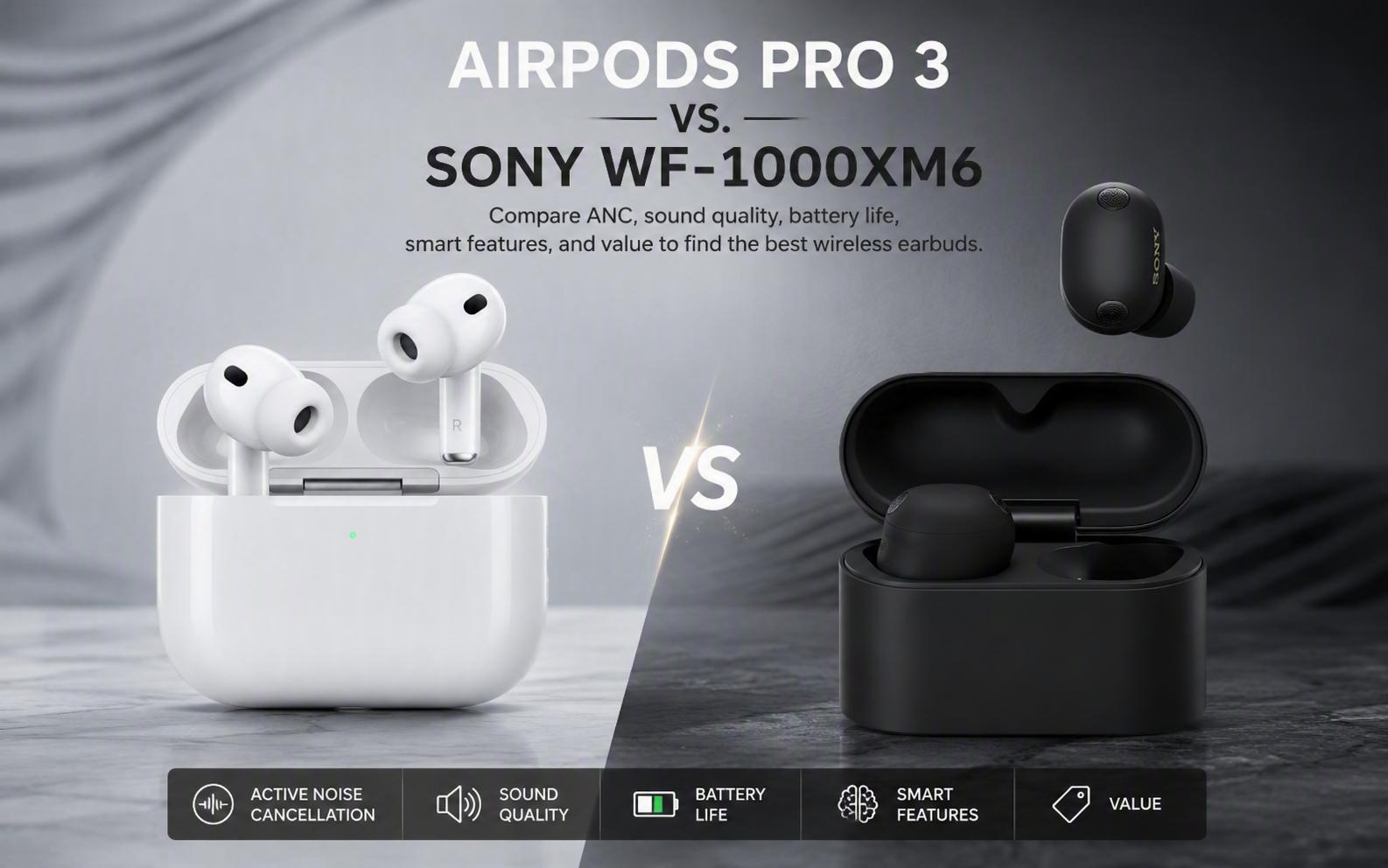
The battle between Apple and Sony reaches a new peak in this AirPods Pro 3 vs. Sony WF-1000XM6 comparison. Apple officially launched the AirPods Pro 3 on September 19, 2025, for $249. Meanwhile, Sony introduced the WF-1000XM6 in February 2026 at $329.99. Both manufacturers target premium audio consumers seeking top-tier portable sound reproduction. Indeed, market competition drives rapid innovation in active noise cancellation and biometric sensing.
Apple keeps its introductory price stable to attract upgrading iPhone owners. However, Sony increases its retail price to cover advanced internal components. Consequently, buyers face a choice between ecosystem synergy and pure acoustic customizability. Industry analysts note that both products redefine expectations for true wireless earbuds. Consumers now evaluate hardware endurance alongside integrated software capabilities.
AirPods Pro 3 vs. Sony WF-1000XM6 Design and Durability
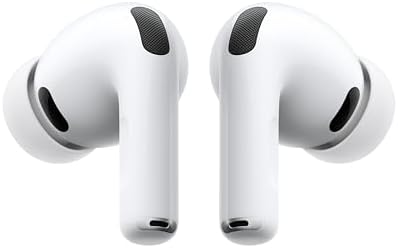
Apple re-engineered the AirPods Pro 3 chassis to deliver superior comfort and security. Furthermore, the earbud package now includes foam-infused ear tips across five distinct sizes. The new housing achieves an IP57 rating against dust, water, and sweat intrusion. Therefore, users can wear these earbuds during intense fitness sessions without concern. Improved stability prevents earbud movement during high-impact running or aerobics.
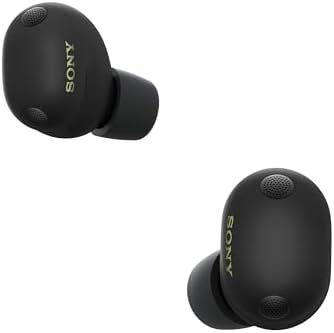
Sony selected an oval structural shape for the WF-1000XM6 earbuds. Additionally, the revised body is eleven percent slimmer than the previous XM5 model. The device carries an IPX4 water resistance rating for everyday outdoor protection. The charging case features sharper structural edges weighing 47 grams. Besides, compact dimensions allow easy storage inside standard pants pockets or small bags.
Acoustic Engineering and Noise Cancellation Power
Active noise cancellation relies heavily on specialized silicon and internal microphone configurations. Apple uses the custom H2 chip to double noise suppression capabilities over prior generations. Specifically, an updated acoustic cavity enhances spatial audio playback for movie streaming. Call quality improves through H2-powered voice isolation algorithms. Voice processing ensures clear speech transmission in windy outdoor settings.
Sony equips the WF-1000XM6 with the new QN3e audio processor. Moreover, eight integrated microphones continuously monitor surrounding environmental noise. An 8.4 millimeter driver unit delivers punchy bass and expansive dynamic soundstage depth. Subsequently, listeners can stream high-resolution audio using the LDAC Bluetooth codec. Dedicated processing reduces audio distortion across all volume levels.
Battery Efficiency and Smart Features
Battery endurance remains vital for power users during long work commutes. Apple delivers eight hours of continuous playback with active noise cancellation enabled. In contrast, transparency mode extends total listening time to ten full continuous hours. The USB-C charging case provides additional power cycles for up to thirty hours. Fast charging provides quick top-ups when battery levels run low.
Sony matches earbud performance with eight hours of noise-cancelled playback. Instead, disabling active noise cancellation extends continuous earbud battery life to twelve hours. The case stores power for twenty-four hours of total wireless listening duration. Hence, a quick five-minute charge supplies sixty minutes of active music listening. Power management optimizations ensure reliable daily battery longevity.
Smart feature developments highlight clear differences in hardware design focus. Apple integrates a photoplethysmography sensor that pulses infrared light 256 times per second. Thus, users track heart rate data across fifty workout types in the Fitness app. Apple Intelligence enables real-time face-to-face live translation during international conversations. Conversely, Sony offers a ten-band equalizer within the Sound Connect software app. Custom sound profiles allow tailored audio listening across different music genres.
Technical Comparison and System Compatibility
Hardware specifications demonstrate how each company approaches mobile audio technology. Direct comparisons illuminate key differences in battery, durability, and processing silicon. Likewise, examining physical dimensions helps users determine earbud portability. The detailed comparison table outlines foundational hardware metrics for both flagship earbuds.
| Hardware Feature | Apple AirPods Pro 3 | Sony WF-1000XM6 |
| Retail Price | $249 | $329.99 |
| Audio Processor | Apple H2 | HD Processor QN3e |
| Microphone Array | Dual beamforming | 8 noise-cancelling mics |
| Codec Support | AAC, SBC, LC3 | LDAC, AAC, SBC, LC3 |
| Battery (ANC On) | 8 hours earbud / 30 hours total | 8 hours earbud / 24 hours total |
| Protection Rating | IP57 dust and water resistant | IPX4 splash resistant |
| Standout Features | Heart rate tracking, Live Translation | 10-band EQ, Voice Passthrough |
System compatibility influences overall long-term product value for diverse smartphone users. Apple optimizes the AirPods Pro 3 specifically for iOS ecosystem devices. As a result, Android owners miss biometric tracking and automated device switching. Sony supports universal Bluetooth multipoint pairing across Android, Windows, and iOS platforms. Multi-device connectivity simplifies switching between laptops and smartphones.
Ecosystem Integration and Strategic Value
Selecting the ideal wireless earbuds depends on personal ecosystem choices and daily habits. Apple offers incredible value at $249 with fitness sensors and rugged IP57 protection. In addition, deep iOS integration makes operation seamless for Apple device owners. Workout tracking features rival dedicated fitness wearables during daily training sessions. Seamless firmware updates maintain long-term device performance.
Sony justifies its $329.99 price through superior acoustic engineering and custom sound controls. Accordingly, audiophiles benefit from LDAC support and extensive ten-band equalizer adjustments. Eight noise-cancelling microphones ensure exceptional background isolation during voice calls. Custom sound profiles enhance audio depth across various media formats.
Market Outlook and Final Verdict
Rapid technological progress reshapes consumer expectations within the true wireless market segment. Apple establishes a dominant position in health-focused personal audio hardware. Meanwhile, Sony reinforces its leadership among audiophiles seeking uncompromised sound fidelity. Cross-platform flexibility remains a major selling point for Sony hardware. Software features continue expanding earbud functionality beyond basic music playback.
Consumers should align earbud choices with existing hardware investment strategies. iPhone owners gain maximum utility from the AirPods Pro 3 feature set. Similarly, Android users find better audio customization within the Sony ecosystem. Price sensitivity will influence adoption rates across different buyer demographics.
Both manufacturers demonstrate impressive engineering achievements in these flagship models. Beyond this, competitive pressures will drive ongoing innovations in future product generations. Active noise cancellation performance reaches unprecedented levels on both platforms. As a consequence, buyers receive exceptional performance regardless of their chosen brand. Wireless audio technology continues transforming everyday personal media consumption. Market demand will reward products combining acoustic clarity with practical utility. Ultimately, both models deliver exceptional value within their targeted user ecosystems.
Support Our Work
Help us keep creating and maintaining our projects. We appreciate your support!
Ways to contribute:
Shop via Affiliate LinksSupport us at no extra cost to you while you shop.
Support on Ko-fiBuy us a coffee to keep the engine running!


Leave a Reply