
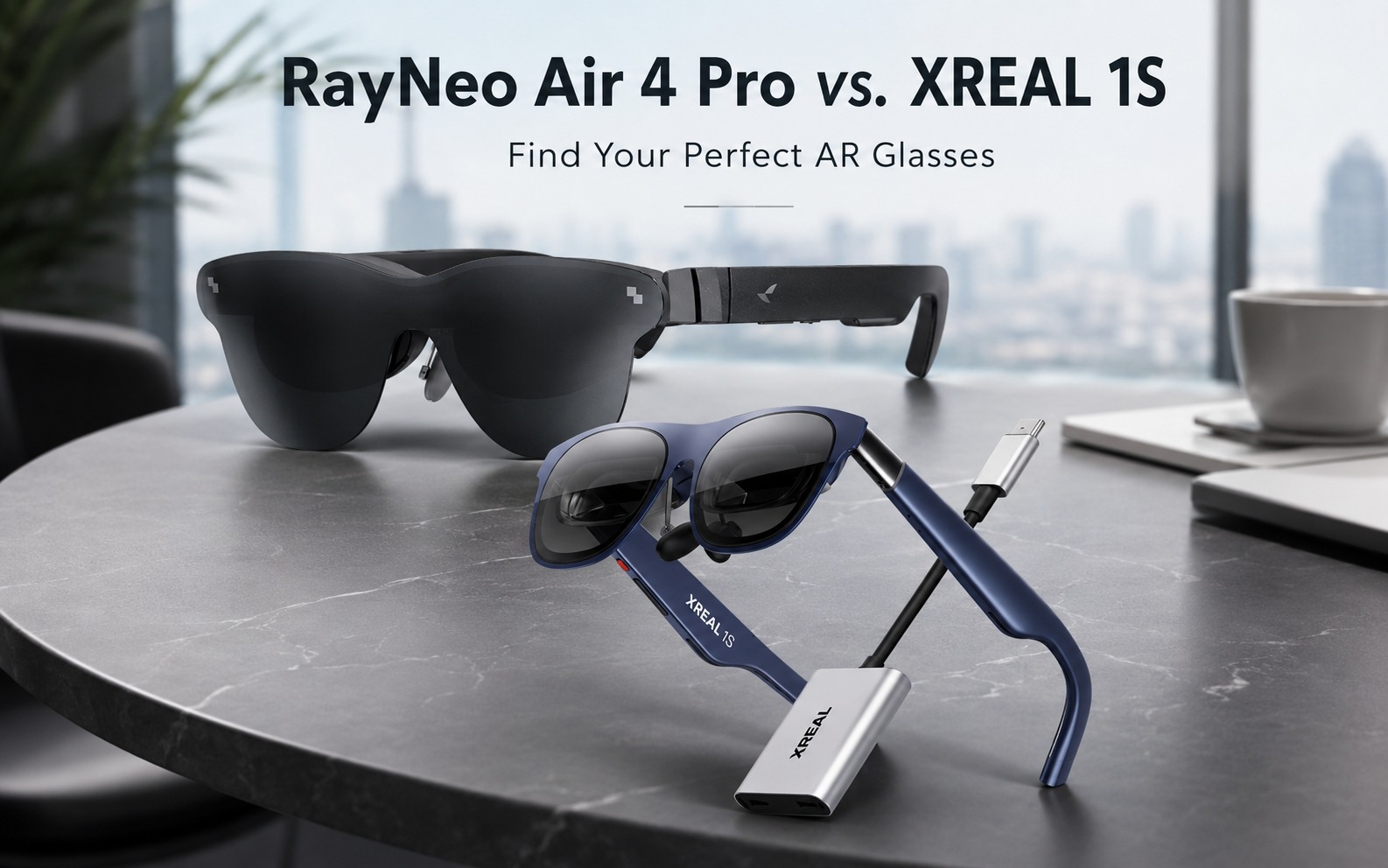


RayNeo Air 4 Pro vs. XREAL 1S AR Glasses Market Entry
Consumer augmented reality displays expanded rapidly during early 2026 product announcements. The direct comparison of RayNeo Air 4 Pro vs. XREAL 1S AR Glasses shows contrasting tech strategies. Both technology leaders aim to replace traditional physical screens with light wearable displays. RayNeo prioritizes dynamic contrast alongside cinematic high dynamic range video processing. Contrastingly, XREAL emphasizes onboard spatial computing chips and elevated panel resolution.
Global pricing strategies reflect these distinct product philosophies across retail markets. RayNeo debuted its flagship glasses at an accessible standard base price of $299. Additionally, early promotional discounts temporarily reduced initial acquisition costs to $249. XREAL positions the updated 1S model at a higher retail price point of $449. Therefore, buyers must decide whether integrated spatial tracking justifies paying additional money.
💰 Market Entry & Pricing
Standard base price and promotional acquisition costs
International launch schedules accelerated competitive dynamics across global consumer markets. RayNeo showcased its new wearables globally at major electronics expos during January 2026. Meanwhile, XREAL released the 1S model directly across digital storefronts and major retailers. Consequently, buyers can easily source both lightweight head-mounted personal displays today.
Visual Performance and Display Engineering
Display quality serves as the primary metric for visual evaluation in wearable electronics. RayNeo incorporates Micro-OLED display panels that output up to 1,200 nits peak brightness. Furthermore, the unit stands out as the world’s first HDR10 certified augmented reality eyewear. A custom Pixelworks Vision 4000 coprocessor provides real-time SDR to HDR content upscaling. As a result, dark entertainment scenes retain full shadow details without washing out dark tones. Reference-grade color calibration maintains low Delta E error metrics below two.
The Air 4 Pro projects a virtual screen equivalent to 201 inches at six meters. Dynamic AI algorithms also support instant real-time 2D to 3D video content conversion. Gamers benefit directly from a smooth 120Hz maximum display refresh rate. High-frequency 3,840Hz dimming reduces visual fatigue during long movie viewing sessions. Specifically, certified low blue light features shield user vision across changing ambient conditions.
XREAL targets high visual sharpness by increasing total pixel density on the 1S. Sony Micro-OLED panels inside the 1S deliver 1920×1200 resolution for each eye. Overall, this upgraded 16:10 aspect ratio provides more vertical space for desktop productivity tasks. Peak display brightness reaches 700 nits under standard operational power settings. The display panel covers 108% of sRGB color space with excellent factory color tuning.
☀️ Display Engineering
Peak brightness, resolution, and HDR capabilities
Spatial Tracking and Optical Control
Onboard hardware processing divides these competing smart display glasses fundamentally. XREAL builds the 1S with its proprietary X1 Spatial Coprocessor chip directly inside. Indeed, this dedicated hardware chip enables native three-degree-of-freedom tracking without external software. Anchor Mode locks projected virtual screens in fixed physical space while wearers turn their heads. Users can adjust virtual display dimensions up to a massive 500-inch virtual screen. Importantly, low motion-to-photon latency of three milliseconds minimizes visual lag during rapid head movements.
Integrated electrochromic dimming provides XREAL wearers with rapid lighting adaptation. Lenses transition automatically between complete transparency and dark tinting levels based on room brightness. Conversely, RayNeo omits electronic lens dimming from the Air 4 Pro frame structure. RayNeo bundles a simple physical snap-on lens shade to block harsh sunlight outdoors. This external shade effectively eliminates screen glare during bright daylight viewing sessions.
RayNeo relies on connected host devices to calculate extended spatial orientation data. Thus, this architectural approach minimizes heat accumulation near user temples during operation. Standard USB-C DisplayPort compatibility allows instant connection to smartphones, consoles, and computers.
⚙️ Spatial Tracking & Optics
Hardware processing and lens dimming technology
🕵️ RayNeo Air 4 Pro
- 💻 Host Device Dependent Tracking
- ❄️ Minimizes Heat Accumulation
- 👓 Attachable Physical Lens Shade
- 🔌 USB-C DisplayPort Plug & Play
🕵️ XREAL 1S
- 🤎 Native 3DoF via X1 Coprocessor
- 📌 Spatial Anchor Mode Included
- 🕶️ Auto Electrochromic Dimming
- ⏱️ 3ms Motion-to-Photon Latency
| Specification / Feature | RayNeo Air 4 Pro | XREAL 1S |
| Retail Price | $299 MSRP (Launch Promo $249) | $449 MSRP |
| Display Panel | Tandem Micro-OLED | Sony Micro-OLED |
| Resolution Per Eye | 1920 x 1080 (16:9 Aspect Ratio) | 1920 x 1200 (16:10 Aspect Ratio) |
| Peak Brightness | 1,200 nits | 700 nits |
| HDR Support | HDR10 Hardware Decoding | Standard Dynamic Range |
| Max Refresh Rate | 120Hz Adaptive | 120Hz Adaptive |
| Spatial Tracking | Host Device Dependent | Native 3DoF via X1 Chip |
| Optical Dimming | Attachable Physical Lens Shade | Automatic Electrochromic Dimming |
| Acoustic Setup | Quad-speakers by Bang & Olufsen | Dual speakers with Sound by Bose |
| Frame Weight | 76 grams | 82 grams |
Acoustic Architecture and Audio Tuning
Immersive personal audio significantly enhances viewing comfort during travel or remote work. RayNeo integrated a quad-speaker acoustic array co-tuned with audio specialists from Bang & Olufsen. Dual opposing acoustic chambers direct private surround sound directly toward user ears. Notably, Whisper Mode 2.0 uses directional sound channels to prevent audio leakage into surroundings. Directional acoustic isolation cuts unwanted audio bleed by up to 80 percent during playback. Hence, users can enjoy private movies on crowded public transit without disturbing neighbors.
XREAL partnered with Bose acoustic engineers to tune sound delivery on the 1S glasses. Integrated stereo speakers rely on Spatial Sound 4.0 software algorithms for soundstage expansion. However, sound leakage remains slightly noticeable when listening at high volume in quiet spaces. An integrated multi-microphone array incorporates noise cancellation to ensure clear voice calls. Accordingly, online meetings and gaming chats remain distinct during outdoor travel sessions.
🎧 Acoustics & Ergonomics
Sound systems and physical frame weight
⚖️ Frame Weight
🔊 Audio Tuning
Quad-speakers by Bang & Olufsen
🤫 Whisper Mode 2.0 Isolation
Dual speakers with Sound by Bose
🎤 Noise Cancellation Mics
Frame Ergonomics and Physical Hardware
Wearable device comfort dictates whether users adopt head-mounted displays for daily work tasks. RayNeo built the Air 4 Pro frame to achieve a total overall weight of 76 grams. In addition, internal mass distribution divides weight precisely at 46.7 percent front and 53.3 percent rear. Nine-level frame adjustments and three nose pad sizes deliver customized ergonomic fit options. Magnetic prescription lens frame attachments accommodate users needing optical vision correction.
XREAL constructs the 1S frame at 82 grams using durable magnesium alloy structural parts. Flexible temple spring hinges absorb physical pressure to increase wearing stability during active movement. Meanwhile, accessory support includes the XREAL Neo power hub for video pass-through and charging. Users can also attach the XREAL Eye camera module to enable six-degree-of-freedom tracking. As a result, modular hardware extensions expand functionality significantly for power users.
Industry Strategy and Market Outlook
Strategic directions for RayNeo and XREAL illustrate divergent growth approaches within smart glasses. RayNeo focuses on democratizing premium visual hardware by offering advanced displays at lower cost. Simultaneously, consumer IP releases like the Batman Edition highlight lifestyle marketing efforts. Parent company TCL owns complete manufacturing supply chains to keep retail prices highly competitive. Accordingly, high-brightness HDR media consumption becomes widely accessible across mainstream consumer segments.
XREAL establishes foundational spatial computing technology aimed at future mixed reality software platforms. Embedded spatial chips and electrochromic optics appeal strongly to technology enthusiasts and developers. Nevertheless, higher initial hardware costs require clear multi-tasking utility from everyday buyers. Upcoming platform integration with Android XR systems promises expanded application capabilities moving forward.
Both manufacturers demonstrate significant progress toward replacing traditional consumer monitors with wearables. Media enthusiasts prioritizing bright HDR cinematic imagery will find great value in RayNeo. Conversely, users wanting spatial screen anchoring and higher resolution will prefer the XREAL 1S. Ongoing component miniaturization will further improve spatial display adoption in coming product generations. Ultimately, competition between these brands accelerates broader augmented reality hardware innovation worldwide. Consumer wearable display choices will grow richer as both platforms advance their technologies.
Support Our Work
Help us keep creating and maintaining our projects. We appreciate your support!
Ways to contribute:
Shop via Affiliate LinksSupport us at no extra cost to you while you shop.
Support on Ko-fiBuy us a coffee to keep the engine running!


Leave a Reply