


Wireless Audio Market Evolution
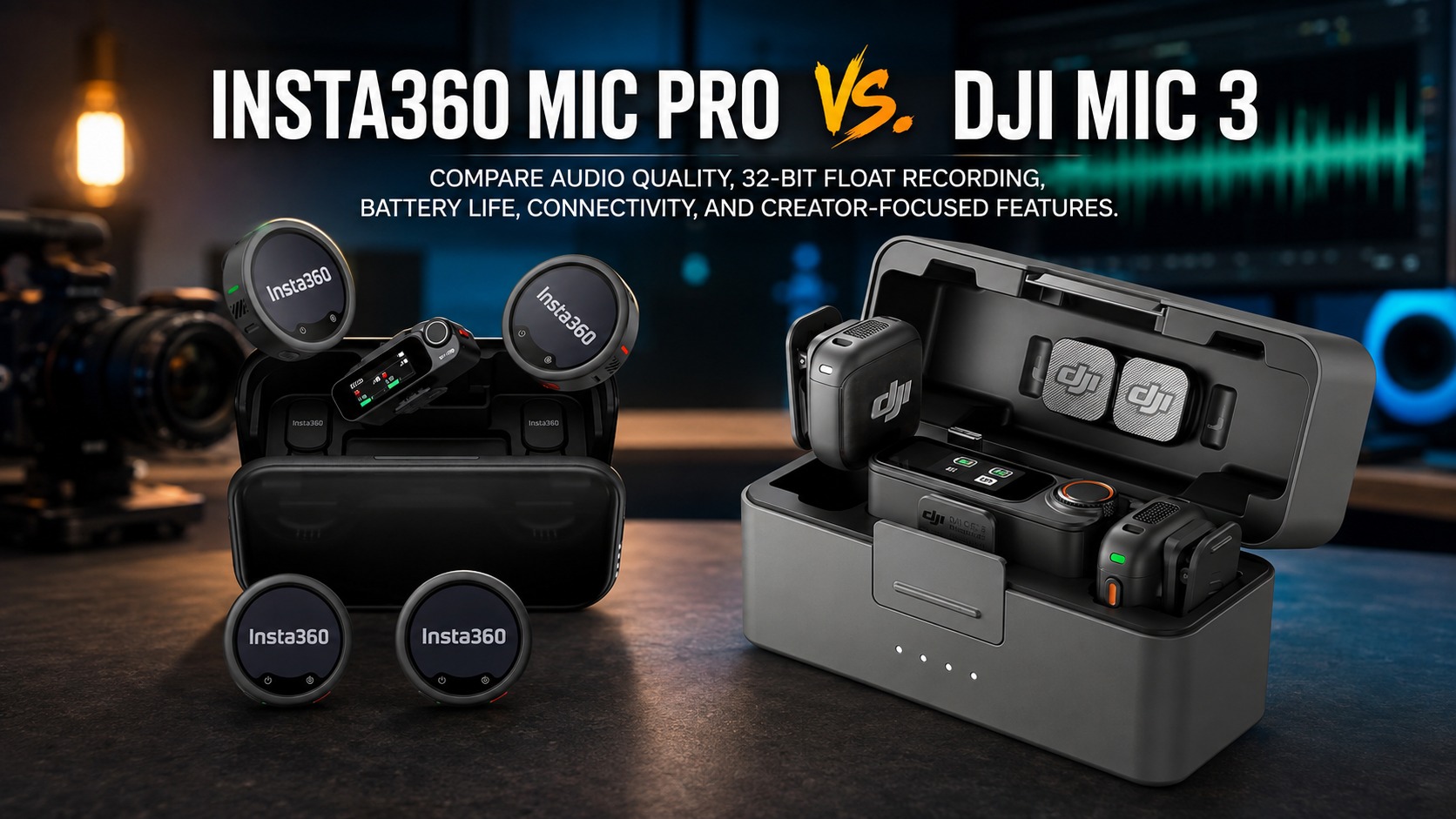
Content creators require lightweight equipment for mobile video shoots. Consequently, the battle of Insta360 Mic Pro vs. DJI Mic 3 highlights a rapid hardware evolution. Both wireless microphone systems deliver high-fidelity sound straight into modern cameras. However, each manufacturer approaches field recording workflows from different technological angles. Integrated NPU processors now streamline complex audio capture on location.
Independent creators no longer need bulky mixer boards for field productions. Onboard storage chips protect field recordings against sudden signal dropouts. Furthermore, thirty-two bit float audio recording prevents digital clipping during unexpected volume spikes. Action camera platforms now pair directly with microphone transmitters through low-latency connections. Therefore, video teams achieve faster setup times while maintaining professional broadcast standards.
Hardware Design and Physical Features
Insta360 equips its transmitter unit with a customizable six-color high-definition E-Ink screen. Specifically, creators upload custom channel logos or graphics through the official smartphone app. The transmitter weighs nineteen point seven grams and features a three-capsule microphone array. Users easily select omnidirectional, super-directional, cardioid, or figure-eight pickup patterns. Moreover, this array allows the clip-on microphone to operate like a directional shotgun mic.
DJI prioritizes ultimate portability with an ultra-light sixteen-gram transmitter frame. In contrast, the DJI Mic 3 uses single-LED indicators instead of a color display screen. The compact body supports versatile magnetic mounting and a detachable rotating clip. Wireless transmission operates over dual-band two point four and five point eight gigahertz frequencies. Resultantly, signal stability remains exceptional inside dense wireless environments.
Audio Fidelity and Processing Standards
Both flagship systems record thirty-two bit float audio directly onto internal transmitter memory. Sudden shouts or loud acoustic peaks will never distort the saved digital audio track. Insta360 supplies thirty-two gigabytes of onboard memory holding up to sixty hours of mono audio. Additionally, the transmitter records localized stereo files for rich ambient audio capture. Sound engineers easily recover clipped audio tracks during post-production editing.
DJI Mic 3 introduces dual-file recording to capture raw and processed backup safety tracks simultaneously. An integrated NPU chip drives AI noise reduction without dulling natural voice frequencies. Meanwhile, three preset voice tones let operators select standard, rich, or bright sound characteristics. High-precision timecode generators maintain tight synchronization with less than one frame drift over twenty-four hours. Accordingly, video editors align multi-camera footage in post-production software with minimal effort.
Comparative Overview: Insta360 Mic Pro vs. DJI Mic 3
A direct specification review clarifies how both hardware systems compare across critical operational metrics. Key physical and audio performance characteristics reflect distinct engineering priorities for content creation workflows.
| Specification | Insta360 Mic Pro | DJI Mic 3 |
| Transmitter Weight | 19.7 g | 16.0 g |
| Display Type | 1.22″ 6-Color E-Ink | Single-LED Indicators |
| Microphone Pickup Modes | 4 Modes (Omni, Super, Cardioid, Fig-8) | Omnidirectional |
| Direct Camera Connection | Supported via Bluetooth V5.4 | Supported via OsmoAudio / SDR |
| 32-Bit Float Internal Recording | Supported (Stereo & Mono) | Supported (Dual-File & Single) |
| Standalone Transmitter Battery | Up to 10 Hours | Up to 8 Hours |
| Total System Battery (with Case) | Up to 30 Hours | Up to 28 Hours |
| Multi-Channel Scalability | 4 TX + 1 RX / 2 TX + 4 RX | 4 TX + 8 RX |
| Maximum Transmission Distance | 400 meters | 400 meters |
Insta360 transmitters provide up to ten hours of standalone battery operation on a single charge. Alternatively, DJI transmitters run for eight hours but achieve a full recharge in fifty minutes. Insta360’s charging case delivers up to thirty hours of extended total operating time. Conversely, DJI’s case provides twenty-eight total hours across multiple charging cycles. Rapid charging technology provides up to one hour of use from a five-minute charge.
Ecosystem Connectivity and Multi-Cam Workflows
Direct connectivity eliminates the need for external receivers when pairing with compatible action cameras. Insta360 Direct Connect links transmitters straight to X5, Ace Pro 2, and GO Ultra models. Direct Bluetooth pairing reduces maximum transmission distance to approximately one hundred meters in open areas. Thus, connecting through the dedicated receiver restores full four hundred meter line-of-sight range. Standard audio cables connect receivers to traditional camera bodies and mobile recording setups.
DJI Mic 3 connects directly to Osmo action cameras using native wireless SDR protocols. Complex multi-camera productions benefit from DJI's ability to sync four transmitters with eight receivers. Similarly, Insta360 supports flexible four-to-one and two-to-four receiver routing modes. Four-channel digital audio output feeds isolated voice tracks directly into professional editing software. Hence, panel discussions and multi-person interviews become significantly easier to mix.
Strategic Industry Implications
Aggressive competition between major camera manufacturers accelerates hardware innovation across the wireless audio landscape. Advanced features once restricted to high-end film sets now reside in pocketable creator tools. Insta360 targets creators seeking visual display customization combined with versatile pickup patterns. Custom E-Ink screens offer clear visual branding opportunities for corporate hosts and mobile broadcasters. Likewise, native stereo internal recording provides exceptional depth for realistic ambient sound design.
DJI maintains strong advantages in lightweight transmitter construction, dual-band stability, and dual-file security. Operational teams working in congested wireless environments benefit greatly from robust dual-band frequency switching. Fast charging cycles and magnetic mounting options optimize field workflows for solo creators. Nevertheless, both wireless platforms deliver outstanding performance that redefines mobile audio expectations. Traditional audio manufacturers must adapt rapidly to remain competitive against these camera ecosystem solutions.
Support Our Work
Help us keep creating and maintaining our projects. We appreciate your support!
Ways to contribute:
Shop via Affiliate LinksSupport us at no extra cost to you while you shop.
Support on Ko-fiBuy us a coffee to keep the engine running!


Leave a Reply