

Industry Trends in Foldable Hardware
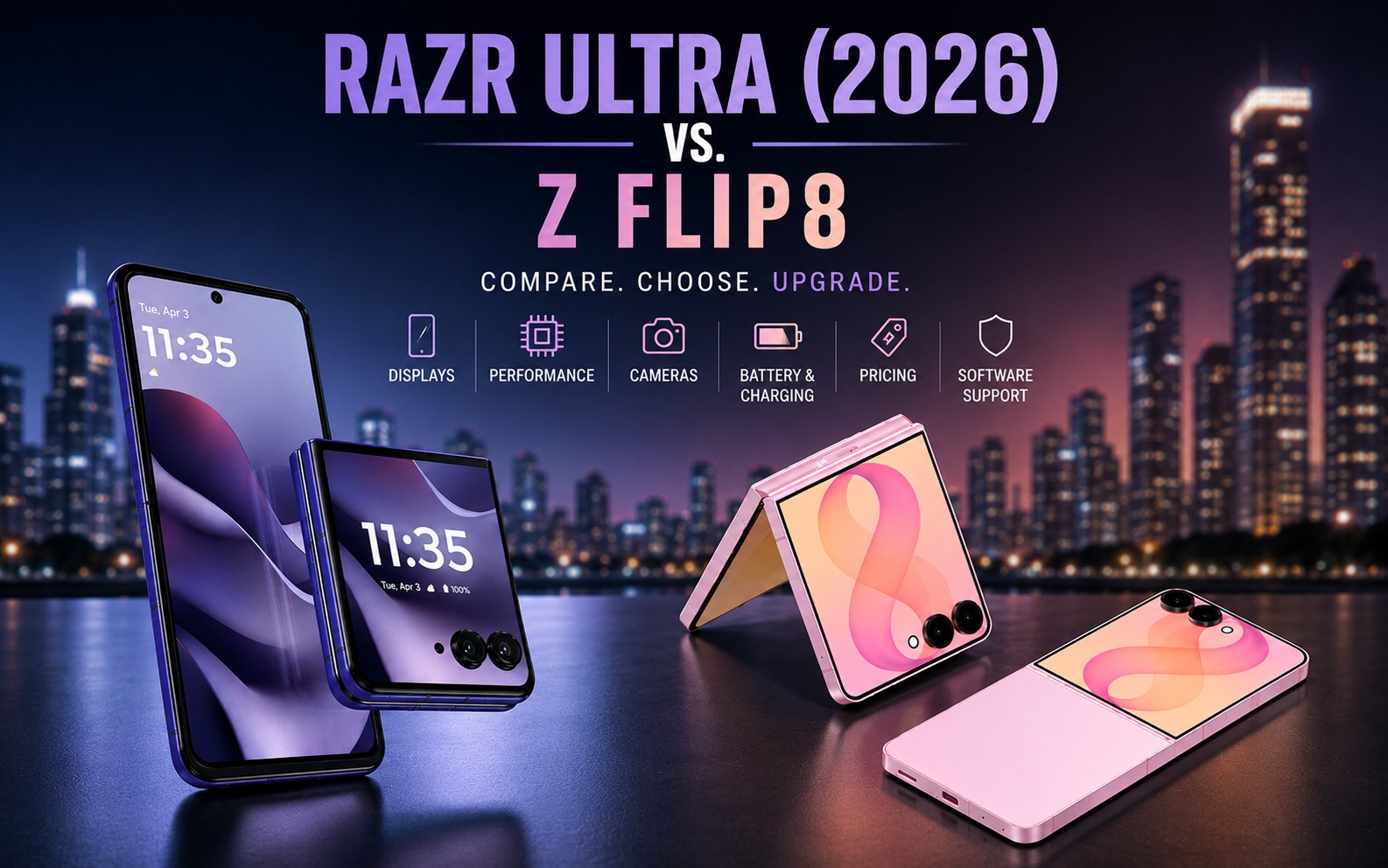
Clamshell smartphones have reached a major developmental milestone in the premium mobile technology market. Tech consumers now observe a direct rivalry in the Motorola Razr Ultra (2026) vs. Samsung Galaxy Z Flip8 matchup. Specifically, both manufacturer giants are advancing hardware boundaries to capture critical market share. Manufacturers continue refining flexible displays to eliminate visible center creases on internal screens. Modern consumers demand flagship processing speeds alongside compact pocketable design aesthetics.
Motorola announced its flagship Razr Ultra on April 29, 2026, setting early industry standards. Meanwhile, Samsung unveiled the Galaxy Z Flip8 during its London Unpacked event on July 22, 2026. Consequently, retail availability expanded rapidly across North America, Europe, and global Asian markets. Pricing strategies highlight clear competitive differences between these two prominent technological approaches. Motorola sets its flagship price tag at $1,499 for the high-end 512GB model. However, Samsung maintains a lower entry barrier at $1,199 for its starting storage configuration. Industry analysts attribute Motorola’s price increase to premium hardware components and RAM supply shortages.
Display Specifications and Panel Engineering
Screen engineering represents the most aggressive arena of competition between foldable devices. Motorola equips its premium model with an expansive 7.0-inch LTPO AMOLED inner folding screen. Notably, this main panel delivers a fast 165Hz refresh rate and 5000 nits peak brightness. Higher refresh rates ensure fluid animations during fast scrolling and demanding gaming sessions. Samsung provides a 6.9-inch Foldable Dynamic LTPO AMOLED 2X internal panel. In contrast, Samsung caps its main display refresh rate at 120Hz with 2600 nits brightness.
Outer cover screens drastically alter daily smartphone usage habits without unfolding the primary chassis. Motorola features a 4.0-inch external LTPO AMOLED screen running at a smooth 165Hz refresh rate. Furthermore, Motorola allows users to launch standard full-featured Android applications directly on the cover screen. Samsung incorporates a 4.1-inch Super AMOLED FlexWindow protected by Gorilla Glass Victus 2. Conversely, Samsung relies primarily on structured widgets and selected mini apps for outer display tasks. Both devices feature robust IP48 ratings for solid particle protection and temporary water submersion. Indeed, Motorola elevates exterior style options by offering Alcantara, eco-leather, and wood finish choices.
Processing Performance and Architecture
Internal processor architectures demonstrate distinct engineering strategies across regional markets. Motorola powers its flagship handset with the 3nm Qualcomm Snapdragon 8 Elite processor. Additionally, Motorola installs 16GB of LPDDR5X RAM alongside 512GB of UFS 4.0 storage. High processing power allows the device to manage heavy multitasking workflows without performance slowdowns. Thermal testing indicates thermal throttling under prolonged peak graphics benchmark loads.
Samsung fits North American models with the Qualcomm Snapdragon 8 Elite Gen 5 chipset. Alternatively, international Samsung variants utilize the new 2nm Exynos 2600 deca-core processor. Both chipsets deliver fast processing speeds for advanced machine learning tasks and artificial intelligence features. The 2nm manufacturing process enhances energy efficiency across daily application usage patterns. Therefore, mobile gamers and power users gain steady frame rates during extended gaming sessions.
Ecosystem Strategy and Software Longevity
Operating system policies present a major contrast between these two folding phone manufacturers. Motorola ships its device with Android 16 and Hello UI software customization. In addition, Motorola guarantees three major operating system updates over the device lifespan. Nonethless, three years of software support feels brief for a premium device costing $1,499. Power users who hold devices for extended periods may find this support timeframe limited.
Samsung equips its phone with Android 17 and One UI 9 out of the box. Moreover, Samsung promises seven full years of major Android upgrades and security patches. Samsung also provides desktop DeX support when connected directly to external computer monitors. As a result, corporate clients frequently select Samsung devices for long-term fleet deployments. Software longevity adds substantial residual value to Samsung folding devices over time.
- 📲 Ships with Android 16
- 🎨 UI: Hello UI
- 🛠️ 3 Major OS Upgrades
- 📲 Ships with Android 17
- 🎨 UI: One UI 9
- 🛠️ 7 Major OS Upgrades
Camera Optics and Battery Capabilities
Camera engineering on clamshell devices balances optical sensor size against overall fold thickness. Motorola embeds dual 50MP rear cameras featuring optical image stabilization on the main lens. Standard daylight photography yields crisp images with natural Pantone validated skin color tones. Similarly, Motorola installs a 50MP internal selfie camera for high-resolution video calls. Samsung incorporates a 50MP optical main camera combined with a 12MP ultrawide sensor. On the other hand, Samsung utilizes a 10MP front camera built into the internal display. Video tests show Samsung achieving smoother image stabilization during handheld video recording.
Battery capacity marks another critical area where hardware design philosophies differ significantly. Motorola includes a large 5000 mAh battery inside its folding aluminum frame. Consequently, Motorola achieves active use battery scores exceeding sixteen hours in continuous tests. Motorola also delivers rapid 68W wired charging alongside 30W wireless charging speeds. Samsung integrates a 4300 mAh silicon-carbon battery pack inside its lightweight folding chassis. Accordingly, Samsung limits charging rates to 25W wired speed and 15W wireless power. Tests demonstrate Samsung reaching fifty percent battery charge in approximately thirty minutes.
30W Wireless
15W Wireless
Motorola Razr Ultra (2026) vs. Samsung Galaxy Z Flip8 Specs
Direct hardware evaluations highlight contrasting design priorities tailored to distinct mobile user demands. Tech buyers must weigh screen refresh rates, charging speed, initial price, and software lifespan. Standard specification benchmarks reveal clear differences across processing silicon, displays, and camera modules. Hence, side-by-side data comparison helps buyers select the ideal clamshell folding smartphone.
| Feature / Hardware Spec | Motorola Razr Ultra (2026) | Samsung Galaxy Z Flip8 |
| Official Release Date | May 14, 2026 | July 22, 2026 |
| Starting Price (USD) | $1,499.99 | $1,199.99 |
| Primary Display | 7.0-inch LTPO AMOLED (165Hz, 5000 nits) | 6.9-inch Dynamic LTPO AMOLED 2X (120Hz, 2600 nits) |
| Cover Screen | 4.0-inch LTPO AMOLED (165Hz, 3000 nits) | 4.1-inch Super AMOLED FlexWindow (120Hz, 2600 nits) |
| Primary Processor | Qualcomm Snapdragon 8 Elite (3nm) | Snapdragon 8 Elite Gen 5 (US) / Exynos 2600 (ROW) |
| Memory & Storage | 16GB RAM / 512GB UFS 4.0 | 12GB RAM / 256GB or 512GB UFS 4.x |
| Rear Camera Sensors | 50 MP Wide (OIS) + 50 MP Ultrawide | 50 MP Wide (OIS) + 12 MP Ultrawide |
| Front Selfie Camera | 50 MP Wide | 10 MP Wide |
| Battery Capacity | 5000 mAh | 4300 mAh Silicon-Carbon |
| Charging Speeds | 68W Wired / 30W Wireless | 25W Wired / 15W Wireless |
| Operating System | Android 16 (Hello UI) | Android 17 (One UI 9) |
| Software OS Updates | 3 Major OS Upgrades | 7 Major OS Upgrades |
| Ingress Protection | IP48 Dust and Water Resistance | IP48 Dust and Water Resistance |
| Weight & Thickness | 199g / 7.2mm Unfolded | 180g / 6.1mm Unfolded |
Motorola achieves superior performance in battery capacity, charging velocity, and inner screen refresh rates. Nevertheless, its higher purchase cost creates a noticeable financial obstacle for prospective consumers. Samsung maintains compelling appeal through long software support, lower entry price, and desktop DeX integration. Thus, seven years of software support ensures extended device utility and updated security protections. Consumers seeking max battery performance should select Motorola, while long-term buyers benefit from Samsung. Ultimately, both folding flagships represent impressive engineering achievements in modern mobile technology.
Support Our Work
Help us keep creating and maintaining our projects. We appreciate your support!
Ways to contribute:
Shop via Affiliate LinksSupport us at no extra cost to you while you shop.
Support on Ko-fiBuy us a coffee to keep the engine running!


Leave a Reply