


The Open-Ear Audio Revolution
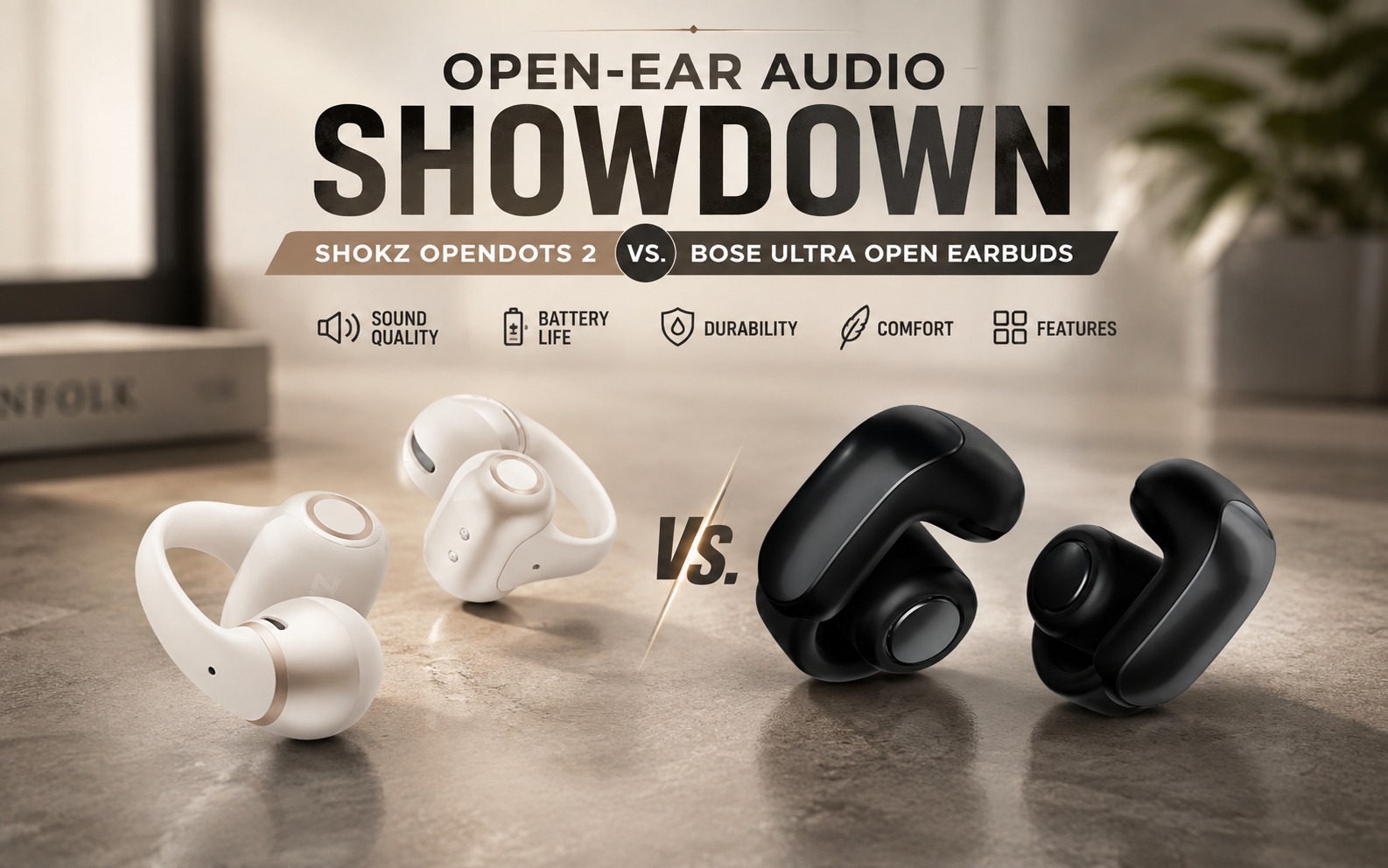
The open-ear audio segment continues to expand rapidly across consumer markets. Listeners increasingly demand situational awareness during daily workouts and office commutes. Consequently, the market comparison between the Shokz OpenDots 2 vs. Bose Ultra Open Earbuds highlights key shifts in wearable acoustics. Both manufacturers utilize open clip-on designs that eliminate physical ear-canal insertion.
Traditional in-ear silicone tips often cause ear fatigue during long listening sessions. Furthermore, open cuffs allow air circulation while maintaining structural stability on outer ear cartilage. Shokz and Bose have introduced competing engineering philosophies to secure market leadership.
Acoustic Architecture and Sound Engineering
Shokz outfits the OpenDots 2 with its Bassphere 2.0 dual-driver acoustic structure. Specifically, two 11.8-millimeter dynamic drivers work in tandem to simulate a larger 16-millimeter unit. A redesigned diaphragm reduces harmonic distortion by seventy percent to strengthen low frequencies. In addition, MirrorPitch technology angles audio waves toward the eardrum to enrich dynamic response.
Conversely, the Bose Ultra Open Earbuds feature proprietary OpenAudio drivers. Bose directs sound directly into the outer ear concha from a small offset distance. Snapdragon Sound supports aptX Adaptive decoding for high-resolution wireless streaming. Moreover, Bose Immersive Audio offers spatial virtualization with onboard head tracking.
Hardware Specifications and Wireless Capabilities
Technical parameters reveal significant hardware differences between these two flagship wireless models. Meanwhile, Bluetooth silicon improvements enhance power management and transmission stability across both platforms.
| Specification | Shokz OpenDots 2 | Bose Ultra Open Earbuds |
| Acoustic Driver Architecture | Bassphere™ 2.0 Dual 11.8mm System | Proprietary OpenAudio Transducer |
| Spatial Audio Processing | Upgraded Dolby Audio | Bose Immersive Audio with Head Tracking |
| Microphone Configuration | 3 Mics (2 Air + 1 Bone Conduction) | Built-in Air-Conduction Microphones |
| Single-Charge Battery Life | Up to 10 Hours | Up to 7.5 Hours (4.5 Hours Immersive) |
| Combined Case Battery Life | Up to 40 Hours | Up to 27 Hours Total |
| Fast Charging Speed | 5 Minutes = 2 Hours Playback | 10 Minutes = 2 Hours Playback |
| Case Wireless Charging | Qi-Certified Wireless & USB-C | Wired USB-C Only |
| Ingress Protection Rating | IP57 (Buds) / IP54 (Case) | IPX4 (Buds Only) |
| Weight (Per Earbud) | 6.4 Grams | 6.4 Grams |
| Wireless Connectivity | Bluetooth 5.4 / 6.1 Platform | Bluetooth 5.3 |
| Supported Audio Codecs | AAC, SBC | Qualcomm aptX Adaptive, AAC, SBC |
| Retail Price (MSRP) | $199.95 / £179.99 | $299.00 / £299.00 |
Modern radio protocols deliver consistent data throughput in dense urban settings. Shokz includes Google Fast Pair and Microsoft Swift Pair for immediate cross-platform device handshakes. However, Bose integrates multipoint pairing through firmware updates across compatible devices. Shokz also provides complete tracking capabilities through Google Find Hub integration.
Structural Ergonomics and Durability Standards
Physical grip mechanics dictate everyday comfort during extended listening intervals. Shokz builds the OpenDots 2 with a flexible nickel-titanium JointArc band. Soft contoured silicone cushions sensitive skin areas across the outer ear helix. Dynamic Ear Detection lets users wear either earbud in either ear interchangeably. An IP57 ingress rating ensures complete defense against dust particles and water immersion.
In contrast, Bose utilizes a cylindrical battery barrel with an attached flexible silicone arm. The cuff rests securely above the earlobe at a recommended angle. Bose holds an IPX4 water rating against sweat and light rain droplets. Therefore, outdoor athletes may prefer the superior water protection of the Shokz design.
Battery Performance and Power Delivery
Battery life remains a crucial consideration for active professionals and endurance athletes. Shokz achieves ten hours of continuous music playback on a single charging cycle. The portable case expands total listening duration up to forty hours. Additionally, a five-minute fast charge yields two full hours of audio playback. Shokz incorporates Qi-certified wireless charging directly into the case enclosure.
In comparison, Bose delivers 7.5 hours of playback during standard operation. Activating Bose Immersive Audio reduces single-charge battery endurance to 4.5 hours. The Bose case provides nineteen additional hours for 26.5 hours of total usage. Nonetheless, Bose omits native wireless charging hardware from its storage case.
Voice Capture and Onboard Control Mechanisms
Clear microphone pickup presents technical difficulties for open-ear form factors. Shokz solves noise interference by integrating three microphones on each earbud. Two air-conduction microphones combine with an integrated bone-conduction vocal sensor. Thus, physical jaw vibrations isolate user speech during busy outdoor phone calls. Shokz combines tap actions on the JointArc with squeeze gestures on the battery.
Alternatively, Bose relies on standard air-conduction microphones for daily voice calls. Bose places physical control buttons on the upper surface of each battery barrel. Physical switches reduce accidental activations during fitness training or head adjustments. Companion smartphone applications allow users to adjust equalizer profiles and controls.
Strategic Market Impact and Industry Outlook
Market positioning reflects divergent commercial approaches across the premium audio landscape. Shokz retails the OpenDots 2 at $199.95 to target mainstream fitness consumers. The brand expands global retail presence through dedicated pop-up retail stores. Concurrently, the affordable OpenDots Air model diversifies the entry-level clip-on catalog. Bose positions the Ultra Open Earbuds at $299 as a luxury audio accessory.
Accordingly, pricing and hardware specifications dictate consumer preference across varied use cases. Shokz offers superior moisture protection, longer battery endurance, and bone-conduction microphone pickup. Bose delivers sophisticated spatial virtualization alongside aptX Adaptive codec processing. Ultimately, these distinct product strategies confirm the permanent market viability of open-ear clip acoustics.
Support Our Work
Help us keep creating and maintaining our projects. We appreciate your support!
Ways to contribute:
Shop via Affiliate LinksSupport us at no extra cost to you while you shop.
Support on Ko-fiBuy us a coffee to keep the engine running!



Leave a Reply