


Market Landscape and Strategic Pivots
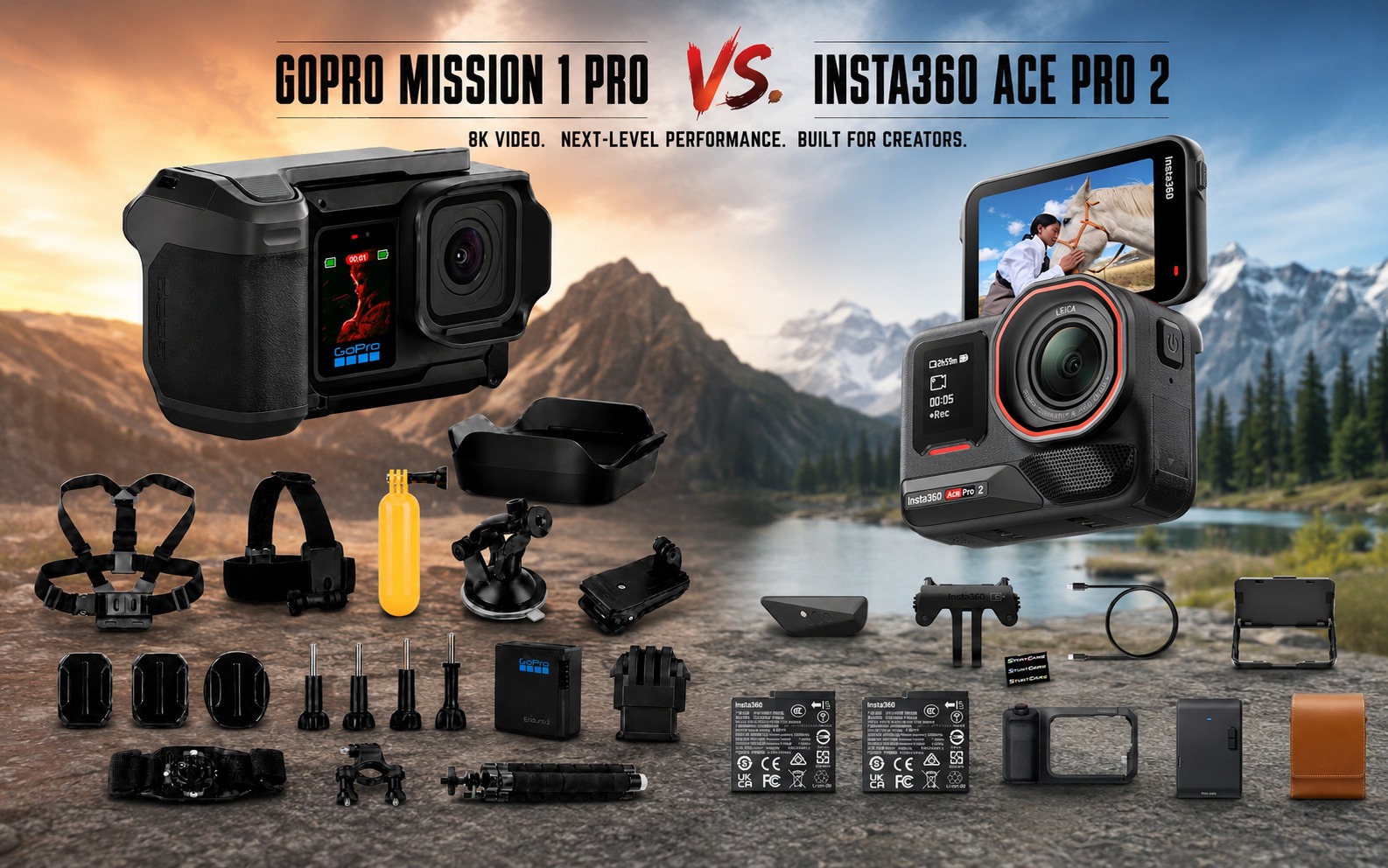
Action camera technology reaches an exciting turning point with the release of flagship models. Enthusiasts frequently compare the GoPro Mission 1 Pro vs. Insta360 Ace Pro 2 to evaluate performance gains. Both camera brands now target different creator groups through tailored hardware strategies. GoPro designed its newest flagship camera as a compact cinematic recording tool for professional filmmakers.
In contrast, Insta360 focuses on fast performance and smart artificial intelligence features for active vloggers. Traditional sports recording features no longer satisfy buyers who want flexible social media editing options. As a result, both manufacturers integrated high resolution sensors alongside specialized video processing hardware. This intense commercial competition pushes technological boundaries across the entire digital imaging sector.
GoPro Mission 1 Pro vs. Insta360 Ace Pro 2: Hardware and Optics
Sensor size plays a major role in optical resolution and low light recording clarity. The GoPro Mission 1 Pro features a large one inch 50 megapixel image sensor. Furthermore, its GP3 image processor captures detailed 8K video at 60 frames per second. Filmmakers can record in 8K Open Gate 4:3 mode to simplify vertical social media cropping. A wide depth of field ensures sharp background details beyond 60 centimeters distance.
On the other hand, the Insta360 Ace Pro 2 uses a 1/1.3 inch sensor paired with Leica optics. The Leica SUMMARIT lens offers an f/2.6 aperture and a 157 degree field of view. Additionally, dual AI processing chips reduce visual noise while accelerating overall camera performance. Active HDR recording supports smooth 4K video capture at 60 frames per second. PureVideo mode uses specialized artificial intelligence algorithms to clarify dark evening scenes.
Frame Rates, Audio Capture, and Usability
High speed recording capabilities differ noticeably between these flagship action camera models. GoPro engineered ultra fast slow motion options reaching up to 1080p at 480fps. However, its Burst Slo-Mo feature records 960 frames per second for ten full seconds. Editors can expand short action moments into five minute smooth slow motion clips. Meanwhile, Insta360 provides reliable 4K slow motion at 120 frames per second for general action sports.
Sound quality represents another major area of differentiation for professional video production. GoPro includes four built-in microphones capable of recording native 32-bit float stereo audio. Consequently, audio editors easily recover distorted loud peaks or quiet ambient background sounds. Insta360 equips its camera with three microphones and a removable physical Wind Guard. Therefore, vloggers capture crisp voice tracks during outdoor sports activities.
Display layouts also reflect contrasting design philosophies for vlogging and underwater action. GoPro uses a fixed 2.59 inch OLED rear display and a front screen. Native housing waterproofing protects the unit down to 66 feet underwater. Alternatively, Insta360 includes a bright 2.5 inch flip touchscreen for flexible front framing.
Technical Specifications Comparison
Comparing direct hardware specifications highlights key operational differences across both systems. Buyers must evaluate resolution limits alongside battery life and physical weight considerations. To that end, structured technical data reveals distinct hardware engineering strategies.
The tabular comparison shows GoPro commanding higher resolution and superior audio depth. By comparison, Insta360 delivers faster battery charging speeds and a lower retail price point. Weight differences remain minor during real world mounting on helmets or handheld tripods. Overall, each camera suits a specific operational profile within the broader creator market.
Business Realities and Strategic Directions
Beyond hardware capabilities, corporate financial trajectories shape long term platform support. GoPro experienced financial challenges during early 2026 despite launching its premium series. First quarter revenue fell 26 percent year-over-year to 99 million dollars. Accordingly, the board authorized a formal review of strategic alternatives including a potential sale. Management retained investment bank Houlihan Lokey to evaluate inbound corporate purchase inquiries. Moreover, consulting firm Oliver Wyman is exploring camera applications within aerospace and defense markets.
Likewise, Insta360 continues demonstrating rapid sales expansion and high revenue growth. The brand holds a 67 percent global market share in 360 degree cameras. Annual corporate revenues reached nearly 1.4 billion dollars due to strong international demand. Substantial research funding allows Insta360 to release feature rich cameras at competitive prices. Subsequently, market competition intensifies as rival manufacturers attempt to match AI capabilities.
Final Industry Outlook and Recommendations
Choosing the ideal action camera requires aligning hardware features with specific project needs. Professional filmmakers benefit most from the GoPro Mission 1 Pro and its cinema focus. Its 1-inch sensor, 32-bit float audio, and Open Gate video provide maximum post-production flexibility. Nonetheless, buyers must consider the higher purchase price when planning production budgets. Buyers seeking maximum grading control will find immense value in GoPro’s custom GP-Log2 color profiles.
The Insta360 Ace Pro 2 offers excellent value for everyday social media creators. Dual AI chips and Leica optics produce clear imagery directly out of the camera. Fast battery charging and a flip screen improve daily vlogging convenience. Active HDR mode ensures balanced exposures across high contrast outdoor environments. Ultimately, continuous technological innovation elevates production quality across the entire digital imaging landscape.
Support Our Work
Help us keep creating and maintaining our projects. We appreciate your support!
Ways to contribute:
Shop via Affiliate LinksSupport us at no extra cost to you while you shop.
Support on Ko-fiBuy us a coffee to keep the engine running!





Leave a Reply