


The Rise of Compact Digital Paper
Industry analysts actively compare the reMarkable Paper Pro Move vs. BOOX Go 6 Gen II in the expanding e-paper market. Specifically, these compact digital devices serve mobile professionals who need portable reading and writing tools on the go. Lightweight hardware allows users to carry complete digital libraries inside standard jacket pockets. Manufacturers continue refining e-paper technology to deliver daylight readability and reduced visual fatigue. Recent product releases highlight major advancements in physical ergonomics and hardware energy efficiency.
Modern knowledge workers increasingly favor focused e-paper devices over traditional notebooks and standard glass tablets. In contrast, traditional paper lacks cloud synchronization, handwriting conversion, and instant search functions. Engineers design compact digital paper to bridge the gap between physical handwriting and modern digital convenience. Consequently, both hardware makers aim to capture a growing demographic of highly mobile professionals.
Executive demand for glare-free digital reading screens has accelerated recent product design cycles. Furthermore, business travel requires compact hardware that withstands daily commutes and unpredictable lighting conditions. E-paper displays fulfill these specialized requirements by reflecting natural ambient light rather than emitting harsh radiation. These design improvements enable seamless transitions between indoor office work and demanding travel environments.
Display Technology and Ergonomic Features
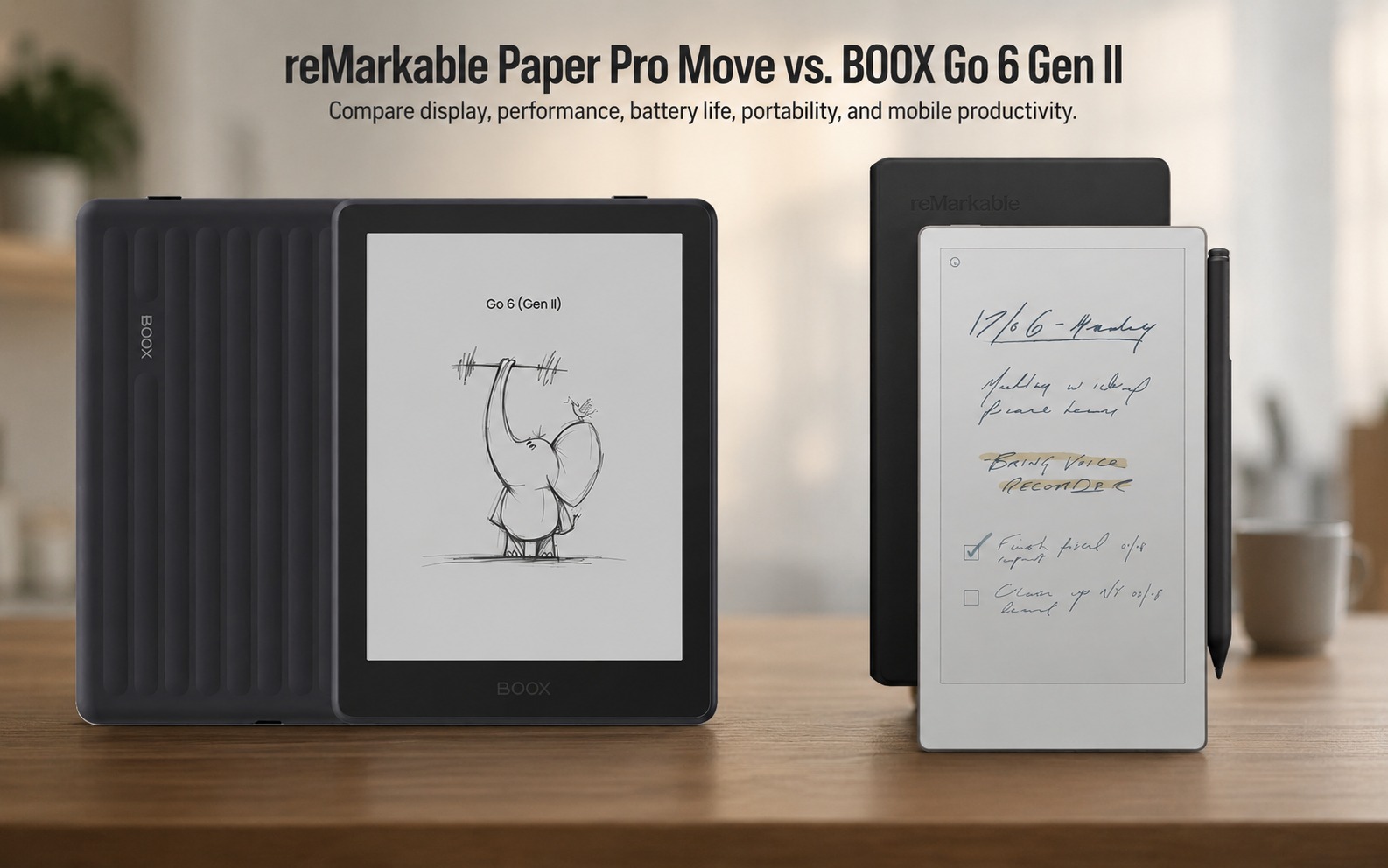
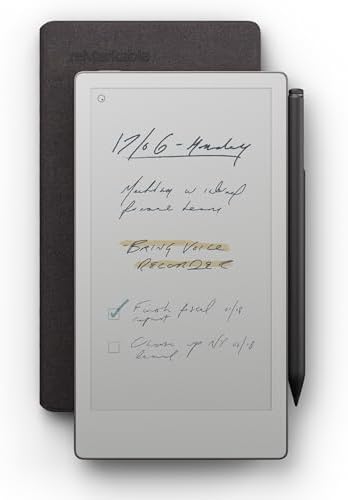
The reMarkable Paper Pro Move features a 7.3-inch Canvas Color display based on E Ink Gallery 3. This custom screen renders over 20,000 distinct colors at a resolution of 264 pixels per inch. Moreover, the textured glass surface creates realistic friction that closely mimics writing on physical paper. Users can annotate color documents and highlight EPUB textbooks without experiencing glare under direct sunlight.
Meanwhile, the BOOX Go 6 Gen II utilizes a 6-inch E Ink Carta 1300 monochrome display. Crisp black text achieves a high pixel density of 300 pixels per inch for maximum legibility. As a result, page transitions occur rapidly when skimming digital books during continuous reading sessions. The flat glass cover lens sits flush against the bezel to maintain a sleek aesthetic.
Integrated lighting systems illuminate display surfaces effectively during nighttime reading sessions. For instance, BOOX incorporates dual-tone front lights that adjust smoothly between warm amber and cool white. reMarkable includes an adjustable front reading light engineered to eliminate eye strain in dark rooms. Therefore, users maintain optimal visual clarity across diverse ambient lighting environments.
Evaluating reMarkable Paper Pro Move vs. BOOX Go 6 Gen II Hardware
Input responsiveness establishes a major functional divide between these two mobile e-paper architectures. reMarkable achieved an exceptionally low writing latency of 12 milliseconds on its color canvas. However, the bundled magnetic Marker pen requires no internal battery or wireless Bluetooth pairing. Advanced palm rejection software prevents unwanted input when users rest their wrists on screen surfaces.
On the other hand, BOOX introduces stylus compatibility to 6-inch e-readers using the InkSense Plus pen. This pressure-sensitive digital stylus enables quick margin notes, freehand sketching, and passage underlining. In addition, an integrated microphone allows users to record audio notes during meetings or lectures. System processing relies on a capable 2.0 GHz octa-core processor paired with 3 GB RAM.
Technical specifications illustrate contrasting design strategies regarding display dimensions, hardware memory, and overall device weight. The following comparison table provides verified hardware data collected directly from official manufacturer specifications.
| Hardware Parameter | reMarkable Paper Pro Move | BOOX Go 6 Gen II |
| Display Panel | 7.3-inch Canvas Color (E Ink Gallery 3) | 6.0-inch B&W E Ink Carta 1300 |
| Resolution Density | 1696 x 954 (264 PPI) | 1448 x 1072 (300 PPI) |
| Processor Type | 1.7 GHz Dual-Core Cortex-A55 | 2.0 GHz Octa-Core Processor |
| RAM & Internal ROM | 2 GB LPDDR4x RAM / 64 GB ROM | 3 GB RAM / 32 GB ROM + microSD (up to 2TB) |
| Stylus Hardware | Marker / Marker Plus (12ms latency) | Optional BOOX InkSense Plus Stylus |
| Software Platform | reMarkable OS (Custom Linux) | Android 11 with Google Play Store |
| Weight & Thickness | 230 g / 6.5 mm | 160 g / 6.75 mm |
| Battery Capacity | 2,334 mAh Li-ion battery | 1,500 mAh Li-ion Polymer battery |
Operating System Freedom and Ecosystems
Operating system architecture defines software capabilities and file accessibility across both e-paper devices. BOOX runs an open Android 11 platform with full access to Google Play Store applications. Readers can install Kindle, Kobo, Moon+ Reader, and Libby directly onto internal device memory. The native NeoReader application supports 26 distinct document formats including PDF, EPUB, MOBI, and CBZ.
In comparison, reMarkable utilizes custom Linux software designed exclusively for distraction-free handwriting. This streamlined operating system intentionally omits web browsers, app stores, and pop-up notification alerts. Writers remain fully focused on structured note taking, outlines, and document annotation. Desktop and mobile companion apps allow fast file syncing across personal cloud storage repositories.
Cloud service offerings provide additional productivity features for users seeking cross-device workflow integration. Additionally, reMarkable provides its Connect subscription for handwriting search and unlimited cloud backup. Connect subscribers can convert handwritten scribble into typed text and send notes straight to Slack. BOOX users manage local backup through expandable microSD storage without recurring subscription fees.
Strategic Positioning and Market Impact
Battery runtime remains vital for active professionals who work outside traditional office environments. reMarkable equips the Move with a 2,334 mAh battery delivering up to two weeks of standard operation. Ten minutes of fast USB-C charging supplies three full days of active battery power. An energy-efficient Cortex-A55 dual-core processor minimizes power consumption during intensive handwriting tasks.
Similarly, the BOOX Go 6 Gen II houses a 1,500 mAh battery within its ultra-thin 6.75 mm body. The featherlight 160-gram frame ensures comfortable single-handed holding during extended reading sessions. Storage expansion up to 2 TB allows avid readers to carry vast digital book archives everywhere. Ultimately, physical portability and robust battery performance position both models as top-tier travel devices.
Strategic positioning highlights distinct core audiences for each innovative e-paper tablet manufacturer. reMarkable serves journalists, researchers, and executives who prioritize authentic paper feel and tactile handwriting. Conversely, BOOX targets multi-format readers who desire open Android app access and budget accessibility. In fact, both products demonstrate how focused hardware engineering continues to transform modern mobile productivity.
Support Our Work
Help us keep creating and maintaining our projects. We appreciate your support!
Ways to contribute:
Shop via Affiliate LinksSupport us at no extra cost to you while you shop.
Support on Ko-fiBuy us a coffee to keep the engine running!





Leave a Reply