
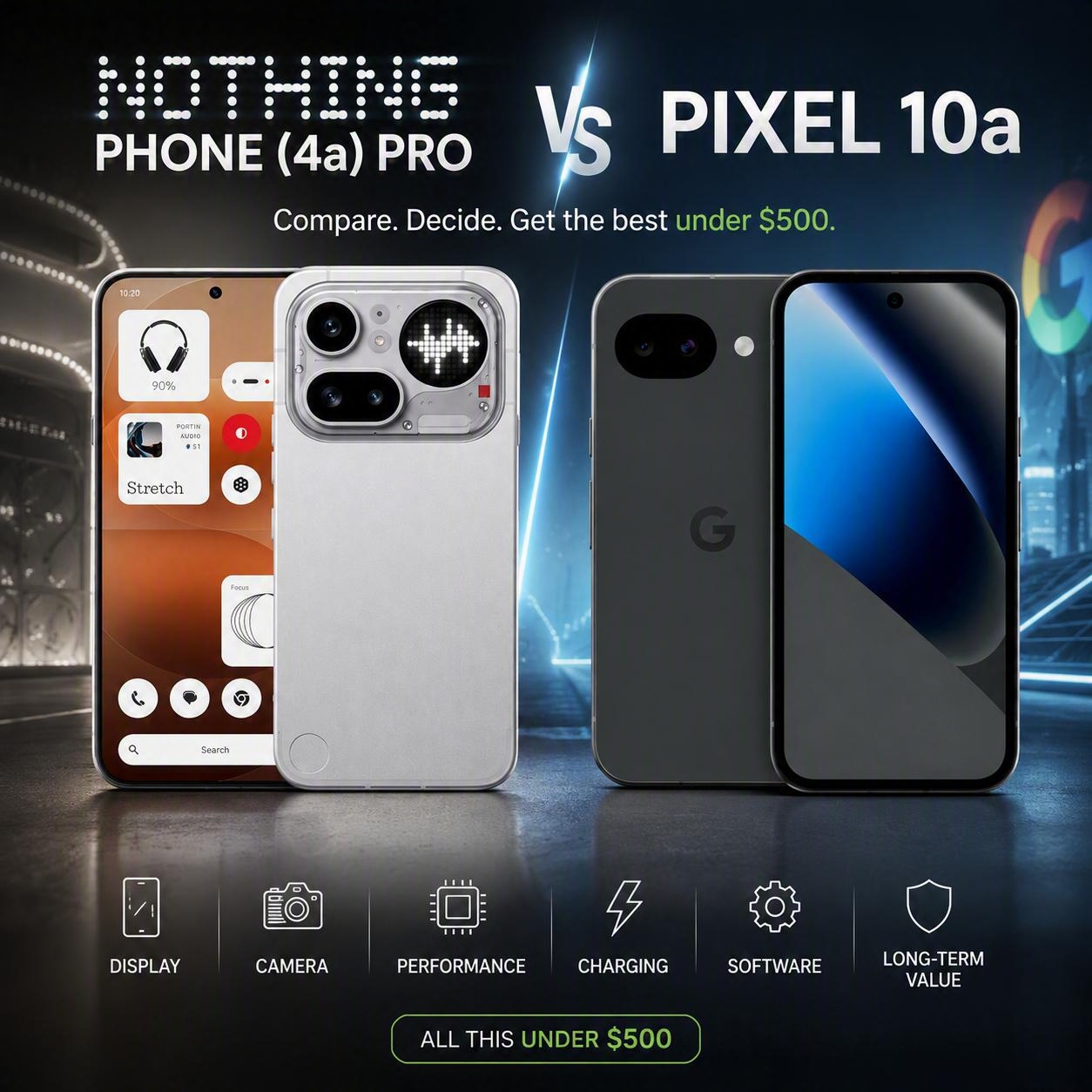


Hardware Innovation Meets Software Strategy
The ongoing competition in the Nothing Phone (4a) Pro vs. Google Pixel 10a market highlights contrasting hardware strategies. Both devices entered the mid-range smartphone segment in early 2026 with matching baseline prices of $499. However, each manufacturer targeted distinctly different consumer priorities at this key price point. Mobile tech enthusiasts evaluate whether hardware flair or deep software integration offers greater long-term value. Recent market developments show rising manufacturing costs impacting mid-range pricing strategies globally.
Component supply pressures forced smartphone manufacturers to optimize their hardware specifications carefully. Consequently, Google reused its proven Tensor G4 processor to maintain target price accessibility. Conversely, Nothing upgraded its device with premium aluminum housing and a dedicated periscope lens. These choices create distinct ownership experiences for consumers seeking value under five hundred dollars.
Industrial Design Analysis in Nothing Phone (4a) Pro vs. Google Pixel 10a
Physical design represents the most dramatic point of divergence between these two mid-range devices. Nothing introduced a solid aluminum unibody build that feels exceptionally structural in hand. Additionally, the rear camera module houses an eye-catching micro-LED Glyph Matrix notification system. The metal body offers IP65 dust and water resistance for daily operational durability. Nothing engineered this metallic chassis to deliver a distinct premium feel without exceeding weight targets.
Google selected a classic mid-range construction featuring an aluminum frame and plastic back. Meanwhile, the Pixel 10a achieves superior IP68 water immersion protection despite its synthetic rear panel. The Pixel weighs 183 grams, making it noticeably lighter than Nothing’s 210-gram metal chassis. Therefore, users seeking a lightweight daily driver might favor Google’s compact ergonomics.
Display Technologies and Outdoor Brightness
Display specifications reveal significant operational differences during intensive media consumption. Nothing features an expansive 6.83-inch AMOLED panel supporting a rapid 144Hz refresh rate. Furthermore, the screen reaches an impressive peak outdoor brightness of 5000 nits. Tough Corning Gorilla Glass 7i shields the front display panel against drops and surface scratches.
Google equips the Pixel 10a with a smaller 6.3-inch P-OLED panel running at 120Hz. Specifically, the display achieves 3000 nits peak brightness, ensuring excellent outdoor visibility. The screen utilizes the same durable Gorilla Glass 7i cover glass as its main rival. Thus, Nothing delivers higher refresh rates and brighter visuals for gaming enthusiasts.
Platform Architecture and Battery Charging Performance
Internal processing architectures dictate heavy application handling and sustained system performance. Nothing chose Qualcomm’s Snapdragon 7 Gen 4 processor built on an efficient 4nm process node. Accordingly, the hardware provides smooth multitasking and reliable thermal management during continuous gaming. System configurations include up to 12GB LPDDR5X RAM and 256GB fast internal storage.
Google powers the Pixel 10a with its proprietary Tensor G4 system-on-chip platform. Instead of maximum benchmark scores, the Tensor architecture prioritizes artificial intelligence workloads. The phone includes a 5100mAh battery paired with improved 30W wired charging support. Moreover, Google maintains 10W wireless charging support, which Nothing lacks entirely. Standardized benchmarking reveals unique hardware tradeoffs between raw performance and power efficiency.
| Specification Parameter | Nothing Phone (4a) Pro | Google Pixel 10a |
| Baseline Starting Price | $499 | $499 |
| Display Size & Type | 6.83-inch 1.5K AMOLED | 6.3-inch FHD+ P-OLED |
| Refresh Rate & Peak Brightness | 144Hz, 5000 nits | 120Hz, 3000 nits |
| Processor Chipset | Snapdragon 7 Gen 4 (4nm) | Google Tensor G4 (4nm) |
| Main Camera System | 50MP Main + 50MP Periscope (3.5x) + 8MP Ultrawide | 48MP Main + 13MP Ultrawide |
| Front Camera Video | 32MP (1080p Max) | 13MP (4K Max) |
| Battery & Wired Charging | 5080 mAh, 50W Fast Charging | 5100 mAh, 30W Fast Charging |
| Wireless Charging Support | No | Yes (10W Qi Wireless) |
| Ingress Protection Rating | IP65 | IP68 |
| Extended Software Policy | 3 Major OS / 6 Security Years | 7 Major OS / 7 Security Years |
Mobile Photography and Lens Architecture
Camera hardware illustrates contrasting strategies for capturing still photos and recorded video content. Nothing installs a versatile triple camera system featuring a 50MP periscope telephoto lens. Indeed, this dedicated lens offers 3.5x optical zoom for clear distant photography. A 50MP primary sensor and an 8MP ultrawide lens complete the rear camera suite.
Google relies on a dual rear array containing a 48MP primary and 13MP ultrawide camera. Nevertheless, Google leverages advanced computational software to produce bright, natural photos. The front 13MP sensor records sharp 4K video clips for content creators and video calls. Nothing caps front camera recording at 1080p resolution despite its 32MP sensor. Users choosing between these cameras must balance optical zoom versatility against selfie video resolution.
Software Operating Systems and Artificial Intelligence
Software execution influences daily system responsiveness and long-term operating system usability. Nothing OS 4.1 delivers a clean Android 16 interface free of third-party software bloat. Simultaneously, functional micro-LED Glyph light patterns display customizable notification alerts on the back. Nothing guarantees three Android operating system upgrades alongside six years of security patches.
Google integrates deep Gemini artificial intelligence directly into the Android 16 operating system. Likewise, smart features like Call Assist and Live Translate function seamlessly on the local hardware. Google provides seven full years of operating system updates and security support. Hence, Pixel owners secure extended software longevity alongside cutting-edge machine learning tools.
Strategic Industry Impact and Consumer Choice
The mid-range market sector expanded its definition of premium hardware standards in 2026. Nothing proved that aluminum unibody builds and periscope zoom fit within sub-$500 budgets. Google demonstrated the value of computational photography and long-term software support. Both smartphones successfully deliver distinct advantages to demanding mobile users worldwide.
Global economic conditions make evaluating trade-offs critical prior to committing to a purchase. Nothing appeals to users wanting physical style, faster displays, and rapid charging speeds. Alternatively, Google caters to buyers prioritizing camera consistency, wireless charging, and extended updates. Ultimately, both devices strengthen competition in the rapidly evolving mid-range smartphone ecosystem.
Support Our Work
Help us keep creating and maintaining our projects. We appreciate your support!
Ways to contribute:
Shop via Affiliate LinksSupport us at no extra cost to you while you shop.
Support on Ko-fiBuy us a coffee to keep the engine running!


Leave a Reply