


- Get the most out of the moment with iconic Ray-Ban style and technology by Meta. Now featuring frames for a broader rang…
- Never miss a beat—ask Meta AI to take photos or videos, unearth information, create clever image captions or check out F…
- Video call hands-free and share your POV so others can feel like they’re right there with you whether you’re cooking, wa…
Market Positioning and Strategic Evolution
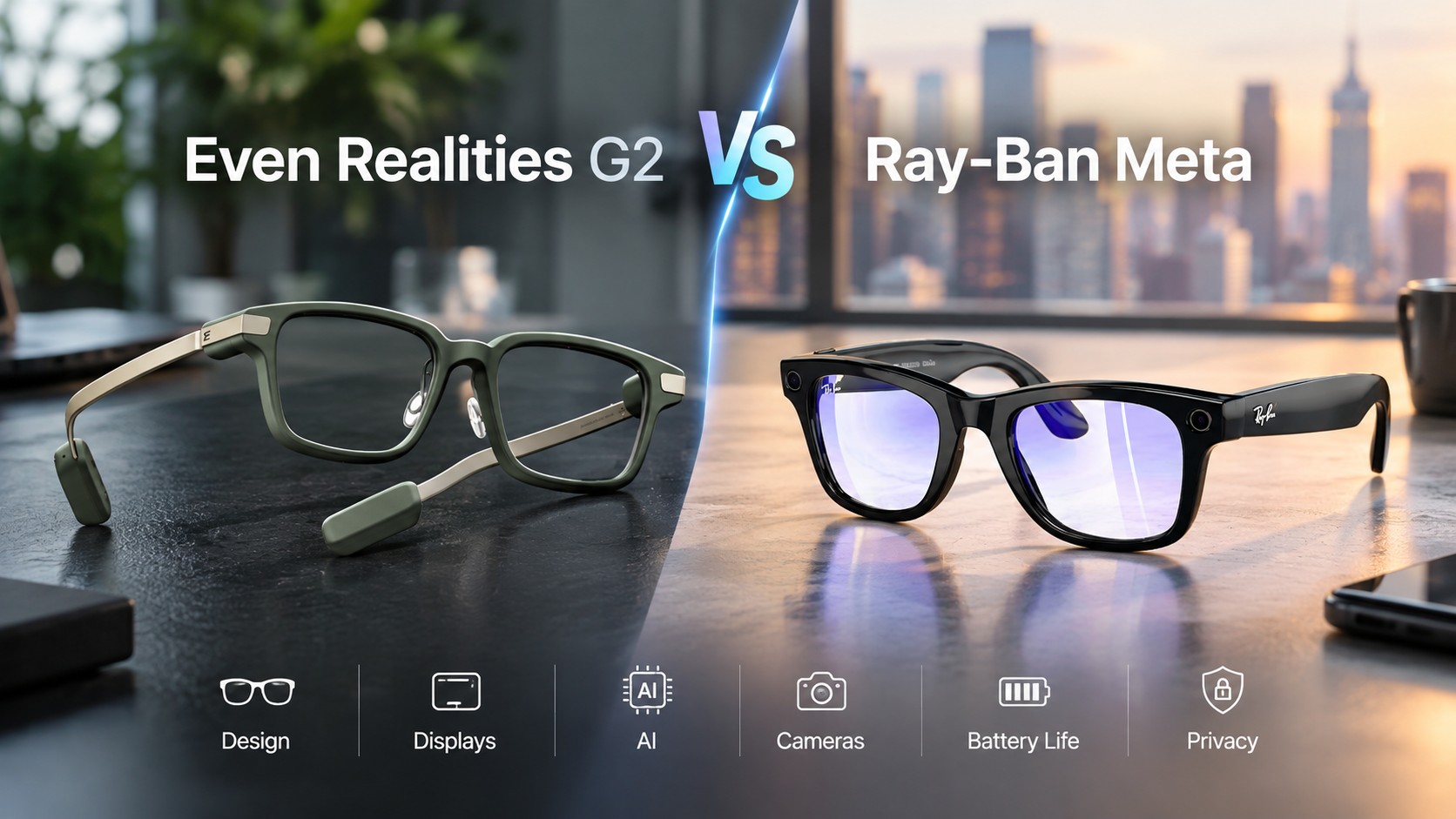
Consumer wearable technology experienced a massive structural evolution throughout 2025 and 2026 across global markets. Industry analysts frequently compare the Even Realities G2 vs. Ray-Ban Meta Smart Glasses to evaluate competing market strategies. However, these two flagship products target radically different everyday use cases for modern smart eyewear adoption. Even Realities prioritizes extreme privacy protection, lightweight ergonomics, and unobtrusive monochrome heads-up display notifications.
Meanwhile, Meta emphasizes rich multimodal camera recording, open-ear stereo audio playback, and visual artificial intelligence assistance. Consumers must decide between quiet personal productivity tools and active personal content capture equipment. Furthermore, this hardware division reflects expanding public debates surrounding recording privacy in urban environments. Frame mass and battery capacity directly dictate daily wearer comfort during long working routines.
Consequently, technical specifications across both brands reveal distinct engineering compromises aimed at specific user segments. Market adoption metrics confirm rapid category growth across enterprise and consumer eyewear demographics. Hardware manufacturers now adapt their product lines to accommodate both minimalist and feature-rich user demands. Thus, understanding hardware differences helps buyers select the ideal device for their personal workflow requirements.
Even Realities G2 vs. Ray-Ban Meta Smart Glasses: Hardware Specs
Frame design directly dictates daily wearability, temple pressure, and physical comfort during extended wearing sessions. Even Realities constructed the G2 chassis using ultralight titanium and magnesium metal alloys for maximum durability. Specifically, the G2 weighs thirty-two to thirty-six grams, matching standard non-smart prescription optical frames. The G2 frame also achieves an IP65 ingress rating for robust water and dust protection.
Electronic components inhabit compact pill-shaped capsules located at the rear of thin metal temple arms. Conversely, Meta utilizes classic style acetate frame construction for its second-generation smart glasses collection. Standard Ray-Ban Meta Gen 2 frames weigh forty-nine grams across popular Wayfarer and Headliner frame styles. However, the advanced Meta Ray-Ban Display model increases total device weight to seventy grams.
Hardware Retail Pricing & Mass Metrics
Even Realities G2
-
Starting Price$599
-
Total Mass32g – 36g
Ray-Ban Meta Gen 2
-
Starting Price$379
-
Total Mass∼49g
Meta Ray-Ban Display
-
Starting Price$799
-
Total Mass69g – 70g
Meta smart eyewear carries an IPX4 water resistance rating across all current active product lines. Therefore, Meta frames easily withstand light rain showers but cannot endure high water pressure exposure. Optical fit options support custom prescription lens installations across both competitive smart eyewear platforms. Users can select tint coatings and photochromic lenses based on indoor and outdoor lighting environments.
Visual Display Architecture and Optical Engineering
Display engines represent the primary technical separator between these two contemporary smart specs architectures. Even Realities G2 integrates a binocular monochrome micro-LED waveguide display into both optical lenses. Consequently, green text overlays float comfortably above the natural eye line without obstructing ambient vision. The G2 display delivers 640 by 350 resolution across a twenty-seven point five degree field. Peak screen brightness reaches twelve hundred nits to ensure clear readability during bright daytime conditions.
In contrast, the Meta Ray-Ban Display integrates a monocular full-color waveguide screen into the right lens. This right-eye display panel reaches five thousand nits peak brightness for outdoor visual clarity. The panel yields six hundred by six hundred resolution running at a smooth ninety hertz refresh rate. Alternatively, standard Ray-Ban Meta Gen 2 models omit display screens entirely to reduce frame weight.
Visual Display Architecture
Even Realities G2
Ray-Ban Meta Gen 2
Meta Ray-Ban Display
Micro-LED waveguides reflect optical light rays into the wearer eye while keeping lenses transparent to bystanders. Moreover, custom clip-on sunglass shades allow users to adapt clear display lenses for outdoor sunlight. Both companies continuously refine waveguide manufacturing to eliminate visible rainbow reflections on optical surfaces. Advanced display optics allow wearers to read incoming messages without looking down at smartphone screens.
Input Mechanics and Artificial Intelligence Systems
User input mechanisms determine how smoothly wearers navigate interface options during active daily transit routines. Even Realities G2 features touch-sensitive control strips positioned directly on the rear temple capsules. Wearers can also pair the optional two hundred forty-nine dollar Even R1 smart ring accessory. Besides control functions, the ring tracks heart rate, body temperature, and pulse metrics. Four embedded frame microphones capture spoken voice queries for the integrated Even AI virtual assistant.
Meanwhile, Meta pairs its display model with the Meta Neural Band electromyography wristband controller. The neural wristband decodes micro finger movements into system inputs without touching the glasses frame. Furthermore, Meta AI employs Llama 4 algorithms with a twelve-megapixel camera for live visual processing. Users ask questions about visible items, capture 3K video, or translate foreign spoken languages instantly. Open-ear directional stereo speakers transmit crystal audio directly into the wearer ears without external earbuds.
Sensors, Multimedia & Privacy
Even Realities G2
Ray-Ban Meta Gen 2
Meta Ray-Ban Display
Artificial intelligence capabilities expand the scope of real-time contextual feedback available to active wearers. Additionally, noise-canceling microphone arrays isolate the user voice during telephone calls on windy streets. Ambient light sensors automatically adjust display brightness to maintain optimal text readability indoors and outdoors. These multimodal software tools convert smart glasses into indispensable daily productivity and communication companions.
Hardware Metrics and Battery Performance
Technical spec comparisons highlight key differences between camera-free display specs and full multimedia recording hardware. The comparative data table below summarizes core specifications across both primary smart eyewear lineups.
| Feature Metric | Even Realities G2 | Ray-Ban Meta Gen 2 | Meta Ray-Ban Display |
| Starting Retail Price (USD) | $599 | $379 | $799 |
| Total Chassis Mass | 32g–36g | ~49g | 69g–70g |
| Integrated Display Engine | Binocular Green Micro-LED | None | Monocular Color Micro-LED |
| Screen Resolution & Brightness | 640x350 (1,200 nits) | N/A | 600x600 (5,000 nits) |
| Camera Hardware | None (Privacy-first) | 12MP Ultra-wide (3K video) | 12MP Ultra-wide (3K video) |
| Audio Setup | 4 Mics / No Speakers | 5 Mics / 2 Speakers | 6 Mics / 2 Speakers |
| Ingress Rating | IP65 Dust & Water Resistant | IPX4 Water Resistant | IPX4 Water Resistant |
| Primary Controller | Touch Strip / R1 Ring | Frame Touch / Voice | Meta Neural Wristband |
| Eyewear Runtime | Up to 48 Hours | Up to 8 Hours | Up to 6 Hours |
Consequently, hardware metrics illustrate a direct relationship between camera processing load and overall battery life. Even Realities G2 achieves up to two full days of typical usage per single charge. Conversely, Ray-Ban Meta Gen 2 provides eight hours of continuous audio and visual operation. The Meta Ray-Ban Display model delivers roughly six hours of continuous active power per charge.
Daily Endurance & Ingress Protection
Even Realities G2
Case Recharges 7xResistant
Ray-Ban Meta Gen 2
Case Extends to 48hResistant
Meta Ray-Ban Display
Case Extends to 48hResistant
Included charging cases supply additional battery capacity to keep both systems operational during business travel. The G2 case recharges the eyewear up to seven times before requiring external outlet power. Similarly, Meta charging cases extend operating endurance up to forty-eight total hours for travellers. Fast-charging capabilities quickly replenish battery levels during short rest breaks throughout busy work days.
Software Ecosystems and Developer Platforms
Software platforms govern long-term device value as independent software developers release new applications for eyewear. Even Realities introduced the open Even Hub app store to accelerate third-party software development. Thus, users install specialized plug-ins for teleprompter viewing, live speech translation, and calendar navigation. The minimalist software interface intentionally avoids visual clutter to prevent digital fatigue during social encounters.
Simultaneously, Meta expands its unified Meta OS ecosystem across diverse fashion frame styles and partner brands. Recent updates introduced Conversation Focus software to isolate targeted human voices in loud ambient environments. Meta expanded its product catalog with athletic Oakley Meta Vanguard frames and prescription Scriber Optics models. The company also launched budget-friendly Meta Glasses starting at two hundred ninety-nine dollars in 2026.
Open platform access allows independent creators to build unique utilities tailored for specific professional workflows. Indeed, enterprise plug-ins assist public speakers, medical professionals, and international business travelers during daily operations. Continuous software enhancements ensure smart eyewear capabilities expand rapidly beyond original factory launch feature sets. Robust application stores represent a critical competitive requirement for sustained consumer adoption in coming years.
Market Impact and Strategic Outlook
Accelerating consumer demand highlights expanding public interest in stylish, unobtrusive head-worn personal computing devices. Enterprise buyers and privacy advocates strongly favor the camera-free architecture engineered into Even Realities G2. Specifically, removing camera modules eliminates recording concerns inside confidential offices, healthcare facilities, and gyms. The G2 delivers glanceable heads-up data overlays while maintaining an elegant prescription optical frame profile.
On the other hand, media creators prefer the rich camera and audio capabilities built into Meta frames. Meta maintains consumer momentum through iconic frame styling and conversational Llama 4 artificial intelligence tools. Therefore, buyers seeking hands-free video capture and spatial audio streaming should select Meta smart glasses. Both manufacturers prove that smart frames can successfully replace conventional optical prescription glasses for users.
Industry investments in micro-LED waveguides and neural control interfaces signal rapid ongoing hardware miniaturization. Furthermore, future software iterations will deliver deeper context awareness and seamless real-time language translations. Competition between camera-free display specs and capture-oriented frames accelerates technological innovation across the sector. Smart eyewear rapidly emerges as the next primary personal computing platform replacing traditional mobile devices.
Support Our Work
Help us keep creating and maintaining our projects. We appreciate your support!
Ways to contribute:
Shop via Affiliate LinksSupport us at no extra cost to you while you shop.
Support on Ko-fiBuy us a coffee to keep the engine running!




Leave a Reply