
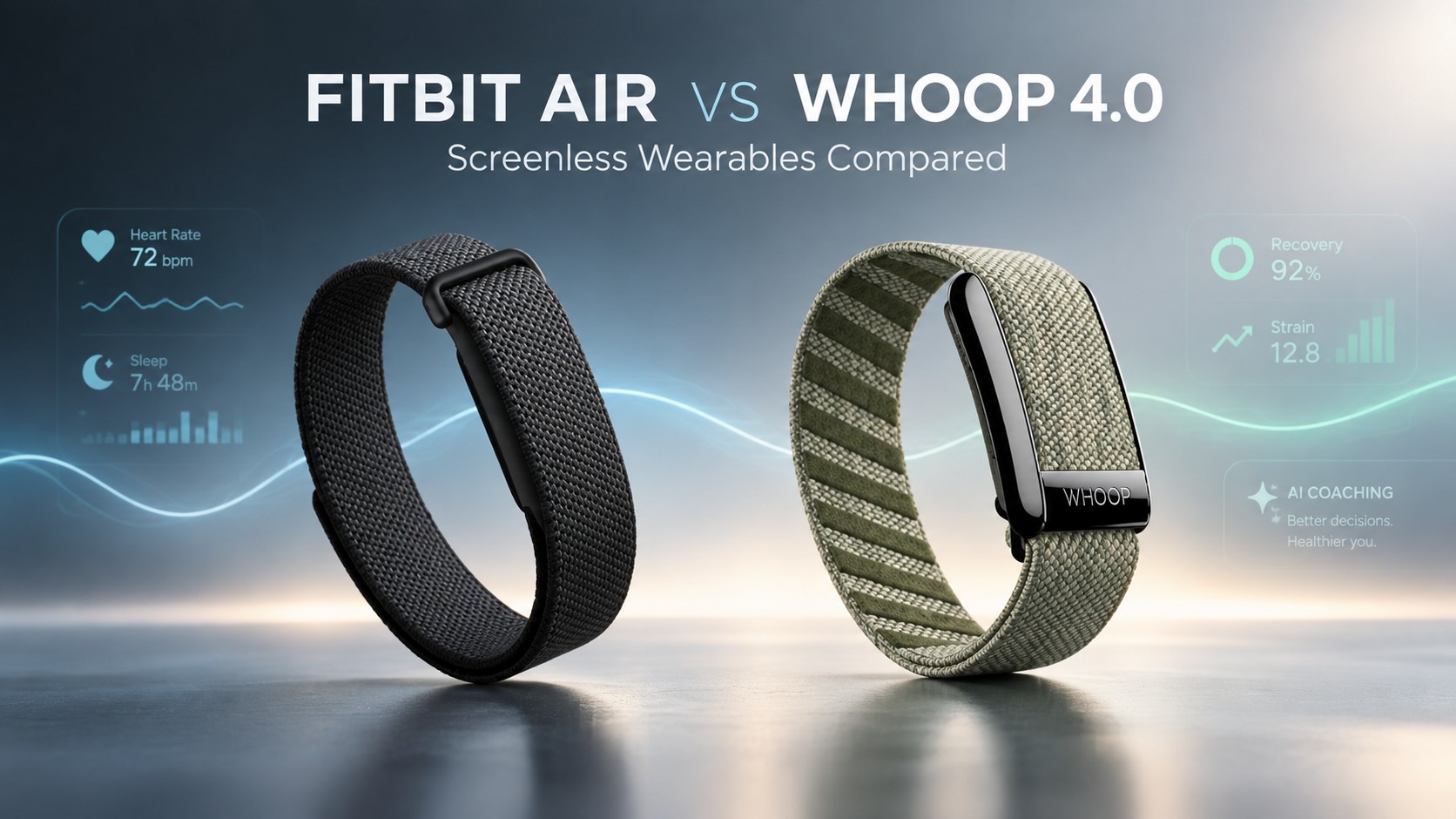


- Meet the performance band built from comfortable, recycled materials that’s micro-adjustable for a flexible fit – no mat…
- Recycled polyester1, nylon, and elastane yarn band with stainless steel buckle.
- One size fits wrists 130-210 mm around, with a micro-adjustable performance loop

- Google Fitbit Air is the unbelievably comfortable, exceptionally smart way to transform your health[1]; and Google Healt…
- Unlock more with Google Health Premium: With a premium membership, get personalized coaching that’s built with Gemini an…
- Comfortable fit – One Size Tracker (130-210 mm): The lightweight, micro-adjustable fit sits comfortably and quietly, so …
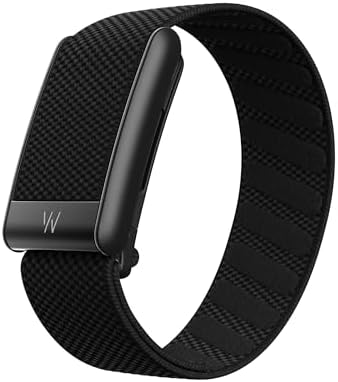
- What You Get – A 12-month membership, WHOOP 5.0 device, a SuperKnit band, and a waterproof* Wireless PowerPack. Choose f…
- HSA/FSA Eligible – All 12-month WHOOP memberships and battery packs qualify for HSA/FSA reimbursement.
- Screenless, Distraction-Free – No screen, no buzzing notifications. WHOOP focuses entirely on your health and performanc…
The Shift Toward Screenless Health Tracking
Google launched the Fitbit Air in May 2026, creating an intense competition in the “Fitbit Air vs. WHOOP 4.0” market. This ultra-compact device drops the traditional display entirely to deliver distraction-free continuous tracking. Consequently, users can monitor core health vitals without suffering from persistent digital screen fatigue. The screenless pebble clips into soft fabric bands, weighing just five point two grams. WHOOP 4.0 maintains an established presence among dedicated athletes seeking continuous physiological monitoring.
Consumers increasingly demand minimalist form factors that support comfortable around-the-clock biometric logging. Furthermore, Google targets broader consumer segments by offering an accessible ninety-nine dollar hardware price. WHOOP relies on mandatory subscription plans that require recurring annual financial commitments. This economic divergence fundamentally reshapes how health-conscious consumers evaluate long-term wearable value.
Fitbit Air vs. WHOOP 4.0: Technical Architecture and Sensor Capabilities
The physical design of both devices reflects contrasting engineering priorities for continuous wearability. Specifically, the Fitbit Air pebble weighs twelve grams including its standard fabric loop band. Conversely, the WHOOP 4.0 sensor assembly weighs twenty-six grams on the user’s wrist. Google builds the Fitbit Air pebble using durable plastic rated for fifty meters of water resistance. Both trackers house advanced optical heart rate sensors alongside three-axis accelerometers and temperature sensors.
Sampling frequency marks an essential operational difference between these two health tracking systems. WHOOP records heart rate data every single second to capture rapid biometric fluctuations. Google stores heart rate readings every two seconds to extend total battery longevity. However, Fitbit Air includes passive heart rhythm monitoring with automated atrial fibrillation alerts. WHOOP does not offer passive atrial fibrillation detection on its primary consumer platform.
Hardware & Mass Analysis
Physical design trade-offs contrasting minimalism against total sensor assembly.
Comparing Biometric Features and Hardware Costs
Evaluating hardware specifications reveals distinct strategic trade-offs across power management, pricing, and health sensors. Additionally, battery performance remains a crucial factor for users committed to uninterrupted sleep and recovery tracking. The table below outlines key technical parameters and subscription requirements for each screenless device.
Power & Sensor Capabilities
Technical parameters driving continuous wearability without interruption.
| Specification Metric | Google Fitbit Air | WHOOP 4.0 |
|---|---|---|
| ❤ Heart Rate Storage | Every 2 Seconds | Every 1 Second |
| ⚠ Atrial Fibrillation (AFib) | ✔ Included Passively | ❌ Not Available |
| ⌛ Battery Endurance | Up to 7 Days | 4 to 5 Days |
| ⚡ Power Delivery | 5 Mins Charge = 1 Day | On-Wrist Battery Pack |
| Specification / Feature | Google Fitbit Air | WHOOP 4.0 |
| Upfront Hardware Cost | $99.99 base price | Free with membership |
| Mandatory Subscription | None required | $199 to $239 yearly |
| Tracker Module Weight | 5.2 grams pebble | 26 grams total |
| Heart Rate Storage Rate | Every 2 seconds | Every 1 second |
| Atrial Fibrillation Alerts | Included passively | Not available |
| Battery Endurance | Up to 7 days | 4 to 5 days |
| Fast Charging Support | 5 minutes for 1 day | On-wrist battery pack |
Power delivery mechanisms further differentiate how users maintain continuous wearability without interruption. Therefore, Fitbit Air’s fast-charging capability provides a full day of usage from a five-minute charge. WHOOP relies on a clip-on battery pack that recharges the unit directly on the wrist. Google delivers a longer battery life while eliminating mandatory recurring software fees.
Software Ecosystems and Gemini AI Integration
Software services drive the modern screenless tracker experience by turning raw biometrics into actionable guidance. Google rebranded the Fitbit application into Google Health in May 2026 to unify its ecosystem. As a result, the optional Gemini-driven Google Health Coach delivers personalized wellness insights. This intelligent assistant analyzes sleep stages, workout history, and daily stress levels in real time.
The financial structures of each company establish sharply contrasting long-term cost models for consumers. WHOOP charges an annual subscription fee between one hundred ninety-nine and two hundred thirty-nine dollars. A three-year WHOOP membership requires over six hundred dollars in total subscription costs. By contrast, Fitbit Air functions fully without any required monthly payment for core tracking features. Users wanting advanced Gemini coaching can subscribe to Google Health Premium for nine dollars monthly.
Software & Market Trajectory
Converting raw biometrics into actionable guidance and strategic industry impact.
Strategic Industry Impact and Market Outlook
The release of the Fitbit Air creates significant ripple effects across the health technology market. WHOOP maintains a firm hold on hardcore athletes who demand intense strain modeling and high-density sampling. Nevertheless, Google appeals to broader demographic groups seeking accessible health tracking and heart screening. Google also allows the Fitbit Air to work simultaneously alongside Pixel Watch devices without data duplication.
Third-party accessory expansion further highlights Google’s open platform strategy for consumer devices. In particular, Google published official hardware specs to let independent designers craft certified custom bands. This open design model encourages rapid aesthetic customization while maintaining affordable accessory options. In contrast, WHOOP controls all band manufacturing directly, preserving high profit margins on proprietary accessories.
Consumer Choice and Category Trajectory
Choosing between these screenless wearables depends primarily on training demands, desired metrics, and budget preferences. Elite athletes seeking second-by-second strain tracking will likely continue using the WHOOP 4.0 platform. Indeed, WHOOP provides deeply specialized recovery metrics tailored to rigorous daily conditioning routines. Those users often justify the higher subscription price through detailed strain and fatigue analytics.
Financial Architecture & Cost
Economic divergence in long-term wearable value and subscription models.
- ✔ Base hardware price
- ✔ $0 Mandatory Subscriptions
- ✔ Free core tracking features
- ➕ Optional Premium: $9/month
- ✔ Free upfront hardware
- ⚠ $199 – $239 Annual Fee
- ⚠ Mandatory recurring commitment
- ⚠ 3-Year Cost Estimation
Alternatively, Fitbit Air redefines value for mainstream buyers needing accurate sleep and activity tracking. Passive atrial fibrillation alerts provide vital peace of mind for health-conscious users across all age brackets. Moreover, affordable hardware combined with powerful AI coaching sets a competitive new standard for fitness wearables. Thus, Google successfully expands screenless health tracking beyond elite athletic circles into mass market adoption.
Support Our Work
Help us keep creating and maintaining our projects. We appreciate your support!
Ways to contribute:
Shop via Affiliate LinksSupport us at no extra cost to you while you shop.
Support on Ko-fiBuy us a coffee to keep the engine running!



Leave a Reply