


- NVIDIA Ada Lovelace Streaming Multiprocessors: Up to 2x performance and power efficiency
- 4th Generation Tensor Cores: Up to 2X AI performance
- 3rd Generation RT Cores: Up to 2X ray tracing performance
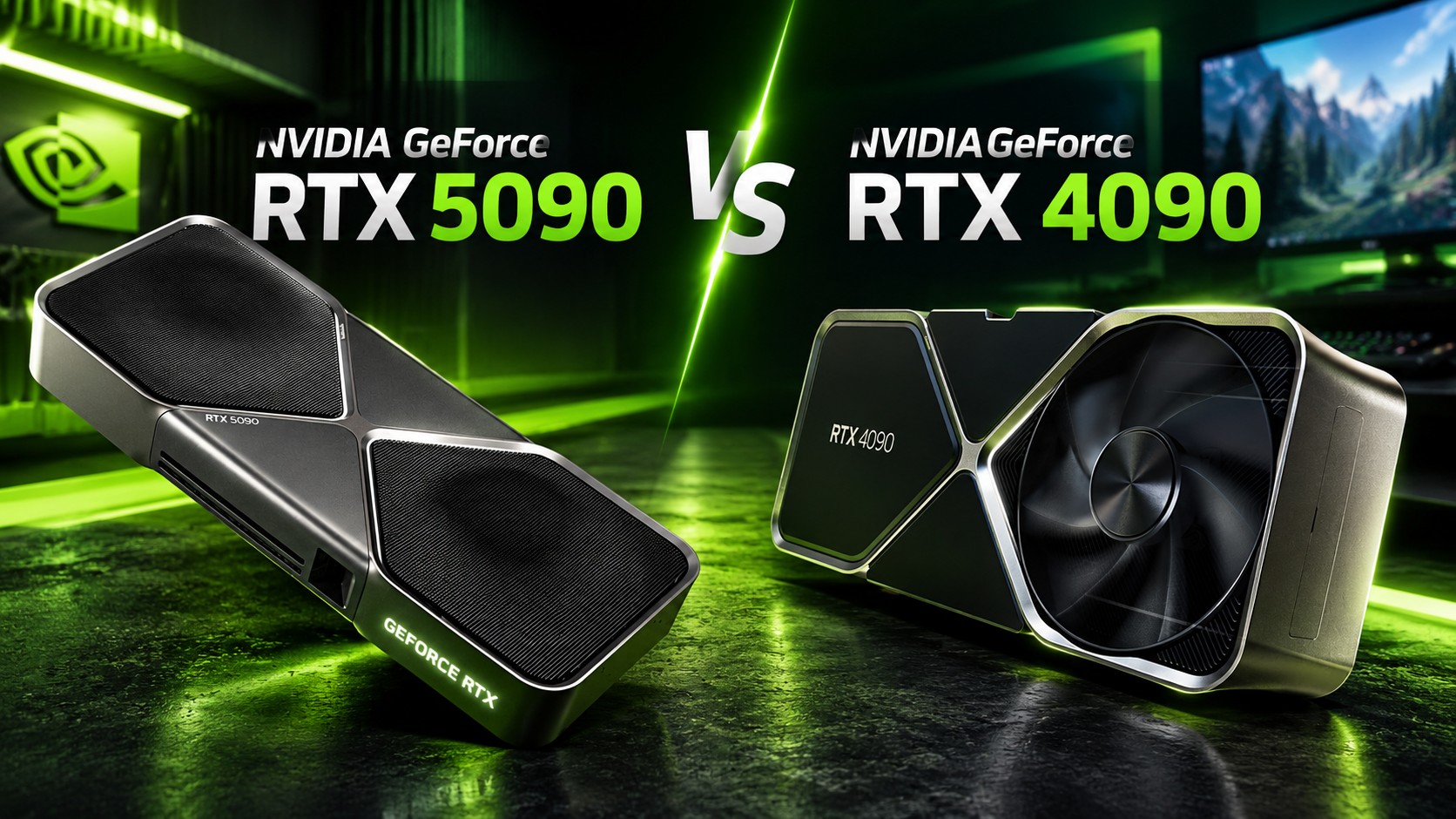
Overview of NVIDIA GeForce RTX 5090 vs. GeForce RTX 4090
NVIDIA launched its flagship Blackwell architecture, sparking major hardware comparisons. Specifically, enthusiasts evaluate the NVIDIA GeForce RTX 5090 vs. GeForce RTX 4090 across demanding workloads. The new top-tier GPU introduces physical structural changes over the older Ada Lovelace generation. NVIDIA built the GB202 silicon die using TSMC 4N process technology with 92.2 billion transistors. Consequently, technology analysts closely examine whether performance gains justify this higher consumer pricing. The launch price reached $1,999, establishing a $400 increase over the predecessor card.
This generational transition highlights NVIDIA’s focus on deep learning graphics pipelines. Meanwhile, custom board partners released diverse air and liquid cooling designs for thermal management. These hardware advancements target real-time path tracing alongside generative artificial intelligence models. However, elevated power requirements demand robust computer system infrastructure and modern power supplies. Industry partners report sustained strong market demand across consumer and workstation sectors.
Technical Specifications and Hardware Architecture
The Blackwell GB202 GPU contains 21,760 CUDA cores across its silicon substrate. In contrast, the older AD102 core provides 16,384 CUDA cores for graphics execution. This structural core increase delivers roughly 33 percent more physical compute resources. Additionally, fifth-generation Tensor cores replace older processing units to accelerate matrix operations. The rated boost clock operates at 2407 MHz on the reference Founders Edition model. Actual clock frequencies often exceed baseline figures during real-world gaming scenarios.
Memory technology represents a major structural shift for the Blackwell hardware platform. The card incorporates 32 GB of ultra-fast GDDR7 memory on a 512-bit bus. This configuration yields a massive memory bandwidth total of 1.79 TB per second. Thus, memory bandwidth expands by 78 percent compared to the prior GDDR6X setup. Power draw increases to 575 W total board power through a 12V-2×6 connector.
| Metric | NVIDIA GeForce RTX 5090 | NVIDIA GeForce RTX 4090 |
| GPU Architecture | Blackwell GB202 | Ada Lovelace AD102 |
| Process Technology | TSMC 4N | TSMC 4N |
| Transistor Count | 92.2 Billion | 76.3 Billion |
| CUDA Core Count | 21,760 | 16,384 |
| Tensor Cores | 680 (5th Gen) | 512 (4th Gen) |
| Ray Tracing Cores | 170 (4th Gen) | 128 (3rd Gen) |
| Base / Boost Clock | 2017 / 2407 MHz | 2235 / 2520 MHz |
| VRAM Capacity & Type | 32 GB GDDR7 | 24 GB GDDR6X |
| Memory Bus Width | 512-bit | 384-bit |
| Memory Bandwidth | 1.79 TB/s | 1.01 TB/s |
| Total Board Power | 575 W | 450 W |
| Base MSRP | $1,999 | $1,599 |
Benchmark Performance Analysis
Synthetic benchmark evaluations reveal significant raw compute improvements for the GB202 processor. For instance, Geekbench CUDA scores demonstrate a 27 percent advantage over the RTX 4090. Blender 3D rendering tests yield a 36 percent rendering throughput advantage. Moreover, 3DMark Steel Nomad tests at 4K resolution show a peak 53 percent uplift. Across all synthetic 3DMark tests, the performance advantage averages roughly 39 percent.
Conversely, native rasterization in games shows more modest generational frame rate jumps. Native 4K gaming without spatial upscaling generates performance gains between 20 and 30 percent. Far Cry 6 tests demonstrate a 27 percent frame rate increase at native resolution. Higher resolution workloads heavily utilize the expanded GDDR7 memory pipeline under ray tracing. Overall, traditional gaming scaling closely matches the physical CUDA core count expansion.
DLSS 4 and Software Architecture Features
Software advances represent a key component of the Blackwell user experience. In addition, DLSS 4 introduces Multi Frame Generation powered by fifth-generation Tensor cores. The new AI transformer model generates up to three extra frames per rendered frame. As a result, frame rates multiply up to eight times in fully path-traced game titles. Cyberpunk 2077 achieves fluid performance exceeding 200 FPS at 4K resolution.
RTX Neural Texture Compression reduces VRAM overhead significantly during gameplay. Texture memory usage drops from 6.5 GB to 970 MB in documented developer tests. NVIDIA Reflex 2 frame warp technology minimizes end-to-end rendering system latency. Older Ada Lovelace GPUs remain hardware restricted to single frame generation routines. Therefore, software capabilities represent a major operational divide between card generations.
Market Position and Upgrade Assessment
NVIDIA positions its flagship graphics card toward elite enthusiasts and artificial intelligence researchers. Machine learning creators benefit directly from 32 GB of VRAM and native FP4 support. Gamers focused on rasterized rendering might find generational jumps modest for pure gaming. Alternatively, users targeting path tracing and high refresh rates gain clear performance advantages. Power consumption increases necessitate careful power supply planning during system installation.
Retail availability constraints remain an ongoing challenge across multiple purchasing channels. Custom partner models provide varied thermal solutions for distinct chassis configurations. Ultimately, the Blackwell platform establishes an advanced benchmark for enthusiast computing hardware. Future software developments will further expand the capabilities of neural rendering architectures.
Support Our Work
Help us keep creating and maintaining our projects. We appreciate your support!
Ways to contribute:
Shop via Affiliate LinksSupport us at no extra cost to you while you shop.
Support on Ko-fiBuy us a coffee to keep the engine running!






Leave a Reply