

The Recovery Still Continues
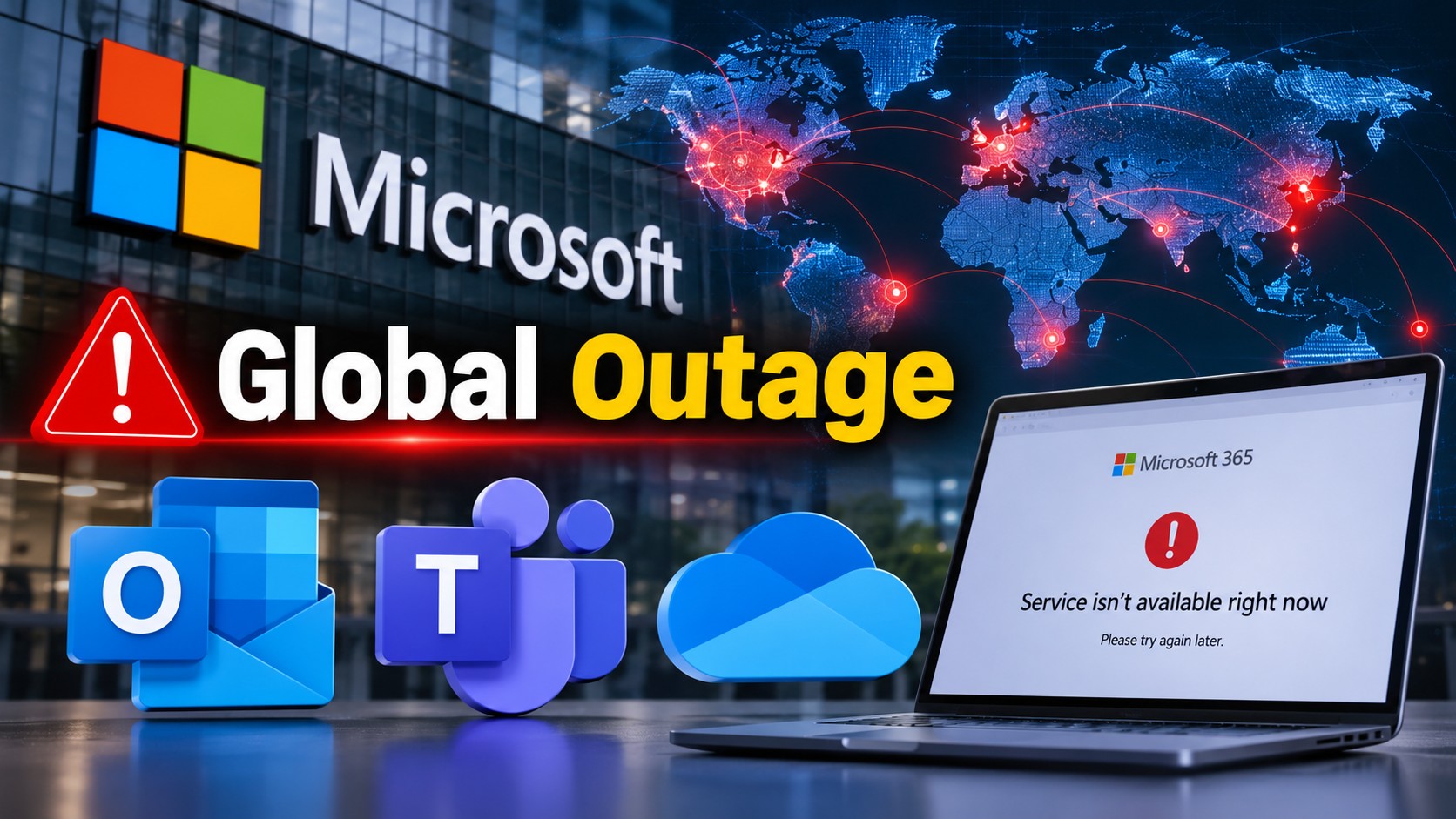
A sprawling Microsoft outage disrupted thousands of businesses and public agencies across three continents. Users lost access to Outlook email, Microsoft Teams, SharePoint, and Copilot across multiple regions. However, Microsoft engineers have published no firm deadline for full global restoration. The disruption began in Exchange Online on November 12 and spread across Microsoft 365.
Microsoft tracked Exchange Online incident EX1550543 alongside broader Microsoft 365 advisory MO1550821. Specifically, cascading server overloads crippled core productivity and security tools around the world. Company executives ruled out a cyberattack, citing overloaded servers and failing health checks. This breakdown arrives amid record $45.2 billion quarterly capital spending and tighter cloud oversight.
What Triggered the November Microsoft Outage
Trouble started at 16:17 UTC on November 12 when Exchange Online mailbox connections failed. Early reports centered on Americas users across web, desktop, mobile, and REST API clients. Meanwhile, Cisco ThousandEyes logged connection resets, timeouts, HTTP errors, and packet loss at 17:30 UTC. Within two hours, Microsoft opened broader incident MO1550821 covering the wider productivity suite. Peak Downdetector reports topped 130,000 in the United States, with complaints spanning 74 countries.
Microsoft found normal overall user traffic without any sudden demand spike. Instead, an overloaded core process caused servers to fail automated health checks and drop offline. Shifting traffic crushed remaining healthy infrastructure and triggered cascading connection failures across regions. Consequently, engineers paused software deployments, restarted machines, and tested alternative health-check procedures.
Restored servers repeatedly crashed again once live user traffic returned. Machines stuck in a bad state stalled network configuration syncs during traffic surges. Nevertheless, Microsoft executive Charles Lamanna confirmed investigators found no signs of malicious cyber activity. Teams chats and meetings returned for many users around 02:00 UTC on Friday. Even so, ThousandEyes observed Outlook timeouts at 03:00 UTC alongside 25,000 lingering US reports. Engineers saw initial server stability upon patching an upstream authentication and routing component early Friday.
Global Fallout Across Businesses and Governments
Beyond Outlook, the outage hit Teams, SharePoint Online, OneDrive, Copilot, and Dynamics 365. Furthermore, administrators lost reliable access to Defender XDR, Intune tools, Power BI, and Purview. Microsoft’s own public status website suffered intermittent loading errors during the disruption. In turn, external AI tools faltered when OpenAI and Anthropic connectors lost Microsoft 365 access.
Public agencies across Asia-Pacific scrambled toward phone calls, text messages, and paper bulletins. Japan’s Cabinet and Defense ministries posted physical notices on office bulletin boards. Similarly, Japan’s Digital Agency used SMS texts to coordinate internal operations. Logistics company Sagawa Express halted baggage reservations, and drugmaker Taisho took orders by phone. In Australia, federal departments, state courts, schools, and intelligence agency ASIO lost email connectivity.
As a result, Victoria officials warned residents against opportunistic scammers sending fake links. RSM Australia analyst Ashwin Pal warned national damages could reach billions of dollars. Australian Assistant Treasurer Daniel Mulino cautioned that officials cannot immediately quantify total losses. Simultaneously, European offices woke to broken tools, and Indian airline IndiGo issued advisories. British schools requested absence calls, spotlighting the UK government’s £1.9 billion annual Microsoft spend.
Comparing Recent Cloud and Microsoft Outage Incidents
November’s failure marks Microsoft’s third major cloud disruption in under seven weeks. Two late-September Azure outages struck networking gateways across 33 regions and Swedish AI clusters. Notably, September’s Swedish AI failure involved automated health checks trapping instances in restart loops.
Separate global breakdowns in October 2025 and July 2024 hit Azure Front Door layers. For instance, October 2025’s eight-hour disruption stalled Alaska Airlines check-ins alongside NatWest and Starbucks. The table below outlines reported dates, windows, services, and triggers across five major incidents.
Cloud Resilience Strategy and Recent Investments
Microsoft tightened internal defenses over two years under its Secure Future Initiative. Its July 2026 report cited 99.97% phishing-resistant MFA coverage across users and devices. Additionally, engineering teams stripped public internet exposure from 732,000 production cloud resources.
Following October 2025, Microsoft temporarily slowed Azure Front Door rollouts to 45 minutes. Therefore, edge workers now keep serving traffic using healthy settings during stalled updates.
Windows Resiliency and Endpoint Security
Endpoint reliability gained urgency when CrowdStrike’s 2024 bug crashed 8.5 million Windows devices. Accordingly, Microsoft launched its Windows Resiliency Initiative to contain kernel-level software crashes. Quick Machine Recovery fixes unbootable enterprise PCs remotely without physical hardware swaps.
Windows 365 Reserve supplies temporary cloud desktops when primary enterprise devices fail. Moreover, Microsoft previewed an endpoint platform moving third-party security tools outside the Windows kernel. Security vendors including CrowdStrike, SentinelOne, ESET, and Sophos endorsed this architectural shift.
AI Infrastructure and 2026 Acquisitions
Hardware spending surged alongside security overhauls to support rising enterprise cloud demand. First-quarter fiscal 2027 CapEx jumped 30% to $45.2 billion, supporting 48% Azure revenue growth. Commercial backlog reached $677 billion, and capacity delays trimmed 2026 CapEx to $170 billion. Media reports state Microsoft wound down Oracle cloud rentals and skipped Nscale data centers.
In addition, Microsoft spent $1.7 billion on acquisitions during fiscal 2026. January’s Osmos acquisition brought autonomous AI data engineering agents into Microsoft Fabric. Subsequently, April’s Fintool purchase aimed to embed financial research tools directly inside Microsoft 365.
Regulatory Pressure on Global Cloud Providers
Regulators oversee top cloud platforms as systemically critical technology infrastructure. In November 2025, European authorities designated 19 critical third-party ICT providers under DORA. That list names Microsoft Ireland Operations Limited alongside AWS, Google Cloud, and Oracle. Thus, EU lead overseers can levy fines reaching 1% of average daily worldwide turnover. Regulated financial firms must report major outages within four hours of incident classification.
Likewise, Britain’s Treasury placed Microsoft and three cloud rivals under critical oversight in July 2026. That month, the Bank of England warned shared AI concentration magnifies systemic operational risk. British and European authorities signed a January 2026 pact coordinating inspections across shared providers. In response, the Australian Computer Society urged a review of single-vendor technology reliance. RMIT professor Mark Gregory recommended thorough pre-deployment testing alongside secondary backup email accounts.
Handling a Microsoft Outage and Claiming SLA Credits
IT teams facing Outlook disruptions should avoid resetting passwords or reinstalling desktop applications. Premature profile rebuilds create extra cleanup work without fixing server-side routing errors. Sending mail servers queue undelivered messages and retry delivery once mailboxes return online. Administrators can inspect mail flow using Exchange message trace tools inside the admin portal. Alternatively, users lacking admin portal access can monitor live updates at status.cloud.microsoft.
Commercial subscribers may qualify for billing credits under Microsoft’s 99.9% monthly uptime pledge. Monthly availability under 99.9% triggers a 25% credit, and uptime below 99% earns 50%. Service dropping below 95% entitles business tenants to a 100% monthly fee credit. Conversely, consumer Outlook users receive zero financial compensation under Microsoft’s standard terms. Multi-hour outages do not automatically trigger payouts under full-month uptime formulas.
Microsoft usually requires manual credit claims and applies approved funds toward future invoices. Crucially, contractual SLA credits cap payouts at monthly fees, excluding lost business revenue. Administrators must file requests inside Help & support citing the relevant incident ID. Yet, independent telemetry from tools like ThousandEyes helps verify outage durations within claim windows.
What Comes Next for Enterprise Cloud Resilience
Microsoft promised a formal Post-Incident Report detailing root causes and permanent engineering fixes. The disruption occurred four days ahead of Microsoft Ignite opening on November 17. Engineers earlier reported that traffic rebalancing surged outbound routing calls toward backend servers. Indeed, enterprise architects must evaluate how internal failover loops interact with cloud automation.
European and British regulators begin 2027 oversight planning with fresh operational evidence. Financial institutions under DORA maintain mandatory supplier registers, concentration checks, and tested exit plans. Ultimately, cloud FinOps specialists note retry logic and circuit breakers often protect uptime cheaply. Microsoft’s $677 billion commercial backlog reflects deep corporate reliance on its cloud ecosystem. Nonetheless, prolonged outages remind organizations to pair cloud suites with independent communication backups.
Support Our Work
Help us keep creating and maintaining our projects. We appreciate your support!
Ways to contribute:
Shop via Affiliate LinksSupport us at no extra cost to you while you shop.
Support on Ko-fiBuy us a coffee to keep the engine running!






Leave a Reply