
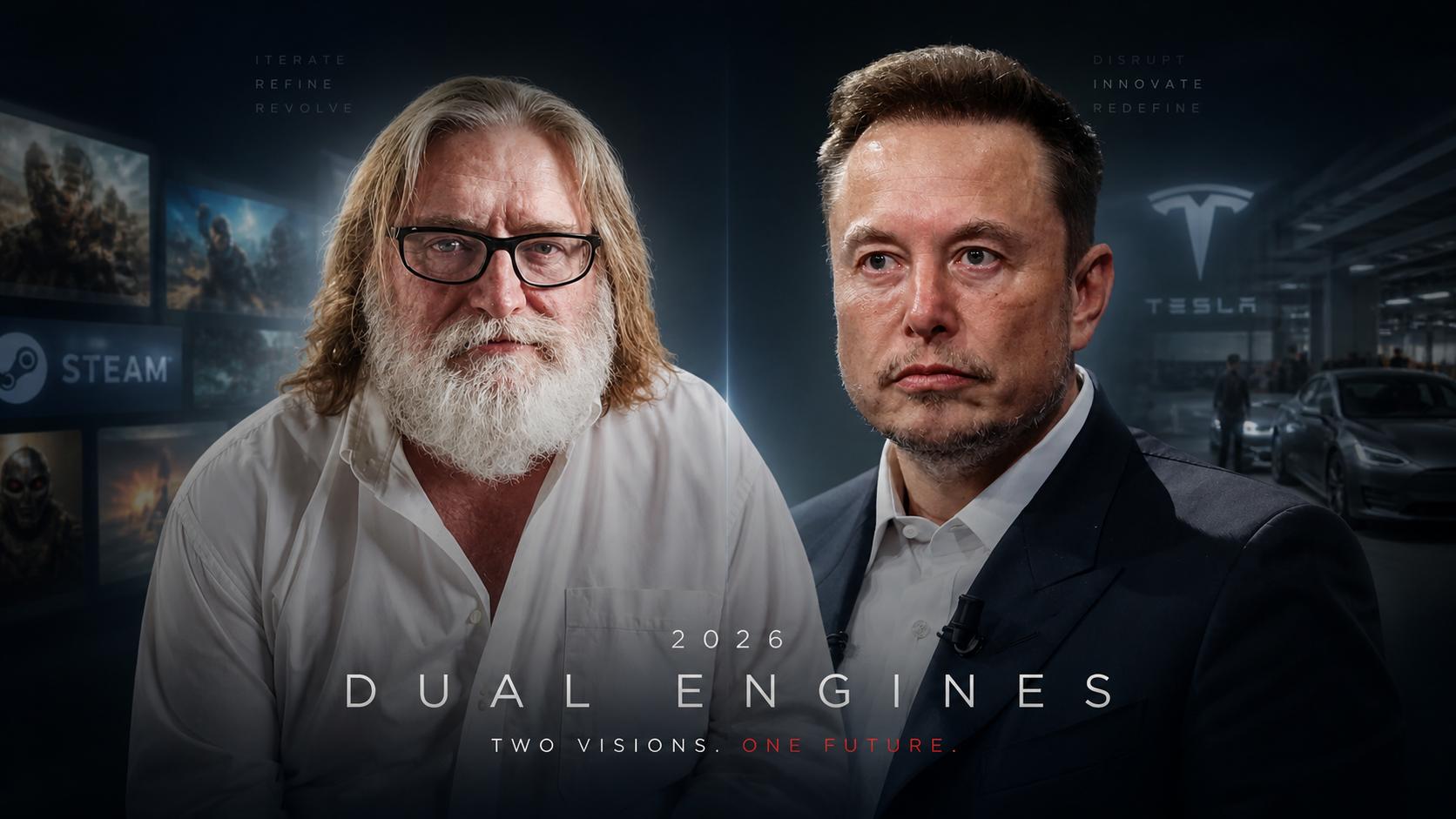
Gabe Newell and Elon Musk dominate the technology landscape with two very different philosophies. We must observe how their leadership styles influence the global market in 2026. Specifically, Gabe Newell focuses on the iterative refinement of the PC gaming ecosystem through private ownership. Meanwhile, Musk pushes for radical transformation in space and autonomous transport sectors. These leaders represent the primary methods for achieving global industry dominance today.

Newell prioritizes the preservation of open hardware and software for all PC enthusiasts. Consequently, he has spent over a decade building a loyal community through the Steam platform. Musk chooses to prioritize physical infrastructure and autonomous systems that redefine human mobility. Furthermore, this divergence creates a unique competitive environment where gaming and aerospace increasingly overlap.
Both figures have reached critical milestones during the first half of this year. Therefore, their strategic choices now define the boundaries of human-machine interaction. The technological landscape reflects a deep ideological split between these two titans. Valve operates as a quiet powerhouse that values product stability and consumer trust. However, Musk leads high-intensity companies driven by rapid scaling and public disruption.
Gabe Newell (Valve)
Newell believes in a decentralized future for technology. Therefore, he invested heavily in Linux-based gaming solutions. This strategy allowed the Steam Deck to succeed. Consequently, Valve liberated PC gaming from the Windows monopoly. Furthermore, his flat management structure encourages internal creativity. Thus, the company retains its most talented engineers. Meanwhile, Newell avoids the spotlight of public markets intentionally. Valve remains a private company under his control.
Elon Musk (Tesla/SpaceX)
Musk views technology as a tool for survival. Therefore, he pushes for rapid colonization of Mars. His Starship program represents the pinnacle of engineering. However, his approach requires control over the stack. Consequently, SpaceX manufactures almost every component in-house. This vertical integration ensures speed and cost-efficiency. Meanwhile, his influence on the automotive sector is unparalleled. Therefore, traditional manufacturers now scramble to catch up.
Gabe Newell and the Philosophy of Iterative Refinement
The management style at Valve emphasizes the importance of employee autonomy and project freedom. Consequently, the company functions without traditional middle management or a rigid corporate hierarchy. This structure allows developers to choose projects that align with their personal passions. Therefore, the resulting products often feature a level of polish rarely seen elsewhere.
Newell believes that creative freedom is the primary driver of technological innovation today. Iterative refinement remains the core strategy for every hardware and software release at Valve. Meanwhile, the company avoids the trap of releasing products before they are truly ready. This patient approach has solidified their reputation as a leader in the gaming industry.
Scaling this flat structure beyond a few hundred people remains a significant challenge. However, Valve continues to prove that non-hierarchical organizations can achieve massive economic success. The success of the Steam platform is a testament to this long-term iterative vision. Specifically, the company has grown its user base to over 132 million monthly active accounts.
| Category | Gabe Newell (Valve) | Elon Musk (Tesla/X) |
|---|---|---|
| Ecosystem Type | Open and modular. Consequently, users modify software easily. | Closed and integrated. Therefore, hardware is strictly controlled. |
| Market Strategy | Niche profitability. Meanwhile, avoids public growth pressure. | Massive scale. Additionally, uses public markets for capital. |
| Hierarchy | Flat structure. Thus, employees choose their projects. | Top-down control. Consequently, execution is extremely rapid. |
Musk’s Methodology of Radical Disruption
Elon Musk employs a rigid five-step operational framework known as the algorithm to scale. This approach requires engineers to question every requirement and delete every unnecessary step. Therefore, his companies can move from concept to production at an incredible pace. This methodology has transformed Tesla and SpaceX into dominant global leaders in their fields.
The high-pressure environment often leads to significant employee burnout and turnover. Nevertheless, radical disruption is the primary goal for every project under the Musk umbrella. The companies prioritize engineering solutions from first principles rather than following industry trends. Consequently, this mindset allowed SpaceX to develop reusable rockets that revolutionized space travel.
The cost of reaching orbit has dropped significantly over the last five years. Meanwhile, the focus at Tesla has shifted toward artificial intelligence and large-scale robotics in 2026. Musk believes that autonomy will account for the majority of the company’s future value. Furthermore, the integration of xAI into the broader ecosystem strengthens this technological push.
Valve’s Hardware Pivot
Valve recently announced a massive shift in its hardware strategy for the coming years. On November 12, 2025, the company unveiled a new internal design for a console. This device is set to release in 2026 as part of a broader lineup. Therefore, Valve is moving away from purely relying on third-party manufacturers for home systems.
Notably, the strategy involves creating a default model that sets a clear performance standard. The new hardware lineup includes the Steam Machine, the Steam Controller, and the Frame. Consequently, Valve aims to control the entire user experience from the couch to the screen. This hardware expansion builds directly on the technical success of the Steam Deck handheld.
The company is preparing the software ecosystem with major updates to SteamOS. Specifically, version 3.8.0 now includes dedicated support for the upcoming console hardware. This pivot represents a significant risk for a company that primarily focuses on software. However, Valve has proven its hardware capabilities with the Index and the Steam Deck.
The Steam Machine: Gabe Newell Unveils Bigfoot
Valve has given its internally designed hardware model the official internal codename of Bigfoot. This system will serve as the baseline experience for the new Steam Machine generation. Consequently, other manufacturers can develop their own versions based on this default specification. The Bigfoot model represents a high-end target for the living room gaming experience.
The design of the Steam Machine emphasizes a console-like experience with PC-level power. Meanwhile, the hardware utilizes a Linux-based operating system to ensure high efficiency and speed. This allows the system to boot directly into the Steam Big Picture interface. Specifically, the focus is on ease of use and immediate access to libraries.
Initial reports suggest that the Steam Machine launch has faced some manufacturing delays. These delays are primarily due to the ongoing global crisis in memory components. However, Valve has recommitted to a 2026 release for the final consumer hardware. Therefore, the company is using this extra time to refine the internal cooling systems.
Technical Prowess of the New Gabe Newell Console
The internal specifications for the 2026 Steam Machine represent a massive leap in power. Specifically, the system is reportedly six times more powerful than the original Steam Deck. It features an AMD 6-core Zen 4 CPU to handle complex game logic. Furthermore, the GPU is a semi-custom AMD RDNA3 design with 28 compute units.
| Component | Steam Machine (Bigfoot) Spec |
| Processor | AMD 6-core Zen 4 X86 |
| Graphics | Semi-Custom AMD RDNA3 (28CU) |
| Memory | 16GB DDR5 |
| Storage | 512GB or 2TB SSD Options |
| Wireless | Wi-Fi 6E / Bluetooth 5.3 |
The system also includes support for advanced features like ray tracing and upscaling. Specifically, achieving high frame rates at 4K requires the use of AMD FSR. Valve is prioritizing efficiency and software-driven performance to compete with larger rivals. Consequently, the inclusion of 16GB of DDR5 RAM ensures smooth multitasking across the OS.
Gabe Newell and Tactile Precision
Valve launched the new Steam Controller on May 4, 2026, for ninety-nine dollars. This device features a unique design that combines traditional inputs with high-precision trackpads. Consequently, it is designed to bridge the gap between gamepads and mice. The controller arrived ahead of the console to satisfy immediate community demand.
The new model emphasizes repairability and durability for long-term use by enthusiasts. Specifically, early reviews have praised the improved tactile feedback of the trackpads. The controller includes an integrated 2.4GHz radio for low-latency wireless play. Furthermore, this ensures that competitive players can maintain their edge in fast-paced titles.
Early batches of the controller were spotted on retail sites in Asia before launch. Meanwhile, the hardware has been refined through years of testing with the Steam Deck. This iterative design process has resulted in a highly sophisticated input device. Specifically, it includes a customizable LED bar and interchangeable face plates.
Steam Deck OLED Success
The Steam Deck OLED remains the gold standard for handheld gaming PCs today. Specifically, the device features a 7.4-inch HDR OLED display with a 90Hz refresh rate. This screen offers superior brightness and color compared to the original LCD model. Furthermore, the 6nm AMD APU provides better efficiency and longer battery life.
| Metric | Steam Deck OLED Specification |
| Refresh Rate | 90 Hz |
| Peak Brightness | 1,000 nits |
| Battery | 50 Whr |
| RAM Speed | 6,400 MT/s |
| Base Price | $549 (512GB) |
Valve has sold millions of units since the handheld first launched. Meanwhile, the price of 549 dollars for the 512GB model remains highly attractive. This balance of price and performance is difficult for competitors to match. Specifically, Valve uses its software revenue to subsidize the hardware costs.
Competitive Edge of SteamOS
SteamOS 3 is the secret weapon behind Valve’s hardware success in 2026. Specifically, the operating system is designed from the ground up for gaming. This allows it to run more efficiently than traditional Windows-based handhelds. Furthermore, the interface is optimized for both touch and controller inputs.
Valve has recently begun allowing third-party manufacturers to use SteamOS. Therefore, the OS is becoming a standard for the entire handheld industry. This move strengthens Valve’s position as the primary software gatekeeper. Meanwhile, the company continues to improve the Proton compatibility layer.
This allows thousands of Windows games to run flawlessly on Linux. Specifically, the integration of SteamOS across different devices creates a unified ecosystem. However, not every game is supported due to anti-cheat or other limitations. Therefore, Valve continues to work with developers to improve compatibility.
Stealth Hero Shooter Deadlock
Valve is currently developing a highly ambitious new game titled Deadlock. The project is a 6v6 third-person shooter with MOBA elements. Specifically, it combines hero selection and strategy with complex shooter mechanics. The game has been growing through a quiet, invite-only beta period.
The game was known internally as Neon Prime before its style changed. Therefore, it shifted from a sci-fi theme to fantasy and steampunk. This aesthetic choice makes the world feel grimy and cohesive. Meanwhile, the gameplay features verticality and complex movement systems.
Deadlock recently crossed the 100,000 concurrent player mark in early 2026. However, the game remains in an invite-only state for most users. This allows Valve to refine the balance and performance of the game. Furthermore, the community engagement across social platforms is growing rapidly.
Tesla’s Strategic Pivot to Artificial Intelligence
Tesla is currently undergoing a massive strategic pivot toward artificial intelligence. Elon Musk believes that robots will account for 80 percent of value. Consequently, the company is shifting resources away from traditional auto manufacturing. This transition requires billions of dollars in new capital expenditure.
The company recently announced a 25 billion dollar investment in AI infrastructure. Meanwhile, they are targeting limited production of the Optimus humanoid robot. This robot is intended to eventually perform complex factory tasks. Specifically, this pivot has been met with both excitement and skepticism from investors.
This change represents a fundamental shift in how the company is valued. Specifically, it is no longer just about selling cars to consumers. Tesla aims to be a global platform for autonomous transport. Therefore, the success of the Cybercab and Optimus projects is critical.
Corporate Capitalization Comparison
Financial scale reveals the different scaling strategies between these leaders. Therefore, we compare public market caps against private estimations. Meanwhile, net worth reflects personal equity in these massive ventures.
Cybercab: Realizing the Autonomous Vision
The Tesla Cybercab represents the realization of Musk’s long-standing robotaxi dream. Specifically, the vehicle is designed to be fully autonomous from the start. It lacks a steering wheel, pedals, or traditional rear windows. This minimalist design simplifies the manufacturing process and reduces overall costs.
Tesla targets a base price of 30,000 dollars for the Cybercab. Meanwhile, the operating cost is estimated at just 20 cents per mile. This would make autonomous travel more affordable than traditional ride-sharing. Therefore, the Cybercab could fundamentally change how people move in cities.
Production began at Gigafactory Texas in February 2026. However, the rollout is still subject to significant regulatory hurdles today. The vehicle operates at Level 4 autonomy in designated urban areas. Specifically, this geofencing allows Tesla to prove the system’s safety in stages.
Starfish Neuroscience Alternative
Gabe Newell’s Starfish Neuroscience is developing a minimally invasive neural chip. Specifically, the chip measures just 2×4 mm and consumes 1.1 milliwatts. This is significantly lower than Neuralink’s 6.0 milliwatt power draw. Furthermore, the chip is battery-free and powered wirelessly through the skull.
The Starfish design emphasizes simultaneous access to multiple brain regions. Meanwhile, the chip is manufactured using TSMC’s 55nm process technology. This focus on efficiency and precision sets it apart from competitors. Specifically, it is intended to treat conditions like Parkinson’s disease.
Starfish plans to release its initial BCI chips by late 2025. However, the company is still in the early stages of commercialization. They are actively seeking partners for wireless power and communication. Therefore, Starfish represents a quiet, results-focused approach to neurotechnology.
The Race for the Neural Interface
Both leaders recognize brain-computer interfaces as critical frontiers. However, their execution models diverge completely. Meanwhile, the technology advances rapidly. Musk targets invasive medical implants via Neuralink. Therefore, he seeks high-bandwidth direct brain interaction. Conversely, Newell supports non-invasive alternatives like Galea. Consequently, he prioritizes gaming and accessibility over surgery.
Gabe Newell and the Management Flatarchy
Valve operates with a flat organizational structure and no formal managers. Specifically, employees can manage processes and make decisions through simple communication. This model encourages direct exchange and maximizes independence for everyone. Furthermore, it allows the company to remain agile and flexible.
Elon Musk uses a hierarchical structure with a clear chain of command. Specifically, his companies follow a pyramid shape with executives at the top. This structure provides clear direction and well-defined advancement paths. Consequently, the company can scale more predictably across large global markets.
Both models have their own sets of advantages and drawbacks in 2026. However, they reflect the distinct personalities of their respective leaders. The cultural impact of these styles is felt across the entire tech world. Therefore, the contrast highlights that there is no single way to succeed.
Future Convergence: Gabe Newell and Musk
The paths of Gabe Newell and Elon Musk are converging on a single goal. Specifically, they are both building the interfaces for the future of humanity. For Newell, this involves immersive digital worlds and neural gaming. Meanwhile, for Musk, it is about autonomous mobility and multiplanetary expansion.
Their current hardware projects are just the first steps toward this goal. Therefore, the boundaries between the physical and digital are being erased. These technologies will redefine how we live, work, and play. Specifically, the year 2026 marks a turning point for these massive ambitions.
The success of these projects depends on public trust and regulation. However, the innovative spirit of both leaders continues to push boundaries. This convergence will ultimately define the integrated human future for decades. Consequently, we must watch these developments with keen interest as they unfold.
Shared Vision, Different Paths
Despite their differences, both men agree on one point. They believe humans must merge with machines to evolve. Newell sees this through virtual entertainment. Therefore, he builds tools to make games feel real. Musk sees this through existential survival. Therefore, he builds tools to make AI safe. Consequently, they are attacking the same problem from different sides.
Open Platforms,
VR, & Gaming
Closed Systems,
AI, & Space
The competition between Newell and Musk defines our era. However, it is not a traditional business rivalry. They are building two fundamentally different versions of the future. Newell’s future is one of decentralized, open-source human empowerment. Therefore, he allows the community to lead the path. Consequently, his legacy will be one of freedom. Meanwhile, Musk’s future is one of centralized industrial progress. Therefore, he takes the burden of innovation alone.
His legacy will be measured in orbital miles. Ultimately, both leaders have pushed the boundaries of possibility. Furthermore, they continue to inspire new generations. The rivalry between open and closed systems continues. Meanwhile, the pace of technological change only accelerates. Consequently, we must choose which vision we support. Therefore, the decisions of these two men matter. Their strategies today will dictate our reality tomorrow.
Thus, we must continue to analyze their impact critically. Thank you for exploring this comparison of titans. Their work will leave permanent marks on our species. However, their legacies will be judged by different metrics. Newell will be remembered for the freedom he enabled. Consequently, gamers will cherish the open ecosystem of Steam. Musk will be remembered for the frontiers he conquered. Therefore, humanity will look to the stars with his ships.
Support Our Work
Help us keep creating and maintaining our projects. We appreciate your support!
How you can help:
Shop via Affiliate LinksSupport us at no extra cost to you while you shop via the link above.




Leave a Reply