
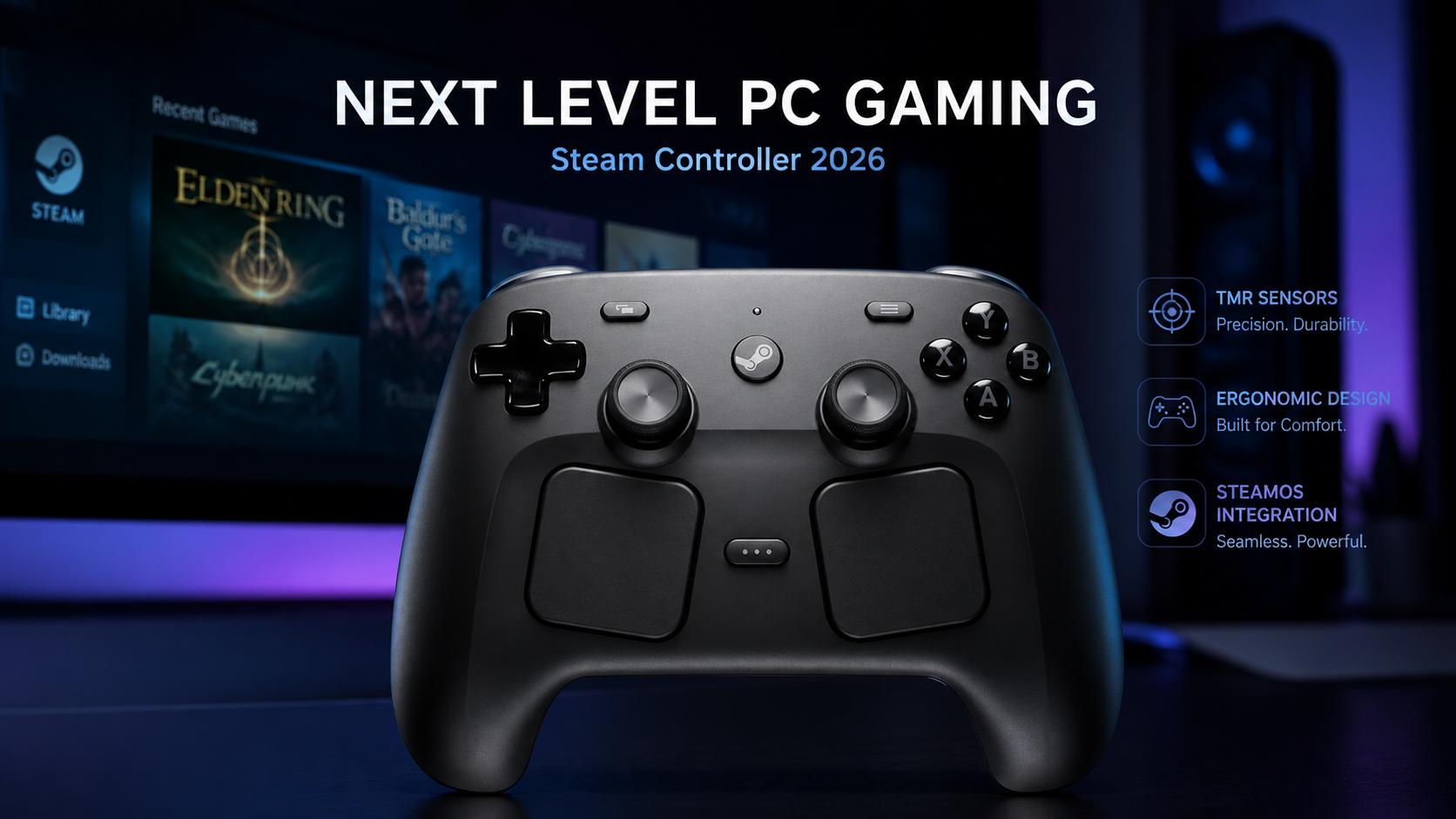
The gaming industry witnessed a massive transformation during the early months of 2026. Valve Corporation officially introduced its next generation of hardware to the global market. This release focused heavily on the sophisticated design of new Steam Controllers. Meanwhile, these devices represent a culmination of a decade of hardware experimentation. Valve successfully integrated its past failures with the triumphs of the Steam Deck.

The return to standalone peripherals marks a pivotal shift for the Washington-based company. It successfully moved beyond the niche appeal of its 2015 predecessor. Consequently, the new model addresses the needs of a much broader gaming audience. Therefore, it serves as the primary interface for the expanding SteamOS ecosystem. Professional analysts view this as a direct challenge to established console manufacturers.
The strategic timing of this launch coincides with a surge in PC gaming. Millions of players now seek high-quality couch gaming experiences from their computers. Specifically, the new peripheral provides the precision required for complex desktop titles. This report explores the technical nuances and industry implications of these recent developments. It examines how Valve redefined control standards for the modern era.
Historical Foundations of Steam Controllers Design
Valve released the original model in 2015 with a very radical vision. It aimed to bridge the gap between mouse inputs and traditional gamepads. However, the unique trackpad-only design proved too difficult for many casual players. Most users struggled to adapt to the lack of a second thumbstick. Nevertheless, a dedicated community of enthusiasts praised its deep customization options.
The company learned several critical lessons from that first hardware attempt. One lesson was the necessity of traditional inputs for familiar game genres. Therefore, engineers decided to include dual thumbsticks in the new 2026 model. This ensures immediate comfort for players transitioning from other platforms. Meanwhile, they retained the innovative trackpads for high-level precision and mouse emulation.
The design of the Steam Deck provided the final blueprint for success. It proved that trackpads and sticks could coexist effectively on one device. Consequently, Valve used the handheld’s layout as a direct reference for the new peripheral. This strategy created immediate parity across the entire Valve hardware family. Players can now move between handheld and stationary modes without any friction.
Technological Innovations in Sensors
The second generation of Steam Controllers utilizes Tunneling Magnetoresistance (TMR) technology. These sensors represent a significant leap over older potentiometer and Hall Effect designs. Specifically, TMR sensors detect movement by measuring changes in magnetic resistance. This occurs at a quantum level for incredible precision. Consequently, the sticks offer a resolution that was previously impossible in consumer gamepads.
The primary benefit of TMR sticks is the total elimination of drift. Unlike traditional sensors, there are no physical parts that wear down over time. Therefore, the controller maintains its accuracy after thousands of hours of intense use. Meanwhile, the technology offers significantly better power efficiency for wireless play. TMR modules consume roughly one-tenth the power of mainstream Hall Effect joysticks.
This efficiency contributes directly to the device’s impressive 35-hour battery life. Players can enjoy extended gaming sessions without worrying about constant recharging cycles. Furthermore, the sensors are highly resistant to environmental factors like temperature changes. This makes the peripheral a robust choice for various gaming environments. Industry experts believe TMR will soon become the new standard for high-end pads.
Comparative Analysis of Steam Controllers Hardware
| Specification | Steam Controller (2026) | Wireless HORIPAD | DualSense (PS5) |
| Sensor Type | TMR Magnetic | Capacitive Analog | Hall Effect/Potentiometer |
| Trackpads | 2x Square Haptic | None | 1x Clickable |
| Battery Life | 35+ Hours | 12 Hours | 10-15 Hours |
| Back Buttons | 4x Integrated | 2x Programmable | None (Base Model) |
| Connectivity | 2.4 GHz Puck / BT | Bluetooth / USB | Bluetooth / USB |
| Haptics | 4x LRA Motors | No Rumble | Advanced Actuators |
| Weight | 292 Grams | 185 Grams | 280 Grams |
Design Philosophy and Ergonomics of Steam Controllers
Valve engineers prioritized human factors during the three-year development of the device. They focused on creating a shape that fits a diverse range of hand sizes. Specifically, the team spent the first year exclusively on ergonomic prototypes. This ensured that every button remains reachable during high-speed competitive play. Therefore, the controller feels natural even during the longest gaming sessions.
The handles feature a crisp edge to define the primary interactive areas. Additionally, the trackpads are angled to follow the natural sweep of the thumb. This “clocked and canted” positioning reduces strain during mouse-heavy gameplay. Furthermore, the layout provides a direct translation of the Steam Deck interface. This creates a sense of immediate familiarity for existing Valve customers.
Millimeters mattered deeply during the final stages of the physical design process. Designers adjusted the distance between the face buttons and the right stick. Consequently, the controller minimizes accidental inputs while maximizing reaction speeds. Instead of a flat surface, the device uses subtle curves to guide fingers. This reflects a more mature approach to industrial design than the 2015 model.
Integrated Haptic Systems in Peripherals
The new peripheral features a sophisticated broadband haptic system for immersion. It utilizes four distinct haptic motors to provide localized tactile feedback. Specifically, two Linear Resonant Actuators are located within the dual trackpads. Two high-output motors are also situated in the controller’s main grips. This setup allows for a wide range of sensory responses.
The trackpads can simulate the physical sensation of different textures and clicks. Meanwhile, the grip motors provide traditional rumble for explosions and environmental effects. Therefore, the device offers a level of feedback that rivals the DualSense. Valve recently secured a specific patent for this multi-mode haptic assembly. This technology allows a single actuator to produce different waveforms for different components.
This nuanced feedback is essential for games that lack native controller support. The haptics can provide a sense of “physicality” to virtual mouse movements. Consequently, strategy and simulation games feel much more intuitive to play. Users can even customize the intensity of these vibrations through Steam Input. This ensures that the tactile experience matches personal preferences and game genres.
The Strategic Role of Steam Controllers in the Living Room
The launch of the controller is a central pillar of the Fremont console. Codename “Fremont” refers to the new Steam Machine designed for big-screen gaming. Specifically, the peripheral serves as the primary gateway to this powerful PC. It allows players to navigate complex interfaces with ease from a distance. Therefore, it effectively turns a high-end computer into a user-friendly gaming console.
Valve’s strategy relies on creating a seamless software and hardware loop. The peripheral includes a dedicated “Steam” button for instant menu access. Additionally, it features a “Quick Access Menu” button for rapid setting adjustments. These dedicated inputs make navigating SteamOS feel effortless and responsive. Meanwhile, the device supports automatic wake-on-wireless for the Fremont machine and connected televisions.
This integration aims to capture the “lean-back” audience of traditional consoles. Professional analysts observe that Valve is leveraging its massive software library. The peripheral makes the entire Steam catalog accessible to non-technical users. Consequently, the company is finally fulfilling its 2013 vision for the living room. It has combined open PC flexibility with the convenience of a dedicated console.
Precision Aiming and Gyro
The inclusion of a six-axis Inertial Measurement Unit enables high-fidelity gyro aiming. This feature allows players to fine-tune their shots with physical movements. Specifically, the controller uses “Grip Sense” technology to manage gyro activation. The motion sensors activate only when the user touches the back handles. Therefore, players can instantly reset their physical position by briefly loosening their grip.
This capacitive sensing also extends to the tops of the thumbsticks. Gyro aiming can be toggled just by resting a thumb on the stick. Consequently, players have multiple ways to engage with motion-controlled gaming. Many FPS enthusiasts now prefer this method over traditional stick-only aiming. It provides a level of speed and accuracy that mimics a mouse.
The software layer allows for deep customization of these motion inputs. Users can adjust sensitivity, damping, and acceleration to their exact liking. Furthermore, community layouts provide pre-configured settings for thousands of popular titles. This removes the barrier to entry for players new to gyro controls. Instead of a gimmick, gyro has become a core competitive feature.
Connectivity and the Wireless Puck
Wireless performance is managed by a proprietary adapter called the Puck. This 2.4 GHz receiver ensures a stable and low-latency connection. Specifically, the system achieves a polling rate of 4 milliseconds. This results in a total end-to-end latency of only 8 milliseconds. Therefore, it is significantly faster than standard Bluetooth 5.0 connections.
The Puck serves a dual purpose as a magnetic charging station. Users can simply drop the controller onto the Puck to begin charging. Furthermore, it features a dedicated 2.4 GHz radio for up to four controllers. This simplifies local multiplayer setups without overcrowding the wireless spectrum. Meanwhile, the device remains compatible with Bluetooth for use with mobile devices.
Valve designed the wireless receiver to be as hassle-free as possible. It connects via a standard USB-C cable to the PC or console. Additionally, it features addressable LEDs to indicate the pairing and charging status. This focus on reliability reflects lessons learned from early wireless headsets. Consequently, players experience fewer disconnections and interference issues in busy environments.
Customization and Software via Steam Controllers Input
Steam Input is the foundational software that powers the entire experience. It allows every single button and sensor to be remapped. Specifically, players can create complex “Action Sets” for different game states. For example, a trackpad can act as a mouse during menu navigation. It can then switch to a radial weapon wheel during combat.
This flexibility makes even the most complex PC games playable. Users can map keyboard shortcuts to the four remappable back buttons. Therefore, strategy and simulation games no longer require a desk and chair. Meanwhile, the community sharing features allow for instant setup of new games. Players can browse and import configurations created by the game’s top experts.
The software also supports “Virtual Menus” that appear on the screen. These menus can hold dozens of custom commands for specialized genres. Consequently, the peripheral overcomes the limited button count of traditional gamepads. This deep integration is what makes Valve’s hardware uniquely powerful. It transforms a simple controller into a highly programmable gaming tool.
Ergonomic Layout and Models Parity
The symmetrical layout of the thumbsticks is a deliberate design choice. It matches the exact configuration found on the popular Steam Deck. Specifically, this parity allows muscle memory to transfer between devices effortlessly. Players do not need to relearn button positions when switching platforms. Therefore, Valve has created a unified “standard” for all its gaming hardware.
The four remappable grip buttons are located on the back handles. These buttons allow players to keep their thumbs on the sticks. Consequently, they can perform actions like jumping or reloading without losing aim. This layout is particularly popular in fast-paced competitive shooters and roguelikes. Instead of simple triggers, these are high-quality mechanical switches for durability.
Valve also included dedicated buttons for the Quick Access Menu. These are positioned centrally to avoid accidental presses during intense gameplay. Furthermore, the “Steam” button provides a consistent anchor to the home interface. This thoughtful arrangement reflects a decade of gathering user feedback. Consequently, the new peripheral is arguably the most versatile gamepad ever built.
Technical Impact of TMR Sensors
Tunneling Magnetoresistance sensors operate through quantum tunneling between magnetic layers. This mechanism provides a much higher signal-to-noise ratio than Hall Effect. Specifically, it allows for finer detection of extremely small stick movements. This precision is vital for long-range sniping and precise platforming. Therefore, the technology offers a tangible advantage in high-stakes competitive matches.
TMR sensors also consume far less power than active magnetic sensors. This allows Valve to use a lighter battery without sacrificing runtime. Consequently, the controller remains comfortable to hold for many consecutive hours. The lack of physical contact also means the stick tension remains consistent. Instead of becoming loose over time, the sticks feel brand new for years.
The durability of these sensors reduces the need for factory repairs. Drift-related issues are the leading cause of modern controller failures. Therefore, TMR technology significantly extends the useful lifespan of the device. This focus on longevity is a core part of Valve’s sustainability strategy. Professional reviewers have praised this “set and forget” approach to stick reliability.
Market Positioning and Pricing Strategy
Valve set the official retail price at $99 for the United States. This positions the device as a premium alternative to standard gamepads. However, it remains much more affordable than “Pro” models from competitors. For instance, the Xbox Elite Series 2 often retails for $140. Therefore, Valve provides elite-level features at a more accessible price point.
The company decided to avoid subsidizing the hardware for this launch. Unlike consoles, Valve sells the peripheral as a standalone PC accessory. Specifically, they aim to compete with high-end DIY builds and peripherals. This pricing strategy reflects the high cost of the custom TMR components. Meanwhile, it ensures that the hardware business remains sustainable and profitable.
International pricing varies slightly based on local taxes and import duties. European customers will pay €99, while UK buyers pay £85. Consequently, the global rollout has been relatively consistent across major markets. The product is sold exclusively through the official Steam storefront initially. This allows Valve to maintain direct control over the customer experience.
Competitive Landscape for Steam Controllers Peripherals
The new peripheral enters a market crowded with established gaming pads. It must compete with the PlayStation DualSense and Xbox Wireless controllers. However, Valve offers several features that these standard pads lack. Specifically, the dual trackpads and TMR sticks are unique in this category. Therefore, it appeals to a specific niche of power users and PC enthusiasts.
Sony’s DualSense remains a strong competitor due to its adaptive triggers. These triggers provide varying resistance based on in-game actions like drawing a bow. Conversely, Valve’s peripheral focuses on precision and software customization instead. Most PC games do not support Sony’s advanced triggers without specific mods. Meanwhile, Valve’s peripheral works natively with every single title on the Steam platform.
The Xbox Elite remains a popular choice for its interchangeable parts. It allows users to swap sticks and paddles for different heights. Nevertheless, the Steam peripheral provides similar functionality through its deep software remapping. It also includes a built-in gyro, which is notoriously absent from Xbox pads. Consequently, Valve’s offering is often viewed as the more technically advanced option.
Hori Wireless HORIPAD and Licensed Steam Controllers
Hori introduced a licensed alternative for players on a tighter budget. The Wireless HORIPAD for Steam retails for approximately $59.99 in most regions. Specifically, it is designed for use with Windows 11 and the Steam Deck. It includes three dedicated menu buttons for navigating the Steam Big Picture mode. Therefore, it provides a “Steam-native” experience at a much lower cost.
However, the HORIPAD lacks many of the premium features of Valve’s model. It does not include haptic feedback motors or the dual trackpads. Consequently, it feels much lighter and more basic than the flagship peripheral. It also uses traditional membrane buttons instead of mechanical switches. Meanwhile, it does include capacitive sensors on the thumbsticks for gyro aiming.
The battery life of the Hori model is limited to 12 hours. This is significantly shorter than the 35 hours offered by Valve. Nevertheless, it remains a popular choice for younger players or travel use. It connects via Bluetooth or a wired USB-C connection for versatility. Professional reviewers suggest it is a solid entry-level choice for SteamOS users.
Legal Challenges and Patent History
Valve’s journey in the hardware market has been marked by lawsuits. In 2021, the company lost a $4 million case to Corsair. Specifically, a jury found that the 2015 model infringed on SCUF patents. These patents covered the use of “back paddles” for additional control surfaces. Therefore, Valve had to discontinue the original model and pay significant damages.
The new 2026 design features “buttons” instead of “paddles” to avoid infringement. These are integrated into the grip and require a different mechanical motion. Consequently, the company aims to avoid the legal pitfalls of its predecessor. Some experts believe Valve may have also secured a licensing agreement. This would ensure long-term stability for the entire hardware product line.
Legal disputes often stifle innovation in the gaming peripheral industry. SCUF currently holds over 100 patents related to trigger and paddle mechanisms. Microsoft and Sony have previously partnered with SCUF to license these designs. Meanwhile, Valve’s shift to a “grip sense” system represents a creative workaround. This allows them to maintain advanced functionality without violating existing intellectual property.
Global Logistics and Availability
The launch of the new hardware faced several global economic headwinds. A massive shortage of RAM and SSD components delayed initial production. Specifically, prices for these materials skyrocketed throughout 2025 and early 2026. Therefore, Valve had to manage its supply chain with extreme care. This contributed to the higher-than-expected $99 retail price for the controller.
The company prioritized availability in its core Steam storefront markets first. This includes the US, Canada, EU, UK, and Australia regions. Additionally, they partnered with Komodo for distribution in Japan and Korea. Consequently, the global rollout has reached millions of players within months. Instead of using third-party retailers, Valve handles most of the shipping logistics.
Maintaining stock has been a challenge due to high consumer demand. The reservation system for the controllers often sees extremely high traffic. Furthermore, the company is bullish on expanding production throughout the year. They have several “logistics knobs” to turn to reach underserved regions faster. This direct-to-consumer model allows Valve to keep prices stable despite market fluctuations.
Performance and Cooling in Steam Controllers Environments
The Fremont console that ships with the peripheral is extremely powerful. It features a custom AMD APU with six Zen 4 cores. Specifically, it can boost up to 4.8 GHz while remaining very quiet. The system uses a 120mm axial fan for superior thermal management. Therefore, it can handle demanding 4K games without thermal throttling issues.
Valve designed the console’s cooling system to be as efficient as possible. It features four 8mm heat pipes and a large aluminum fin stack. Consequently, the device operates at only 28 to 30 decibels under load. This is significantly quieter than most modern gaming PCs or consoles. Meanwhile, the integrated power supply helps reduce the overall footprint of the unit.
The peripheral itself is designed for repairability and easy maintenance. Users can open the device with a few standard Torx drivers. Additionally, Valve partnered with iFixit to provide official replacement parts. This ensures that the hardware can be maintained for many years. Such openness is rare in an industry dominated by locked-down hardware.
VR Integration and Connectivity
The “Roy” VR controllers represent the next frontier of Valve’s hardware. These are designed to work seamlessly with the new Steam Frame headset. Specifically, they feature a full gamepad layout on motion-tracked sticks. This allows users to play traditional 2D games while inside VR. Therefore, it expands the utility of the headset beyond standard VR titles.
These controllers include bumpers, triggers, and a full D-pad for parity. Consequently, the transition between VR and flat games is completely seamless. They also feature capacitive touch on every single button for hand tracking. This allows for more realistic hand movements and “skeleton creation” in virtual space. Meanwhile, the controllers use next-generation magnetic sticks to prevent drift issues.
Industry analysts believe this hybrid approach is key to VR adoption. It allows players to enjoy their entire Steam library in a virtual theater. Specifically, it leverages the power of Steam Input for universal compatibility. The Roy controllers are expected to launch alongside the Steam Frame in 2026. This will finalize Valve’s comprehensive lineup of high-end gaming peripherals.
The Strategic Importance of Steam Controllers Input Parity
Achieving “input parity” across all devices was a top priority for Valve. The new peripheral features the exact same inputs as the Steam Deck. Specifically, it includes the same trackpads, sticks, and back buttons layout. This allows developers to optimize their games for one single standard. Therefore, any “Deck Verified” game works perfectly with the standalone peripheral.
This standardization simplifies the user experience for millions of current Deck owners. They can dock their handheld and continue playing with a familiar feel. Additionally, it encourages developers to support more advanced input methods like gyro. The peripheral effectively acts as a “Pro” version of the Deck’s controls. Meanwhile, it maintains the open-platform philosophy that Valve is famous for.
Professional designers noted that “millimeters matter” when creating this unified layout. They carefully adjusted the spacing to ensure it felt right for all users. Consequently, the transition between the handheld and the couch is natural. This cohesive strategy has solidified Valve’s position as a major hardware player. Instead of isolated gadgets, they have created a unified gaming ecosystem.
Customizing Steam Controllers for Complex Game Genres
The dual trackpads are the secret weapon for playing complex PC genres. Strategy games and RTS titles rely heavily on mouse-driven interfaces. Specifically, the trackpads allow for high-speed scrolling and precise unit selection. Therefore, these games become accessible from the comfort of a sofa. Meanwhile, the software can map common hotkeys to the back buttons.
Flight simulators and racing games also benefit from the advanced sensors. The high-resolution gyro provides a sense of physical steering or flight. Additionally, the triggers can be set to analog or digital modes. This allows for precise throttle control or hair-trigger response for shooters. Consequently, one single peripheral can replace multiple specialized controllers for many fans.
Community-made templates are a joy for adding features to existing games. For example, some users map limb movements to paddles in climbing games. These layouts are shared and improved upon by the global Steam community. Furthermore, Valve continues to release steady drumbeats of improvements to the software. This ensures that the hardware continues to evolve long after the initial purchase.
Conclusion: The Integrated Vision for Steam Controllers
The release of the 2026 hardware suite marks a new era for Valve. It has successfully moved from a software-first company to a hardware giant. Specifically, the new Steam Controllers represent the gold standard for PC input. They combine the best parts of traditional gamepads with innovative PC features. Therefore, they provide a level of versatility that is unmatched in the industry.
The integration with the Fremont console and Steam Frame creates synergy. Valve has built a closed-loop ecosystem that remains remarkably open and repairable. Consequently, they have won the hearts of both casual and enthusiast gamers. The use of TMR sensors and advanced haptics shows a commitment to quality. Meanwhile, the Steam Input software ensures that the hardware remains universally compatible.
As the gaming industry continues to evolve, Valve is leading the way. They have proved that innovative design and user-centric features drive success. Specifically, the return to standalone peripherals has been a resounding market triumph. The peripheral is no longer a niche tool for power users. It is now an essential part of the modern PC gaming experience.
Support Our Work
Help us keep creating and maintaining our projects. We appreciate your support!
Ways to contribute:
Shop via Affiliate LinksSupport us at no extra cost to you while you shop.
Support on Ko-fiBuy us a coffee to keep the engine running!




Leave a Reply