

The Deep Structural Disruption of the Modern Labor Market
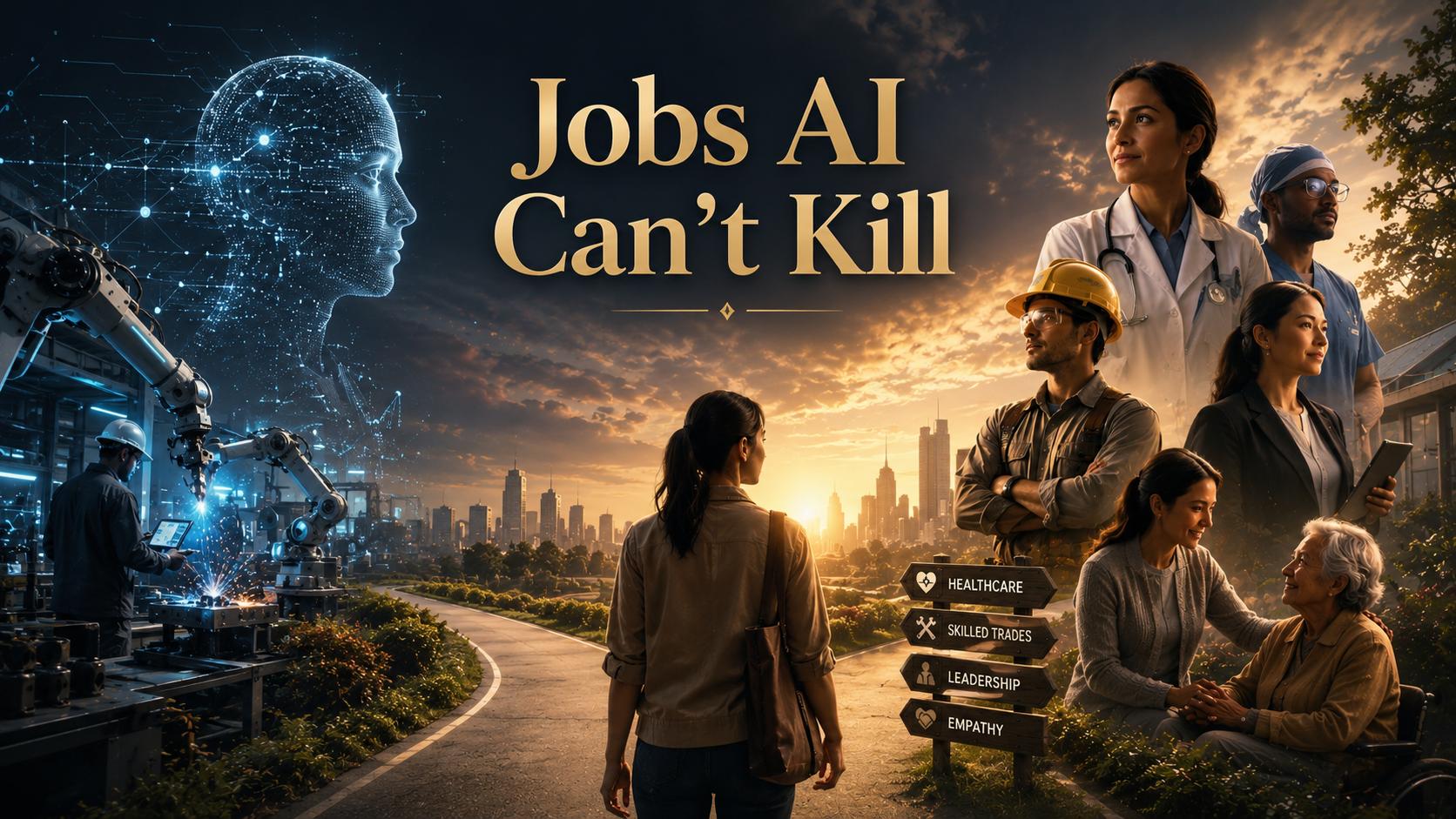
The global labor market in 2026 faces an unprecedented structural transformation. In May 2025, Anthropic predicted that automated systems would eliminate half of all white-collar jobs within five years. Subsequently, major corporate restructurings confirmed this aggressive shift toward automated workflows. For example, Amazon laid off sixteen thousand corporate workers in mid-January 2026. This sudden reduction reflects the permanent automation of administrative operations. Furthermore, Block slashed forty percent of its staff in late February 2026. These corporate cuts create intense pressure on young professionals entering the workforce. Recent college graduates face rising unemployment and highly competitive hiring conditions. Meanwhile, overall national employment numbers display unexpected resilience across specific industries—the sectors containing the Jobs AI Can’t Kill. Job seekers must navigate a complex landscape of shifting professional requirements.
In February 2026, the United States economy lost ninety-two thousand positions. Most economists expected a healthy gain of fifty-five thousand new roles. However, the overall national unemployment rate remained steady at just over four percent. The modern job market exhibits deep structural complexity beneath these headline numbers. Forrester expects automation to affect six percent of total American positions by 2030. Specifically, artificial intelligence will permanently alter twenty percent of existing jobs. This widespread influence requires massive workforce reskilling and strategic corporate planning. Therefore, professionals must identify and transition toward secure career paths. Forward-looking employees proactively adapt to automated systems to secure their livelihood.
Analyzing the Dynamic Sectors with Jobs AI Can’t Kill
Professional security in this automated era depends entirely on adaptive capacity. Brookings Institution researchers analyzed how easily employees navigate major technological transitions. Indeed, workers with deep savings and general skills transition much faster. High-income white-collar workers face substantial algorithmic exposure in their daily work. Conversely, these highly educated professionals possess robust resources to manage disruption. The most vulnerable group consists of clerical workers with narrow specialization. Over eighty percent of highly exposed low-capacity workers are women. Consequently, public institutions must design targeted support systems for these groups.
Adaptive occupations require high-level judgment and strategic problem-solving. Web designers and financial analysts easily weather changes caused by automation. Meanwhile, court clerks and tax preparers face immediate risks of displacement. Companies deploy large language models to process repetitive clerical tasks rapidly. These models automate structured data entry with minimal human error rates. Thus, physical presence and relationship-driven tasks shield certain modern roles. These protected roles form the core of the resilient labor force.
Jobs AI Can’t Kill: Resilient Occupation Matrix
High-level career paths shielded from automation.
| Occupation | Median Salary | 10-Yr Growth | AI Risk Profile |
|---|---|---|---|
| Psychiatrist | $250,000+ | +7% | Very Low |
| Operations Manager | $103,000 | Stable | Low/Very Low |
| Physical Therapist | $99,000+ | +14% | Very Low |
| Electrician | $62,000+ | +9% | Very Low |
| Social Worker | $58,000+ | +7% | Very Low |
| Home Health Aide | $33,000+ | +21% | Very Low |
The Trades-Office Inversion and Real-World Execution
A remarkable structural inversion currently elevates physical labor over traditional office work. Unpredictable physical environments prevent autonomous machines from performing complex manual repairs. Electricians and plumbers must solve complex diagnostic problems on-site. No digital system can fix a broken water main on the spot. Therefore, skilled tradespeople command high salaries and strong long-term security. Average wages for experienced technicians frequently surpass those of college graduates. This economic reality changes the value proposition of traditional higher education. Moreover, the ongoing national labor shortage fuels massive demand for these experts. Industrial operations depend heavily on skilled human technicians.
Building managers coordinate complex teams across dynamic real-world construction sites. Every project presents unique physical challenges and design inconsistencies. However, automated software cannot replicate the tactical oversight of these human managers. Technicians also find secure employment maintaining automated industrial hardware. Robots require constant human supervision and physical maintenance to operate correctly. Subsequently, the technical repair sector grows rapidly as automated factories expand. These physical careers remain entirely immune to remote algorithmic substitution.
Trades-Office Inversion Index
Physical manipulation environments remain fully immune to remote algorithmic replacement.
Jobs AI Can’t Kill in Healthcare
Healthcare professions leverage clinical intuition and emotional support to protect workers. For example, registered nurses assess patient distress and manage emergencies dynamically. Currently, advanced software tools handle administrative filing but cannot provide physical empathy. Home health aides deliver intimate physical care in unpredictable domestic settings. This role will add the most new jobs to the economy. Furthermore, occupational therapists design customized physical rehabilitation plans based on human feedback. The healing process remains fundamentally human and highly relationship-driven. Thus, clinical professions represent a highly secure area of employment. Medical institutions require human interaction to ensure complete patient comfort and safety.
Hospital systems quickly integrate medical imaging algorithms to support radiologists. These tools analyze massive diagnostic datasets with exceptional speed and accuracy. Nevertheless, qualified human professionals must assume ultimate clinical accountability. No healthcare facility allows an autonomous model to prescribe therapies without review. Machine learning serves as an assistant rather than a replacement. Consequently, demand for experienced medical practitioners remains strong across the globe. Real-time decision-making protects clinical staff from complete technological displacement.
Jobs AI Can’t Kill in Psychology
Mental health counseling relies heavily on deep trust and mutual understanding. Psychiatrists combine medical science with intense emotional attunement to heal patients. Currently, research proves that automated software cannot replicate human empathy. Substance abuse counselors build long-term relationships that guide vulnerable people. Patients require safe spaces to share sensitive experiences with human guides. Moreover, ethical judgment is absolutely critical when treating complex clinical cases. Algorithms operate on mathematical rules and lack moral reasoning capabilities. Mental health roles will continue to grow without threat of automation. Clinical psychology demands contextual awareness that language models do not possess.
Social work represents another highly resistant field in the modern economy. Social workers assist families navigating extremely unpredictable socioeconomic crises. Indeed, their work requires navigating delicate personal and structural dynamics. Machine learning systems cannot coordinate complex social services effectively. These community-centered professions demand active human interaction and constant empathy. Thus, employment projections for social services remain highly positive through 2034. Compassionate professionals hold a distinct competitive edge in the automated era.
Creativity and Strategic Leadership in Corporate Governance
Strategic corporate leadership requires navigating complex organizational politics and external forces. Operations managers make high-level decisions under conditions of intense uncertainty. Specifically, executive positions require balancing competing interests and managing talent. Modern organizations must rely on leaders to guide structural transformations. Artificial intelligence tools analyze historical data but cannot forge personal alliances. Conversely, human executives foster teamwork and build strategic industry partnerships. These leadership actions keep human strategy central to enterprise success. Consequently, strategic management remains highly secure against algorithmic encroachment. Effective governance relies heavily on personal trust between senior corporate leaders.
Creative directors design brand identities using profound cultural intuition and taste. They orchestrate emotional campaigns that connect deeply with target audiences. However, automated generators merely combine existing patterns without original intent. AI serves as an efficient tool for brainstorming ideas rapidly. Human artists must guide these generators to ensure stylistic coherence. Subsequently, professional creators focus more on high-level direction and taste. Original storytellers retain complete ownership over their creative expressions.
Strategic Adaptation and the Rise of Jobs AI Can’t Kill
Modern technology giants launch sophisticated software platforms to integrate human workflows with automation. Workday recently completed the acquisition of Sana to transform corporate learning. Currently, Workday integrates these advanced knowledge engines into its core platform. Workday also signed a definitive agreement to acquire Pipedream in late 2025. Pipedream connects thousands of APIs to let AI agents trigger processes automatically. Furthermore, Workday purchased Flowise to strengthen its agentic orchestration capabilities. Businesses plan to deploy these tools in the first half of 2026. Meanwhile, human oversight remains vital to guarantee system safety and reliability.
Modern Workflow Adaptation Hub
Strategic pipeline utilizing modern software architecture alongside key human control points.
Process Audit
Evaluate and flag purely mechanical and transactional processes.
Agentic Connection
Incorporate orchestration software (Workday, Flowise) for automation.
Human Oversight
Final tactical review, strategic decisions, and emotional delivery.
Recruitment platforms deploy advanced match engines to streamline talent acquisition. Indeed launched Career Scout to provide job seekers with automated career advice. Additionally, Indeed introduced Talent Scout to help employers pre-screen applicants. Indeed Connect offers conversational screening tools to verify professional licenses. Comscore data confirms Indeed drives over thirty hires per minute globally. Similarly, LinkedIn launched Hiring Assistant to automate initial candidate searches. LinkedIn Recruiter users easily share promising profiles through Microsoft Teams. Thus, software handles repetitive scheduling while humans make final decisions.
Actionable Strategies for Corporate Leadership and Talent Systems
Forward-looking corporate leaders must invest in AI fluency to prepare their workforces. PwC reports that workers with advanced digital skills earn massive salary premiums. Specifically, tech-literate professionals command up to fifty-six percent higher wages. Strategic executives should focus on role redesign rather than mere head-count reduction. They need to reform entry-level training pathways as software absorbs basic tasks. Otherwise, organizations risk weakening the overall pipeline of future industry experts. Continuous learning programs will help junior staff transition to analytical roles. Corporations must actively sponsor upskilling to sustain business growth.
The Upskill Premium Factor
Leveraging technical literacy yields exponential income value.
Adaptability remains the ultimate defense against structural economic change. Automated systems cannot replicate creative thinking, physical coordination, and clinical judgment. Currently, the job market undergoes a major redistribution of labor. Successful firms will combine automated software with highly skilled human workers. Professionals must focus on developing their unique interpersonal and diagnostic strengths. Ultimately, cultivating these strengths guarantees career safety in a highly automated world. The human touch remains irreplaceable across every major sector of commerce.
Support Our Work
Help us keep creating and maintaining our projects. We appreciate your support!
Ways to contribute:
Shop via Affiliate LinksSupport us at no extra cost to you while you shop.
Support on Ko-fiBuy us a coffee to keep the engine running!





Leave a Reply