

Infrastructure Evolution and Market Shift

- 24/7 Autonomous Digital Butler: Unlike passive cloud AI, this smart execution system operates constantly to automaticall…
- Edge-Cloud Hybrid Inference: Powered by the cutting-edge AMD Strix Halo 395 processor, it prioritizes local AI computing…
- Next-Gen AMD Strix Halo 395 Power: Equipped with the powerful FP1 package AMD 395 processor (TDP up to 65W) and integrat…
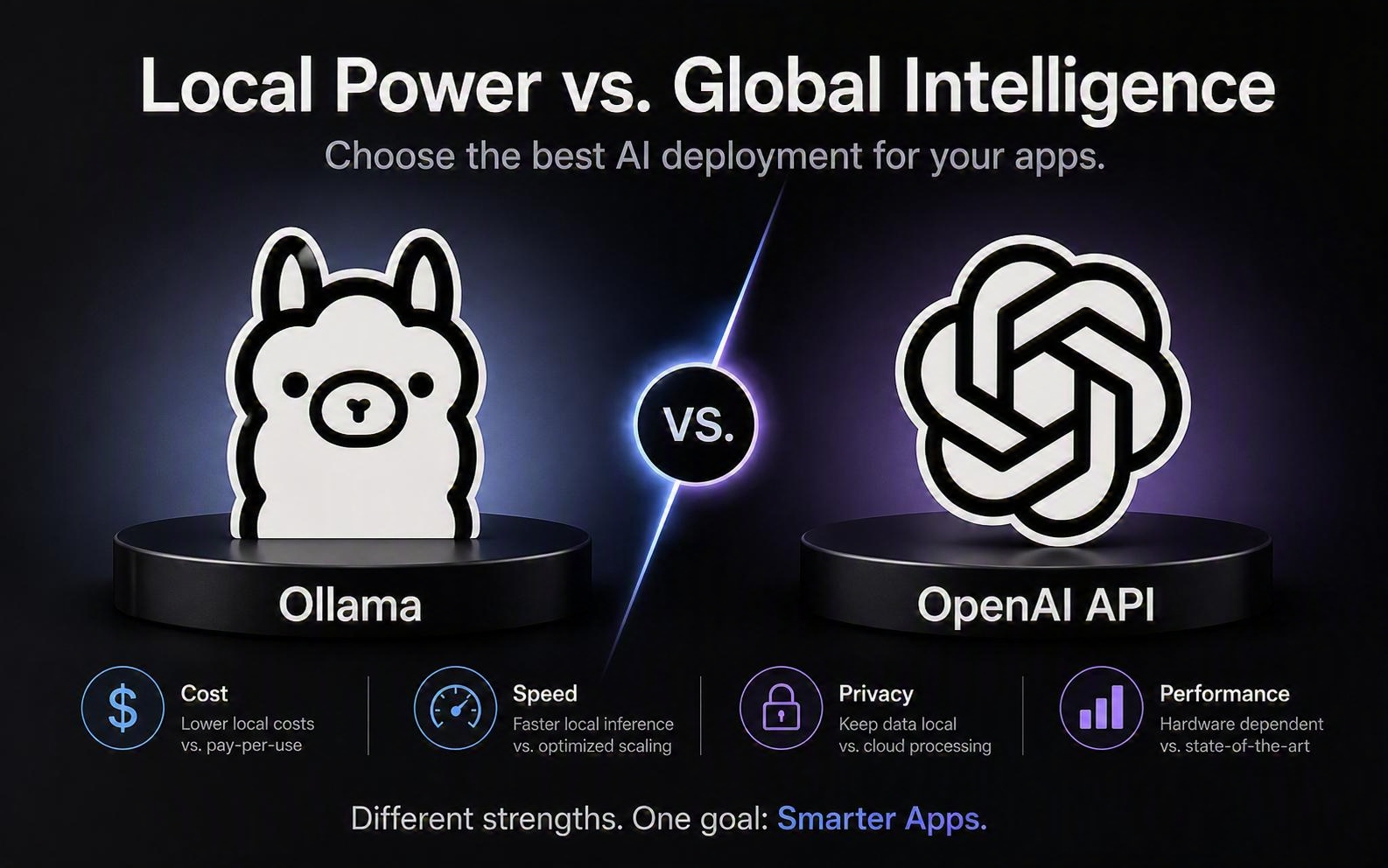
Developers face an important choice between Local LLMs (Ollama) vs. OpenAI API when designing modern applications. Both platforms offer advantages for managing software complexity and scaling enterprise workloads. Specifically, Ollama provides completely offline execution while OpenAI delivers unmatched model intelligence. Proprietary systems require constant internet access and expose sensitive corporate data to external risks. Software engineering teams must evaluate these competing tools to optimize their long-term architecture. Consequently, selecting the wrong deployment model can severely damage budget plans and system security.
The local ecosystem has matured rapidly since Jeffrey Morgan and Michael Chiang founded Ollama in 2023. Active monthly downloads spiked from one hundred thousand to fifty-two million by early 2026. Meanwhile, OpenAI maintains its market leadership with continuous upgrades to its powerful model families. This intense competition drives unprecedented rapid innovation across both open and closed platforms. Developers now enjoy a wide variety of excellent choices for running deep learning tasks. Indeed, open-source options now match proprietary models on several industry-standard benchmarks. Additionally, open models allow rapid prototyping before developers commit to cloud hosting.
Financial Dynamics of AI Integration
Cloud systems charge developers strictly based on the number of processed input and output tokens. Flagship options like GPT-5.5 cost five dollars per million input tokens for standard tasks. Specifically, output processing raises this cost significantly to thirty dollars per million generated tokens. Standard reasoning models like o3 require two dollars per million input tokens. High volume workloads can generate massive monthly bills for growing development teams. Consequently, unpredictable software usage patterns make strict long-term budget planning extremely difficult.
Local deployments avoid recurring per-token charges by leveraging on-premise hardware infrastructure. A standard developer setup with an RTX 4090 costs about two thousand dollars. Alternatively, developers can purchase a premium Mac Studio for higher model capacities. This upfront capital expense amortizes to affordable monthly figures over a three-year lifespan. Operating costs remain completely predictable because developers only pay for basic electricity consumption. Therefore, self-hosting shields development teams from sudden pricing changes implemented by cloud providers. Self-hosted services keep operational budgets completely secure from future provider changes.
Performance Metrics and Hardware Bottlenecks
Memory bandwidth represents the primary hardware bottleneck for local token generation speeds. Discrete NVIDIA graphics cards feature VRAM with bandwidth exceeding one thousand gigabytes. However, these consumer GPUs cap physical memory limits at twenty-four gigabytes. Apple Silicon Mac Studio devices utilize shared unified memory architectures up to 192 gigabytes. Developers can comfortably run massive local models without facing slow system RAM offloading. Subsequently, the lack of a transfer bottleneck allows smoother execution of larger weights.
An RTX 4090 generates roughly fifty-two tokens per second on Llama 3.1 70B models. The Apple M4 Max reaches twelve point five tokens per second on identical workloads. Conversely, cloud-based APIs consistently deliver speeds between eighty and one hundred fifty tokens per second. Cloud systems maintain stable performance without requiring expensive local workstation hardware maintenance. Developers should configure their runtimes to utilize available GPU resources for maximum speed. Indeed, Ollama v0.30.8 improves local scheduling to reduce out of memory crashes significantly. Hardware adjustments remain critical for maximizing overall throughput in local setups.
Data Security and Regulatory Compliance
Enterprise organizations must adhere to strict regulatory compliance frameworks when managing user data. OpenAI complies with security standards by securing SOC 2 Type 2 certifications. Furthermore, the API platform encrypts business data both at rest and in transit. The vendor guarantees that it does not train models on organization data by default. Medical apps require strict physical isolation of patient records to follow HIPAA rules. Therefore, sharing data with external servers can create significant liabilities for digital products.
Running Ollama on local servers guarantees absolute data sovereignty for highly regulated businesses. Information never leaves the local network, eliminating the need for complex data agreements. Accordingly, developers can confidently build applications that process highly sensitive financial records. Regulated teams can safely deploy local models in strict air-gapped server environments. This robust setup completely prevents accidental leaks to external artificial intelligence providers. Indeed, local execution provides unmatched control over prompt contexts and system parameters. Compliance officers strongly favor local configurations for secure data environments.
Model Specialization and Ecosystem Dynamics
Different developer use cases require highly specialized model architectures for optimal performance. OpenAI offers cutting-edge reasoning with the o3 model to tackle complex mathematics. Additionally, the cloud provider supports advanced real-time voice translation and image generation. Open-source repositories deliver excellent alternatives through highly targeted, task-specific weights. Ollama 0.31 runs Gemma 4 ninety percent faster using Apple Silicon MLX acceleration. Thus, developers can achieve high speeds on consumer hardware for specialized coding agents.
OpenAI partners with Ollama to distribute safety reasoning weights like gpt-oss-safeguard. This permissive model allows teams to run secure trust and safety classifications locally. Specifically, the safeguard model interprets custom moderation policies with high precision. Local tools empower developers to inspect model thoughts directly without extra overhead. These developments show a strong industry shift toward transparent, collaborative intelligence tools. Developers can balance performance and privacy without sacrificing critical software features. Modular code structures allow developers to switch between local and cloud models.
Comprehensive Architectural Trade-Offs
Choosing between these platforms requires a careful analysis of long-term operational costs. Cloud APIs offer rapid deployment and guaranteed system uptime for initial releases. However, scaling user traffic can quickly generate unsustainable billing cycles over time. Local hosting demands more initial engineering effort but provides completely predictable expenses. The following markdown table presents a detailed structural comparison of both approaches. These distinct profiles help developers choose the best path for their projects.
| Deployment Metric | Local LLM (Ollama) | OpenAI Cloud API |
| Upfront Cost | Hardware-dependent ($500-$5,000) | $0 |
| Per-Token Cost | $0 | $0.10 to $180 |
| Service SLA | Self-managed (No SLA) | 99.9% Uptime SLA |
| Offline Capability | Yes (Full) | No |
| Data Sovereignty | Absolute | Third-party managed |
High-volume projects with predictable query styles typically benefit the most from local hosting. Applications demanding state-of-the-art cognitive performance must utilize cloud-based endpoints. Therefore, engineering teams often design hybrid systems that leverage both technologies strategically. Developers run cheap classification locally while routing complex tasks to premium cloud APIs. This balanced architecture optimizes overall operational expenditure without sacrificing critical software quality. Consequently, combining these platforms prepares modern software products for a highly flexible future. Concurrently, wise architectural choices prepare teams for next-generation intelligence technologies.
Support Our Work
Help us keep creating and maintaining our projects. We appreciate your support!
Ways to contribute:
Shop via Affiliate LinksSupport us at no extra cost to you while you shop.
Support on Ko-fiBuy us a coffee to keep the engine running!




Leave a Reply