
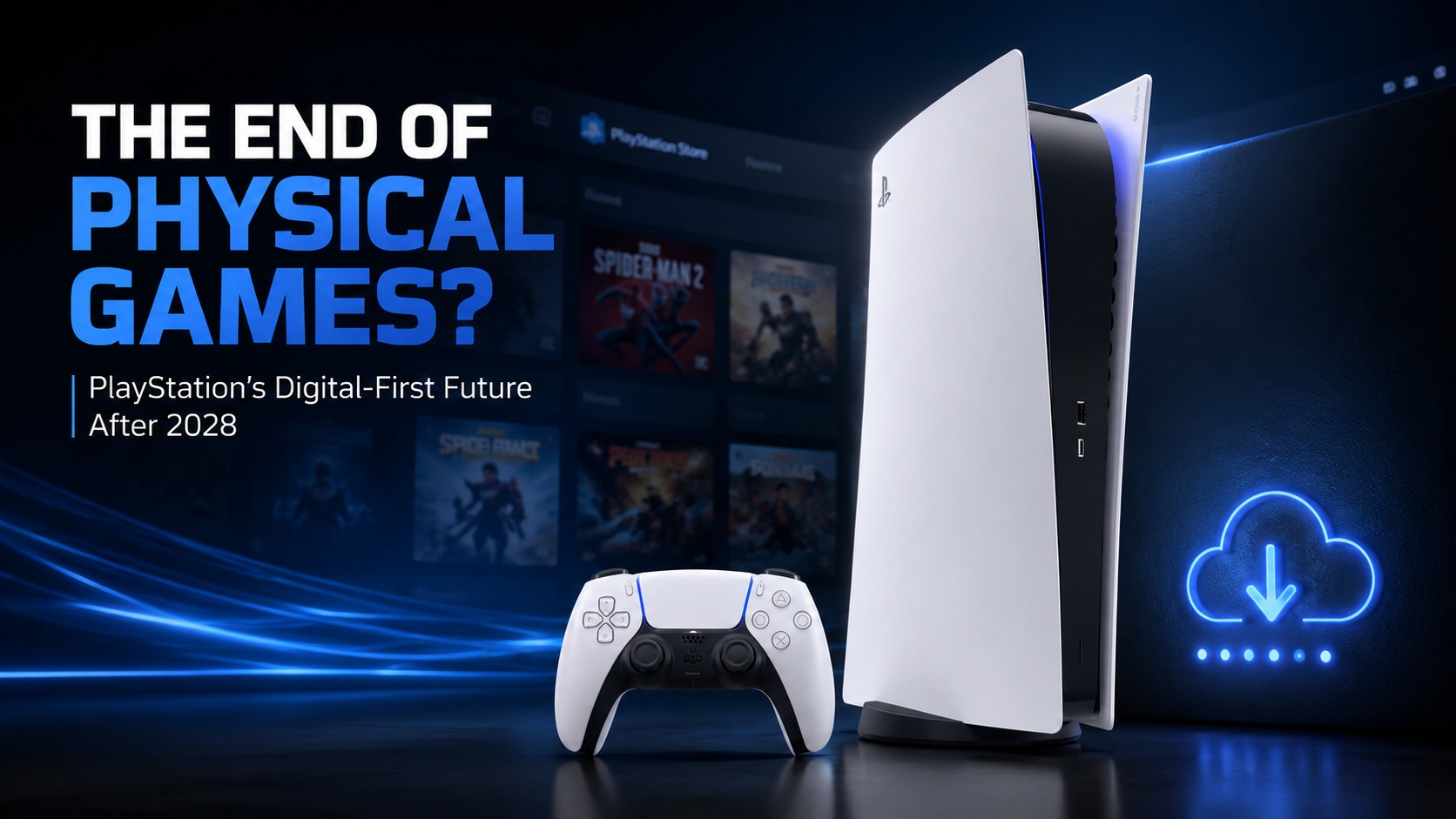


- Model Number CFI-2000
- Includes DualSense Wireless Controller, 1TB SSD, Disc Drive, 2 Horizontal Stand Feet, HDMI Cable, AC power cord, USB cab…
- Vertical Stand sold separately
Playstation Physical Disc Discontinuation and Industry Strategy
Sony Interactive Entertainment plans to implement a full Playstation Physical Disc Discontinuation for new titles after 2028. Consequently, future game releases will distribute exclusively through the PlayStation Store and verified commercial channels. Physical disc software sales dropped to fifteen percent of total game purchases during recent fiscal periods.
Consumer purchasing habits shifted dramatically toward digital downloads throughout the PlayStation 4 era. For example, digital downloads accounted for under ten percent of game sales during the PS4 launch. However, digital game adoption expanded to eighty percent of total software units in recent years. Retail stores still sold nearly seventy million boxed physical games during 2025 across global markets.
Software Sales Data and Digital Dominance
Sony achieved record digital distribution figures across the PlayStation 5 ecosystem during FY2025 Q4. Specifically, digital downloads reached eighty-five percent of full game software sales in that quarter. Physical media comprised only fifteen percent of full game volume during that same reporting period. Furthermore, digital game sales generated $1.5 billion in revenue during those three months. Conversely, physical software sales brought in $109 million across global retail channels.
Digital software sales averaged seventy-eight percent across all four quarters of FY2025. In addition, Sony reported an eighty-two percent digital ratio for Q1 of FY2026. Active monthly PlayStation Network users climbed to 125 million accounts by mid-2026.
| Fiscal Quarter | Digital Sales Share | Physical Sales Share | Market Trend |
| FY2025 Q1 | 83% | 17% | Heavy Digital Adoption |
| FY2025 Q2 | 72% | 28% | Brief Physical Rise |
| FY2025 Q3 | 76% | 24% | Digital Growth |
| FY2025 Q4 | 85% | 15% | Record Digital High |
| FY2026 Q1 | 82% | 18% | Sustained Digital Lead |
Q1
Q2
Q3
Q4
Q1
Hardware Architecture and Modular Disc Options
Hardware engineering strategy aligns directly with Sony’s long-term digital distribution goals. For instance, the PlayStation 5 Pro launched without an integrated optical disc drive. The system base configuration retails at $699.99 in North American electronics markets. Therefore, players requiring disc compatibility must purchase a separate Ultra HD Blu-ray drive.
The standalone detachable optical drive retails for $79.99 on official PlayStation channels. As a result, building a disc-capable PS5 Pro configuration costs consumers nearly $780. Modular drives allow Sony to unify console manufacturing around a single base chassis. Sony announced global price adjustments for PlayStation 5 hardware in April 2026. Total lifetime PlayStation 5 console shipments reached 95.3 million units by June 2026.
Financial Incentives and Publisher Alignment
Major third-party game publishers are mirroring Sony’s rapid transition toward discless game sales. Capcom reported that ninety-three percent of its game software sales were digital in 2026. Indeed, Capcom’s digital software share grew from seventy-three percent over just two years. Electronic Arts recorded $528 million from digital launches versus $81 million from physical sales.
Digital storefronts eliminate disc manufacturing, packaging, freight, and physical retail distribution expenses. Moreover, discless distribution effectively eliminates the unmonetized pre-owned video game resale market. Industry analyst Daniel Ahmad notes that all digital store revenues flow directly to platform owners. Platform operators gain total pricing authority and complete licensing management over software.
Consumer Rights and Software Preservation
Digital purchasing provides convenient access, automated game patching, and persistent cloud library storage. Nonetheless, game preservation advocates raise significant concerns regarding long-term digital software rights. Digital storefront purchases grant revocable user software licenses rather than physical personal property ownership. Eventual network server shutdowns could permanently restrict player access to uninstalled games.
Physical disc media enables consumers to trade, lend, resell, and store games fully offline. In contrast, all-digital storefronts leave consumers entirely reliant on official store discount events. Secondary retail markets historically provided budget-conscious players with affordable access to older titles. Legacy hardware collectors value physical boxed releases as tangible historical media artifacts.
Long-Term Market Impact and Industry Horizon
Industry developments point toward a permanent structural reorganization across video game distribution models. As a consequence, analysts expect next-generation systems like PlayStation 6 to abandon built-in disc drives entirely. Cloud streaming services and digital subscription models will dominate future software distribution channels. Major gaming publishers are prioritizing day-one digital storefront availability for flagship releases.
Retail chains must adapt commercial strategies by expanding digital currency cards and technical hardware accessories. The video game market is completing its transition into an all-digital service ecosystem. Sony’s strategic course reflects broader digital shifts already established across personal computer gaming markets. Ultimately, the transition highlights an evolving balance between operational convenience and software ownership rights.
Support Our Work
Help us keep creating and maintaining our projects. We appreciate your support!
Ways to contribute:
Shop via Affiliate LinksSupport us at no extra cost to you while you shop.
Support on Ko-fiBuy us a coffee to keep the engine running!




Leave a Reply