
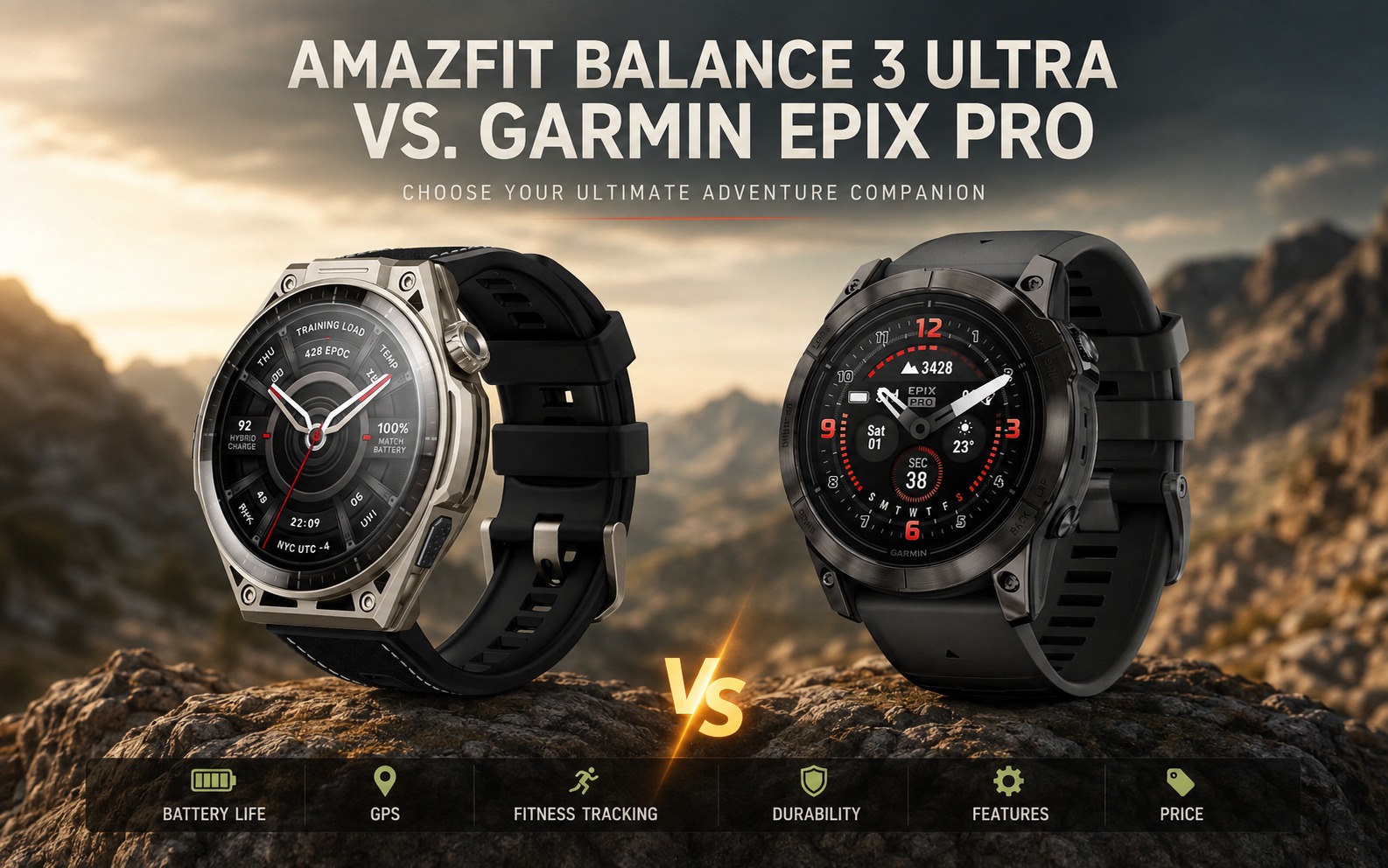


- GRADE 5 TITANIUM BUILD: This premium smartwatch balances strength with restraint. Formed from Grade 5 titanium, every ed…
- ZEPP APP INTELLIGENCE: Connect training, sleep, nutrition, and daily stress into a continuous view of your adaptation. T…
- EFFORTLESS WEARABILITY: Engineered to feel lightweight, the structure carries a quiet confidence on the wrist. This smar…

- Ultimate high-performance smartwatch features a large 1.4” always-on, stunning AMOLED display and a scratch-resistant sa…
- Built-in LED flashlight with variable intensities and strobe modes gives you greater awareness while you train at night …
- New hill score feature measures your running strength and endurance during ascents and gauges your progress over time
Shifting Dynamics in the Endurance Wearable Market
The market competition intensifies as athletes evaluate the Amazfit Balance 3 Ultra vs. Garmin Epix Pro. Athletic consumers demand uncompromising accuracy and extensive battery life across all conditions. Garmin historically ruled the endurance segment with deeply rooted navigation features and robust analytics. However, Amazfit now disrupts this dominance by introducing premium hardware at aggressive prices.
Brand strategies increasingly focus on hybrid athletes rather than standard casual runners. Consequently, modern training devices must deliver durable casings, responsive interfaces, and specialized activity modes. This expanding rivalry drives rapid hardware innovation across the entire sports tech sector.
Display Technology and Structural Engineering
Screen legibility remains essential for outdoor athletes facing direct solar exposure. Amazfit equips its flagship wearable with an expansive 1.5-inch AMOLED screen delivering 3,000 nits. In contrast, the 51mm Garmin Epix Pro features a 1.4-inch AMOLED display. Both displays use sapphire crystal glass to protect against harsh exterior damage.
Material choices reveal divergent ergonomic priorities between the two engineering teams. Amazfit builds the Balance Ultra with a Grade 5 titanium chassis weighing 57 grams. Meanwhile, Garmin’s 51mm titanium edition carries a noticeably heavier weight of 88 grams. Furthermore, each watch provides five distinct physical buttons alongside 10 ATM water resistance ratings.
Hardware Benchmarking and Performance Metrics
Physical architecture directly affects how smoothly these devices execute real-time map rendering. Specifically, the Balance Ultra uses an upgraded ZPS3044S processor for rapid map navigation. Garmin deploys proprietary onboard chips optimized for continuous sensor polling and offline processing.
| Feature / Specification | Amazfit Balance Ultra (51.8mm) | Garmin Epix Pro Sapphire (51mm) |
| Display Type & Size | 1.5-inch AMOLED | 1.4-inch AMOLED |
| Resolution & Density | 480 × 480 px (323 ppi) | 454 × 454 px (453 ppi) |
| Peak Brightness | 3,000 nits | ~1,000 nits |
| Chassis Materials | Grade 5 Titanium & Polymer | Titanium & Polymer |
| Lens Glass | Sapphire Crystal | Sapphire Crystal |
| Weight (No Strap) | 57 g | 88 g |
| Water Resistance | 10 ATM / 45m Freediving | 10 ATM (100 meters) |
| Internal Storage | 64 GB | 32 GB |
| Processor Platform | ZPS3044S | Proprietary Architecture |
| LED Flashlight | Dual-Mode (White / Red / SOS) | Multi-LED (Variable White / Red) |
| Sensor Array | BioTracker 6.0 | Elevate Gen 5 Optical Array |
| Smartwatch Battery | Up to 30 Days (10 Days AOD) | Up to 31 Days (11 Days AOD) |
| GPS Tracking Battery | Up to 50 Hours (97h Power Save) | Up to 82 Hours (Standard GPS) |
| MSRP / Launch Price | ~$600 / £599.90 | $1,099.99 |
Internal memory configurations also illustrate distinct computational strategies. Amazfit supplies 64GB of storage for media, extensive apps, and detailed topographic maps. Conversely, Garmin includes 32GB of internal storage for regional map packages. Both manufacturers also incorporate multi-mode LED flashlights for nocturnal trail running safety.
Biometric Sensors and Specialized Training Software
Tracking software heavily influences daily recovery management and workout execution. Amazfit targets functional fitness competitors through native HYROX race simulation tools and pacing metrics. Additionally, its BioCharge and LifeLoad engines generate integrated, continuous readiness insights. The BioTracker 6.0 optical array reliably monitors heart rate, blood oxygen, and skin temperature.
Garmin provides unmatched physiological modeling through established Hill Score and Endurance Score tools. Moreover, the Elevate Gen 5 sensor delivers FDA-cleared ECG recording capabilities. Garmin Connect remains an industry standard for mapping elevation profiles and training stress. Advanced athletes rely heavily on Garmin’s dynamic ClimbPro and comprehensive TopoActive maps.
Battery Longevity and Energy Management
Battery endurance remains a fundamental criterion for ultramarathon runners and wilderness explorers. The Balance Ultra houses a 780mAh cell yielding 30 days of typical smartwatch usage. Similarly, the Epix Pro 51mm achieves up to 31 days in standard gesture mode. Always-on display mode reduces Garmin’s operation to 11 days and Amazfit’s to 10 days.
Operational life changes markedly once continuous satellite navigation runs during training. Garmin sustains 82 hours in standard GPS mode and 38 hours during multi-band tracking. Therefore, Garmin delivers superior power efficiency during extended backcountry expeditions. Amazfit counters by providing 50 hours of standard GPS and 97 power-saving hours.
Pricing Strategy and Commercial Impact
Retail pricing creates a stark division between these two capable multisport watches. Garmin positions the Epix Pro Sapphire 51mm at an enterprise-tier price of $1,099. Nonetheless, Amazfit delivers titanium casing and sapphire glass for approximately $600.
This aggressive pricing strategy disrupts Garmin’s traditional stronghold in the premium sports category. Accordingly, budget-conscious athletes can access flagship build quality without paying steep brand premiums. Market competition intensifies as challenger brands refine their hardware and companion software ecosystems.
Strategic Takeaways: Amazfit Balance 3 Ultra vs. Garmin Epix Pro
Wearable technology now offers remarkable depth across competing flagship ecosystems. Garmin excels for remote expeditions requiring standalone map routing and deep endurance metrics. Thus, dedicated outdoor navigators often prefer the proven Garmin Connect software suite.
Instead, hybrid athletes training for HYROX events gain exceptional value from the Balance Ultra. Amazfit combines an ultra-bright display, lightweight titanium chassis, and modern fitness algorithms seamlessly. Ultimately, this matchup proves that elite sports tracking hardware is becoming far more accessible.
Support Our Work
Help us keep creating and maintaining our projects. We appreciate your support!
Ways to contribute:
Shop via Affiliate LinksSupport us at no extra cost to you while you shop.
Support on Ko-fiBuy us a coffee to keep the engine running!



Leave a Reply