
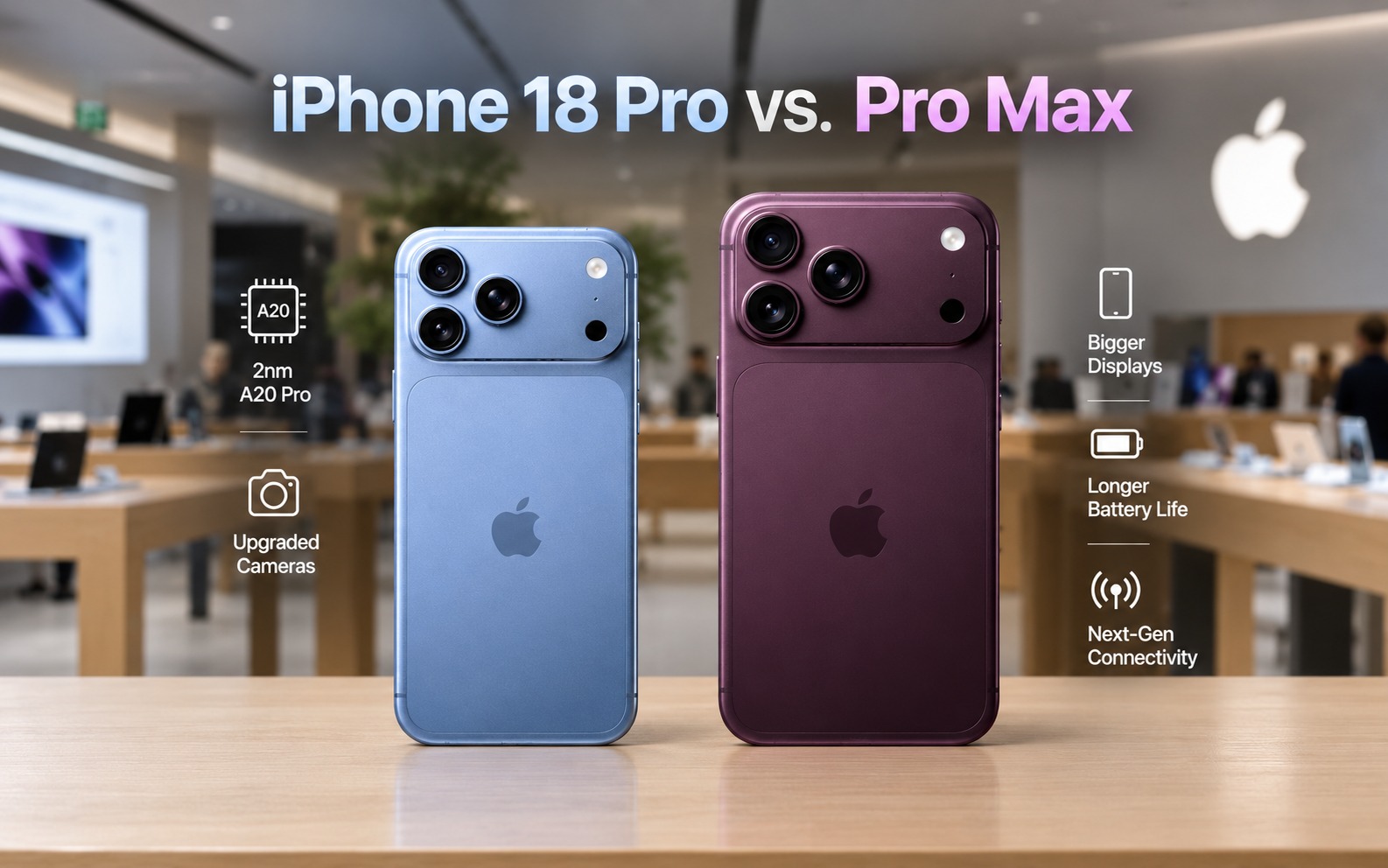



Strategic Launch Timelines of Apple iPhone 18 Pro Series
The technology sector anticipates a major architectural shift when evaluating the Apple iPhone 18 Pro vs. Apple iPhone 18 Pro Max. Apple plans to alter its traditional release cadence by splitting hardware debuts across two separate calendar windows. Consequently, the premium tier will arrive in September 2026 alongside a new foldable smartphone. Standard models will debut later in the spring of 2027 to balance supply chain operations.
This staggered launch strategy allows suppliers to prioritize complex component manufacturing for the flagship devices. Furthermore, industry analysts project that advanced semiconductor allocations will concentrate heavily on the pro-tier products initially. Rising component costs and silicon fabrication constraints justify this revised commercial approach. Premium buyers will access next-generation capabilities months ahead of entry-level consumers.
Display Engineering and Biometric Hardware Integration
Both flagship models maintain the physical screen dimensions established in preceding hardware generations. The smaller flagship features a 6.3-inch screen, while the larger variant retains an expansive 6.9-inch display. However, Apple has integrated upgraded LTPO+ display panels to deliver superior power efficiency across variable refresh rates. This panel update lowers baseline energy consumption during always-on display tasks and video rendering.
Engineers achieved a critical design milestone by reducing the Dynamic Island cutout by approximately 35 percent. Specifically, moving select Face ID optical sensors beneath the active display layer enabled this dimensional reduction. The cutout width shrinks from 20.7 millimeters down to roughly 13.5 millimeters on both front panels. Full under-display biometric arrays will arrive in later hardware cycles due to manufacturing yields.
Silicon Architecture and Thermal Packaging
Apple’s next-generation A20 Pro system-on-chip powers the flagship hardware lineup. TSMC manufactures this advanced processor using a cutting-edge 2-nanometer gate-all-around process node. Accordingly, the A20 Pro delivers an 18 percent increase in computational performance over previous chips. The refined lithography also reduces overall active power consumption by up to 30 percent.
Modern on-device artificial intelligence requires substantial memory bandwidth and tight thermal dissipation. Meanwhile, Apple adopted TSMC Wafer-Level Multi-Chip Module packaging to mount RAM directly adjacent to silicon dies. Both flagships now feature 12 gigabytes of unified memory to support local generative machine learning models. Moreover, redesigned internal vapor chambers maintain sustained clock speeds during heavy computational workloads.
Optical Mechanics and Variable Aperture Innovations
Imaging hardware represents the primary operational divergence between the two premium models. Leaked supplier documentation reveals that the larger flagship incorporates a custom Sony IMX905 sensor. This advanced imaging sensor features a physical variable aperture mechanism capable of adjusting between f/1.4 and f/4.0. Thus, mobile photographers gain mechanical control over optical depth of field and exposure in dynamic lighting.
Supply chain reports indicate the variable aperture lens may remain exclusive to the larger chassis initially. The mechanical assembly requires a thicker camera plateau, measuring 11.54 millimeters on the Pro Max. Conversely, the standard Pro variant maintains a more compact chassis profile with fixed aperture optics. Both devices still incorporate 48-megapixel ultra-wide sensors and upgraded telephoto lenses for high-resolution capture.
Custom C2 Modem and Non-Terrestrial Network Capabilities
Apple is deploying its proprietary C2 modem to replace third-party cellular components across major global markets. The in-house C2 chip delivers a 10 to 15 percent improvement in cellular power efficiency. Additionally, the modem introduces a privacy setting that limits network carrier tracking to neighborhood-level data. The chip also optimizes real-time data queues during extreme network congestion at crowded venues.
Satellite communication capabilities expand beyond emergency texting to support full non-terrestrial 5G data routing. Nevertheless, domestic United States variants will continue using Qualcomm modems to support high-band millimeter-wave infrastructure. International variants will ship exclusively with Apple custom baseband hardware. Therefore, international users will benefit from superior cellular battery performance compared to domestic units.
Battery Architecture, Chassis Design, and Specifications
Physical dimensions and battery capacities differ noticeably between regional device variants. United States models feature larger batteries because the removal of physical SIM trays frees valuable internal volume. In contrast, Chinese market models include dual physical SIM slots, resulting in slightly lower battery capacities. Apple also refined the anodized aluminum chassis and back glass to eliminate color discrepancies. Simultaneously, the company introduced a dark cherry finish alongside refined silver, gray, and light blue tones.
| Specification | iPhone 18 Pro | iPhone 18 Pro Max |
| Display Size & Panel | 6.3-inch LTPO+ OLED (120Hz) | 6.9-inch LTPO+ OLED (120Hz) |
| Dynamic Island Width | ~13.5 mm (35% reduction) | ~13.5 mm (35% reduction) |
| Processor Node & Packaging | 2nm A20 Pro (TSMC WMCM) | 2nm A20 Pro (TSMC WMCM) |
| Unified Memory | 12GB Unified RAM | 12GB Unified RAM |
| Primary Camera Sensor | 48MP Fixed Aperture (f/1.78) | 48MP Sony IMX905 Variable Aperture (f/1.4–f/4.0) |
| Camera Plateau Depth | ~11.23 mm standard profile | ~11.54 mm (13.77 mm total protrusion) |
| Cellular Modem | Apple C2 (Global) / Qualcomm (US) | Apple C2 (Global) / Qualcomm (US) |
| Satellite Connectivity | 5G NR-NTN (Data / Maps / Apps) | 5G NR-NTN (Data / Maps / Apps) |
| Battery Capacity (US / CN) | 4,288 mAh (US) / 4,056 mAh (CN) | 5,567 mAh (US) / 5,391 mAh (CN) |
| Base Storage & Price | 256GB / Starting at ~$1,299 | 256GB / Starting at ~$1,399 |
Rising DRAM procurement costs and 2-nanometer wafer pricing will drive retail price increases across both flagships. Component bills of materials have expanded by 200 to 300 dollars per unit. As a result, entry retail pricing will likely shift upward to accommodate these higher manufacturing expenses. Base configurations will begin at 256 gigabytes of onboard storage for both models.
Strategic Market Implications and Industry Outlook
The expanding feature gap between the two premium models reflects a deliberate product differentiation strategy. Apple leverages the larger chassis of the Pro Max to debut cutting-edge optical and battery systems. Similarly, the custom C2 modem represents a major step toward total internal silicon independence. Competitors in the premium segment face mounting pressure to match these vertical hardware integrations.
Splitting the annual iPhone release schedule smooths corporate revenue distribution across quarterly earnings cycles. In turn, high-margin pro models capture early adopters while mainstream variants sustain mid-cycle demand. The transition to 2-nanometer architecture establishes a robust foundation for long-term on-device artificial intelligence execution. Ultimately, this generation redefines performance metrics and hardware boundaries across the premium smartphone landscape.
Support Our Work
Help us keep creating and maintaining our projects. We appreciate your support!
Ways to contribute:
Shop via Affiliate LinksSupport us at no extra cost to you while you shop.
Support on Ko-fiBuy us a coffee to keep the engine running!





Leave a Reply