


Market Evolution and Platform Shift
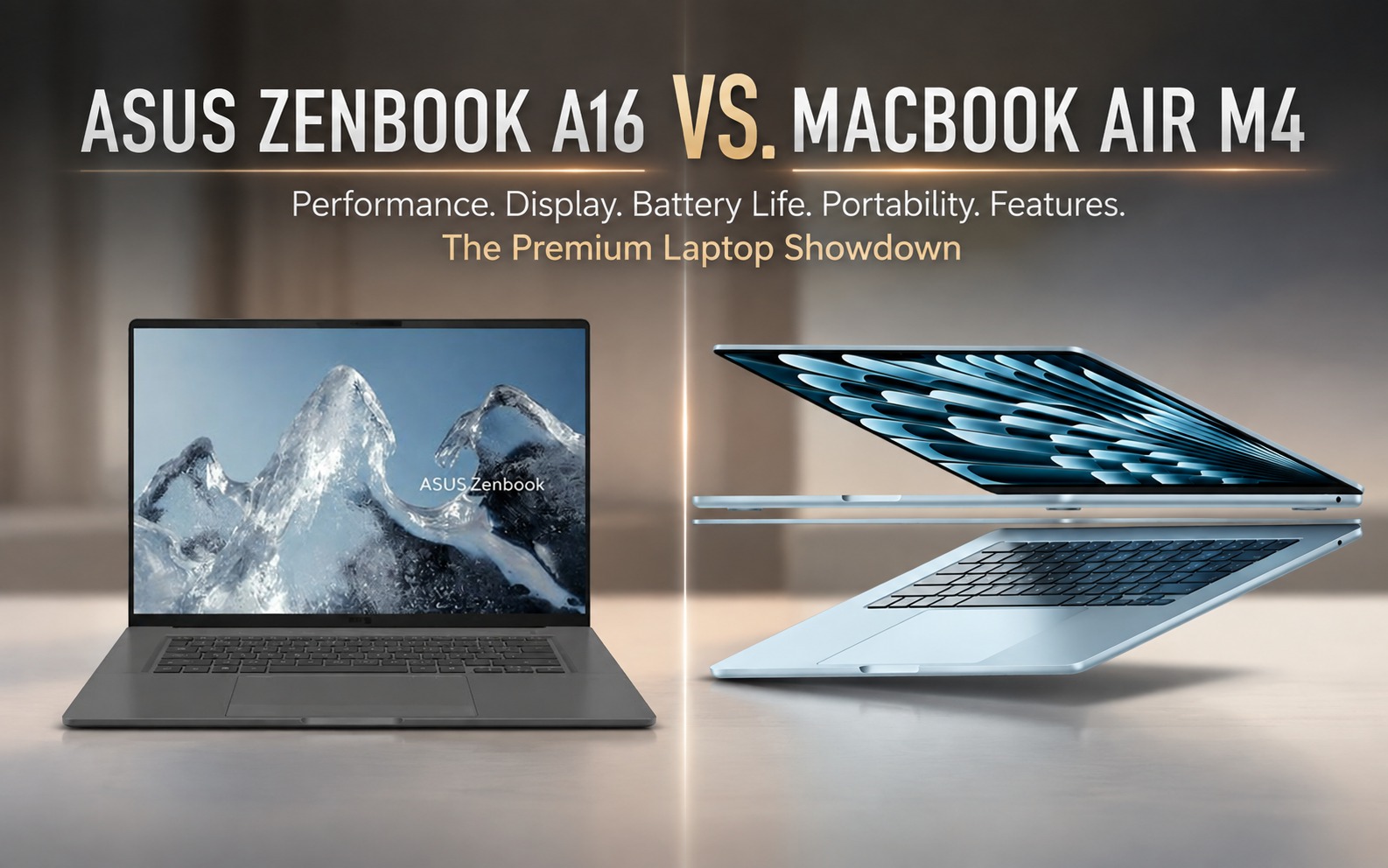
The ongoing debate surrounding the Asus Zenbook A16 vs. Apple MacBook Air M4 highlights a major shift in ultraportable computing. Indeed, both hardware manufacturers now leverage highly efficient ARM architecture to redefine modern mobile performance. Asus introduces a lightweight sixteen-inch notebook engineered with high-tech ceramic materials for durable daily travel. Meanwhile, Apple continues refining its established fanless design with incremental system updates.
Qualcomm developed the Snapdragon X2 platform to challenge Apple Silicon directly in efficiency. Consequently, Windows laptops now match or exceed traditional MacBook battery longevity benchmarks. This aggressive competition accelerates hardware innovation across the entire premium laptop category. Furthermore, enterprise buyers now consider ARM-based Windows devices viable alternatives for heavy computing workloads.
Processing Architecture and Compute Capabilities
Qualcomm equips the Zenbook A16 with the flagship Snapdragon X2 Elite Extreme processor. Specifically, eighteen CPU cores combine twelve prime cores and six performance cores for high throughput. An integrated Hexagon neural processing unit delivers up to 80 TOPS for local artificial intelligence tasks. In addition, the Adreno X2-90 graphics processor supports heavy digital content creation software smoothly.
Apple powers the latest MacBook Air using the energy-efficient M4 system chip. However, the ten-core CPU design prioritizes high single-thread speeds for routine productivity applications. Apple integrates a ten-core GPU alongside hardware-accelerated ray tracing capability for graphical tasks. Alternatively, unified memory architecture provides up to 32GB of shared memory for applications.
- ⚒ CPU Cores 18 Cores
- ✪ Core Split 12 Prime / 6 Perf
- 🧠 Neural Processing Hexagon NPU80 TOPS
- 🎨 Graphics Adreno X2-90
- ⚒ CPU Cores 10 Cores
- ✪ Priority Single-thread speed
- 🧠 Neural Processing Apple Neural Engine
- 🎨 Graphics 10-Core GPUHardware Ray Tracing
Display Technology and Chassis Design
Asus installs a vivid sixteen-inch 3K OLED screen featuring a smooth 120Hz refresh rate. Notably, the display achieves 1100 nits peak HDR brightness and full color space coverage. The expansive screen area allows mobile professionals to multitask comfortably without external monitors. Smudge-resistant Ceraluminum construction ensures structural durability during frequent business travel.
Apple offers Liquid Retina IPS displays in 13.6-inch and 15.3-inch sizing options. Nevertheless, these panels operate at a standard 60Hz rate with 500 nits brightness. The unibody aluminum chassis maintains an ultra-thin profile measuring less than half an inch. Standard color choices include Midnight, Starlight, Silver, and Sky Blue options.
Hardware Specifications Comparison
Comparing structural specifications reveals key hardware tradeoffs between both ultraportable laptops. Therefore, buyers must evaluate display technology alongside thermal design and overall weight.
| Feature | Asus Zenbook A16 (UX3607) | Apple MacBook Air M4 |
| Processor | Snapdragon X2 Elite Extreme | Apple M4 Chip |
| Display | 16.0″ 3K (2880×1800) 120Hz OLED | 13.6″ / 15.3″ Liquid Retina 60Hz IPS |
| Peak Brightness | 1100 nits HDR / 500 nits SDR | 500 nits |
| Neural Processing | Hexagon NPU (up to 80 TOPS) | Apple Neural Engine |
| System Memory | Up to 48GB LPDDR5X (228 GB/s) | Up to 32GB Unified Memory (120 GB/s) |
| Storage | Up to 2TB PCIe 4.0 SSD | Up to 2TB SSD |
| Battery Runtimes | Up to 21+ hours (70Wh) | Up to 18 hours (53.8Wh / 66.5Wh) |
| Chassis Weight | 1.20 kg / 2.65 lbs | 1.24 kg (13″) / 1.51 kg (15″) |
| Connectivity | Wi-Fi 7 & Bluetooth 5.4 | Wi-Fi 6E & Bluetooth 5.3 |
| Base Price | $1,699 USD | $999 USD (13″) / $1,199 USD (15″) |
The technical matrix emphasizes clear divergence in hardware engineering priorities. Fundamentally, Asus provides double the memory bandwidth alongside superior screen refresh capability. Conversely, Apple maintains lower base configuration prices starting at $999 for entry models.
- 🖥 Max Memory 48GB LPDDR5X Bandwidth: 228 GB/s
- 💾 Max Storage 2TB PCIe 4.0 SSD
- 📶 Networking Wi-Fi 7 & Bluetooth 5.4
- 🖥 Max Memory 32GB Unified Bandwidth: 120 GB/s
- 💾 Max Storage 2TB SSD
- 📶 Networking Wi-Fi 6E & Bluetooth 5.3
Asus Zenbook A16 vs. Apple MacBook Air M4 Performance Analysis
Multi-core benchmark tests showcase massive processing throughput on Qualcomm’s 18-core architecture. Heavy multi-threaded workloads like video rendering execute rapidly on the Zenbook A16. Resultantly, active dual-fan cooling prevents thermal throttling during sustained computing sessions. Local artificial intelligence processing runs smoothly on the 80 TOPS neural processor.
The MacBook Air M4 relies on passive cooling for completely silent desktop operation. Thus, single-core responsiveness remains outstanding across everyday office productivity applications. Updated display engines support running two external 6K displays simultaneously. Accordingly, creative professionals receive versatile desktop expansion options when docked.
Thermal Management and Portability
Engineers designed the Zenbook A16 chassis to weigh just 1.2 kilograms. Consequently, users carry a large sixteen-inch screen that weighs less than typical competitors. Dual fans exhaust heat efficiently under heavy multi-threaded processing loads. Full I/O ports include USB4, HDMI 2.1, USB-A, and an SD card reader.
The 13-inch MacBook Air weighs 1.24 kilograms while providing zero fan noise. Similarly, the 15-inch model weighs 1.51 kilograms with a quiet fanless design. External ports include two Thunderbolt 4 connections and a MagSafe charging jack. Hence, users might need USB hubs for legacy connectivity requirements.
Energy Efficiency and Battery Runtimes
Large internal batteries power both laptops through long workdays away from wall outlets. Specifically, the Zenbook A16 houses a 70Wh battery yielding over 21 hours runtime. High silicon efficiency ensures steady performance output during unplugged operation.
Apple equips the 15-inch MacBook Air with a 66.5Wh battery cell. Meanwhile, testing confirms up to 18 hours of video streaming on a charge. Fast charging capabilities replenish battery levels quickly using MagSafe power cables. Consequently, road warriors enjoy dependable all-day battery life across both operating systems.
Strategic Industry Impact and Verdict
Snapdragon X2 processors represent a pivotal moment for Windows laptop hardware evolution. Indeed, PC manufacturers can finally rival Apple Silicon in power efficiency and mobility. Software developers optimize mainstream application suites for ARM architectures rapidly.
Apple retains leadership in lightweight fanless computing and software integration. Nevertheless, Asus delivers unmatched display quality and multi-core processing in a large format. Power users needing maximum screen real estate should select the Zenbook A16. Overall, this hardware rivalry drives extraordinary progress for ultraportable laptop users.
Support Our Work
Help us keep creating and maintaining our projects. We appreciate your support!
Ways to contribute:
Shop via Affiliate LinksSupport us at no extra cost to you while you shop.
Support on Ko-fiBuy us a coffee to keep the engine running!




Leave a Reply