

![Apple Watch Ultra 3 [GPS + Cellular 49mm] Running & Multisport Sm...](https://m.media-amazon.com/images/I/410UsX8rgRL._AC_.jpg)

Flagship Wearable Overview
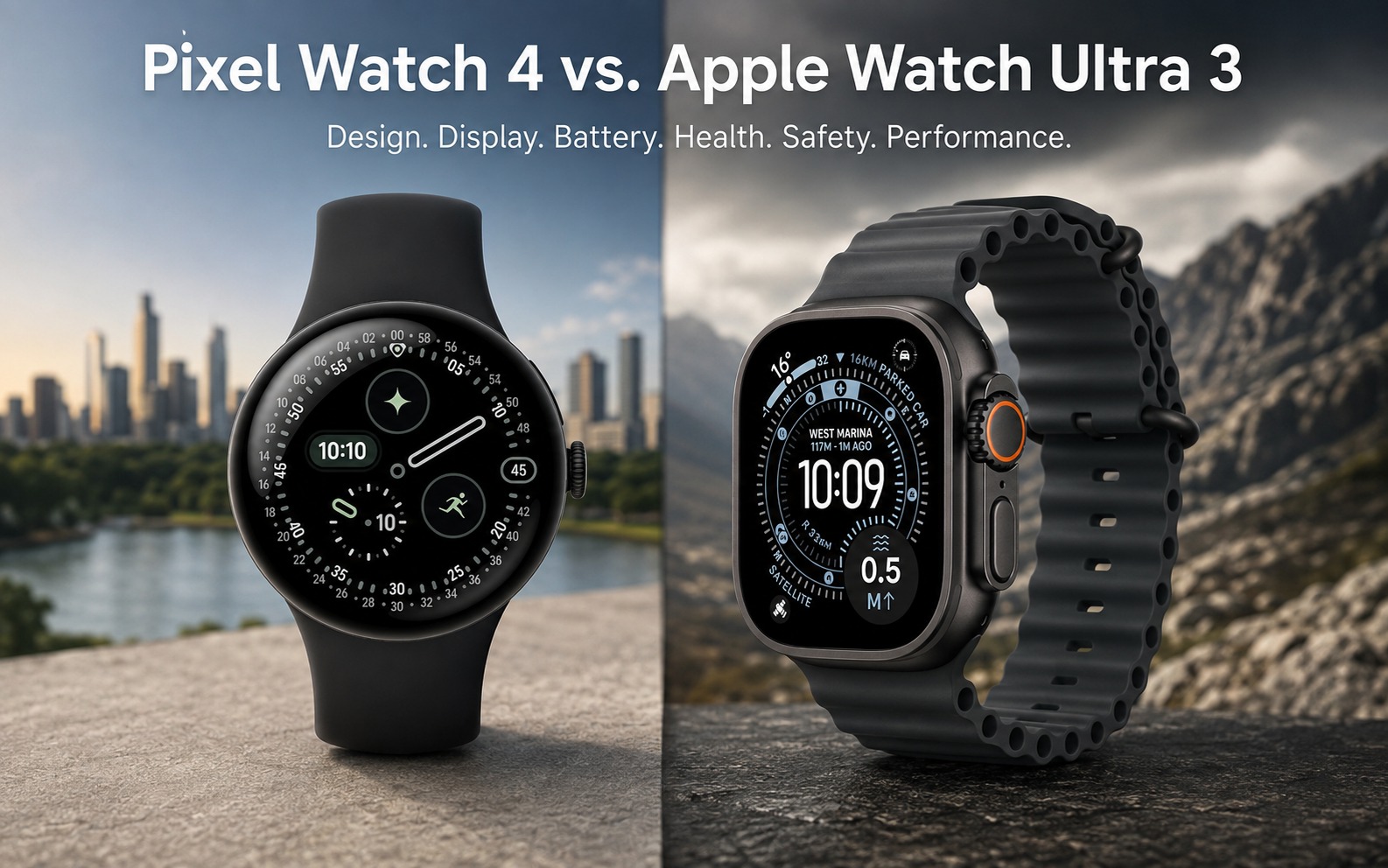
Recently, tech enthusiasts began debating the Google Pixel Watch 4 vs. Apple Watch Ultra 3 matchup following late 2025 product releases. Google officially announced its new smartwatch lineup on August 20, 2025. Retail store shipments for the Pixel wearable officially started on October 9, 2025. Google priced the base Wi-Fi model at $349.99 for consumers.
Meanwhile, Apple introduced its rugged flagships during a major September 9 keynote event. Official store availability for the premium device began on September 19, 2025. Apple set the retail price at $799 for all users. Both tech companies now offer standalone emergency satellite communications on wrist hardware.
Google Pixel Watch 4 vs. Apple Watch Ultra 3: Design and Display
Google refined its iconic circular watch chassis with lighter aerospace aluminum materials. Specifically, the watch comes in 41mm and 45mm case sizes. The 45mm model weighs 36.7 grams without wrist bands attached. The domed Actua 360 display boasts 3,000 nits peak brightness. Furthermore, bezels shrank by 15 percent compared to older generations.
Apple relies on a massive 49mm Grade 5 titanium case design. The rugged titanium body weighs 61.6 grams for extreme durability. In contrast, Apple utilizes flat sapphire crystal to protect the screen. The LTPO3 wide-angle OLED screen also hits 3,000 nits peak brightness. Thinner display borders expand active viewing areas by 24 percent.
Hardware Specifications and Battery Performance
Silicon choices reveal distinct architecture strategies between both technology giants. Google equips its watch with the Qualcomm Snapdragon W5 Gen 2 processor. Additionally, a dedicated machine learning co-processor accelerates AI tasks. The 45mm Google model houses a 455 mAh battery cell. Consequently, battery runtime reaches up to 40 hours with Always-On display.
Apple powers its wearable using the custom dual-core S10 system chip. A large 599 mAh internal battery powers the device during long workouts. Therefore, standard daily usage lasts up to 42 continuous hours. Moreover, Low Power Mode extends operational battery stamina up to 72 hours.
Technical Specifications Comparison
A detailed hardware comparison demonstrates key differences across critical metrics. Overall, each brand optimizes components for distinct consumer priorities.
| Specification | Google Pixel Watch 4 (45mm) | Apple Watch Ultra 3 |
| Case Material | Aerospace Aluminum | Grade 5 Titanium |
| Display Panel | Actua 360 AMOLED | LTPO3 Wide-Angle OLED |
| Peak Brightness | 3,000 nits | 3,000 nits |
| Processor | Snapdragon W5 Gen 2 | Apple S10 Dual-Core |
| Storage / RAM | 32GB / 2GB | 64GB / 1GB |
| Battery Capacity | 455 mAh | 599 mAh |
| Max Battery Life | Up to 40 Hours | Up to 42 Hours |
| Water Resistance | 50m (5ATM) | 100m (40m Dive) |
| Base Price | $399.99 | $799.00 |
Modern wireless standards differ significantly between these competing flagship models. For instance, Google includes Bluetooth 6.0 while Apple provides 5G RedCap cellular support. Both smartwatches incorporate precision dual-frequency GPS for accurate route tracking.
Health Sensors and Safety Features
Safety capabilities expanded dramatically through integrated satellite communication hardware. Google offers emergency Satellite SOS on LTE models off the grid. Similarly, Apple enables satellite text messaging and emergency connectivity. Google integrates skin temperature sensing alongside advanced sleep cycle analysis. Besides, Google watch wearers access Gemini AI assistants by raising their wrist.
Apple provides comprehensive health monitoring features for outdoor lifestyle tracking. However, Apple adds dedicated hypertension alerts and sleep apnea detection. Water sensors track depth down to 40 meters during recreational diving. Military-grade certification ensures robust performance during extreme outdoor adventure activities.
Industry Strategy and Market Impact
Recent hardware developments highlight shifting competitive strategies across the wearable ecosystem. Google focuses on screen repairability through official iFixit component partnerships. Thus, Google lowers long-term ownership costs for mainstream Android users. Accessible starting prices keep Google competitive against alternative Android options.
Apple dominates high-end endurance market segments through premium titanium construction. Indeed, deep water capabilities justify the higher price tag for extreme athletes. Extended battery life solidifies Apple’s lead in wilderness outdoor navigation. Both flagship platforms establish new benchmarks for consumer wrist technology.
Support Our Work
Help us keep creating and maintaining our projects. We appreciate your support!
Ways to contribute:
Shop via Affiliate LinksSupport us at no extra cost to you while you shop.
Support on Ko-fiBuy us a coffee to keep the engine running!

Leave a Reply