


- [Solar Powered & 100% Wire-free] VIZIUUY solar camera security outdoor has a large capacity battery built in to provide …
- [2K Ultra HD & 360 Degree Coverage] The solar security cameras wireless outdoor is equipped with 3mp(2048×1536) resoluti…
- [AI Powered Human Motion Detection & Customizable Motion Area] VIZIUUY solar security camera supports human motion detec…
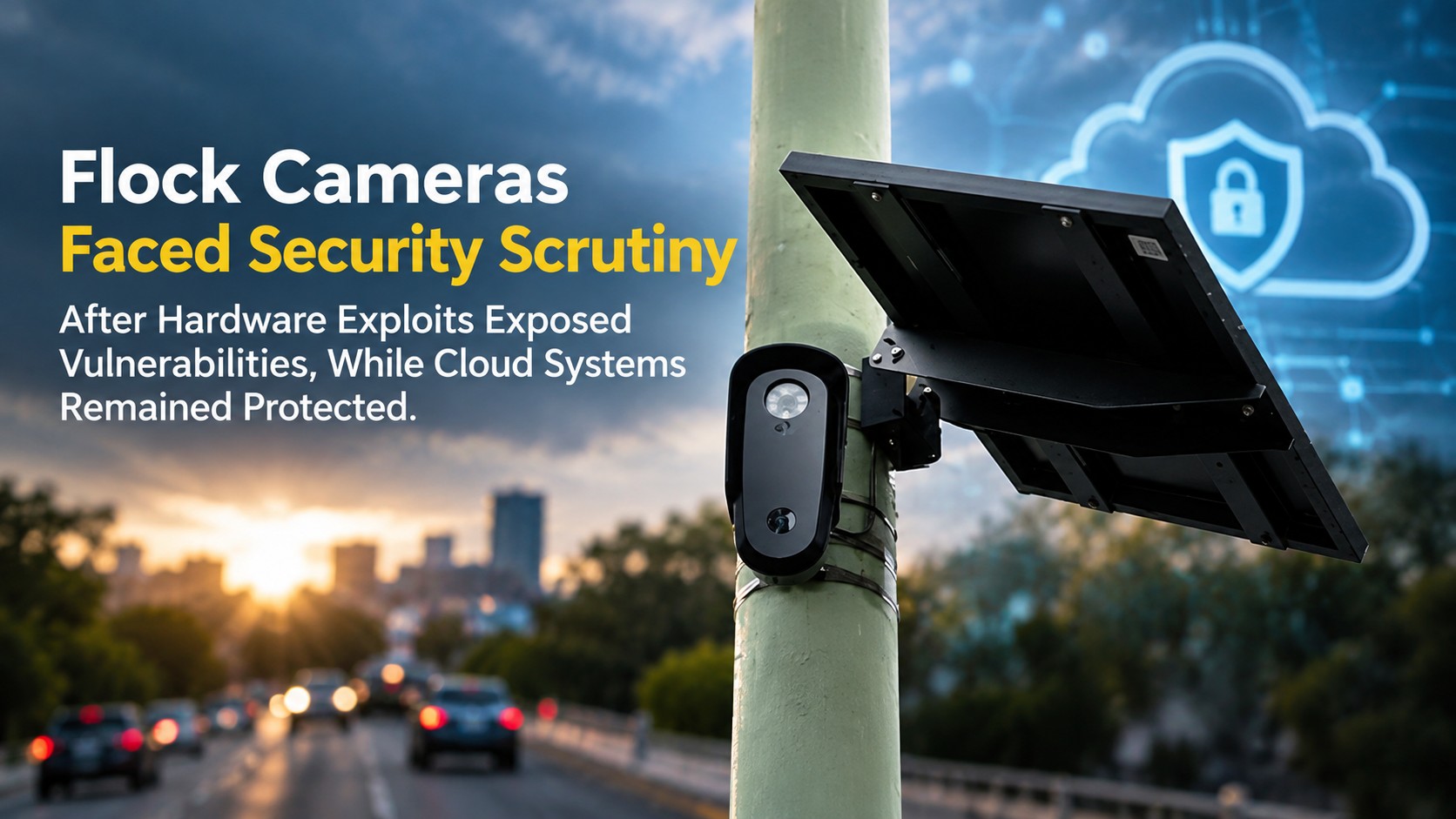
Examining Reports of Flock Cameras Hacked in Security Audits
Headlines claiming that Flock Cameras Hacked systems surfaced online, triggering widespread debate among law enforcement officials. However, corporate executives clarify that central cloud infrastructure never suffered any remote data breach or system compromise. Company leaders emphasize that external servers remain secure, protecting customer databases against unauthorized access. Instead, public confusion often arises when commentators misinterpret theoretical security research as actual network intrusions. Security teams continuously monitor cloud systems to prevent unauthorized exfiltration of sensitive municipal vehicle logs.
Physical hardware tampering presents distinct threat vectors compared to remote network attacks on cloud databases. Consequently, cybersecurity experts urge public officials to evaluate edge camera security separately from cloud storage integrity. Independent audits confirm that centralized client records remain isolated under strict customer ownership policies. Furthermore, standard protocols dictate that agencies retain full operational authority over their specific camera feeds. Customers control data access rights and determine retention schedules according to local legal guidelines.
Hardware Teardowns and Android Vulnerability Analysis
A hacker collective named Stegan0gram physically disassembled a roadside camera to analyze its internal file systems. Notably, the group extracted an encryption key stored directly on unencrypted partitions within the captured hardware. The recovered media files contained nearly three weeks of operational history detailing thousands of vehicle movements. Specifically, the device recorded 1.6 million images and tracked over 50,000 unique vehicles during that period. The internal computer vision models also executed pedestrian detection algorithms, logging human presence with confidence scores.
Vulnerability researchers also identified severe software flaws within the camera application framework. Designated as CVE-2025-59403, the Collins Android application exposed administrative API endpoints on port 8080 without authentication. Therefore, unauthenticated attackers on the local network could trigger remote code execution or system reboots. Enabling Android Debug Bridge over TCP allowed shell access without requiring debugging confirmation from administrators. Meanwhile, engineers patched these vulnerabilities swiftly while noting that exploitation requires local network proximity.
Financial Growth, Corporate Strategy, and Hardware Security
| Metric or Specification | Operational Indicator | Strategic and Security Context |
| Corporate Valuation | $8.4 Billion (April 2026) | Reached via $200M+ Series G extension round |
| Primary Software Vulnerability | CVE-2025-59403 (Port 8080) | Unauthenticated API endpoints fixed via patches |
| Physical Teardown Finding | Stegan0gram Hardware Exploitation | Unlocked 1.6M images across 21-day log history |
| Drone Tech Acquisition | Uniform Sierra Aerospace (2025) | Expands NDAA-compliant public safety hardware |
| Customer Retention Policy | 30 Days Standard Limit | Automatic purge of non-investigative vehicle scans |
Corporate capital expansion supports ongoing technological development and strategic acquisitions across public safety markets. Flock Safety achieved an 8.4 billion dollar valuation following recent equity funding rounds in early 2026. Additionally, annual recurring revenue surpassed 300 million dollars, reflecting strong demand from law enforcement clients. Strategic acquisitions like Uniform Sierra Aerospace expand the corporate product portfolio into NDAA-compliant drone technology. These aerial systems integrate with existing license plate readers to provide rapid real-time emergency response capabilities.
Cybersecurity investments remain vital as the corporate technology ecosystem expands across thousands of municipal jurisdictions. Indeed, a dedicated security team of over twenty engineers manages architectural reviews and threat modeling continuously. The company partners with independent testing firms like Bishop Fox to conduct annual offensive security assessments. Standard operational procedures mandate automatic deletion of unneeded surveillance footage after thirty days of storage. Thus, robust compliance frameworks protect public safety data against unauthorized third-party intrusion attempt vectors.
Audit Findings and Internal Access Concerns
Investigative audits uncovered unexpected internal search activity on active municipal surveillance networks. Audit logs from Dunwoody, Georgia revealed vendor employees conducting searches using non-investigative terms like chicken trucks. Moreover, records showed several company employees holding department administrator access privileges within municipal accounts. Automated programmatic API connections tied to corporate acquisitions also executed dozens of unauthorized network queries. These disclosures contradicted public marketing assurances asserting that company personnel never monitor live client feeds.
Widespread privacy concerns prompted several local governments to reevaluate their automated surveillance contracts. As a result, anti-surveillance organizations reported over ninety U.S. cities and counties ending camera agreements recently. Municipal leaders demand stricter oversight controls to guarantee that data sharing aligns with local community expectations. Corporate leadership introduced enhanced audit features to help agencies track search activities more effectively. Public agencies must enforce explicit contractual language to maintain accountability over sensitive law enforcement data systems.
Governance Standards for Future Surveillance Infrastructure
Deploying automated license plate readers requires balancing law enforcement benefits against vital civil liberty protections. Nonetheless, physical device teardowns demonstrate that edge hardware security requires continuous physical and cryptographic fortification. Municipalities must adopt comprehensive risk management frameworks before mounting surveillance hardware along public roadways. Independent security audits should evaluate both cloud application interfaces and local hardware vulnerability vectors. Transparent vulnerability disclosure processes strengthen public safety infrastructure against sophisticated malicious exploit attempts.
Future public safety platforms must prioritize robust access controls and strict administrative logging mechanisms. Ultimately, clear data governance policies determine whether communities maintain trust in automated police technologies. Proactive risk mitigations protect sensitive vehicle logs while preserving effective investigative capabilities for law enforcement. Collaborative oversight between civic leaders and technology vendors ensures responsible implementation across all public deployment sites.
Support Our Work
Help us keep creating and maintaining our projects. We appreciate your support!
Ways to contribute:
Shop via Affiliate LinksSupport us at no extra cost to you while you shop.
Support on Ko-fiBuy us a coffee to keep the engine running!






Leave a Reply