
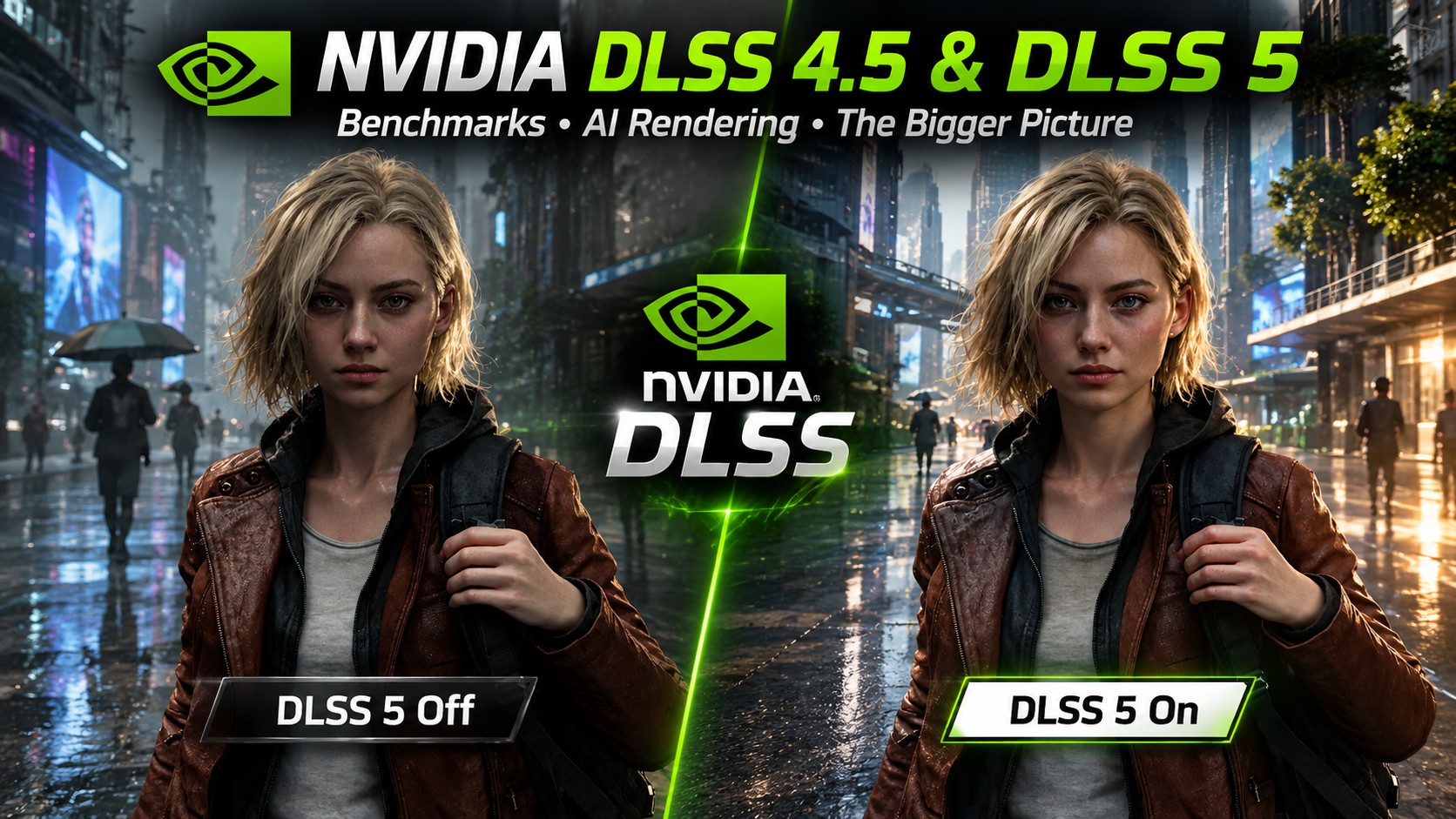

NVIDIA DLSS in 2026: Neural Rendering, Benchmarks, and Industry Turmoil
What is DLSS in Gaming? NVIDIA builds Deep Learning Super Sampling as an AI neural rendering suite. Specifically, DLSS 4.5 refined frame multipliers, and DLSS 5 added 3D-Guided Neural Rendering.
Independent reviews, however, expose steep GPU costs behind NVIDIA’s ambitious frame-rate claims. Longtime CEO Jensen Huang resigned on November 12 amid personal-conduct reports and export scrutiny. PC gamers must weigh sharper AI visuals against real hardware trade-offs.
What is DLSS in Gaming? Core Architecture and Hardware Support
NVIDIA structures DLSS around upscaling, frame generation, ray reconstruction, and neural rendering. Super Resolution renders smaller frames and uses Tensor Cores to reconstruct crisp detail. Meanwhile, Ray Reconstruction replaces traditional denoisers with unified AI lighting models.
GPU generations govern official access across GeForce RTX cards. Only RTX 50 GPUs unlock Multi Frame Generation and DLSS 5 officially. RTX 20 and 30 cards retain Super Resolution, DLAA, and Ray Reconstruction.
2026 DLSS Feature & GeForce RTX Support Matrix
DLSS 4.5 Introduces 2nd-Gen Transformers and 6X Frames
CES 2026 marked the launch of DLSS 4.5 and its 2nd-gen Transformer model. Additionally, August’s Gamescom update delivered DLSS 4.5 Ray Reconstruction with 35% more compute capability. March’s beta unlocked 6X Multi Frame Generation via Game Ready Driver 595.79 WHQL.
Fifth-generation Tensor Cores generate up to five AI frames per rendered frame. Therefore, Dynamic mode adjusts multipliers automatically to match a monitor’s refresh rate. NVIDIA pairs generated frames with Reflex to protect responsiveness at 4K.
By contrast, RTX 20 and 30 cards lack FP8 hardware, raising overhead roughly fivefold. NVIDIA’s teased Reflex 2 Frame Warp tool remains absent from shipping retail games. Still, over 30 announced games integrate native DLSS 4.5 features.
DLSS 4.5 vs. DLSS 5: 2026 Architecture & Rollout
DLSS 5 Shifts Focus to 3D-Guided Neural Rendering
In March, NVIDIA unveiled DLSS 5 before shipping it on September 3, 2026. 3D-Guided Neural Rendering differs from upscalers by refining already rendered game frames. Consequently, a Pixel Space Diffusion Transformer enhances skin scattering, hair, and fabric lighting.
Developers integrate DLSS 5 using Streamline, Unreal Engine 5 plugins, and semantic masks. Visual Concepts debuted DLSS 5 in NBA 2K27 using Game Ready Driver 616.64 WHQL. Subsequently, an October 16 patch shipped an updated model claiming up to 40% more FPS.
Hogwarts Legacy added DLSS 5 on November 5, and Where Winds Meet launches November 23. Nevertheless, Igor’s Lab notes NVIDIA withheld standalone VRAM footprints and motion stability data. PC Gamer reviewers saw realistic close-ups alongside heavy-handed AI shifts on some character models.
Independent Benchmarks Reveal Quality Gains and Heavy Costs
Real-world tests separate DLSS 4.5’s visual lead from DLSS 5’s steep GPU demands. For instance, ComputerBase tallied 6,747 blind-test votes across six 4K games in Quality mode. DLSS 4.5 captured 48.2% of votes, beating native TAA (24.0%) and FSR 4 (15.0%).
Conversely, a HYPERPC comparison notes AMD’s FSR 4 runs 10% to 15% faster. NVIDIA’s 370 FPS 4K DLSS 5 claim combines Super Resolution with 6X Multi Frame Generation. As a result, 91mobiles measured 79.2 ms latency with Frame Generation on RTX 5070 Ti. Tom’s Hardware confirmed nearly every RTX 50 GPU runs DLSS 5 acceptably at 1080p.
Independent 2026 Benchmarks: Image Quality vs. GPU Cost
Ecosystem Reach Beyond Traditional Gaming Desktops
Over 1,000 games and apps include RTX technologies across PC and cloud platforms. Modders use RTX Remix with DLSS 4.5 to path-trace classics including Morrowind.
NVIDIA is pushing neural rendering onto portable AI PCs and custom consoles. Two late-2026 platforms anchor this expansion outside traditional desktop towers.
Ecosystem Reach: RTX Spark, Cloud & Nintendo Switch 2
RTX Spark and GeForce NOW Cloud Access
November’s RTX Spark laptops and mini-PCs target local AI agents and gaming. Each superchip pairs a 6,144-core Blackwell GPU with 128 GB of unified memory.
In addition, GeForce NOW Ultimate streams DLSS 4.5 and DLSS 5 to lighter devices. ASUS and Gigabyte unveiled compact RTX Spark systems supporting the full DLSS suite.
Nintendo Switch 2 Custom Upscaling Strategy
NVIDIA confirmed DLSS and ray tracing inside Nintendo’s custom Switch 2 processor. On the other hand, reported system dumps suggest DLSS 4.0 support without DLSS 4.5.
Those unconfirmed files list Preset K Transformer quality alongside two custom CNN presets. Accordingly, analysts expect Switch 2 studios to favor lighter models for smooth handheld play.
Acquisitions, Rivals, and Leadership Turmoil Reshape 2026
Massive AI partnerships bolstered NVIDIA ahead of late-2026 corporate turmoil. In December 2025, NVIDIA struck a reported $20 billion Groq licensing deal. Moreover, hiring Groq’s founders drew US Senate scrutiny and birthed the Groq 3 LPU.
On September 3, the chipmaker agreed to buy Hugging Face for $12.93 billion. A $30 billion OpenAI investment deepened NVIDIA’s data-center footprint. Senate letters note NVIDIA held 92% of the PC GPU market in late 2025.
Nonetheless, November 2026 brought acute leadership and export shocks to NVIDIA. Jensen Huang resigned on November 12 amid personal-relationship reports and unproven espionage claims. Interim CEO Colette Kress leads NVIDIA amid halted China chip shipments and probes. AMD shares rallied 158% this year alongside record data-center revenue and FSR 4.1. Cross-platform titles like Helldivers 2 support DLSS 4.5, FSR 4, and XeSS 3.0. Ultimately, DLSS 5’s steep performance trade-off awaits promised late-2026 neural model optimizations.
2026 Industry Turmoil, AI Mega-Deals & Rivalry
Support Our Work
Help us keep creating and maintaining our projects. We appreciate your support!
Ways to contribute:
Shop via Affiliate LinksSupport us at no extra cost to you while you shop.
Support on Ko-fiBuy us a coffee to keep the engine running!




Leave a Reply