
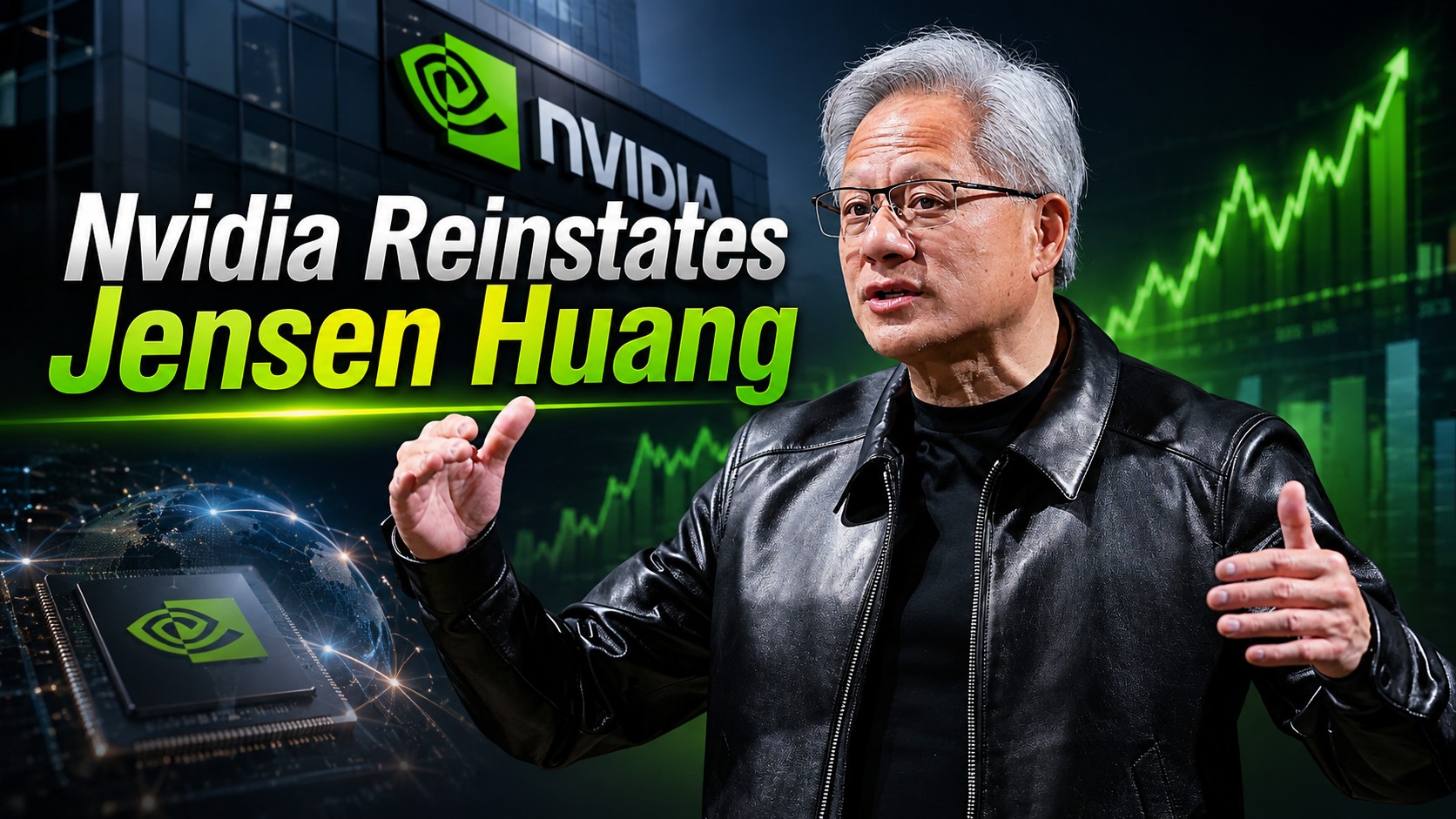

Nvidia Reinstates Its Co-Founder After an 11-Day Leadership Crisis
Wall Street woke up on November 23 to one stunning headline: Jensen Huang is Back. Nvidia’s board voted unanimously to restore its co-founder as president, chief executive, and director. Revelations about extramarital affairs and potential foreign intelligence exposure had triggered his abrupt exit. However, intense lobbying from President Donald Trump and Silicon Valley figures rapidly reversed that decision.
Monday’s reinstatement ignited a massive rally that restored roughly $1 trillion in market value. Meanwhile, the chipmaker keeps posting historic revenue gains from Vera Rubin data center systems. Tighter export rules, antitrust probes, and December congressional hearings await Huang upon his return. Thus, how Nvidia handles those mounting legal challenges will ripple across the global artificial intelligence economy.
⚡ Jensen Huang’s 11-Day Exit & Reinstatement
📈 ~$1T Market Value Restored- Huang apologizes for marital infidelity in an emotional employee email.
- Board opens independent probe; press links 2 Nvidia staff & ex-Megaspeed exec Alice Huang (denied Chinese intelligence suspicions).
- Directors accept Huang’s resignation and appoint CFO Colette Kress as interim CEO.
- Longtime director Harvey Jones becomes Nvidia’s inaugural board chair.
- Chair Harvey Jones tells investors Nvidia does not intend to reinstate Huang.
- Potential successor Rene Haas signs contract keeping him at Arm through 2033.
- Shares fall 14% to $125.53 on SEC inquiry into Singapore revenue disclosures (~50% of global sales).
- Huang signals willingness to serve again if directors ask.
- President Donald Trump lobbies directors (“I made the deal”) alongside VP JD Vance & Elon Musk.
- AG Todd Blanche cites no unlawful conduct; Treasury Sec. Scott Bessent softens outside-CEO stance.
- Board restores Huang as President, CEO & Director without consulting senior staff; Kress returns to CFO.
- Shares jump 30%+ to $165.05, adding ~$1T in market value.
Why Jensen Huang is Back at Nvidia
The leadership crisis surfaced publicly on November 8 through an emotional employee email from Huang. In that message, he apologized for marital infidelity as directors launched an independent investigation. Media reports linked Huang to two Nvidia employees and former Megaspeed executive Alice Huang. According to press accounts, Alice Huang faced suspicions of Chinese intelligence ties, which Beijing denied.
Directors accepted Huang’s resignation on November 11 and named CFO Colette Kress interim chief executive. At that transition, the board appointed longtime director Harvey Jones as its inaugural chair. Subsequently, Jones told investors on November 17 that Nvidia did not intend to reinstate Huang. In addition, potential successor Rene Haas signed a contract keeping him at Arm through 2033.
Still, Huang broke his silence, saying he would gladly serve if directors asked. Following extensive discussions, directors expressed satisfaction with his candor and leadership capability. Therefore, citing input from senior federal officials, the board concluded his return posed no risk. Upon returning, Huang thanked employees and his family and promised renewed humility and commitment. Finally, Jones praised Kress for her interim service as she resumed full-time CFO duties.
Washington and Wall Street Shape the Deal
Intense political lobbying over one weekend reshaped Nvidia’s leadership stance. President Trump intervened directly with board members, telling CNBC reporters that he made the deal. Notably, Vice President JD Vance joined White House talks alongside tech billionaire Elon Musk. Attorney General Todd Blanche found no evidence of unlawful conduct, the president claimed. On Truth Social, the president hailed Huang as a great patriot and national treasure.
Outside Washington, an online petition backing Huang collected over 200,000 signatures across tech circles. Treasury Secretary Scott Bessent softened Sunday remarks that had urged an outside CEO search. Consequently, prediction-market odds on Polymarket climbed from roughly 10 percent to 18 percent overnight. According to Bloomberg, directors approved the reinstatement without consulting Kress or senior executives.
Wall Street’s relief followed a sharp Friday selloff stemming from regulatory headlines. Nvidia shares fell 14 percent to $125.53 on November 20 upon news of an SEC probe. That inquiry examines accounting disclosures when Singapore sales reached nearly half of global revenue. On Monday, shares rallied over 30 percent to $165.05, boosting the Nasdaq 7 percent.
Record Earnings Drive Investor Urgency
Wall Street’s anxiety reflected Nvidia’s extraordinary financial scale heading into fiscal 2027. On November 17, Kress reported third-quarter revenue of $115.8 billion, doubling year over year. Data center sales hit $107.6 billion, representing nearly 93 percent of total company revenue. Specifically, hyperscale customers generated $60.1 billion alongside $47.5 billion from enterprise and cloud buyers.
Profitability stayed strong as GAAP gross margin reached 74.8 percent on $65.3 billion net income. Edge Computing contributed $8.2 billion, rising 42 percent on strong Blackwell workstation demand. Furthermore, management projected $130.0 billion for a 14-week fourth quarter without China compute revenue. Nvidia returned $28.1 billion to shareholders during the period, leaving $227.3 billion in buyback capacity.
💰 Record Q3 FY27 Earnings & Q4 Outlook
▲ Revenue +103% YoYVera Rubin Ships With Revised Bandwidth Specs
Nvidia confirmed volume shipments of its liquid-cooled Vera Rubin NVL72 platform during the quarter. Independent hardware checks uncovered quiet September spec edits made ahead of commercial deliveries. Each Rubin GPU keeps 288 GB of HBM4 memory and 50 PFLOPS of NVFP4 inference. In that rack, 36 Vera CPUs pack 88 custom Olympus cores each. Conversely, per-GPU HBM4 bandwidth dropped from 22 TB/s to 19.2 TB/s on shipping sheets. Rack-scale networking actually rose 12.5 percent to 32.4 TB/s across the NVL72 system.
Nvidia told Wccftech that initial specifications reflected development targets rather than production hardware. In vendor-submitted MLPerf v6.1 results, Vera Rubin reached up to double Blackwell Ultra performance. Separately, Windows laptops running RTX Spark N1X silicon reached retail shelves on October 16. Top N1X units pair 20 Grace cores, 6,144 Blackwell cores, and 128 GB unified memory. Unlike Linux DGX Spark boxes, RTX Spark lacks the 200 GbE ConnectX-7 clustering port. Additionally, Nvidia launched CUDA-Q Logical for quantum simulation and tested commercial AI-RAN with T-Mobile.
⚙ Vera Rubin NVL72 Shipping Specs vs. Targets
🚀 Up to 2x Blackwell Ultra (MLPerf v6.1)Supply Deals, Acquisitions, and Antitrust Scrutiny
Nvidia locked up upstream manufacturing capacity to support multiyear Vera Rubin factory demand. Supply commitments swelled to $390 billion by late October, mainly covering long-term memory contracts. On November 17, Nvidia expanded packaging partnerships with Kinsus, Samsung Electro-Mechanics, Amkor, SPIL, and TSMC. For instance, Kinsus will expand dedicated ABF substrate capacity over 3.5-fold, targeting Q3 2028.
Beyond hardware, Nvidia agreed in September to buy developer platform Hugging Face for $12.93 billion. As a result, Justice Department officials opened an antitrust review examining competition and sales practices. Nvidia pledged that Hugging Face will stay open and continue supporting rival chipmakers. Moreover, regulators are scrutinizing Nvidia’s $20 billion Groq licensing deal that hired key chip architects. Indeed, some Groq common stockholders sued over deal payouts despite company claims of exceptional value.
Those Groq processors power new LPX inference racks running alongside Vera Rubin clusters. Previously, Nvidia’s December 2025 purchase of Slurm developer SchedMD sparked questions about open-source neutrality. In Asia, Nvidia partnered with Rebellions and SK Telecom on sovereign Korean AI infrastructure. That collaboration pairs Rebellions processors with NVLink Fusion alongside planned investments in local startups. Nvidia closed a Point2 Technology stake and outlined Motif, RLWRLD, and Upstage plans.
💼 Supply Lock-In, M&A & AI Credit Exposure
⚠ UBS & Citi Target: $240- Commitments swelled by late October, focused on long-term memory contracts.
- Nov 17 packaging deals with TSMC, Samsung Electro-Mechanics, Amkor, SPIL & Kinsus (3.5x+ ABF substrate expansion by Q3 2028).
- September deal to buy developer platform; triggered DOJ antitrust review.
- Nvidia pledged Hugging Face will stay open and support rival chipmakers.
- Hired key Groq architects to power LPX inference racks (faces regulator scrutiny & stockholder lawsuits).
- Bought SchedMD (Slurm) in Dec 2025; partnered with Rebellions & SK Telecom on Korean AI + Point2, Motif, RLWRLD & Upstage.
- Includes $105B in conditional credit support for OpenAI’s Ohio campus.
- Holds $65.5B in non-marketable securities; mobilizing $500B+ with Apollo, BlackRock & Goldman Sachs.
- CoreWeave pledged Nvidia GPUs as loan collateral, lost $709M last quarter, and owes $10B in 2027.
- Nvidia owns ~11% of CoreWeave and backs $6.3B in unsold capacity.
- Anthropic’s volatile Nov IPO and 20+ pre-Q3 analyst target cuts reflected AI bubble fears.
- UBS and Citi reaffirmed $240 Buy ratings following Nvidia’s Q3 earnings beat.
Debt Guarantees and AI Bubble Concerns
Nvidia’s aggressive dealmaking has intensified Wall Street debate over artificial intelligence spending durability. Third-quarter filings show $65.5 billion in non-marketable securities and $118 billion in maximum credit guarantees. That guarantee pool includes $105 billion in conditional credit support for OpenAI’s Ohio campus. Simultaneously, Nvidia joined Apollo, BlackRock, and Goldman Sachs to mobilize over $500 billion.
Skeptics warn that circular vendor financing masks fragility among heavily indebted cloud operators. For example, CoreWeave carries $47 billion in debt, pledging Nvidia GPUs as loan collateral. In fact, CoreWeave lost $709 million last quarter and faces $10 billion due in 2027. Nvidia owns roughly 11 percent of CoreWeave and backs $6.3 billion in unsold capacity.
Anthropic’s volatile November IPO failed to calm market nerves over inflated sector valuations. Over 20 Wall Street analysts trimmed Nvidia price targets ahead of third-quarter earnings. Nevertheless, strong results prompted UBS and Citi to maintain buy ratings at $240. Accordingly, investors must balance doubling hardware demand against rising leverage across major customers.
Export Rules and Hearings Now That Jensen Huang is Back
Tighter federal export restrictions challenge global expansion right as Huang returns to headquarters. On November 16, Commerce officials issued a rule targeting overseas cloud compute rentals. Foreign data centers serving Chinese clients above 12 million TPP compute require federal licenses. That threshold equals roughly 760 Nvidia H100 GPUs, with 90 compliance days for existing providers. Besides, chip shipments to Singapore, Malaysia, Thailand, Indonesia, and Brazil require federal approval. Likewise, the measure formally rescinds Washington’s January 2025 AI Diffusion Rule.
Inside Nvidia, directors created a National Security and Export Control Oversight Committee. Nonetheless, the board’s independent probe into alleged foreign intelligence targeting continues toward completion. Nvidia is currently recruiting a Chief Compliance Officer and assisting ongoing government inquiries. At the same time, California investigators and federal prosecutors are examining Megaspeed’s Singapore shipments.
Lawmakers from both parties blasted Trump’s intervention and scheduled immediate oversight hearings. Senator Elizabeth Warren called the reinstatement reckless as Representative Robert Garcia cited corruption concerns. Huang plans a December 1 House interview and public Senate testimony on December 3. Ultimately, sustaining Nvidia’s trillion-dollar comeback requires proving its governance matches its unmatched engineering pace.
⚖ Export Curbs, Legal Probes & December Hearings
📅 Dec 1 & Dec 3 Capitol Hill Testimony- Rescinds Jan 2025 AI Diffusion Rule; gives existing providers 90 compliance days.
- Foreign data centers serving Chinese clients above 12M TPP (~760 H100 GPUs) require federal licenses.
- SEC: Examines accounting disclosures as Singapore reached ~50% of global revenue.
- DOJ & Prosecutors: Antitrust reviews (Hugging Face/Groq) plus California & federal probes into Megaspeed’s Singapore shipments.
- Board formed a National Security and Export Control Oversight Committee.
- Recruiting a Chief Compliance Officer while finishing the foreign intelligence probe.
- Dec 1: U.S. House interview with Jensen Huang.
- Dec 3: Public U.S. Senate testimony following bipartisan criticism from Sen. Elizabeth Warren and Rep. Robert Garcia.
Support Our Work
Help us keep creating and maintaining our projects. We appreciate your support!
Ways to contribute:
Shop via Affiliate LinksSupport us at no extra cost to you while you shop.
Support on Ko-fiBuy us a coffee to keep the engine running!



Leave a Reply