
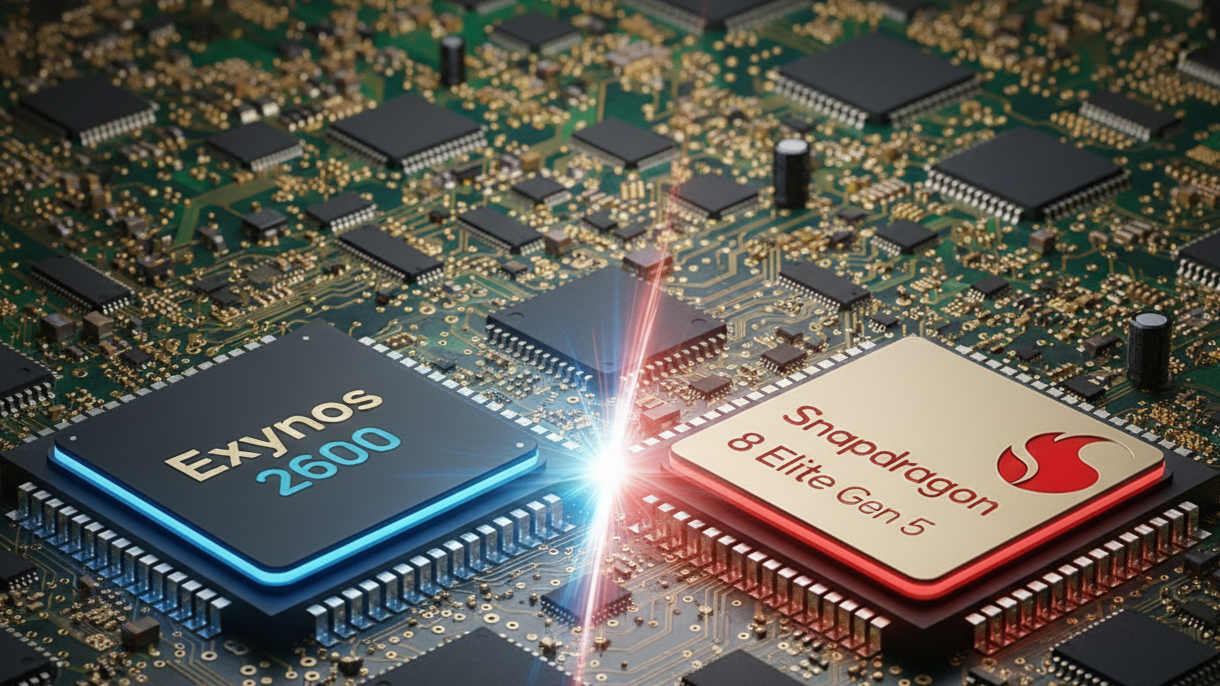
The tech world stands at a massive crossroads this February 2026. Samsung prepares to launch its highly anticipated Galaxy S26 series very soon. Consequently, a Chip War erupts between two silicon titans for mobile supremacy. We are looking at the Snapdragon 8 Elite Gen 5 vs. Exynos 2600 rivalry. This competition represents more than just a simple incremental yearly update. Instead, it signals a fundamental shift in how we perceive mobile power.
Samsung has finally officially announced its Exynos 2600 as a 2nm marvel. Meanwhile, Qualcomm counters with the incredible Snapdragon 8 Elite Gen 5 platform. Both chips aim to redefine the limits of handheld artificial intelligence. However, they take vastly different paths to reach that lofty goal. Fans are currently debating which processor will actually dominate the 2026 flagship market.

The 2nm Revolution and Manufacturing Feats
Samsung is betting everything on its cutting-edge 2nm Gate-All-Around (GAA) process. Historically, the company struggled with efficiency issues in its previous chipset designs. Therefore, the Exynos 2600 serves as a crucial “redemption arc” for the brand. The GAA architecture allows for much tighter control over current leakage. As a result, the chip should theoretically run much cooler than its predecessors. This is vital because heat often ruined the user experience before.
In contrast, the Snapdragon 8 Elite Gen 5 relies on a highly refined 3nm node. Qualcomm prioritizes stability and proven manufacturing yields over experimental 2nm shrinking. Nevertheless, the performance gains reported by early testers remain absolutely staggering. The 3rd Gen Oryon CPU inside this chip reaches speeds of 4.6GHz. Such high clock speeds were once reserved only for desktop computers. Now, they reside comfortably within our pockets.
Graphic Performance: Xclipse 960 Takes the Lead?
Perhaps the most shocking news involves the new Xclipse 960 GPU. Samsung developed this graphics unit using AMD’s latest RDNA 4 architecture. Surprisingly, early Geekbench 6 OpenCL tests show it outperforming the Snapdragon 8 Elite. The Exynos 2600 recently scored a massive 25,791 points in GPU tests. Meanwhile, the OnePlus 15 with Snapdragon 8 Elite scored slightly lower at 24,319 points. This marks a significant turning point for the often-criticized Exynos brand.
Furthermore, Samsung is introducing a technology called “Heat Path Block” (HPB). This innovation aims to solve the thermal throttling issues of the past. If the chip stays cool, it can maintain peak performance longer. Gamers especially value sustained frame rates over short, high-speed bursts. Therefore, the Exynos might finally be a legitimate choice for mobile enthusiasts. However, Qualcomm’s Adreno 840 GPU is certainly no slouch in real-world gaming. It features 23% better performance and significantly improved ray tracing capabilities.
AI and the “Agentic” Future in Chip War
Both companies are pushing “Agentic AI” as the next big software frontier. This means your phone won’t just answer questions anymore. Instead, it will proactively take actions across various apps for you. The Snapdragon 8 Elite Gen 5 features a powerful Hexagon NPU. This unit is 37% faster than the previous generation’s AI engine. Additionally, it supports a “Personal Scribe” to help manage your daily digital life. Privacy remains a top priority, so most processing stays on-device.
Samsung counters this with a massive 113% boost in generative AI performance. The Exynos 2600 integrates a 32K MAC NPU for complex machine learning tasks. Consequently, features like “Bixby 2.0” will feel much more natural and intuitive. Moreover, a new “Privacy Display” feature is rumored for the Galaxy S26. This software-driven solution narrows viewing angles when you open sensitive banking apps. Such innovations prove that hardware power is nothing without smart, useful features.
Which Chip Wins the 2026 Chip War?
The choice between these two chips often depends on your region. Samsung traditionally uses Snapdragon in the US and Exynos in Europe. However, the gap between them appears to be narrowing significantly this year. While Qualcomm leads in raw CPU clock speed, Samsung shows strength in graphics. Many users still feel hesitant about trusting the Exynos brand again. Yet, the 2nm transition might finally level the playing field for good.
For a deeper look at the raw benchmarks, check out this detailed GPU comparison of the Exynos 2600 and Snapdragon 8 Elite. This video provides a clear breakdown of why the graphics battle is closer than ever before.





Leave a Reply