
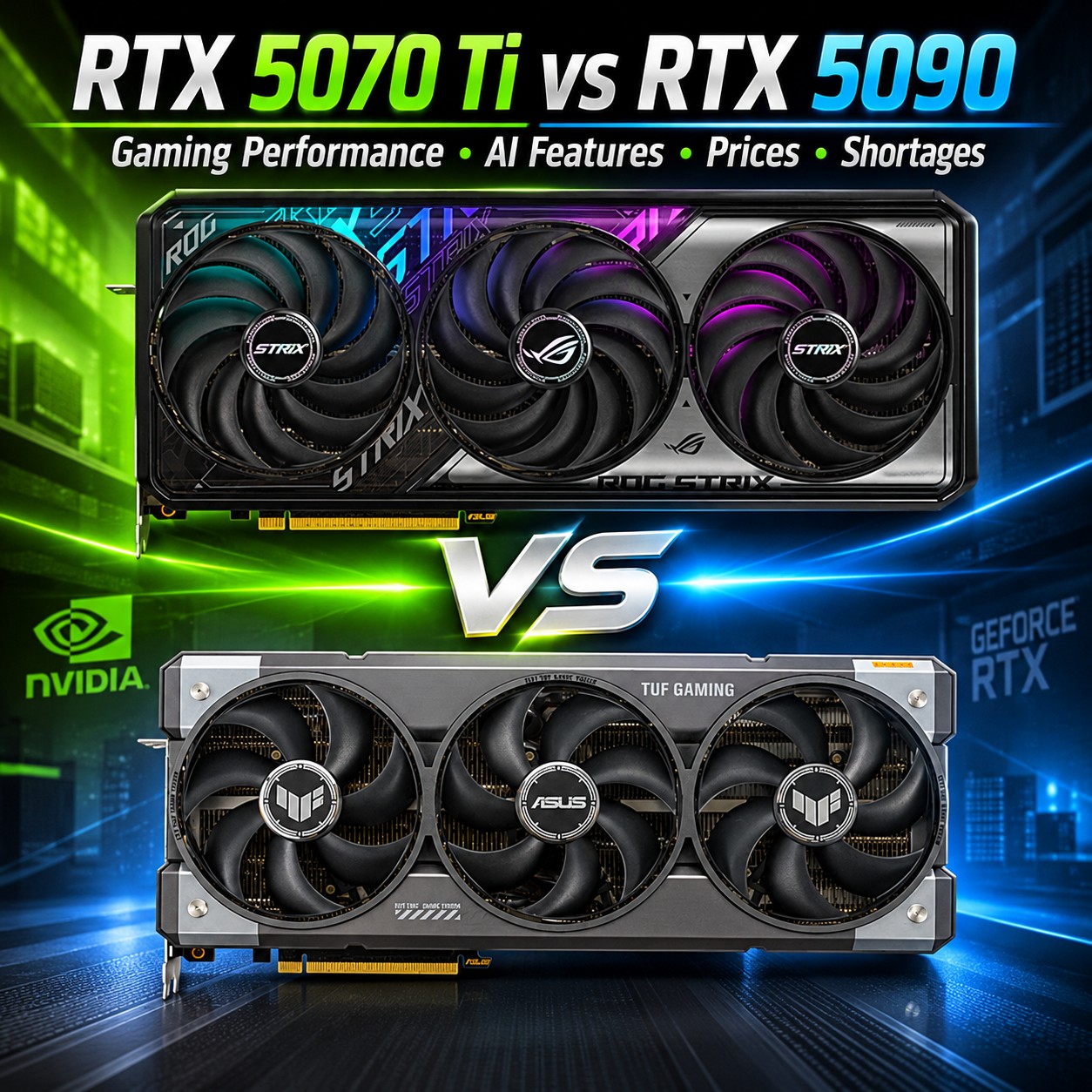

RTX 5070 Ti vs. RTX 5090: 2026 Specs, Prices, and Reality
The NVIDIA GeForce RTX 5070 Ti vs. GeForce RTX 5090 matchup shifted dramatically during 2026. NVIDIA launched both Blackwell desktop cards in early 2025 at $749 and $1,999. However, U.S. street prices climbed to $1,399 and $6,919 by November without MSRP hikes. Meanwhile, co-founder Jensen Huang resigned on November 12, erasing $180 billion in daily value. Bulk AI purchases and memory shortages now squeeze high-end retail graphics inventory across major stores.
Buyers must weigh real workload gains against extreme retail markups and new AI tools. Consequently, the midrange RTX 5070 Ti makes far more financial sense for everyday gaming. It delivers smooth 1440p frame rates and compact AI efficiency without massive power supplies. Conversely, heavy 3D artists and 4K enthusiasts chase the 32 GB RTX 5090. Both cards share Blackwell neural features across vastly different silicon budgets and retail prices.
💻 Blackwell Architecture & Core Specs (2026)
NVIDIA GeForce RTX 5070 Ti vs. GeForce RTX 5090 Architecture and Specs
NVIDIA builds both desktop cards on TSMC’s 5 nm 4N process using Blackwell silicon. Specifically, the RTX 5090 packs GB202 silicon with 92.2 billion transistors and 21,760 cores. That flagship chip houses 170 multiprocessors, 680 Tensor Cores, and 176 raster pipelines. Instead, the RTX 5070 Ti trims GB203 silicon down to 8,960 CUDA cores. Board partners manufacture every RTX 5070 Ti directly without an NVIDIA Founders Edition.
Memory hardware exposes the clearest gap across NVIDIA’s desktop Blackwell lineup. The flagship RTX 5090 doubles memory size, bus width, and bandwidth over its sibling. Additionally, it integrates three ninth-gen encoders and two sixth-gen decoders for video. Similarly, both cards feature DisplayPort 2.1b and PCIe 5.0, running fine on PCIe 4.0. Laptop versions share these names on smaller chips with tighter power envelopes.
| Specification | GeForce RTX 5070 Ti | GeForce RTX 5090 |
| GPU Silicon | GB203 (45.6B transistors) | GB202 (92.2B transistors) |
| CUDA Cores | 8,960 | 21,760 |
| 5th-Gen Tensor AI | 1,406 AI TOPS | 3,352 AI TOPS |
| 4th-Gen RT Cores | 133 TFLOPS | 318 TFLOPS |
| Boost Clock | 2.45 GHz | 2.41 GHz |
| Memory Config | 16 GB GDDR7 (256-bit) | 32 GB GDDR7 (512-bit) |
| Memory Bandwidth | 896 GB/s | 1,792 GB/s |
| NVENC / NVDEC Engines | 2x 9th / 1x 6th | 3x 9th / 2x 6th |
| Board Power (TDP) | 300 W | 575 W |
| Launch MSRP | $749 | $1,999 |
Gaming Benchmarks Across 1440p, 4K, and Power Draw
Independent game benchmarks show how screen resolution expands the RTX 5090’s performance advantage. In Tom’s Hardware rasterization tests, the RTX 5090 averages 203.8 FPS at 1080p Ultra. The RTX 5070 Ti manages 155.4 FPS there, trailing the flagship by 23.8 percent. However, stepping up to 4K Ultra gives the RTX 5090 a 61.5 percent lead. At 4K Ultra, the flagship hits 110.8 FPS against 68.6 FPS on the 5070 Ti.
Tom’s Hardware logs 167.3 FPS at 1440p Ultra versus 116.8 FPS on the 5070 Ti. Meanwhile, TechPowerUp observes the RTX 5070 Ti matching Radeon’s RX 7900 XTX in rasterization. Against AMD’s RX 9070 XT, TechSpot found mixed game averages with lower GeForce power draw. Under ray tracing, the 5070 Ti records 66.2 FPS at 1440p and 36.7 FPS at 4K. Its published summary omits RTX 5090 RT figures, leaving exact RT scaling unverified. Nevertheless, TechSpot calls the RTX 5090 the lone GPU remotely viable for 6K 165Hz displays.
Electrical demand separates these two graphics cards just as starkly as frame rates. TechSpot tests cited by FlowUP measured 492 W average RTX 5090 gaming power. Furthermore, custom cards like MSI’s RTX 5090 Lightning reach 1,000 W with overclocked firmware. Builders need a 1,000 W supply and must seat 12V-2×6 power plugs carefully. By contrast, the 300 W RTX 5070 Ti requires only a 700 W power supply.
🎮 4K & 1440p Gaming Benchmarks
Neural Rendering, DLSS 5, and Software Updates
Both cards run NVIDIA’s neural pipeline, including DLSS 4.5 Dynamic Multi Frame Generation. Fifth-gen Tensor Cores synthesize up to five AI frames per rendered frame for smoother motion. Blackwell shaders unlock direct FP4 and INT4 Tensor Core access through new DirectX APIs. Notably, NVIDIA restricts official Multi Frame Generation support exclusively to GeForce RTX 50-series GPUs. Third-party modders demonstrated unofficial Frame Generation on RTX 30-series cards in September 2026.
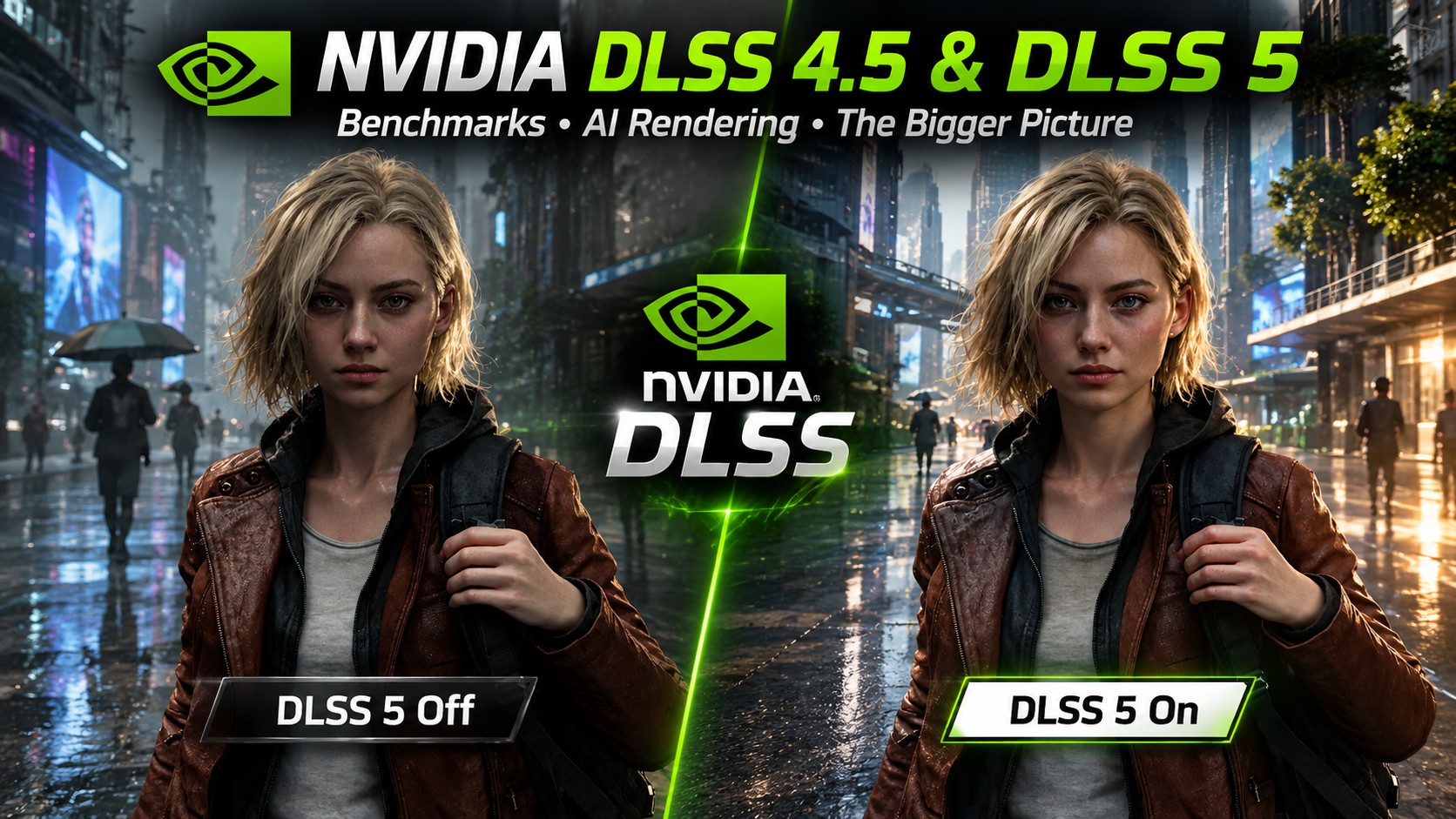
Software features shifted when NVIDIA released DLSS 5 in NBA 2K27 on September 3. DLSS 5 applies 3D-Guided Neural Rendering to alter game lighting and material surfaces. Even so, Eurogamer and Tom’s Hardware reported steep frame-rate penalties across every tested Blackwell GPU. Without upscaling, the RTX 5090 barely cleared 60 FPS at 4K Ultra during initial showcases. Corsair notes pairing DLSS 5 with Frame Generation helps restore triple-digit frame rates. Subsequently, NVIDIA previewed DLSS 5 in Hogwarts Legacy and promised future RTX 40-series support.
PC gamers continue waiting for Reflex 2 and its promised Frame Warp feature. NVIDIA forums and VideoCardz note Frame Warp lacked any confirmed launch date after 18 months. At the same time, heavy DLSS 5 loads revived questions around 16-pin GPU plugs. Thermal tests by VideoCardz caught an RTX 5090 12V-2×6 plug at 91.7°C and 647 W. One owner separately reported a melted MSI RTX 5090 connector during DLSS 5 testing.
Creative Workflows and Local AI Performance
Creative applications and local AI expose sharper gaps than PC gaming. Extra memory and dual decoders directly accelerate demanding studio pipelines.
Still, Puget Systems observed early Blackwell bugs in several creative suites. Topaz Video AI lagged older GPUs until developers delivered software updates.
3D Rendering and Video Editing
In Puget Systems’ June 2026 tests, the RTX 5090 hits 15,872 Blender points. The RTX 5070 Ti scores 7,882 and finishes V-Ray in 220 seconds versus 133. Puget Systems estimates 1,440 V-Ray frames take 53 hours on the RTX 5090.
Both Blackwell GPUs decode 10-bit 4:2:2 video natively for colorists and editors. Further, the RTX 5090 plays eight 4K60 streams smoothly inside DaVinci Resolve. In contrast, the single-decoder RTX 5070 Ti dropped frames at five H.264 or six H.265 feeds.
Local AI Models and Image Tools
Fifth-gen Tensor Cores add FP4 math, hitting 3,352 AI TOPS against 1,406. For example, NVIDIA’s blog says FP4 trims FLUX.1 [dev] VRAM needs below 10 GB. NVIDIA claims an RTX 5090 finishes that image in just over five seconds.
Independent Puget Systems reviews lack a direct 5070 Ti vs. 5090 LLM test. Therefore, independent token-per-second gaps between both models stay unverified in our sources. Its 1,792 GB/s bandwidth accelerates tokens, and 32 GB VRAM fits far larger models.
🤖 Neural Rendering & Local AI Performance
The 2026 Memory Crunch and Street Prices
Street pricing defines late-2026 GPU shopping far more than original NVIDIA announcements. TrendForce data cited by GPUwerk shows DRAM contract prices jumping 93 to 98 percent. Moreover, SK hynix warned CNBC that tight DRAM supply could persist through 2030. PCMag UK reported NVIDIA might trim RTX 50-series output by up to 40 percent. Accordingly, 3 GB GDDR7 shortages reportedly sidelined NVIDIA’s rumored RTX 50 Super refresh.
U.S. retail tags detached sharply from NVIDIA’s unchanged $749 and $1,999 MSRPs. For instance, BestValueGPU tracked new RTX 5070 Ti cards hitting $1,499 on November 15. Tom’s Hardware lists the cheapest RTX 5090 at $6,919 after October’s $9,400 peak. In addition, TechRadar covered unconfirmed rumors of $600 partner price hikes on 5070 Ti cards. GPUwerk notes memory cost rises explain only a fraction of $7,400+ retail markups.
💰 2026 Memory Crunch & Retail Prices
Leadership Turmoil, AI Deals, and Market Impact
Corporate upheaval inside NVIDIA now adds uncertainty to long-term consumer GPU supply. Co-founder Jensen Huang resigned immediately on November 12 following reports of extramarital affairs. U.S. intelligence linked one relationship with former Megaspeed executive Alice Huang to espionage probes. NVIDIA’s board named CFO Colette Kress interim CEO and Harvey C. Jones chairman. Shares plunged 13 percent intraday before closing down 4.3 percent near $4 trillion.
Simultaneously, NVIDIA restructured enterprise AI competition through massive non-exclusive licensing agreements. In December 2025, NVIDIA struck a reported $20 billion licensing deal with Groq. U.S. senators questioned that arrangement in March 2026 over antitrust review concerns. Next, Bloomberg reported a $12.9 billion Hugging Face deal alongside Newcomer’s $7 billion Poolside report. NVIDIA partnered with SK Telecom and Rebellions and opened funding talks with Perplexity.
Enterprise priorities directly squeeze consumer GeForce availability across retail shelves. NVIDIA shipped 11.25 million desktop discrete GPUs in Q2 2026 for 90 percent share. As a result, consumer gamers hold limited leverage when fabs favor high-margin AI silicon. VideoCardz reports AI companies buy RTX 5090 cards in bulk, draining retail stock. Yet AMD’s RX 9070 XT reached 1.46 percent Steam share despite planned 10 percent hikes.
Practical Advice for Late 2026 Buyers
Smart hardware shoppers face a sharp divide between everyday utility and extreme pricing. The RTX 5070 Ti satisfies 1440p high-refresh gaming and entry-level FP4 AI workloads. Besides, its 300 W power budget avoids costly 1,000 W PSU upgrades. At $1,399, it costs roughly one-fifth as much as Tom’s Hardware’s cheapest RTX 5090. Used RTX 5070 Ti cards averaged $1,380 on eBay, offering minimal relief over new units. Complete RTX 5070 Ti desktops like ABS’s Ryzen 7 9800X3D system list near $2,599.99.
Tom’s Hardware notes AMD’s RX 9070 XT remains cheaper for native 4K 60 FPS gaming. Indeed, only demanding 4K gamers, 3D studios, and large-model AI engineers justify an RTX 5090. Those buyers should inspect prebuilt desktops where bundles sometimes undercut standalone retail GPUs. Thus, renting RTX 5090 cloud GPUs at $0.72 hourly offers a sensible short-term alternative. Spot RTX 5070 Ti nodes start near $0.10 hourly for flexible project workloads. NVIDIA provides no restocking recovery timeline, keeping steep GeForce markups likely entering 2027.
Support Our Work
Help us keep creating and maintaining our projects. We appreciate your support!
Ways to contribute:
Shop via Affiliate LinksSupport us at no extra cost to you while you shop.
Support on Ko-fiBuy us a coffee to keep the engine running!




Leave a Reply