
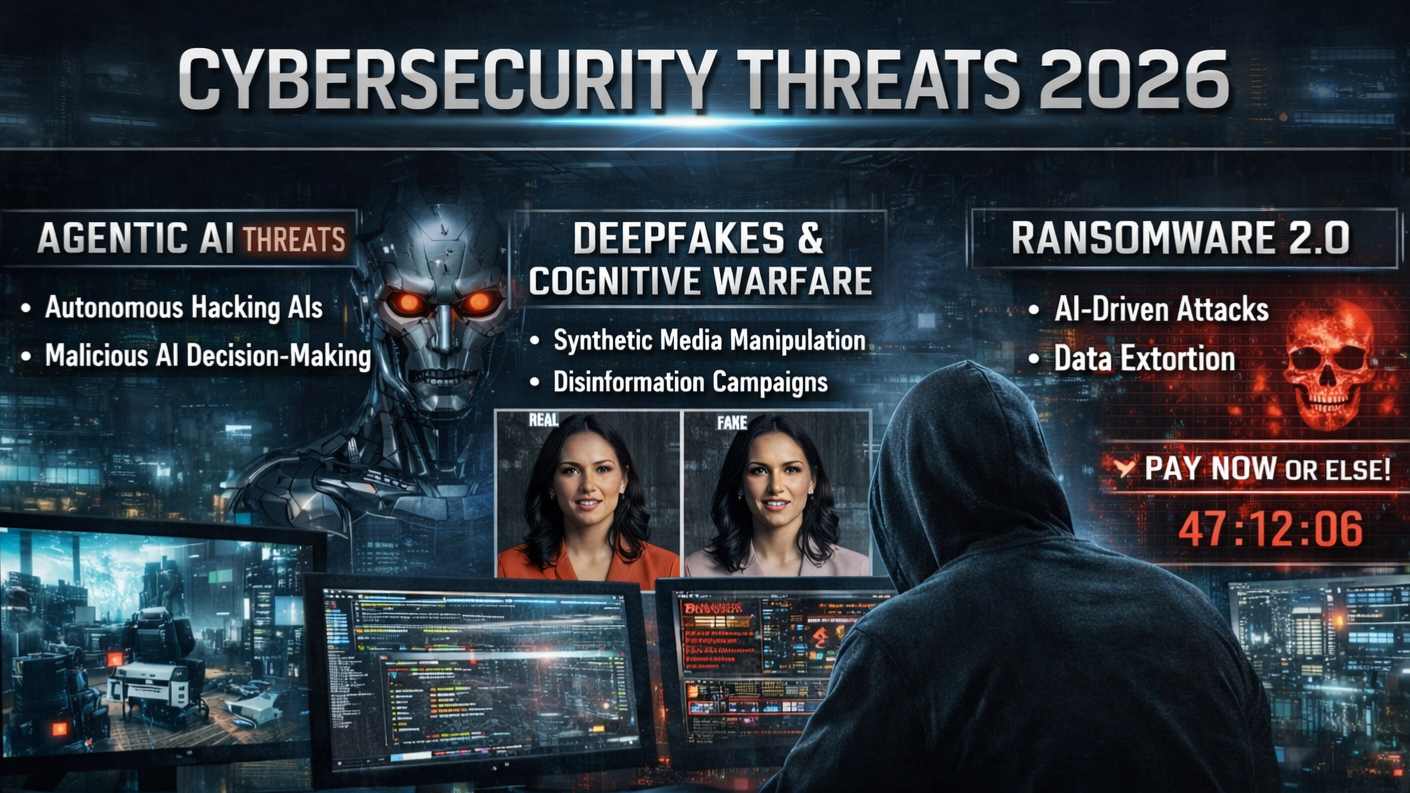
Welcome to the bleeding edge of the digital revolution. Currently, we face a landscape where code defines our reality. However, this progress brings a dark reflection known as the modern cyber threat. Today, we are exploring the most pressing 2026 Cybersecurity Threats.

The Rise of the Machine: Agentic AI Threats
First, we must discuss the elephant in the digital room. Artificial Intelligence has officially transitioned from a helpful assistant to a primary combatant. Specifically, we are seeing the rise of “Agentic AI” in the hands of hackers. These are not just scripts running on a server. Instead, they are autonomous entities capable of making real-time decisions during an attack.
Consequently, the speed of 2026 Cybersecurity Threats exploitation has reached machine-scale levels. In the past, a hacker might spend days researching a target. Now, an AI agent can scan, identify, and exploit a vulnerability in seconds. For instance, recent reports from February 2026 highlight “ClawHub” malware. This threat specifically targets AI marketplaces to poison developer tools.
Furthermore, these agents can adapt to defensive measures on the fly. If a firewall blocks one path, the AI immediately calculates a new route. Therefore, traditional “static” defenses are becoming largely obsolete. We are moving toward a “post-malware” era where intent matters more than file signatures.
Moreover, the barrier to entry for cybercrime has vanished entirely. Previously, you needed deep technical skills to launch a sophisticated breach. Today, a novice can rent an AI-driven “Crimeware-as-a-Service” platform. This democratization of destruction means more attacks are hitting smaller organizations. Consequently, no business is too small to be a target in 2026.
The Human Element of 2026 Cybersecurity Threats: Deepfakes and Cognitive Warfare
Next, we should pivot to the most intimate form of hacking. Social engineering has evolved into something much more sinister in this 2026 Cybersecurity Threats. Specifically, deepfake technology has moved from a novelty to a primary weapon. Cybercriminals now use real-time voice and video cloning during live calls.
Imagine receiving a video call from your CEO on a Tuesday morning. They look right, sound right, and even mention your recent project. Then, they ask you to authorize an urgent “emergency” wire transfer. Unfortunately, this scenario is a daily reality for many global firms now. According to the World Economic Forum, cyber-enabled fraud is now a top concern.
Additionally, we are seeing the rise of “Cognitive Warfare.” This involves using AI to spread hyper-personalized disinformation at scale. Instead of broad propaganda, attackers target specific individuals with tailored lies. They use your social media history to craft the perfect psychological trigger. Consequently, the goal is often to manipulate stock prices or internal corporate decisions.
Furthermore, identity theft has taken a leap into the “synthetic” realm. Attackers combine real stolen data with AI-generated details to create fake personas. These “Frankenstein” identities can pass many standard verification checks. Thus, protecting your digital identity is now more complex than ever. We must treat every digital interaction with a healthy dose of skepticism.
The Infrastructure Crisis: Critical Systems Under Fire
Moving on, we need to address the physical consequences of digital failure. In early 2026, the line between IT and physical infrastructure has blurred. Specifically, we are seeing a surge in attacks on “OT” or Operational Technology. This includes the systems that run our power grids and water plants.
Recently, CISA released a major report on the “BRICKSTORM” backdoor. This malware, linked to state-sponsored actors, targets critical public sector networks. It specifically aims for persistent access to VMware vCenter servers. By doing so, attackers can control the virtual heart of an entire organization.
Consequently, the public’s confidence in national cyber preparedness is wavering. Many citizens now worry about the stability of their basic utilities. For example, recent disruptions at airports and hydroelectric facilities have made headlines. These incidents prove that a single line of code can stop a city.
Therefore, “Secure-by-Design” is no longer just a fancy industry slogan. It is now a survival requirement for modern civilization. Governments are finally pushing for stricter regulations on infrastructure security. However, the pace of legislation often lags behind the speed of the hackers. We are currently in a race to patch our most vital systems.
The Supply Chain Trap of 2026 Cybersecurity Threats: Trust as a Vulnerability
Furthermore, we must look at how we build and buy technology. The “Supply Chain Attack” has become a favorite tool for sophisticated groups. Instead of attacking a target directly, they hit a trusted vendor. By compromising one software provider, they gain access to thousands of customers.
A clear example is the recent surge in “typosquatting” on package registries. Attackers upload malicious code with names similar to popular libraries. Developers, in a hurry, accidentally download the poisoned version. Consequently, the malware is baked directly into the organization’s own software.
Moreover, the complexity of modern software makes auditing nearly impossible. Most apps today are a “Lego house” of third-party components. If one brick is hollow, the entire structure is at risk. Therefore, “Vendor Risk Management” has become a full-time job for security teams.
Additionally, we are seeing the emergence of “SaaS-to-SaaS” worms. These threats jump between cloud platforms like Slack, Salesforce, and Microsoft 365. They exploit the “OAuth” tokens we use to link our apps together. Once a worm gets in, it can pivot across your entire cloud ecosystem. Thus, the very tools we use for collaboration are being used against us.
The Economic Impact of 2026 Cybersecurity Threats: The Trillion-Dollar Toll
Now, let’s talk about the cold, hard cash involved in this. The cost of data breaches has reached staggering new heights in 2026. In the United States, the average cost has jumped to over $10 million. This increase is driven by higher regulatory fines and complex recovery efforts.
Interestingly, global costs are actually slightly decreasing in some regions. This is due to the adoption of AI-driven defensive automation. However, the U.S. remains a primary target for high-value ransomware. Attackers know that American companies are often willing to pay for speed.
Specifically, “Multi-Vector Extortion” is the new standard for ransomware. It isn’t just about encrypting your files anymore. Now, hackers steal your data, threaten your customers, and launch DDoS attacks. They apply pressure from every possible angle to ensure a payout. Consequently, the recovery process is no longer just a technical fix.
Furthermore, the cybersecurity talent gap continues to widen. We simply do not have enough skilled humans to fight this war. This shortage drives up the cost of hiring and retaining security experts. Many firms are now turning to “Managed Detection and Response” (MDR) services. They are outsourcing their safety to specialized firms with bigger AI budgets.
The Future of Defense: Zero Trust and Beyond
So, how do we actually fight back against these looming shadows? The answer lies in a fundamental shift in our security mindset. We must move away from the “Castle and Moat” philosophy of the past. In 2026, we assume the attacker is already inside the walls.
This strategy is known as “Zero Trust” architecture. Under this model, every user and device must be continuously verified. Just because you are on the office Wi-Fi doesn’t mean you are safe. Access is granted on a “least privilege” basis for every single task. Consequently, even if a hacker gets in, their movement is severely limited.
Additionally, “Quantum-Safe Cryptography” is moving from theory to practice. We know that future quantum computers will break our current encryption. Therefore, forward-thinking organizations are already upgrading their data protection. They are encrypting today’s data to survive tomorrow’s computers.
Moreover, “Continuous Exposure Management” is replacing the old annual audit. Instead of a once-a-year check, we now monitor systems in real-time. We use AI to simulate attacks against our own networks constantly. This allows us to find and fix holes before the bad guys do. Defense is becoming just as proactive and automated as the offense.
The Geopolitical Chessboard: Cyber as a State Weapon
Next, we cannot ignore the influence of global politics on our screens. In 2026, cyberattacks are a primary tool of statecraft and espionage. Geopolitical fragmentation has led to the rise of “G-RaaS” or Geopolitical Ransomware. These are state-steered criminal groups that pursue national interests.
These groups target critical infrastructure in rival nations during times of tension. For instance, we see increased activity around national election cycles. Attackers use deepfakes and DDoS attacks to undermine faith in democratic processes. Consequently, cybersecurity is now a matter of national security and sovereignty.
Furthermore, the “Sovereignty Dilemma” is forcing countries to rethink their tech stacks. Nations are increasingly wary of using software from geopolitical rivals. This is leading to a more fragmented and “splintered” internet. While this may increase security, it also complicates global cooperation.
Additionally, the “Cyber Inequity” gap is growing between rich and poor nations. Wealthy countries can afford the latest AI-driven defensive shields. Meanwhile, developing nations remain vulnerable and serve as testing grounds for new malware. This creates a global instability that eventually affects everyone. We are only as strong as the weakest link in the global network.
The Role of the Individual: Your Digital Shield
Finally, we must talk about what you can do as an individual. While the threats are massive, personal responsibility still carries immense weight. Most major breaches still start with a single compromised credential or link. Therefore, your daily habits are the frontline of this digital war.
First, you must embrace “Identity-First” security in your personal life. Use hardware security keys instead of just simple text-message codes. Password managers are no longer optional; they are a basic necessity. If you aren’t using one, you are essentially leaving your front door unlocked.
Second, be extremely wary of any “urgent” digital communications. This applies to emails, texts, and even voice calls from “family.” If something feels off, verify it through a completely different channel. Call the person back on a known number to confirm their request.
Third, keep your software updated without any delay or hesitation. Most updates include critical security patches for newly discovered “zero-day” holes. By clicking “remind me later,” you are giving hackers an open window. In 2026, a delay of one hour can be the difference between safety and loss.
Conclusion: Staying Resilient in a Volatile World
In summary, the cybersecurity landscape of 2026 is both terrifying and fascinating. We are witnessing a high-speed arms race between human and artificial intelligence. While the threats are evolving at light speed, so are our capabilities to defend.
The key to survival in this era is not just better technology. It is a combination of radical transparency, constant vigilance, and systemic resilience. We must build systems that can withstand failure and recover quickly. Security is no longer a destination; it is a continuous, living process.
As we move further into this decade, the digital world will only get noisier. There will be more “AI swarms” and more sophisticated deepfake campaigns. However, by staying informed and adopting a “Zero Trust” mindset, we can thrive. The digital frontier is wild, but it is also full of incredible potential.
Stay curious, stay cautious, and most importantly, stay secure. The future of our digital world depends on the choices we make today. We are all participants in this grand experiment of global connectivity. Let’s make sure we build a net that is strong enough to catch us all.
The 2026 Cybersecurity Threats Toolkit
Transforming your home or small business into a “Zero Trust” fortress is the best way to handle the 2026 threat landscape. Here is a curated, actionable checklist of the top tools and steps to get you there.
1. Identity & Access: The Foundation
- Hardware Security Keys: Ditch SMS codes for physical keys.
- Top Pick: YubiKey 5C NFC (The gold standard for durability and cross-platform use).
- Budget Pick: Google Titan Security Key (Excellent for Google-centric workflows).
- Biometric Option: YubiKey Bio (Uses your fingerprint for even faster, secure logins).
- Passkey Adoption: Transition your accounts to Passkeys via Windows Hello or Apple FaceID. This replaces passwords with encrypted, device-based keys that hackers cannot steal through phishing.
- Business-Grade Password Managers: Use a manager that supports Zero Trust principles and passkey storage.
- Recommendations: 1Password or Bitwarden (both have excellent business and family plans for 2026).
2. Network Security: Verifying the Connection
- ZTNA (Zero Trust Network Access) for Small Business: Replace your old VPN with a ZTNA solution. This ensures users only see the specific apps they need, rather than the whole network.
- Cloudflare One: Free for up to 50 users; perfect for micro-businesses.
- Twingate: Incredibly easy to set up for remote teams without changing your router settings.
- NordLayer: A great all-in-one “Zero Trust” suite for small teams.
- Micro-Segmentation: If you have a smart home or office, put your “Internet of Things” (IoT) devices on a separate VLAN (guest network). This prevents a hacked smart bulb from being a gateway to your laptop.
3. Device Posture: Trusting the Hardware
- Endpoint Protection (EDR): You need software that doesn’t just scan for viruses but watches for suspicious behavior.
- CrowdStrike Falcon Go: Tailored specifically for small businesses to stop modern AI-driven ransomware.
- SentinelOne: Offers autonomous protection that can “rollback” a device to its state before a ransomware attack.
- Automatic Patching: Ensure Windows Update, macOS Software Update, and your mobile OS are set to “Automatic.” In 2026, a 24-hour delay in patching can be fatal.
4. Strategic Implementation Steps
- Inventory Check: List every device and user that connects to your network. If you don’t know it, you can’t secure it.
- Least Privilege: Audit your accounts. Does your marketing intern really need admin access to the company’s financial drive? If not, revoke it.
- The “Assume Breach” Drill: Regularly backup your data to an immutable cloud storage (like Backblaze or Wasabi). This ensures that even if hackers delete your local backups, your data remains safe.





Leave a Reply