
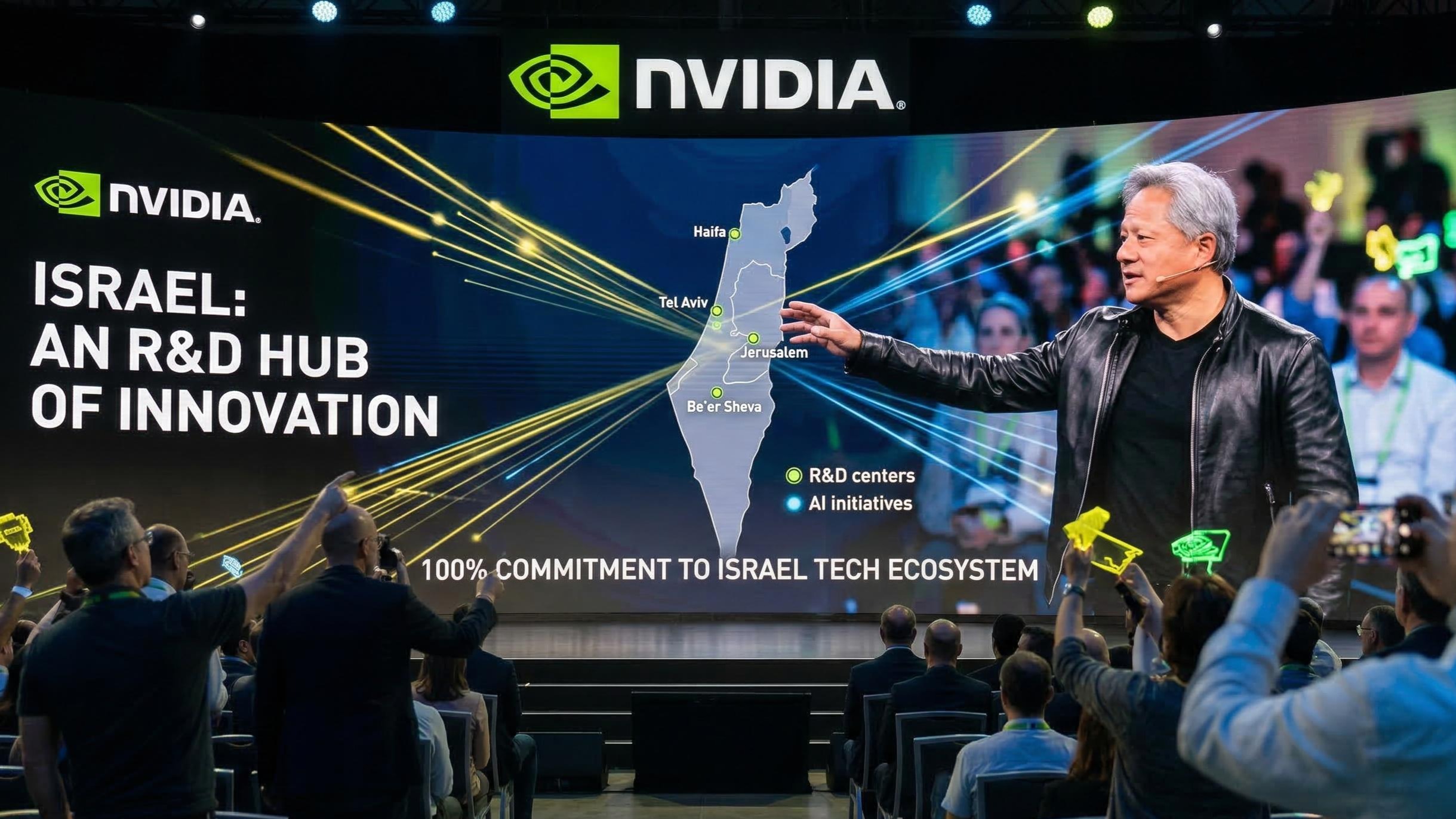
The tech world is currently fixated on one massive story about Nvdia and Israel Relationship. This blog article centers on Nvidia and its deep roots in Israel. Recently, CEO Jensen Huang made some very bold public statements. He spoke during the 2026 GTC keynote in San Jose. Huang confirmed a “100 percent” commitment to the Israeli tech ecosystem. This promise comes despite the ongoing regional geopolitical turbulence. Many analysts wondered if the company would scale back its operations. Instead, the green giant is doubling down on its local presence.

A Growing Footprint in the Holy Land
Currently, Nvidia employs over 6,000 workers across various Israeli cities. This workforce has doubled since the Mellanox acquisition in 2020. Furthermore, the company is planning a massive new R&D campus. This facility will be located in the northern town of Kiryat Tivon. Estimates suggest the project will cost roughly $1.5 billion. Consequently, this will become one of Israel’s largest private investments. The campus should eventually house up to 10,000 high-tech employees. Construction is slated to begin sometime during the next year.
Meanwhile, Nvidia is expanding its reach into southern Israel. The existing Be’er Sheva center is undergoing a significant transformation. It will soon move into a much larger 3,000-square-meter site. This new hub will focus on advanced AI networking hardware. Engineers there will develop the next generations of Spectrum-X Ethernet. They will also work on the Quantum-X InfiniBand connectivity systems. These tools are vital for modern, large-scale AI data centers.
Nvdia and Israel Relationship: The Strategic Acquisition of Illumex
Strategic growth also involves buying up promising local startups. Just last month, Nvidia acquired an Israeli firm called Illumex. The deal had a value Sat approximately $75 million. Interestingly, Illumex specializes in managing complex enterprise data structures. Their technology helps create “joint languages” for fragmented data banks. This capability is essential for training sophisticated AI agents. Nvidia plans to integrate these tools into its broader software stack.
By doing so, they aim to accelerate “Agentic AI” adoption. This term refers to AI that can perform multi-step tasks. Moreover, the Illumex team brings deep expertise in building ontologies. This acquisition follows the 2024 purchases of Deci and Run:ai. Clearly, Israel serves as a primary source for Nvidia’s talent. The country is now their second-largest R&D hub globally. Only their United States operations are larger in overall scale.
Nvdia and Israel Relationship: Fueling the Global AI Infrastructure
During GTC 2026, Huang outlined a $1 trillion market opportunity. He believes the world is shifting toward generative inference models. Therefore, the demand for specialized AI infrastructure is skyrocketing. Israel plays a critical role in producing this specific hardware. The networking division, headquartered in Israel, is a primary engine. It recently reported annual revenues of nearly $31 billion. This represents a tenfold increase since the 2020 Mellanox deal.
To support this, Nvidia is investing in photonics technology. They recently committed $4 billion to Coherent and Lumentum. While these are U.S. firms, the goal supports Israeli-led designs. These companies produce the lasers needed for high-speed data. Modern AI clusters require bandwidth exceeding 1.6 terabits per second. Copper wires simply cannot handle these extreme data loads. Thus, the transition to advanced optical connectivity is now mandatory.
The Power of Israel-1 and Beyond
Additionally, the “Israel-1” supercomputer continues to break performance records. This system features over 2,000 Nvidia H100 Tensor Core GPUs. It utilizes the BlueField-3 SuperNICs for ultra-fast data processing. Recent tests proved that Ethernet can handle massive AI workloads. Traditionally, researchers believed only InfiniBand was suitable for such tasks. However, Israel-1 showed a 1.6x increase in networking throughput. This discovery allows more companies to build powerful AI clusters.
Looking ahead, the roadmap includes the new “Vera Rubin” platform. This architecture is named after the famous American astronomer. It features the Vera CPU and the Rubin GPU. Many of these components are being refined in Israeli labs. The platform aims for a 10x reduction in inference costs. It also uses 100 percent liquid cooling for better efficiency. Consequently, data centers can be deployed in just two hours. This is a massive improvement over the previous two-day standard.
Innovation in the Face of Adversity
Operations in Israel remain remarkably stable despite the conflict. Huang emphasized that the safety of employees is paramount. Nevertheless, the company is not slowing down its regional projects. They are even exploring renewable energy for their data centers. For instance, Eco Wave Power was featured in the keynote. This Israeli firm uses coastal waves to generate clean electricity. Nvidia uses digital twins to optimize these wave energy systems.
In summary, the partnership between Nvidia and Israel is thriving. The company sees the “North” as a center for AI. New offices are being leased in Tel Aviv and Ra’anana. They are also building a $500 million data center in Ramot Menashe. This facility will eventually span over 10,000 square meters. It will serve as a testing ground for Blackwell GPUs. Clearly, Nvidia’s destiny is intertwined with Israeli engineering prowess.





Leave a Reply